When to Use Vue vs React with Laravel: A Strategic Guide for 2026


With 48,320 job listings for React compared to just 12,840 for Vue.js in 2026, the traditional "Vue-first" mindset in the Laravel community is facing a significant commercial challenge. Deciding when to use vue vs react with laravel is no longer just a matter of developer preference. It's a strategic decision that affects your hiring pipeline and the long-term structural integrity of your digital assets.
You likely feel the pressure to balance immediate development speed with the risk of choosing a stack that might become difficult to staff or maintain. We'll help you resolve this tension by providing a clear decision framework based on your specific project goals. You'll discover how the release of Laravel 13 and Inertia.js v3 has changed the integration landscape, allowing you to choose a stack with absolute confidence. We'll examine the impact of each framework on your bottom line, from SEO performance to the ease of recruiting specialized talent in the UK.
The release of Laravel 13 in March 2026 has solidified a new era of frontend flexibility for developers. Historically, the ecosystem felt heavily weighted toward Vue.js, largely due to early community adoption and first-party support from the Laravel core team. This created a generation of developers who viewed Vue as the natural extension of a PHP backend. However, the modern landscape has shifted. The decision of when to use vue vs react with laravel is now dictated by architectural requirements and long-term business strategy rather than ecosystem defaults.
Central to this shift is Inertia.js v3. This major update has refined the "monolith-style" Single Page Application (SPA) bridge, making it equally robust for both frameworks. By removing the need for a separate API layer for internal application logic, Inertia allows teams to build dynamic interfaces while keeping the routing and controller logic firmly within Laravel. This bridge is supported by Vite, which provides a unified, lightning-fast build experience regardless of whether you're compiling Vue components or React hooks. It's a structured journey toward growth that doesn't force you into a specific JavaScript camp.
Vue's enduring popularity stems from its seamless integration with Laravel's first-party starter kits, such as Breeze and Jetstream. These tools provide a "batteries-included" starting point that many teams find indispensable for rapid prototyping. The Single File Component (SFC) philosophy in Vue also feels intuitive to PHP developers; it keeps templates, logic, and styles in one place, mirroring the structured approach of Laravel itself. This synergy is a primary reason why a specialized Laravel development agency will often recommend Vue for projects where speed to market and developer happiness are the primary drivers.
Despite Vue's history, React has seen a massive surge in enterprise-level Laravel projects. This is often driven by the sheer scale of the React ecosystem and its dominance in the global job market. For complex, data-heavy applications, React’s functional programming style and extensive library of third-party components offer a level of structural integrity that appeals to modern software architects. When reviewing a neutral comparison of JavaScript-based web frameworks, it becomes clear that React’s massive community support translates into better longevity for enterprise systems. Teams choosing React often prioritize the ability to hire from a larger talent pool and the framework's perceived performance advantages when integrated with AI-driven development tools.
Determining when to use vue vs react with laravel requires a deep dive into architectural integrity. In 2026, both React 19.2.6 and Vue 3.5.34 offer highly optimized Virtual DOM implementations that ensure fluid transitions and high performance. When evaluating benchmarks for large-scale Laravel applications, the bottleneck is rarely the framework's rendering speed. Instead, it's how efficiently the system handles data hydration and server-side rendering (SSR). A neutral Laravel Livewire vs Vue vs React comparison shows that while all three can achieve excellent SEO scores, the implementation complexity varies significantly.
The decision of when to use vue vs react with laravel often hinges on how your application manages its state. React’s "everything is JavaScript" philosophy allows for incredibly complex UI logic, but it can lead to fragmented codebases if not managed with discipline. Vue’s more structured approach provides a steady promise of reliability, making it easier to maintain over long life cycles. Both frameworks now leverage Vite for a unified build process, ensuring that your development workflow remains brisk regardless of the chosen library.
Vue’s Single File Components (SFCs) keep styling, logic, and templates encapsulated in a way that feels natural to PHP developers. This structure mirrors the separation found in traditional Laravel controllers and views. React uses JSX, which treats UI components as functional JavaScript entities. It's exceptionally powerful for enterprise-scale platforms with massive data requirements where UI components must be highly composable. For teams transitioning from traditional Blade templates, Vue offers a gentler learning curve and a more intuitive mental model.
Managing API data effectively is the cornerstone of a high-performance application. Vue teams have largely standardized on Pinia, which offers a lightweight and intuitive way to manage global state. React developers typically lean toward Zustand or Redux for more granular control over complex data flows. The release of Inertia.js v3 in March 2026 has significantly reduced the need for heavy client-side state management by handling data synchronization through its built-in XHR client. Following modern Vue.js frontend development standards ensures your application remains scalable without becoming bogged down in boilerplate code. If you need help architecting these systems, our team provides expert Laravel web development to ensure your project starts on a solid foundation.
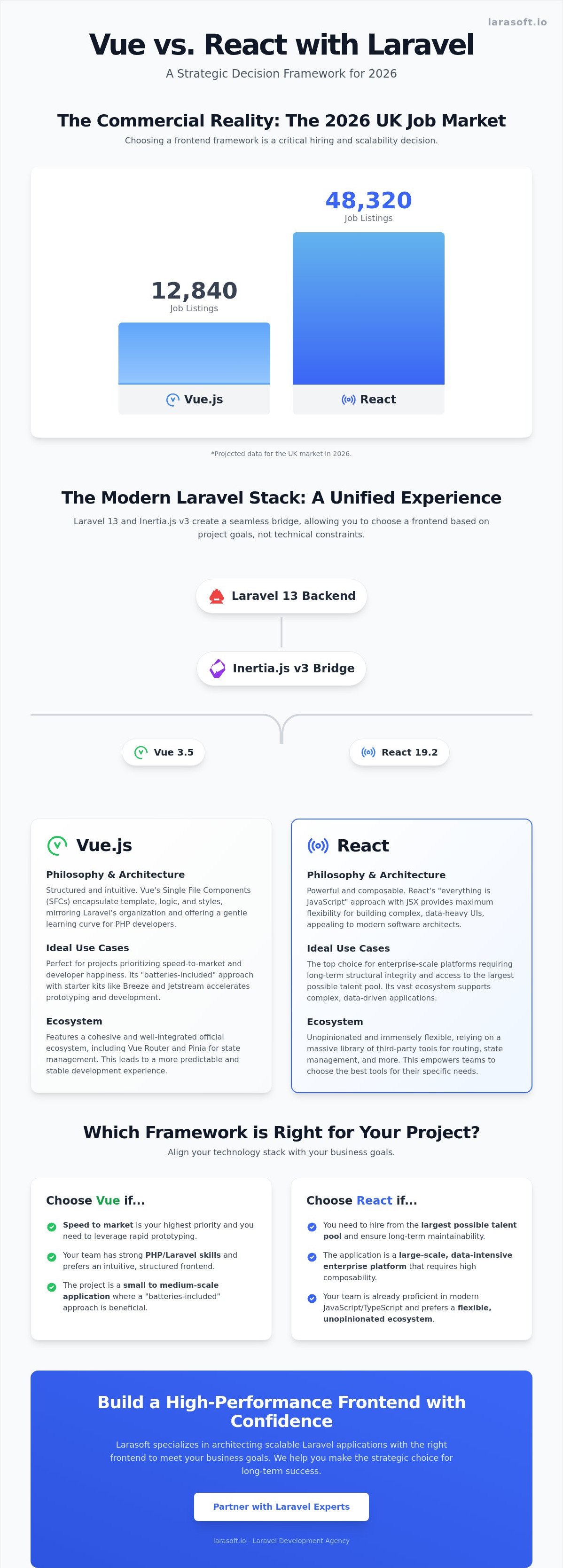
Choosing a technology stack is a long-term financial commitment that extends far beyond the initial launch. When considering when to use vue vs react with laravel, the most significant business factor is the availability of specialized talent. In 2026, the UK job market shows a clear disparity; there are 48,320 active listings for React developers compared to only 12,840 for Vue.js. This 4-to-1 ratio suggests that while Vue might offer a gentler learning curve for an existing PHP team, React provides a much broader safety net for rapid scaling and recruitment.
Recruitment isn't the only cost factor. Business leaders often find that Laravel with Inertia.js and Vue provides a highly efficient workflow for internal business applications. However, enterprise-scale platforms with massive data requirements often lean toward React to capture broader ecosystem advantages. Training an internal team to use Vue is often faster, but the long-term cost of being unable to find senior Vue talent in a competitive UK market can outweigh those initial savings.
React's 42.6% adoption rate among developers makes it the dominant choice for large-scale national projects. This popularity creates a competitive landscape where senior React talent commands high salaries, yet the sheer volume of candidates makes roles easier to fill. Vue has a dedicated and highly satisfied talent pool, with a 95% recommendation rate. However, the smaller number of specialists can lead to project bottlenecks if key personnel depart. You must decide if your priority is the high satisfaction of a smaller team or the recruitment agility of a larger market.
Technical debt is a silent killer of digital growth. React 19.2.6 and Vue 3.5.34 are both stable, but their ecosystems move at different speeds. React’s massive community support means that breaking changes are often accompanied by automated migration tools and extensive documentation. Conversely, Vue’s ecosystem is more centralized, offering a steady promise of reliability but fewer third-party options for niche requirements.
Future-proofing also involves looking at AI. Currently, 78% of AI-First development teams choose React due to the superior performance of AI coding assistants with JSX. For projects involving legacy code modernisation, we often recommend the framework that best matches the existing team's trajectory while ensuring the new architecture can support these emerging AI integrations. A well-structured Laravel 13 backend mitigates much of the frontend risk, but the choice of library still dictates the pace of your innovation for years to come.
Determining when to use vue vs react with laravel requires an objective analysis of your project's lifecycle. While both frameworks are technically capable, their strengths manifest differently depending on your commercial objectives. We've identified five common scenarios where one framework typically outshines the other in a production environment.
Vue remains the optimal choice for teams that are already deeply proficient in the Laravel ecosystem. If your application relies heavily on Laravel Pulse or Horizon for real-time monitoring, Vue’s community-standard integrations ensure a cohesive developer experience. It's the go-to framework when you need a custom-built solution that feels like a natural extension of the PHP backend. The simplicity of Vue’s Single File Components ensures that software maintenance remains straightforward for your internal team.
React is the winner for applications requiring highly interactive UIs with complex, nested state requirements. The ability to tap into a vast range of third-party UI libraries gives React an edge in specialized enterprise use cases. It's also the safer bet for long-term scalability in the UK market, given the larger talent pool. If your project demands a tech-forward approach with a focus on longevity, React provides the necessary architectural flexibility.
Selecting the right stack is a foundational step in your digital journey. If you're ready to build a high-performance system, explore our bespoke Laravel web development services to ensure your project is built on a solid architectural foundation.
Choosing when to use vue vs react with laravel is a decision we approach with meticulous detail at Larasoft. As a specialized technical partner, we don't believe in a one-size-fits-all stack. Instead, we analyze your specific business requirements to ensure the final architecture provides both structural integrity and a clear path for future growth. Our team acts as technical artisans, taking immense pride in building systems that perform perfectly under the pressure of real-world enterprise demands. We bridge the gap between complex development processes and manageable, structured journeys toward digital expansion.
Our consultative approach begins by mapping your long-term goals against the technical capabilities of the modern Laravel ecosystem. If you're managing a transition from outdated systems, our expertise in legacy code modernisation ensures a fluid shift to a modern Vue or React frontend without disrupting your core operations. We don't just deliver a product and disappear. We provide ongoing software maintenance to ensure your platform remains secure and optimized as new versions of Laravel and JavaScript libraries emerge. This steady promise of reliability allows your internal team to focus on business strategy while we handle the granular technical execution and architectural stability.
The choice between Vue and React has a direct impact on your bottom line. A well-chosen frontend improves user engagement and reduces friction, leading to higher conversion rates and better retention. We integrate advanced SEO services and Laravel AI integration directly into our development workflow, ensuring your application is both discoverable and tech-forward. Our focus is on creating high-performance architectures that stand the test of time, regardless of how the JavaScript landscape shifts.
Whether you need complex API integration or a high-performance cross-platform mobile solution, we build with long-term scalability in mind. We treat every line of code as a foundational asset for your company's future, ensuring that your tech stack remains an engine for growth rather than a source of technical debt. We find genuine satisfaction in building systems that aren't just functional, but are engineered for peak efficiency.
Ready to build a system that scales? Partner with Larasoft for your next Laravel project and let’s architect a solution that drives genuine business returns.
Deciding when to use vue vs react with laravel is a pivotal moment in your platform's development lifecycle. We've explored how the UK talent market favors React's scalability, while Vue remains the benchmark for rapid, integrated development. With the arrival of Laravel 13 and Inertia.js v3, the technical barriers between these frameworks have dissolved. This allows you to focus on long-term commercial strategy and structural integrity rather than syntax.
At Larasoft, we specialize in navigating these complex architectural decisions. Whether you're seeking expert Vue.js and React frontend development or require comprehensive legacy code modernisation, we build with a focus on high-performance, SEO-optimized results. Our team of technical artisans ensures that your chosen stack provides a foundational asset for your company's future. We find genuine satisfaction in building systems that perform perfectly under pressure.
Consult Larasoft for your bespoke Laravel development needs to ensure your next application is engineered for success.
Neither framework is objectively superior; the right choice depends on your specific commercial goals and team profile. Vue.js offers the most seamless integration with Laravel’s official starter kits like Breeze and Jetstream. Conversely, React 19 provides a more extensive library ecosystem for complex enterprise platforms. Deciding when to use vue vs react with laravel should be based on your long-term hiring strategy and the architectural complexity of your application.
You can technically use both, but we strongly advise against it for production environments. Running two different JavaScript frameworks simultaneously significantly increases your bundle size and complicates your state management logic. This fragmentation often leads to higher maintenance costs and a disjointed developer experience. It's better to commit to a single standard to ensure the structural integrity and scalability of your digital asset.
Vue.js is generally considered the more intuitive choice for developers coming from a PHP background. Its template-based syntax mirrors the logic found in Laravel Blade, making the transition significantly smoother for most teams. React requires a deep understanding of JSX and functional programming patterns. While React is powerful, it often demands a longer training period for teams that aren't already proficient in modern JavaScript ecosystems.
Framework choice has a negligible impact on SEO if you utilize Server-Side Rendering (SSR) effectively. Both libraries integrate perfectly with Inertia.js v3 to deliver pre-rendered HTML to search engine crawlers, ensuring your pages are indexable. Your rankings will depend more on your overall content structure and technical SEO implementation than on the specific library used. We focus on ensuring that either choice results in a high-performance, search-optimized application.
Inertia.js v3 treats both frameworks as first-class citizens with no performance disparity between them. While early versions of the Laravel ecosystem historically favored Vue, the current Vite-driven build process provides an identical level of support for React. You should choose based on your functional requirements rather than a perceived advantage in how Inertia.js handles either library. Both options deliver a robust, monolith-style SPA experience with high reliability.
Livewire is an excellent alternative if you want to stay within the PHP ecosystem without managing a complex JavaScript build process. It's ideal for standard CRUD applications and projects with moderate interactivity requirements. However, if your project requires highly complex client-side state or needs to share logic with a native mobile app, Vue or React is the superior choice. The decision depends on the specific level of frontend sophistication your users expect.
React currently offers a more resilient recruitment pipeline in the UK due to its dominant 42.6% adoption rate among professional developers. This makes it a safer bet for long-term software maintenance and rapid team scaling. Vue has a smaller but highly satisfied community and remains a stable choice with a dedicated pool of specialists. While both ecosystems are technically mature, React’s market volume provides more reassurance for enterprise-level projects requiring a steady supply of senior talent.
Here’s what we've been up to recently.
Certified Quality. Great Prices