Legacy Code Modernisation: A Strategic Guide for UK Business Leaders


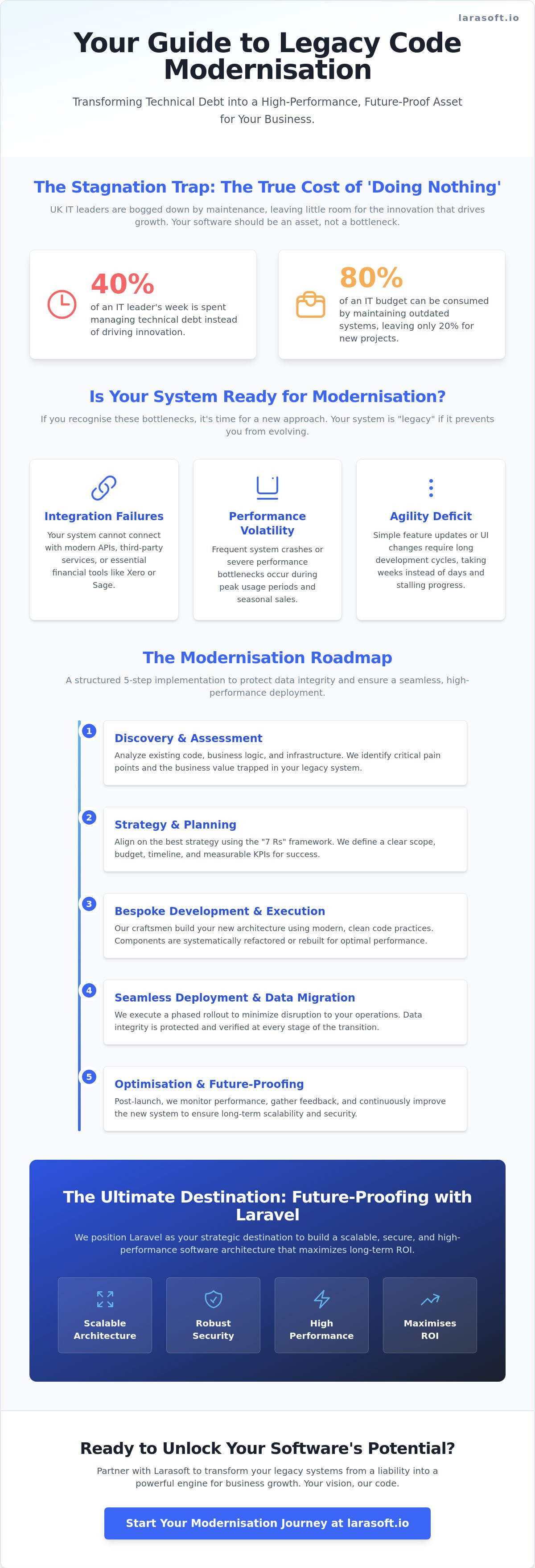
Did you know that UK IT leaders now spend an average of 40% of their weekly hours managing technical debt instead of driving innovation? You likely feel the weight of this daily as rising maintenance costs and the scarcity of developers for aging languages stall your strategic goals. It's frustrating to watch competitors launch new features in weeks while your team struggles with security vulnerabilities and brittle, unpatched systems. We believe your software should be a foundational asset, not a bottleneck that restricts your market agility.
This guide shows you how to execute a legacy code modernisation strategy that transforms these liabilities into high-performance, scalable assets while protecting your bottom line. You'll learn how to navigate the transition with a roadmap that minimizes disruption and maximizes ROI. We'll provide a clear overview of how to reduce technical debt through modern architecture and the craftsmanship of bespoke development. By the end of this article, you'll have a structured plan to turn aging code into a secure, future-proof engine for your business growth.
For many UK business leaders, software is often viewed as a static tool rather than a living asset. True legacy code modernisation is not a simple patch or a cosmetic update. It's the systematic transformation of aging, rigid software into agile systems that can pivot with market demands. At its core, what is software modernization? It's a strategic realignment that releases value trapped within systems that no longer serve their purpose. We don't define "legacy" by the age of the code. We define it by its inability to evolve. If your software prevents you from launching a new service or reacting to a competitor, it's legacy, regardless of when it was written.
The invisible burden of technical debt weighs heavily on UK business growth. Research indicates that maintenance of outdated systems can consume up to 80% of a company’s IT budget, leaving a mere 20% for actual innovation. This creates a stagnation trap where you're paying a premium just to keep the lights on. We approach this challenge through the lens of software craftsmanship. This means treating your codebase as a foundational asset. We focus on clean architecture and bespoke engineering to ensure your systems aren't just functional today, but scalable for the next decade.
Beyond software, maintaining outdated IT and telecommunications infrastructure can also lead to significant inefficiencies and stagnant growth. You can learn more about how modern, tailored IT solutions provide the flexibility needed to support your overall business digital transformation.
Sticking with obsolete systems carries a heavy financial penalty. In the UK, the pool of developers proficient in older languages is shrinking. This scarcity drives up day rates, with specialists for legacy systems often commanding 30% more than modern full-stack engineers. Beyond staffing, there's the critical issue of security. Legacy systems often lack the architecture to support modern encryption or security protocols, making them prime targets for data breaches. Technical debt is the interest paid on past shortcuts. Every day you delay modernisation, that interest compounds, making the eventual transition more complex and expensive.
Recognising the tipping point is vital for maintaining a competitive edge. Your business needs a new approach if you encounter these bottlenecks:
Modernising your software is a journey toward reliability and high-quality craftsmanship. By moving away from "value-trapped" code, you transition from a state of constant firefighting to a position of strategic momentum. At LaraSoft, we believe in the philosophy of "Your vision, our code," ensuring that your technical foundation is robust enough to support your most ambitious business goals.
Selecting a path for legacy code modernisation isn't a purely technical decision. It's a strategic pivot that must align with your commercial objectives and long-term scalability. The "7 Rs" framework provides a structured methodology to evaluate your software assets, ensuring you don't over-invest in low-value systems or ignore critical technical debt. Whether you're managing a web-based ERP or a suite of mobile applications, the right strategy balances immediate risk mitigation with future growth.
For UK business leaders, the goal is to transform software from a maintenance burden into a high-performing asset. A structured approach to legacy application modernization ensures that every pound spent contributes to better user experiences and streamlined operations.
Rehosting, frequently termed "Lift and Shift," involves moving your existing software to modern cloud infrastructure like AWS or Azure without modifying the code. It's an appropriate choice when you need to reduce on-premise hardware costs quickly. Replatforming acts as a middle ground; we make minor adjustments to the code to leverage cloud-native features without changing the core architecture.
Sometimes, "Retaining" is the most strategic move. If a system is stable, meets current compliance standards, and isn't hindering growth, keeping it as-is preserves capital for more urgent projects. This is often a temporary holding pattern while other parts of the ecosystem are upgraded.
These strategies deliver the most significant competitive advantage. Refactoring involves cleaning and optimising internal code without altering external behaviour. For many UK firms, this means upgrading older PHP versions to a secure, modern Laravel framework to improve speed and security.
Rearchitecting goes deeper, often shifting a monolithic system toward a headless Laravel environment or microservices. This allows your web and mobile platforms to communicate through a unified API, making the system far more flexible. Rebuilding is the "Greenfield" approach. When technical debt becomes too expensive to manage, starting fresh with a bespoke solution ensures your tech stack is perfectly aligned with your current business model. Our team can help you map your technical roadmap to determine which path offers the best ROI.
Not every legacy system is worth saving. Replacing involves decommissioning a bespoke tool in favour of a modern SaaS alternative or a completely new custom-built platform that reflects current market needs.
Retiring redundant systems is equally critical for security. A 2023 report by the Standish Group suggested that up to 20% of features in mature software are rarely or never used. By identifying and retiring these components, you reduce your attack surface and lower the ongoing costs of maintenance. Eliminating "zombie" code ensures your developers focus on features that actually drive revenue.
CTOs face a binary choice that defines their technical roadmap for the next five years. Do you polish the existing engine or build a new one from scratch? This decision determines your speed of innovation and your risk profile. Legacy code modernisation isn't a one-size-fits-all process; it requires a calculated risk-reward matrix that balances immediate stability against long-term agility. While refactoring offers lower immediate risk and preserves business continuity, a full rebuild is a greenfield approach that provides the highest reward for scalability and performance.
Bespoke development plays a critical role here. By choosing a tailored path rather than an off-the-shelf compromise, you ensure the final architecture matches your specific UK operational requirements. A clear understanding of legacy code helps determine if your system is merely dated or fundamentally broken. We view this choice through a lens of craftsmanship; we don't just write code, we build foundational assets for your future growth.
A technical audit is your first step to identify salvageable code. We look for modules that still deliver value and can be isolated via API integration. Automated testing is the deciding factor in refactoring feasibility. If your current test coverage is below 15%, the risk of "breaking" the system during refactoring rises by nearly 40%. Documentation, or the lack thereof, also dictates the path. Systems relying on "tribal knowledge" from developers who left in 2018 often require a rebuild to ensure the logic is captured and secured in a modern Laravel framework.
Time-to-market is a vital metric for UK business leaders. Refactoring can often be delivered in phases, showing ROI in as little as 12 weeks. Conversely, a full rebuild might take 9 to 12 months before the first user logs in. You must weigh this against long-term maintenance costs. Maintaining a "patched" legacy system can cost 2x more per year than supporting a clean, bespoke build. A 2023 report highlighted that technical debt consumes up to 40% of IT budgets in the UK. The most expensive code is the code that fails. Our approach focuses on legacy code modernisation that eliminates this debt, ensuring your vision is backed by code that performs under pressure.
Your vision, our code. We help you navigate these complexities with a structured journey toward a seamless, modern system.
Successful legacy code modernisation isn't a single event. It's a disciplined sequence of technical interventions designed to protect your business continuity. History shows the cost of failure is high; the 2018 TSB migration failure resulted in a £330 million loss, proving that "big bang" launches are often too risky for complex UK enterprises. We advocate for a 5-step, iterative framework that prioritises stability and data integrity.
We begin with a forensic technical audit. Our team maps every dependency and identifies the "bottleneck" code that restricts your growth. This isn't just about code; it's about aligning your technical architecture with specific business KPIs and UK GDPR requirements. We define a Minimum Viable Product (MVP) that addresses your most critical operational pains first. This ensures you see a return on investment within the first few months, rather than waiting years for a total system overhaul. We treat your software as a foundational asset, not a disposable commodity.
Execution relies on the Strangler Fig pattern. We build new, bespoke functionality around the edges of your old system, gradually migrating features to a modern Laravel or full-stack architecture. This iterative delivery allows for zero-downtime data migration. We use robust API integration to keep the old and new systems communicating perfectly during the transition. Continuous testing and QA are non-negotiable here. Every logic change is validated against real-world UK market conditions to ensure your service remains uninterrupted. Success requires precision, not speed.
The final phase focuses on longevity. Once the legacy code modernisation project goes live, we implement post-launch monitoring to tune performance under load. We establish a long-term maintenance plan to ensure technical debt doesn't accumulate again. Crucially, we integrate SEO services during the migration to protect your search rankings. This involves meticulous 301 redirect mapping and site speed optimisation, ensuring your digital visibility remains intact. We don't just build systems; we build systems that work perfectly under pressure.
Modernising your infrastructure requires a partner who treats code as a craft. Learn how our bespoke Laravel development team can architect your roadmap.
Choosing a framework for legacy code modernisation determines your company's technical trajectory for the next decade. Laravel has emerged as the premier destination for UK business leaders who require a balance of rapid delivery and architectural integrity. It isn't just about replacing old code. It's about building a scalable foundation that supports modern business requirements like AI integration and high-traffic performance. This framework provides the stability of an enterprise-grade system with the agility of a modern startup.
The UK tech market currently supports a vast ecosystem of Laravel experts. This makes it significantly easier to scale your internal teams compared to searching for developers skilled in niche or aging languages. Beyond talent availability, Laravel simplifies compliance with UK data regulations. Its built-in security features protect against SQL injection and cross-site request forgery, providing a head start on GDPR requirements. At Larasoft, we apply a "Your vision, our code" philosophy to every legacy transition. This ensures the final product reflects your unique business logic while benefiting from our technical precision and deep framework expertise.
Modernising the backend provides the perfect opportunity to revitalise your user experience. By using Laravel as a headless API, we integrate high-performance frontends like Vue.js or React. This architecture decouples the data layer from the presentation layer, allowing for seamless future updates. It also creates a ready-made environment for AI integration. Laravel's robust service providers make it simple to connect with OpenAI or local LLM instances, turning your legacy data into a source for predictive analytics. Our craftsman approach focuses on building resilient, bespoke software that doesn't just work; it excels under pressure. We've seen deployment cycles accelerate by 30% for clients who move to this decoupled structure.
The journey away from technical debt starts with a clear understanding of your current state. A Larasoft consultation provides a transparent breakdown of your system's vulnerabilities and a structured roadmap for legacy code modernisation. We'll examine your existing database structures, third-party integrations, and security protocols to determine the most efficient path forward. You'll receive a detailed technical assessment that prioritises ROI and long-term stability. Ready to transform your infrastructure? Modernise your legacy code with Larasoft today to secure your digital future and regain your competitive edge.
Maintaining aging infrastructure is an expensive burden that stifles growth. Industry data from 2023 shows that UK enterprises often spend 80% of their IT budgets on maintenance rather than innovation. Effective legacy code modernisation replaces these bottlenecks with a resilient, Laravel-driven foundation that supports rapid scaling. Success relies on choosing the right path between refactoring and rebuilding while ensuring seamless API integration for your existing tools.
Larasoft operates as your dedicated technical ally. We're a specialist Laravel development agency focused on bespoke solutions and high-performance frontends using Vue.js and React. Our team provides the craftsmanship needed to turn complex technical challenges into streamlined business advantages. Partner with Larasoft for expert legacy code modernisation to secure your technical future today. Your vision deserves code that performs perfectly under pressure.
Legacy code modernisation is a structural transformation of your software architecture, while a software update is a routine maintenance task. Updates usually fix bugs or apply security patches to your existing version. Modernisation involves migrating to newer frameworks or cloud environments to improve performance and scalability. This process ensures your technology stack can support new business requirements that your old system simply can't handle.
Modernisation costs for UK businesses typically range from £50,000 to over £250,000 depending on the scale of the application. Smaller, modular projects might sit at the lower end, while enterprise-grade transformations often exceed these figures due to complexity. Accurate pricing depends on the level of technical debt and the number of third-party integrations. We provide a detailed technical audit to help you budget effectively for the project.
Your business won't experience significant downtime if you use a phased migration strategy. We often employ the "Strangler Fig" pattern, which replaces legacy components one by one while the rest of the system stays online. This approach ensures your daily operations continue without interruption. Any critical updates that require a brief pause are scheduled during off-peak hours to minimize the impact on your UK customers.
The choice between refactoring and rebuilding depends on your current system's stability and your long-term growth goals. Refactoring is best if your core logic is functional but needs modernising, perhaps by moving it to a framework like Laravel. Rebuilding is necessary when the original technology is completely obsolete. Gartner indicates that 70% of successful projects use a hybrid approach to balance initial investment with future scalability.
A typical legacy code modernisation project takes between 6 and 18 months to complete from start to finish. Simple applications might be updated in 12 weeks, but complex enterprise systems require a longer, phased roadmap. The timeline is influenced by the quality of your existing documentation and the complexity of the data migration. We break the work into two-week sprints to deliver measurable progress throughout the journey.
AI tools like ChatGPT can't modernise a complex system automatically because they lack deep context regarding your specific business rules. While these tools are excellent for explaining snippets of old code or generating basic scripts, they can't manage high-level architectural decisions or ensure security compliance. Human expertise is vital for overseeing the integration and testing phases. We use AI as a productivity aid, but our senior developers write the final code.
Modernisation usually improves your SEO rankings by enhancing site speed and mobile responsiveness, which are key Google ranking factors. A cleaner codebase leads to faster crawl times and better Core Web Vitals scores. We carefully manage URL structures and 301 redirects to ensure you retain your existing search authority. A more reliable, modern system provides the technical foundation needed to outrank competitors in the UK search landscape.
The primary risks of legacy code modernisation include data loss during migration and the discovery of hidden dependencies in the old system. Industry data shows that 30% of projects face delays due to undocumented logic that surfaces during the refactoring phase. We mitigate these risks by using automated testing and a rigorous discovery process. This ensures your transition to modern architecture is controlled, predictable, and doesn't disrupt your core business functions.
Here’s what we've been up to recently.
Certified Quality. Great Prices