The Strategic Guide to Vue.js Frontend Development for Modern Businesses


A legacy frontend isn't just a technical hurdle; it's a silent drain on your UK business's conversion rates. Data from Portent in 2023 reveals that a 1 second load time yields triple the conversions of a 5 second delay. Most decision-makers recognize that vue.js frontend development has moved from a developer preference to a strategic necessity for maintaining a competitive edge. You likely feel the pressure of managing an aging codebase that struggles to scale, yet you need a solution that balances rapid deployment with long-term stability.
We agree that your technology should empower growth rather than restrict it. This guide explores how Vue.js transforms web application performance and integrates with Laravel to create high-performance digital products that grow alongside your company. You'll gain a clear roadmap for implementation and the confidence to treat your frontend as a high-value technical asset. We'll break down the architecture of successful builds and show you how to ensure your software remains maintainable for years to come.
Vue.js is a progressive JavaScript framework designed for building modern user interfaces. Unlike monolithic frameworks that require a total architectural overhaul, Vue allows for incremental adoption. This means you don't have to rewrite your entire codebase to see the benefits of vue.js frontend development. This flexibility is a primary reason why What is Vue.js? has become a central question for UK businesses looking to modernise their digital assets without the risk of massive downtime.
The framework operates on three core pillars: declarative rendering, reactivity, and a component-based architecture. These elements allow developers to create vue.js frontend development solutions that are both scalable and easy to maintain. By 2026, Vue has solidified its position as the preferred choice for bespoke web applications because it balances developer productivity with superior end-user experiences. It provides the structure needed for complex systems while remaining lightweight enough to ensure fast loading times on mobile networks.
Modern web development has moved far beyond the static HTML pages of the early 2000s. We've shifted toward dynamic, reactive Single-Page Applications (SPAs) that feel as responsive as native desktop software. Vue.js specifically addresses the "spaghetti code" problem found in legacy systems built with jQuery, where data and UI updates become tangled. By adopting a component-driven design, businesses can reduce development cycles by approximately 30% through the reuse of tested, modular code blocks.
Understanding the underlying technology helps leaders make informed investment decisions. Reactivity is the system that updates the UI instantly when data changes. To maintain high performance, Vue utilises a Virtual DOM; this ensures the browser only updates the specific elements that have changed rather than reloading the entire page. Single-File Components (SFCs) further enhance this by housing logic and styles together, which streamlines team collaboration and simplifies long-term code maintenance for your technical staff.
Choosing the right framework dictates the long-term viability of your digital product. Vue.js has emerged as a powerhouse for vue.js frontend development because it balances lightweight architecture with robust functionality. Its core library focuses strictly on the view layer, resulting in a gzipped bundle size of approximately 20KB. This compact footprint ensures that initial page loads remain rapid, even on restricted mobile networks across the UK. By reducing the weight of the frontend, businesses see a direct correlation in user retention and engagement metrics.
Efficiency is a hallmark of the Vue ecosystem. The framework's intuitive syntax allows our engineering teams to build complex features up to 25% faster than with alternative libraries. This speed doesn't sacrifice quality; instead, it stems from a well-defined component system that encourages code reusability. Whether you are launching a bespoke internal tool or a massive enterprise platform, Vue scales horizontally without the technical debt often associated with rapid growth. The stability of the framework is backed by a global community, ensuring that your core technology remains supported and secure for years to come.
User experience is no longer a subjective preference; it is a measurable driver of ROI. Vue.js enables "instant-feel" interactions through its virtual DOM implementation, which updates only the necessary elements of a page rather than refreshing the entire view. This seamlessness reduces bounce rates by providing an app-like experience within a standard web browser. Furthermore, Vue’s architecture aligns perfectly with Google’s Core Web Vitals. By optimising Largest Contentful Paint (LCP) and First Input Delay (FID), high-performance frontends built on this stack significantly improve organic SEO rankings and conversion paths.
The "progressive" nature of Vue.js is a strategic advantage for businesses managing legacy systems. Unlike other frameworks that require a total "rip and replace" approach, Vue allows for phased modernisation. You can integrate it into specific parts of an existing application, reducing the financial risk of a complete overhaul. The clarity of Vue’s documentation also pays dividends during developer onboarding. We've found that new team members become productive within days, not weeks, which lowers long-term operational costs. Investing in a custom Vue frontend creates a foundational asset that is easy to maintain and cheap to scale. If you're looking to build a resilient digital presence, our team can help you engineer a solution that grows with your business objectives.
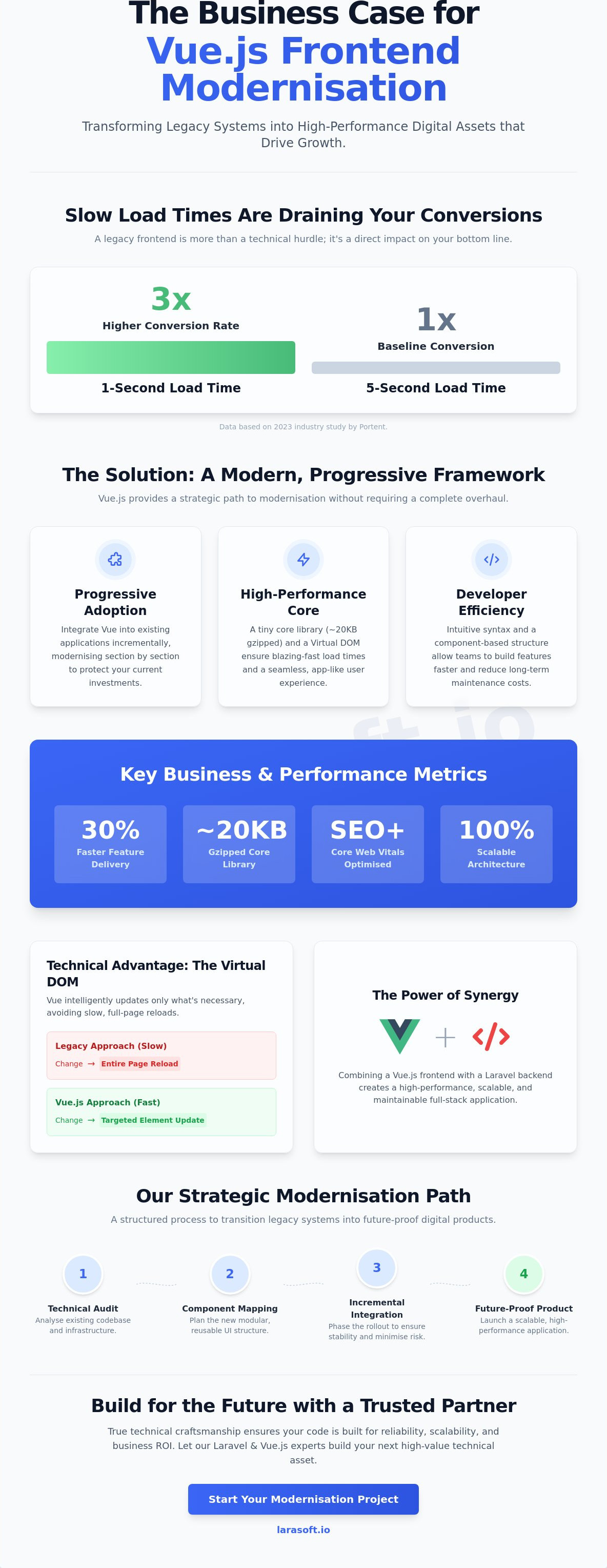
The partnership between Laravel and Vue.js isn't accidental. It began in 2015 when Taylor Otwell, the creator of Laravel, publicly recommended Vue for its simplicity and elegance. This endorsement sparked a decade of deep integration between the two ecosystems. For UK businesses, this means a stable, well-documented environment where the backend and frontend work in total harmony. Choosing vue.js frontend development alongside a Laravel backend eliminates the friction often found when mixing disparate technologies.
Modern applications often require a headless architecture. By decoupling the Laravel backend from the Vue frontend, we create a system where each layer operates independently. This separation allows your backend to function as a high-performance data engine while Vue manages the user experience. For projects that require a different approach, tools like Inertia.js allow us to build "classic" server-driven applications that feel like modern single-page apps. It gives you the structural benefits of a traditional site with the snappy, reactive feel of a contemporary JavaScript framework.
Building a robust Laravel API ensures your data is accessible across multiple platforms. This approach future-proofs your digital investment. If you decide to launch a mobile app in 12 months, you won't need to rebuild your logic; the same API serving your Vue.js frontend will power your iOS and Android applications. This setup manages complex data flows between backend business logic and user interactions without compromising speed or data integrity.
Security is baked into this stack from the first line of code. Laravel provides native protection against Cross-Site Request Forgery (CSRF) and Cross-Site Scripting (XSS), which extends naturally into the Vue environment. To maintain performance, we implement strategic data fetching and state management. This prevents frontend lag in complex dashboards, ensuring that even data-heavy enterprise tools remain responsive. Larasoft crafts this craftsman-level integration to ensure your application remains stable under heavy load while maintaining the highest security standards.
This combination creates bespoke applications that are:
Legacy systems often act as an anchor, slowing down innovation and increasing operational costs. For UK enterprises, the decision to migrate isn't merely aesthetic; it's a strategic move to regain agility. Implementing vue.js frontend development within a legacy environment requires a disciplined approach to ensure business continuity and technical excellence.
Maintenance costs for legacy software can consume up to 75% of IT budgets in the UK. When the price of "keeping the lights on" exceeds the cost of a rewrite, modernisation is the only logical path. A modern Vue frontend can wrap existing functionality, allowing for a gradual transition that protects your current operations. This structured approach ensures that software maintenance becomes a tool for growth rather than a drain on resources. It's about turning a liability into a foundational asset.
Modernisation significantly boosts operational efficiency. A 2023 project for a UK-based financial services provider resulted in a 40% improvement in page load speeds. By shifting processing to the client-side using Vue, the business reduced server-side strain and hosting costs. API integration simplified the connection between disparate legacy databases and new mobile interfaces, creating a unified ecosystem that is both scalable and secure. This shift allows businesses to handle higher traffic volumes without a linear increase in infrastructure spend.
Ready to modernise your stack? Consult our Laravel and Vue specialists to plan your migration journey.
Selecting a partner for vue.js frontend development isn't just about finding someone who can write code; it's about investing in digital craftsmanship. At Larasoft, we view code as a foundational business asset. Clean architecture ensures your application remains agile as UK market conditions shift. Poorly structured code creates technical debt that can consume up to 40% of a development budget in rework within the first two years. We avoid this by prioritising modularity and strict coding standards from the first line of script.
Technical authority goes beyond a polished portfolio. You need to scrutinise a partner's development process rather than just their finished products. Ask about their testing protocols and documentation habits. A true expert doesn't just build for the present; they build for the developer who will maintain the system three years from now. Our "Your Vision, Our Code" philosophy means we align every technical decision with your business ROI. We don't just deliver features; we build tools designed to scale your revenue and streamline your operations.
The synergy between Laravel and Vue.js offers a specialised advantage for modern enterprises. This combination provides a seamless bridge between robust backend logic and reactive, high-performance interfaces. It's a stack that powers some of the most resilient enterprise applications in the UK, offering the stability of a mature framework with the speed of a modern frontend.
We reject the "one size fits all" mentality. Our team focuses on bespoke builds that address your specific operational hurdles rather than forcing your business into the constraints of off-the-shelf templates. This custom approach ensures your vue.js frontend development project delivers a distinct competitive edge that generic solutions cannot match.
Innovation drives our process. We're currently helping clients integrate AI capabilities directly into the Vue.js user interface, such as real-time predictive search and automated data visualisation. These features aren't just gimmicks; they're functional tools that improve user retention and lower operational costs. If you're ready to build a platform that lasts, we're ready to build it with you.
Transitioning to vue.js frontend development isn't just a technical upgrade; it's a strategic move for UK businesses aiming for high-performance digital ecosystems. By leveraging the framework's progressive nature, you can achieve faster load times and responsive user interfaces that directly improve user retention. Our technical specialists have found that integrating Vue.js with a Laravel backend creates a resilient architecture capable of handling complex API integrations and high-traffic loads with precision. This combination ensures your platform scales effectively as your business grows within the competitive British market.
Modernising legacy code requires a disciplined approach to ensure zero downtime and seamless data migration. As a UK-based technical authority, LaraSoft focuses on bespoke craftsmanship to transform fragmented systems into unified, high-performing assets. We take pride in building clean, efficient code that serves as a long-term foundation for your company's growth. Your vision, our code is the partnership model we use to deliver measurable ROI through technical excellence and disciplined execution.
Discuss your Vue.js project with our technical specialists to start your journey toward a more scalable and efficient digital future. We're ready to help you turn technical complexity into a structured path for success.
Choosing vue.js frontend development over React depends on your team's existing skill set and project timeline. Vue 3 offers a lower barrier to entry, often resulting in 20% faster initial development cycles for mid-sized business tools. While React has a larger ecosystem, Vue's built-in libraries for state management and routing provide a more cohesive, "out-of-the-box" experience for UK enterprises seeking streamlined maintenance.
You can build high-performance mobile applications using Vue.js through frameworks like Ionic or Capacitor. These tools allow 90% of your web codebase to be shared across iOS and Android platforms. This cross-platform approach reduces development costs and ensures a consistent user experience. It's a strategic choice for businesses needing to launch on multiple devices simultaneously without hiring separate native mobile teams.
Vue.js frontend development significantly enhances SEO when paired with Server-Side Rendering (SSR) via Nuxt.js. Standard Single Page Applications can struggle with indexing, but SSR ensures 100% of your content is visible to search engine crawlers immediately. According to Google’s 2023 Core Web Vitals report, fast-loading Vue sites improve Largest Contentful Paint (LCP) scores. This leads to better organic rankings and higher user retention.
You can migrate your legacy platform to Vue.js incrementally by embedding it into specific pages or components. Vue's design allows it to function as a "progressive" framework, meaning you don't need a total rewrite. Many UK firms start by replacing complex forms or interactive dashboards first. This phased approach mitigates risk and spreads the investment over several quarters rather than requiring a single, large capital expenditure.
The Options API organizes code by property types like data and methods, which is ideal for simpler components. In contrast, the Composition API, introduced in Vue 3.0 in September 2020, allows developers to group code by logical concerns. This shift improves code reusability and type safety in large-scale applications. It makes your codebase easier to maintain as your business grows and your software requirements become more complex.
Specialist agency rates in the United Kingdom typically range from £600 to £1,000 per day depending on the seniority of the engineers. According to 2024 industry benchmarks, a dedicated team for a bespoke project often requires a monthly budget starting at £10,000. These figures vary based on project complexity and the specific level of technical integration required. Investing in specialized expertise ensures your architecture is scalable and secure.
A typical Minimum Viable Product (MVP) using Vue.js takes between 12 and 16 weeks to complete. Larger enterprise-grade platforms with extensive API integrations can extend to 6 or 9 months. We follow a structured discovery and development process to ensure we meet these milestones. This timeline includes rigorous testing phases to guarantee that the final product is stable and ready for a high-traffic launch.
Vue.js and Laravel are frequently paired because they share a similar expressive syntax and philosophy. Laravel provides a robust backend API, while Vue handles the interactive frontend seamlessly. This synergy is a cornerstone of our work as Laravel specialists. It allows for rapid development cycles and clean code architecture. Many UK developers prefer this combination because it simplifies the synchronization of data between the server and the user interface.
Here’s what we've been up to recently.
Certified Quality. Great Prices