Software development lifecycle: How to choose a model for your business

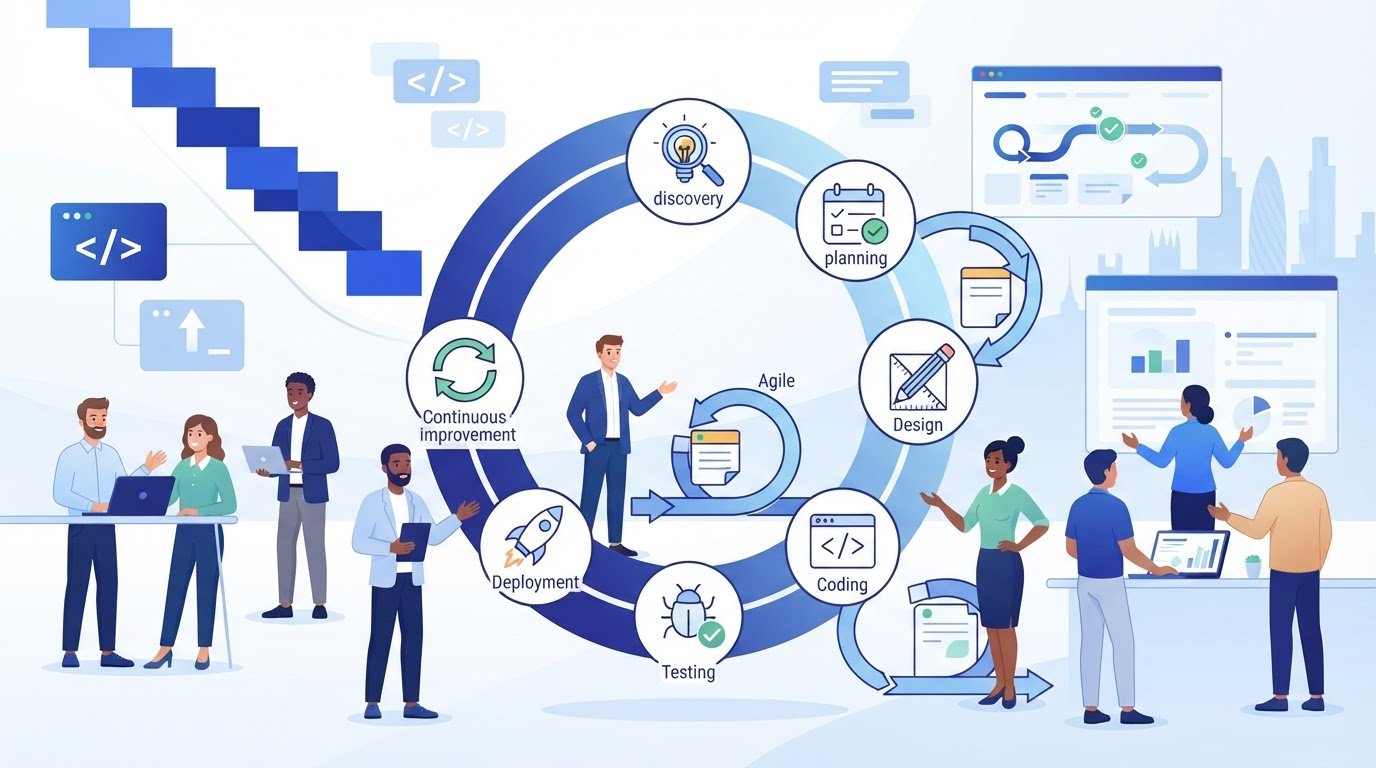
The best software development lifecycle for business owners is the one that fits a project’s complexity, objectives and expected rate of change. Waterfall can suit stable, clearly defined requirements; Agile is better suited to projects where priorities may evolve and regular feedback matters. No single model works for every business.
A fixed plan can make scope and delivery easier to structure, while short Agile sprints can deliver working features sooner and leave room for change. The choice affects how you plan investment, involve stakeholders and manage delivery risk, making it a business decision as much as a technical one.
This guide compares SDLC models, explains Agile sprint planning and outlines the development phases. It also shows how full cycle software development connects discovery, delivery and ongoing improvement, and how software product development can address practical needs such as inefficiency and miscommunication.
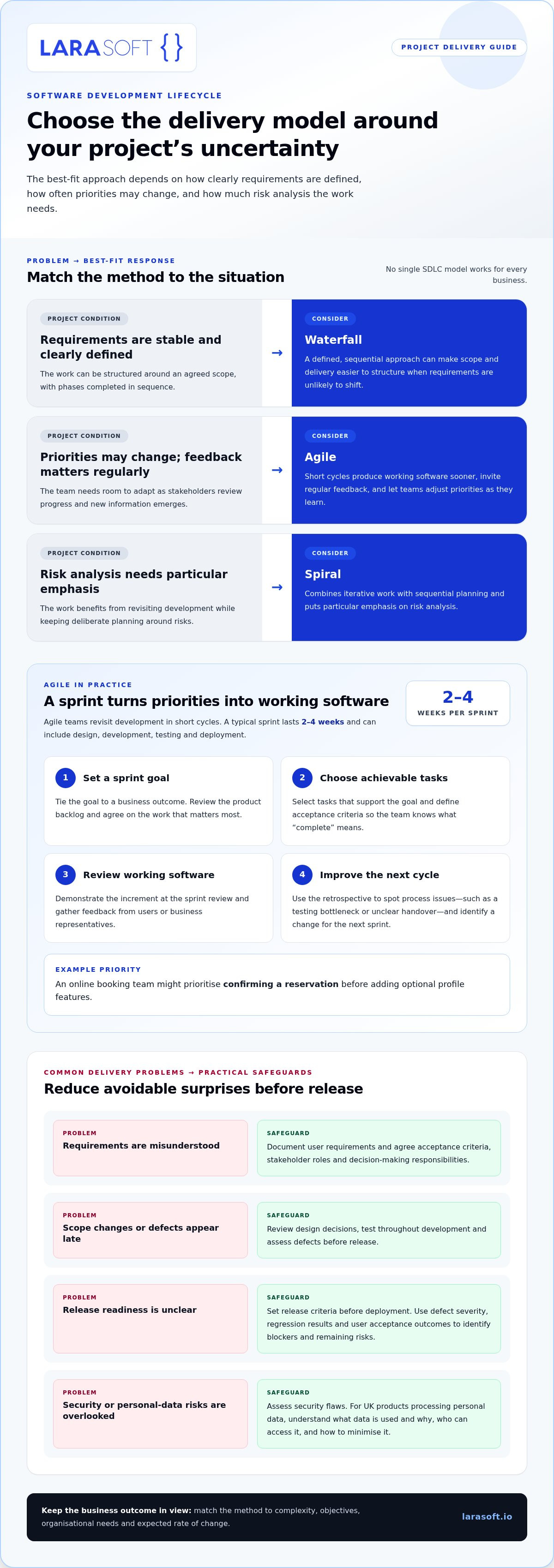
There is no single best model. Match the stages to the product’s complexity, objectives, regulatory requirements, organisation and expected rate of change. Waterfall proceeds through defined phases in sequence, making it suitable when requirements are stable. Agile revisits development in short cycles, helping teams respond as priorities change. Spiral combines iterative work with sequential planning and puts particular emphasis on risk analysis.
Deployment is more than a final handover. A tested version can be released for beta testing, giving early users the opportunity to report bugs before wider adoption. Teams can use that feedback to prioritise fixes, complete user acceptance testing and decide whether release criteria are met. For example, a business might ask a small user group to test a new booking workflow before rolling it out more widely.
After launch, maintenance covers bug fixes, security updates, compatibility changes and improvements based on how people use the software. The lifecycle also includes retirement: when a system no longer meets business needs, the organisation plans its replacement or withdrawal and manages data and integrations during the transition. A release plan should therefore cover deployment, feedback review, ongoing maintenance and eventual retirement.
To choose and manage a software development partner, define the business outcome and requirements, then assess the partner’s experience with relevant methods and technologies. Agree on stakeholder roles, decision-making responsibilities, delivery milestones, acceptance criteria, and how progress and risks will be reported. These steps give both sides a shared basis for managing changes throughout the lifecycle.
Common project risks include misunderstood requirements, scope changes, security flaws and defects found late. Reduce them by documenting user requirements, reviewing design decisions, testing throughout development and assessing defects before release. For products that process personal data in the UK, teams should understand what data is used and why, who can access it, and how to minimise it.
Plan testing around intended use and release risk. Quality assurance checks whether the software meets defined standards; user acceptance testing checks whether it meets users’ needs. Set release criteria before deployment, then use defect severity, regression results and acceptance outcomes to identify blockers, deferrable issues and remaining risks. Decide how users will share feedback and how maintenance work will be prioritised after launch.
Agile organises the development process around short cycles, frequent feedback and working software. In a typical Agile lifecycle, teams revisit development phases in sprints lasting 2-4 weeks. Each sprint can include design, development, testing and deployment, producing a usable increment rather than waiting for one final release.
Sprint planning turns business priorities into a focused, achievable body of work. The team reviews the product backlog, agrees on a sprint goal, then selects tasks that support it. For example, an online booking team might prioritise confirming a reservation before adding optional profile features. Clear acceptance criteria help everyone understand what counts as complete.
During the sprint, developers and stakeholders stay in contact as requirements are clarified. At the review, the team demonstrates working software and gathers feedback from users or business representatives. A retrospective then examines the process, such as a testing bottleneck or unclear handover, and identifies a change for the next cycle.
The Agile Manifesto, produced by the Agile Software Development Alliance in 2001, sets out 12 principles. Its approach values early, continuous delivery and close customer collaboration. For a business, this means reviewing useful progress regularly and adjusting priorities when evidence changes, rather than treating the initial specification as fixed.
Waterfall and Agile involve different trade-offs. Waterfall completes one phase before moving to the next, so it can suit stable, defined requirements and work that does not need frequent updates. Agile accommodates changing requirements and produces working versions across successive sprints. Teams can change direction, but must manage priorities carefully to avoid expanding scope without a clear business reason.
DevOps complements either methodology by connecting development with deployment and ongoing operation. It focuses on collaboration and a reliable flow from code changes to running software. For example, a team can plan an operational handover alongside a sprint feature, rather than leaving deployment concerns until the end. Agile describes how work is organised; DevOps addresses how software is delivered and operated.
Agile works best when decision-makers can review progress and make timely priority calls. If your team is shaping a delivery approach for a web or mobile product, discuss an Agile development approach as part of planning the work.
Both Agile and Waterfall take software from requirements to tested delivery, but they organise the work differently. Waterfall completes each phase before the next begins, while Agile revisits design, development and testing in sprint cycles. The choice affects when stakeholders review progress, how teams manage changes and when testing findings shape implementation.
A software project requirements document should define users, business objectives, required functions, acceptance criteria and constraints. It should also record relevant security, performance, usability and industry-specific requirements, along with assumptions and dependencies.
Make the document useful to both business and technical stakeholders. Describe a user’s task, such as submitting an order, and specify the expected result, including what happens when information is missing. High-level design can explain system architecture; low-level design can describe components and their interactions. Record decisions, responsibilities and risks so each version gives the team a shared reference.
In Waterfall, teams document requirements and design before implementation, then test after development. This creates a defined baseline, but changing scope mid-process can be difficult and costly. In Agile, teams build and test increments throughout the process. Feedback can refine requirements between sprints, while acceptance criteria keep each change tied to a user need.
Testing should cover different failure modes, not just whether a screen looks right. A booking feature, for example, may work in isolation but fail when several users submit requests at once. Combine suitable testing methods to assess behaviour, code quality and the experience for intended users:
Quality assurance checks whether software meets prescribed standards; testing provides evidence of how it behaves. Requirements may also include industry rules, legislation and security expectations. For software that processes personal data in the UK, teams should understand the data’s type and purpose, who can access it, and how to minimise it.
Before releasing a version, assess test results against agreed acceptance criteria. Use defect severity and regression results to identify release blockers, issues that can wait and remaining risks. In Waterfall, this assessment generally follows the main build; Agile teams can apply it to each increment. Document decisions and assign owners to unresolved issues, so deployment reflects evidence rather than assumptions.
Full cycle development connects the decision to build software with its delivery, improvement and eventual retirement. Understanding this span helps business owners plan beyond launch and make choices that support lasting business value.
The software development life cycle (SDLC) is the sequence of work from identifying a need and building software to checking stakeholder satisfaction. Microsoft describes these core activities as identifying a need, writing code to meet it and checking whether stakeholders are satisfied. For a business, a defined lifecycle makes responsibilities and decisions visible, helping teams connect technical work to business requirements and intended outcomes.
Product definition turns an initial idea into a shared description of who the product serves, why they need it and what it must do. Discovery combines market analysis with a review of technical and market risks. Documenting required features and their functions helps developers and managers assess differentiation and avoid misreading customer needs. Technology evaluation then considers which architecture, tools and resources can support those requirements and future change.
Project duration depends on scope, complexity, integrations, testing needs and how quickly stakeholders make decisions. A focused product with clear requirements involves less discovery and fewer changes than a platform with complex workflows. Sequence delivery around dependencies, such as validating data flows before building reports, and revisit estimates as the team learns more.
Build the budget around the work required for discovery, design, development, testing, deployment and maintenance. Assign each milestone a deliverable, approval owner and acceptance criteria, then track spending against completed work. Choose success metrics that reflect the business goal, such as reduced manual handling for an automation project or successful task completion for a customer-facing service.
Full cycle planning also accounts for work after the first release. A deployed product can be refined using user feedback, while maintenance addresses bugs and changing technical needs. Plan for retirement when the software no longer serves the business, including the transition of data and connected systems.
For example, a growing business might first validate demand, then release a core workflow before adding advanced reporting. This staged approach links investment to evidence: each milestone can test a product assumption, expose a technical risk or deliver a useful capability. Clear decision points help owners prioritise the next increment without losing sight of the product’s longer-term direction.
Software product development creates value when it addresses a defined operational or customer need. For a business dealing with repeated manual tasks, a bespoke workflow can bring steps together in one system and reduce unnecessary hand-offs. The practical test is whether the product improves a business process, supports a clear decision or makes a service easier to use.
Low efficiency and miscommunication can contribute to missed deadlines. A shared software workflow can make responsibilities and task status visible, helping teams coordinate their work. For example, a project system might bring requests, approvals and progress updates together instead of relying on separate email threads. The benefit comes from resolving a specific communication gap, not simply adding another tool.
Growth can also create information-management challenges. As a customer base expands, the volume of business data that needs organising and maintaining grows. A product designed around the organisation’s processes can structure that information for financial and strategic decisions. Clear data fields and consistent records help teams work from a more coherent view of customers and operations.
For a business expanding into other locations, software can record inventory movements in real time. This gives teams a way to track stock transfers between sites and identify where items are held. The architecture should reflect how locations, products and movements relate. If those foundations are unclear, reports may not answer the operational questions managers need to resolve.
Product development also lets a business shape functionality around its own workflows. First define the user, the task and the intended outcome. Then prioritise essential capabilities, such as recording a transaction, before adding secondary reporting. A development team can use sprint feedback to refine the product as stakeholders review working features. This keeps decisions connected to actual use rather than initial assumptions.
Measure value against the original problem. If missed deadlines drove the project, review whether hand-offs and task visibility have improved. If inventory tracking was the goal, assess whether teams can locate movement records and use them for planning. Pair performance measures with observed changes in team behaviour, so the development team can distinguish a useful product from software that has merely been delivered.
For a product shaped around your workflows, plan your bespoke software development project around the business outcomes it needs to support.
Larasoft is a practical next step when your business has defined a software need and is ready to shape it into a bespoke product. Laravel Web Development can support custom web applications built around business requirements, while Vue.js or React Frontend Development can provide the user-facing interface. For products designed primarily for mobile use, Native Mobile App Development is another option.
The right approach depends on the product’s users, functionality and technical architecture. Bring those priorities into the development discussion to connect business goals with implementation decisions. If you’re ready to explore a bespoke software project, contact Larasoft or visit larasoft.io.
A well-planned software development lifecycle for business owners starts with a decision: which business outcome deserves investment now, and what evidence will show that the work is helping? Turn that decision into a concise project brief covering users, essential workflows, constraints and meaningful success measures. This gives technical planning a clear foundation and helps keep future changes connected to the product’s purpose.
Larasoft can turn that brief into an implementation through Laravel Web Development, with Vue.js or React Frontend Development for the interface. The architecture should support current requirements while allowing room for future change. Keep the discussion centred on priorities, user needs and how the solution will fit existing business processes. Bring any questions you still need to resolve, too.
To explore how your project could move from business need to a considered technical plan, Discuss your project with Larasoft. A clear starting point makes the next decision easier and gives your software investment a purposeful direction.
SDLC is a structured way to take software from a business need through development and ongoing use. A software development lifecycle for business owners provides a framework for connecting business requirements to delivered features. For example, if staff need an expense approval system, the process can define who approves each request and how the workflow will be assessed. This shared reference helps teams control scope and make informed decisions as work progresses.
Agile helps startups learn from working software before committing to a larger product scope. A team can release a small, useful capability, observe how intended users respond, then use that evidence to shape the next increment. For example, a new service could first validate its core customer journey before adding account management features. This approach makes user feedback part of product decisions instead of relying only on assumptions made during planning.
Discovery costs depend on the work required to define the product, not on a universal UK fee. Key factors include the number of user groups, workflow complexity, integrations, technical risks and the depth of research or design needed. A discovery quote depends on the project and is provided after a quote request. A clear brief helps define the discovery work, its deliverables and the decisions it must support.
SDLC describes the full lifecycle of software, while Agile is one methodology for organising work within that lifecycle. The SDLC can include discovery, requirements, design, implementation, testing, deployment, maintenance and retirement. Agile shapes how teams plan and deliver those activities, often through iterative work and regular feedback. A business can use Agile within its SDLC, rather than treating the terms as competing alternatives.
Responsibility is shared, but each phase needs a clear decision owner. Business stakeholders explain priorities and approve requirements; product or project leads coordinate scope and decisions; designers shape user flows; developers build the system; and testers assess quality. For example, a finance lead might approve expense rules while the development team implements them. Naming owners for approvals, dependencies and acceptance prevents important decisions from falling between roles.
Common stages are discovery, requirements analysis, design, development, testing, deployment, maintenance and retirement. They describe the work software passes through, although teams may revisit earlier decisions as needs change. For instance, user testing might reveal that a planned feature needs a simpler workflow before release. Treat the stages as connected decision points, each with a defined output, rather than isolated tasks handed between teams.
The best software development lifecycle for business owners depends on how settled the requirements are and how often priorities may change. Waterfall can fit a project with a clearly defined scope; Agile can suit work that needs frequent feedback and adaptation. A hybrid approach can set firm budget or approval checkpoints while delivering selected features iteratively. For companies that want to test market demand quickly with responsive digital touchpoints, Dulyfixed Small Business Solutions delivers mobile-first website and landing page design tailored for small business growth. Weigh the cost of changing direction against the value of learning from users during development.
Here’s what we've been up to recently.
Certified Quality. Great Prices