How to assess readability and dependency risks with Laravel code reviews
Alex Stevens
Laravel code review services should assess whether code is readable, maintainable and secure, not just whether it runs. A practical review checks consistency with PSR-2, PSR-4 and PSR-12, examines design choices and tests third-party dependencies for vulnerabilities. The result should be clear findings and practical fixes that fit the application.
Readable code is easier to change, but style alone won’t reveal tangled business logic, inefficient database access or vulnerable dependencies. Laravel code review services can assess these risks systematically, clarify what useful feedback should include and help prioritise improvements without turning a review into a rewrite.
The steps below cover coding standards, controller design, query behaviour and dependency security. Together, they provide a structured way to assess whether a Laravel codebase is maintainable and where targeted changes can improve it.
Key Takeaways
Use PSR standards as a consistency baseline, then assess whether naming, structure and validation make the code easy to follow.
Keep controllers focused: move complex business rules into suitable service classes and use comments to explain decisions that aren’t obvious from the code.
Review third-party packages alongside authentication flows and custom middleware to identify dependency and access-control risks.
Make audit findings actionable by linking each issue to its impact, priority and a practical patch or next step.
Set review scope around codebase size, complexity, test coverage and access to project context; these factors shape the work involved.
Assess readability alongside coding standards: consistency makes a codebase easier to review and update. Use these steps to prepare the project and make findings actionable.
Improve Code Readability
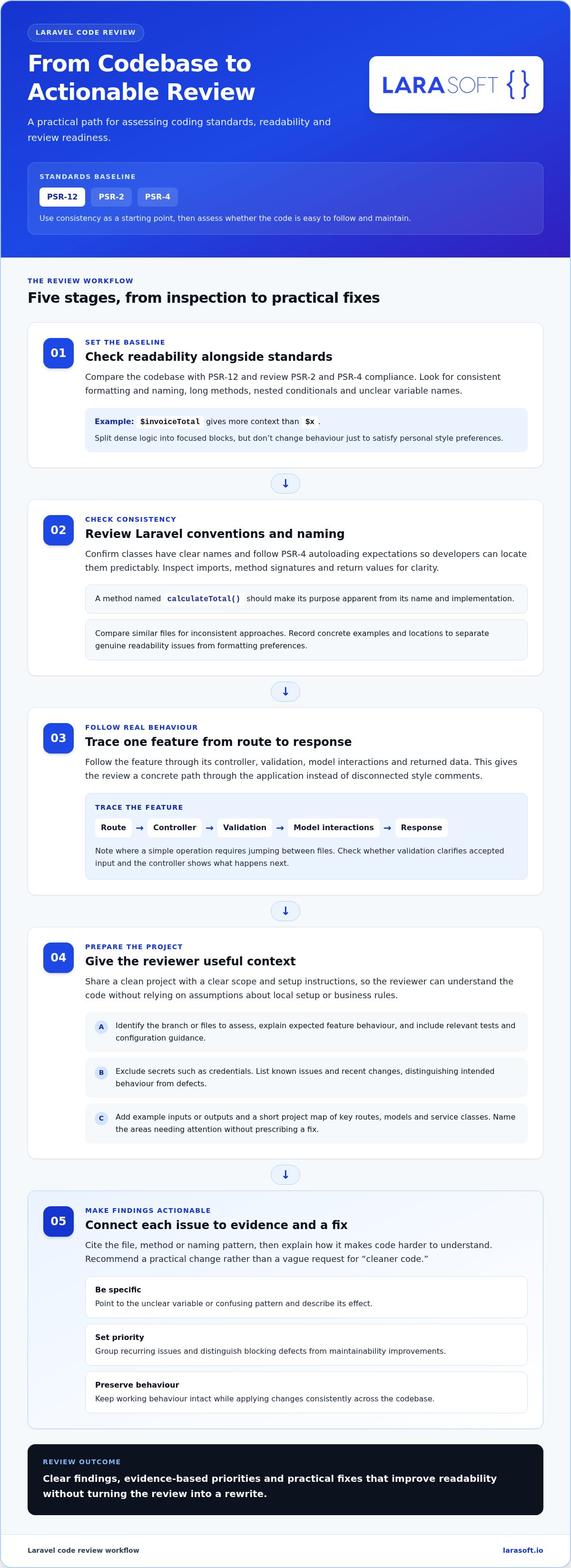
Start by comparing the codebase with PSR-12, then check whether naming and formatting stay consistent across files. Review PSR-2 and PSR-4 compliance as part of the standards assessment. Look for long methods, nested conditionals and unclear variable names. For example, a variable called $x gives less context than $invoiceTotal. Split dense logic into focused blocks, but avoid changing behaviour solely to satisfy personal style preferences.
Check how Laravel conventions support consistency. Confirm classes use clear names and follow PSR-4 autoloading expectations, so developers can locate them predictably. Inspect imports, method signatures and return values for clarity. A method named calculateTotal() should make its purpose apparent from its name and implementation. Compare similar files for inconsistent approaches, then record examples and locations. Specific examples help reviewers distinguish a genuine readability problem from a preference about formatting.
Trace a representative feature from route to response. Follow its controller, validation, model interactions and returned data. Note where understanding a simple operation requires jumping between files. For example, validation rules should clarify accepted input, while the controller should show what happens next. Record confusing transitions and their likely effect on future updates. This gives the review a concrete path through the codebase, rather than a collection of disconnected style comments.
Prepare the Project for External Review
Prepare a clean, readable Laravel project with a clear scope and setup instructions. Before a review, identify the branch or files to assess and explain the feature’s expected behaviour. Include relevant tests and configuration guidance, but exclude secrets such as credentials from shared materials. This gives the reviewer enough context to understand the code without relying on assumptions about local setup or business rules.
List known issues and recent changes, including the update under review. Distinguish intended behaviour from defects, and provide example inputs or outputs where useful. A short project map can identify key routes, models and service classes. Keep the review focused by naming areas that need attention, such as readability or consistency with coding standards, without prescribing a particular fix.
Make each standards finding actionable. Cite the file, method or naming pattern, then explain how it makes the code harder to understand. For example, recommend a descriptive variable name when its purpose is unclear, rather than simply asking for “cleaner code.” Group recurring issues, distinguish blocking defects from maintainability improvements, and preserve working behaviour when making changes. A concise, evidence-based review helps the team apply fixes consistently across the Laravel codebase.
Meaningful comments and design patterns
Inspect comments and structure to check whether Laravel business rules remain understandable as the application grows. Use these steps to distinguish useful explanations from unnecessary comments and identify suitable design patterns.
Start with controller methods such as store() and update(). Trace each branch and identify decisions driven by business rules. A comment should explain why a condition exists, not restate the code in ordinary language. For example, document a legacy billing exception that looks unusual but is still required.
Flag comments that merely repeat implementation details. A line such as “increment the counter” adds little beside $counter++. Explain the reason for the change instead, such as preserving a customer’s billing sequence. Remove obsolete comments after code changes, as stale explanations can mislead developers maintaining the feature.
Use precise examples to make complex logic clear. If a discount rule has exceptions, explain the business condition behind each branch. There is no need to comment on every line. Instead, annotate the decision point a future developer might misinterpret, then verify that the explanation still matches the code.
Check whether a controller has too many responsibilities. A store() method that validates input, calculates charges, updates models and sends notifications can be difficult to change safely. Identify distinct business operations, then move suitable logic into a service class. Keep the controller focused on coordinating the request and response.
Use the Single Responsibility Principle to decide where logic belongs. For example, put invoice totals in a billing service rather than adding calculations to a controller or Blade view. This gives the rule a clear home and makes related behaviour easier to inspect. Check that the service has a focused purpose.
Consider the Service pattern when multiple actions need the same business operation. A billing service can centralise charge calculations used by web requests and queued tasks. Use a Repository pattern only when it clarifies data access or separates a genuine persistence concern. Avoid layers that merely pass calls between models and controllers.
Trace how models fit into the design. If a model contains unrelated billing, reporting and notification rules, consider whether those responsibilities belong in focused services. Preserve clear Eloquent relationships and make each operation understandable. A useful review explains the maintenance problem instead of demanding a pattern simply because it appears in a design guide.
Make each recommendation specific and testable. Point to the method, explain its responsibility, and suggest a practical boundary for extraction. For example, move charge calculation from OrderController into a billing service, then test that service independently. Teams refining Laravel architecture can explore Laravel application development as a next step.
Third-party dependency vulnerabilities
Review package risks alongside Laravel authentication, middleware and database access. These steps connect dependency findings to practical application exposure.
Start with composer.json and composer.lock. Identify the direct packages and versions installed in the application. A package requirement alone does not show the resolved version. Compare both files, then flag abandoned or unexpectedly introduced dependencies. This creates a clear inventory of what the codebase actually uses.
Trace each package through the application. For example, check whether a payment package handles controller input, calls external services or reads customer records. A dependency used only by an isolated development tool presents a different level of exposure from one processing login requests. Establish the package’s role before assessing its impact.
Trace authentication from request to protected action. Follow how Laravel receives credentials, establishes a session or token, and checks access. Look for dependencies that change authentication behaviour or handle identity data. Review custom middleware and gates too, especially when a controller relies on them to protect sensitive actions.
Test potential paths around middleware and policies. Compare a permitted request with one from a user who lacks the required role. Check whether alternate routes, API controllers or queued actions can reach the same operation without equivalent access checks. Document the exact route and condition that allows access, rather than reporting only an “authorisation issue.”
Trace dependency data into queries and outputs. A package that accepts user-controlled filters may affect database queries or expose records in an API response. Review escaping, validation and query construction at the integration boundary. For example, follow a submitted search term from the controller into the package call and returned results.
Assess passwords and credentials wherever a package touches them. Laravel applications should hash passwords with secure algorithms such as bcrypt or Argon2, rather than storing plain text. Check whether a custom integration logs credentials or exposes them in error messages. Describe the affected data path and where the handling needs correction.
Prioritise findings by exploit path and business impact. A vulnerable package connected to login or payment flows warrants more attention than an unused development dependency. Explain the affected component, reachable entry point and potential consequence. Distinguish a confirmed unsafe code path from a version concern that needs further technical assessment.
Recommend a focused fix and regression test for each issue. Updating a package can change its API, so inspect related Laravel controllers, queries and tests before merging. If no safe update fits the application, isolate or replace the affected integration. Recheck authentication and access behaviour after applying the patch.
Audit reports and code patches
Turn findings into a prioritised report and a sequence of testable fixes. These steps connect architectural risks to specific Laravel files and functions.
Group findings by architecture, performance and maintainability. For each issue, name the affected controller, model, function or integration. Explain the observed behaviour and why it matters. For example, billing rules in a controller can make changes harder to isolate and test. Keep the evidence separate from the proposed fix.
Assess SOLID compliance across related classes, not just individual lines. Trace a request through its controller, service and model interactions. Identify business logic that has leaked into controllers or Blade files. Explain which responsibility is misplaced and outline a practical way to move it into focused service classes.
Map the Eloquent structure before recommending changes. Identify the models, relationships and database operations used by the reviewed feature. Then trace likely N+1 queries, where related records are fetched repeatedly. Describe the triggering operation and affected relationship, so a developer can reproduce the behaviour and assess the proposed fix.
Compare database indexes with actual query patterns. Connect each slow or repeated query to its filters, joins and ordering. Note where an index may not support those operations, and explain the expected benefit of a targeted adjustment. Avoid recommending indexes without linking them to a specific application query.
Examine Redis caching as part of the feature’s data flow. Identify what the application caches, where cache keys are created, and when values are refreshed or invalidated. For example, a stale cached record after an update may indicate an invalidation gap. Record the affected function and the consequence for users.
Rank findings by impact, reachability and repair scope. Prioritise defects affecting core business flows over cosmetic restructuring. Distinguish a confirmed query problem from a broader architectural improvement. This helps teams schedule patches without treating every observation as equally urgent or changing unrelated behaviour.
Make each patch recommendation specific. Name the relevant class or function, describe the intended behaviour and state which existing tests should still pass. If billing logic moves from a controller into a service class, preserve the route’s response and verify the calculation with targeted tests.
End the report with a verification plan. Link each patch to its finding, affected files and regression checks. For an Eloquent query change, confirm that the relationship still returns the expected records. For a Redis adjustment, test that an update refreshes the cached value. This makes the review a practical engineering plan.
How long does a Laravel code review usually take?
Review time depends on scope, codebase complexity and access to project context. Define these factors first, then estimate the work based on the activities involved.
Set the review boundaries before estimating the effort. Reviewing one Laravel feature differs from assessing routes, models, controllers and integrations across an application. Name the files or workflows in scope, and separate urgent concerns from broader architectural questions. This lets the reviewer plan the depth around the work required.
Assess the codebase’s size and structure. Modules with clear boundaries are easier to trace than tightly coupled features spread across many classes. For example, an order flow involving a controller, service and model has a clearer review path than logic distributed across unrelated files.
List the questions the review needs to answer. A readability assessment requires different analysis from a security review of authentication, middleware and dependencies. Specify each outcome, such as identifying inefficient queries or checking a payment integration. Every additional concern adds investigation and reporting work.
Account for setup and access. A reviewer needs a working project context, relevant branches, configuration guidance and tests. Missing environment details can make an issue harder to reproduce. Clear instructions and a reliable way to navigate the application help the reviewer focus on code behaviour.
Consider test quality when planning validation. Existing Laravel tests can clarify expected behaviour and help reproduce regressions. If a feature lacks useful tests, the reviewer may need to trace requests manually or establish test cases before assessing a proposed patch. This affects how thoroughly the change can be verified.
Separate findings from implementation work. A report identifying an N+1 query is different from fixing it, reviewing the changed Eloquent relationship and running regression checks. Decide whether the requested scope ends with recommendations or includes code patches and retesting.
Plan communication around the complexity of the findings. A straightforward naming issue may need only a concise note. A controller combining billing rules, database writes and external API calls needs supporting evidence, impact analysis and a careful remediation path. Agree on how findings will be grouped and discussed.
Estimate the work by review activity rather than choosing an arbitrary duration. Break it into setup, code tracing, security or architecture analysis, reporting and follow-up. Adjust the plan if the scope changes, for example, by adding another integration or expanding the review from one feature to the wider application.
For professional insights, many teams rely on specialized laravel code review services to ensure quality and security.
Complete your final validation by revisiting the estimate if the agreed scope, access or review questions change, since each factor directly affects the overall time and effort involved.
Larasoft: Laravel Web Development
Larasoft provides Laravel Web Development for teams ready to turn review findings into focused application improvements. This is a natural next step when results point to deeper structural changes, new features or an application that needs to evolve with business requirements. Larasoft can also connect Laravel with a Vue.js or React frontend, or extend a product through Native Mobile App Development. The right approach depends on the application’s architecture, priorities and planned changes. A review report gives your team a clearer basis for deciding what to address first and how development should support the product’s longer-term direction. Contact Larasoft to discuss your Laravel project, or visit larasoft.io.
Turn review findings into your next development decision
A code review clarifies what deserves attention, but its lasting value comes from connecting findings to your product roadmap. Decide which changes protect essential workflows, simplify future updates or support planned growth. Then turn those priorities into a development brief your team can act on.
Larasoft offers Laravel Web Development to build and evolve bespoke applications. If a review highlights a gap between the backend and user experience, Vue.js Frontend Development or React Frontend Development can help create a more cohesive product. The right implementation depends on your application, technical priorities and intended direction.
If you’re considering laravel code review services, bring the questions raised by your codebase into a conversation about the next practical step. Contact Larasoft about your Laravel project and move forward with a clearer plan.
Frequently Asked Questions
What is included in a professional Laravel code review?
Laravel code review services assess changes in the context of application behaviour, edge cases and maintainability. A review can cover API contracts, queued jobs and database transactions. For example, a reviewer might check whether an order update rolls back cleanly if a later operation fails. Agreeing on the purpose, such as release approval or technical planning, helps keep findings relevant to your decision.
What Laravel security checks should a code review cover?
A Laravel security review should trace how untrusted input reaches sensitive actions and data. Check authorisation at the point of access, not just whether a user is logged in. For example, test whether one customer can retrieve another’s record by changing an identifier in a request. Also inspect secret handling, file uploads, error responses and API resource exposure. Document the vulnerable path and the change needed to close it.
What Laravel coding standards and best practices should reviewers assess?
Reviewers should assess consistency with PSR-12 and PSR-4, alongside Laravel conventions that make classes easier to locate and test. Check whether validation uses FormRequest classes, whether Eloquent relationships express data access clearly, and whether responses suit the action performed. For example, creating a resource should return an appropriate success response. Apply these practices in context, so the review strengthens consistency without imposing unnecessary layers.
How to compare Laravel code review agencies, freelancers and automated tools?
Compare review options by whether they assess readability, maintainability, security and third-party dependencies, and provide actionable findings with practical fixes. Check that the scope reflects the codebase’s size and complexity, test coverage and available project context.
What risks and limitations should you consider when hiring a Laravel code review service?
Review scope depends on codebase size, complexity, test coverage and access to project context. The Laravel Developers’ audit scope covers up to 250,000 lines of code.
Which Laravel code review providers specialise in security and performance?
The Laravel Developers’ security reviews examine authentication flows, custom middleware gates, security-bypass paths and third-party dependency vulnerabilities. Their audits also check Eloquent structures, N+1 queries, index configurations and Redis caching strategies.
We use cookies to improve your experience and to help us understand how you use our site. By using this site, you accept our use of cookies. Cookie Infox