The Hidden Risks of Off-the-Shelf Software: A Strategic Guide for UK Businesses


Did you know that SaaS vendors raised prices by an average of 12.2% in 2026, yet research shows most organisations typically use only 10% to 15% of the features in a standard installation? It's a sobering statistic for UK directors who view commercial products as the efficient choice. While the initial setup feels like a win, the long-term risks of off-the-shelf software often include mounting technical debt and rigid workflows that break during critical updates. You might find yourself trapped in a cycle of high monthly licensing fees for a system that refuses to talk to your existing legacy code.
We understand the pressure to deploy solutions quickly to maintain momentum. You need tools that support growth rather than hindering it with integration bottlenecks. This strategic guide will help you calculate the true total cost of ownership and identify when commercial limitations start to threaten your business scalability. We'll examine how to mitigate procurement hazards through the lens of the UK's 2026 Software Security Code of Practice, providing you with a clear framework to decide when a custom Laravel or React build is the only viable path forward for your digital infrastructure.
Most business leaders start their digital journey looking for the path of least resistance. This usually leads to Commercial-off-the-shelf (COTS) software. These products, ranging from ubiquitous CRM systems to complex ERP platforms, are designed to solve general problems for a mass audience. They offer an enticing promise: pay a monthly fee, download the client, and start working immediately. However, this convenience often masks the inherent risks of off-the-shelf software that only surface as your business begins to scale.
The primary danger lies in what we call "Strategic Fragility." This occurs when a business is forced to bend its unique processes to fit the rigid architecture of a third-party tool. Instead of the software supporting your growth, it begins to dictate how you operate. While these tools serve a tactical purpose for startups or small-scale projects, they rarely function as foundational assets. A foundational asset is something you own and control; a tactical tool is something you rent until it no longer fits.
The "Speed to Market" argument is the most common trap for decision-makers. Choosing a ready-made solution feels like a win because it bypasses the development cycle. Yet, "ready to use" almost always means "ready to compromise." When you use the same software as your competitors, you lose the ability to innovate through your digital workflows. You might save weeks on deployment, but you'll spend months training staff to perform "workarounds" for features the software simply doesn't support.
In a UK business context, the false economy of COTS software lies in trading long-term operational sovereignty for a short-term reduction in initial deployment time.
Financial clarity is essential when evaluating the risks of off-the-shelf software. While a bespoke build requires upfront capital, COTS products represent a perpetual, escalating expense. Consider these factors:
Understanding these variables is the first step toward a more sustainable technology strategy. For a deeper look at the financial transition from renting to owning, you can explore our guide on How Much Does Bespoke App Development Cost in the UK?
Vendor lock-in is a silent growth killer for many UK enterprises. When you rely on third-party platforms, you're essentially building your house on rented land. The risks of off-the-shelf software become apparent when you try to migrate data or pivot your business model. Most proprietary systems use "black box" architectures that keep your data siloed. This makes extraction difficult and expensive; it effectively traps your operational history within a vendor's ecosystem. If that vendor changes their pricing or retires a feature, your business is forced to react to their roadmap rather than your own.
Proprietary codebases create an invisible barrier known as the "Integration Ceiling." This is the point where a commercial product can no longer communicate effectively with your other business tools. While most vendors promise connectivity, they often provide limited API integration capabilities that only allow for surface-level data exchange. You can't reach deep into the application's logic to trigger custom workflows or sync complex datasets in real-time. This friction forces your team into manual data entry, which introduces errors and drains productivity.
The rise of machine learning has introduced new complexities. Closed-source ecosystems make it nearly impossible to implement custom AI logic tailored to your specific datasets. You're often limited to the vendor's generic AI wrappers, which may not meet your security or performance standards. There are also significant security risks of off-the-shelf AI tools, particularly regarding how your proprietary data is used to train their models. If you're hitting a wall with your current stack, exploring professional API integration services can help bridge the gap before a full migration becomes necessary.
Direct database access is often restricted in commercial installations. This lack of transparency prevents you from building custom reporting dashboards or performing deep data analysis. You are forced to use the vendor's built-in analytics, which are often shallow and inflexible. Closed APIs stifle innovation in high-growth sectors by forcing businesses to wait for vendor-approved updates that may never arrive. You lose the agility required to respond to market shifts because you don't own the underlying technology.
Performance bottlenecks are inevitable when your software wasn't built for your specific load patterns. As your user base grows, off-the-shelf platforms often become sluggish, yet you have no way to optimise the back-end code. Adding bespoke features to a platform you don't control is a recipe for technical debt; it creates a "Frankenstein" system that is difficult to maintain. Choosing Laravel Web Development allows for a clean, scalable architecture where performance is tuned to your exact requirements, ensuring the system grows at the same pace as your business.
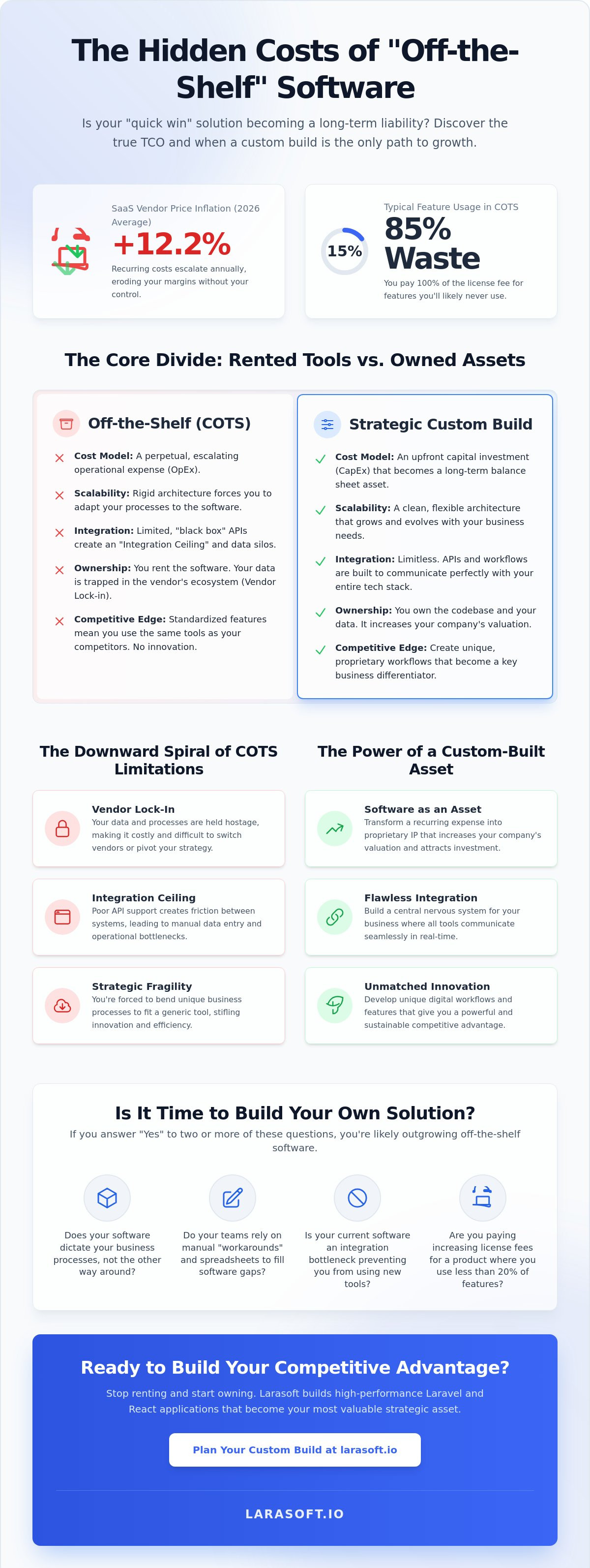
Ownership of the codebase is often the deciding factor in a company's long-term financial health. When you rely on commercial products, your software is a recurring expense that sits on the debit side of your balance sheet. You're essentially paying for the right to use someone else's innovation. In contrast, a custom-built solution is a tangible intellectual property (IP) asset. This ownership changes the fundamental nature of your technology stack; it moves from being a monthly drain to a capital investment that appreciates in value as your business grows.
One of the most overlooked risks of off-the-shelf software is platform deprecation. If your vendor goes bust or decides to sunset the specific product you rely on, your entire operation faces an immediate crisis. You're forced into an unplanned migration that can cost thousands in lost productivity and emergency development fees. By investing in legacy code modernisation, you ensure that your core systems remain under your control, regardless of market shifts or vendor stability. This control allows you to maintain the system's longevity indefinitely.
Investors and potential buyers look for unique competitive advantages. If your core operations run on the exact same CRM or ERP as your rivals, you lack a technical moat. This dependency creates a valuation ceiling. Acquisition teams often discount companies that don't own their critical technology because they see a high replacement risk. Proprietary software functions as a foundational business asset that secures market position, rather than a mere utility that facilitates daily tasks. Owning your IP allows you to claim a higher valuation during investment rounds because the technology itself is part of the sale.
Relying on a third party means you're at the mercy of their development priorities. Off-the-shelf updates are designed for the "average user," which often means your specific business needs are ignored. You might find a critical bug that halts your production, yet you have no power to fix it yourself. You're forced to wait for the vendor's support team to acknowledge the issue. This lack of control extends to security patches as well. In a custom environment, you dictate the priority of every fix. In a COTS environment, you're just one ticket in a global queue, highlighting another of the significant risks of off-the-shelf software.
Every UK business reaches a tipping point where the tools that once facilitated growth begin to restrict it. Determining if you've reached this stage requires a cold assessment of your operational friction. A reliable benchmark is the "80/20 Rule" of software procurement. If a commercial product meets 80% of your needs out of the box, it's often a viable tactical choice. However, if you require more than 20% customisation to make the system functional for your specific workflow, the risks of off-the-shelf software escalate rapidly. You're no longer using a tool; you're fighting its architecture.
Consider this brief checklist to evaluate your current risk level:
If you answered yes to two or more of these, your "standard" solution has likely become stagnant. You're paying for a product that forces you into inefficient workarounds, which drains your team's productivity and stalls innovation. If your current stack is holding you back, it may be time to consult with a technical ally to evaluate a more scalable transition plan.
Many decision-makers fall for the myth of "Security through Obscurity" or assume that a massive global vendor is inherently safer. The reality is that popular commercial platforms are high-value targets for exploits. According to recent data, 59% of organisations have been impacted by a software supply chain attack. When a vulnerability is found in a popular COTS product, thousands of UK businesses become vulnerable simultaneously. Bespoke Laravel builds provide a hardened, unique environment that is significantly more difficult for automated bots to target. Furthermore, custom builds allow you to maintain absolute data sovereignty, ensuring sensitive UK customer data resides on local servers rather than being subject to the fluctuating privacy laws of US-based cloud providers.
Using the same software as your competitors means you're limited to the same user experience (UX) capabilities as they are. It's difficult to differentiate your brand when your customer portal or internal dashboard looks and feels like every other generic template. This is where the risks of off-the-shelf software impact your market position. By leveraging Vue.js Frontend Development, you can create highly reactive, unique interfaces that provide a genuine competitive advantage. You gain the agility to pivot your interface based on user feedback in days, rather than waiting months for a vendor to update their standard UI components.
Mitigating the risks of off-the-shelf software requires a transition from a procurement mindset to an architectural one. At Larasoft, we focus on building future-proof applications using the Laravel framework, ensuring your digital infrastructure remains an asset rather than a liability. Our development process is anchored in a problem-solution framework. This structured journey ensures that every technical intervention directly addresses a business challenge, creating a clear path toward measurable growth and a superior return on investment.
Bespoke development is not a one-off transaction; it is a commitment to quality. Regular software maintenance is essential to protect your investment and maintain structural integrity. This proactive approach allows us to deploy security patches, optimise performance, and ensure your system stays compatible with evolving web standards. By maintaining the cleanliness of the codebase, we prevent the "rot" that typically plagues commercial installations over time.
We prioritise modular architecture to ensure your system can evolve without friction. This design philosophy allows for incremental updates where specific features can be enhanced without risking the stability of the entire platform. Our team of technical artisans takes immense pride in the efficiency of their work. We implement automated testing and adhere to strict clean code principles from the first day of development. This discipline reduces long-term technical debt and ensures the system handles increased loads with quiet competence.
Choosing a partner is about finding an ally who is as invested in your success as you are. We move beyond the traditional software vendor model to act as a specialized technical partner. This relationship allows us to provide expert guidance on complex API integrations and Laravel AI implementation, keeping your business at the cutting edge of digital innovation. We don't just deliver a product; we provide the foundational tools for your company's future. If you are ready to move beyond the limitations of commercial products, partner with Larasoft to build your foundational software asset today.
Moving beyond a procurement mindset is the only way to avoid the long-term risks of off-the-shelf software. This guide has detailed how standard products create rigid ceilings that stifle innovation and erode your company's valuation. By choosing to own your codebase, you transform a recurring expense into a balance-sheet asset. This control allows you to pivot quickly as market demands shift, ensuring your technology supports your growth instead of hindering it.
Larasoft provides the quiet competence required to manage this transition. As specialists in high-performance Laravel and Vue.js architecture, we build systems designed for longevity and structural integrity. Our UK-based team offers deep expertise in legacy code modernisation and API integration, ensuring your new infrastructure communicates perfectly with your existing tools. We don't just deliver code; we provide a manageable, structured journey toward a more efficient future. Discuss your bespoke software project with Larasoft today and start building a platform that performs flawlessly under pressure.
The primary security threat is the shared vulnerability profile of popular platforms. Because these systems are used by thousands of organisations, they are high-value targets for automated exploits. Data from 2026 shows that 59% of organisations have been impacted by software supply chain attacks. Unlike bespoke builds, you don't control the patch schedule and must wait for the vendor to address critical flaws.
Commercial products often lead to a "rent-forever" financial model with escalating costs. SaaS inflation reached an average of 12.2% in 2026, creating a predictable annual increase in overheads. You also face the hidden cost of feature bloat, where you pay for a full suite of tools despite typically using only 10% to 15% of the available functionality.
Customisation is usually limited to the surface level or specific plugins approved by the vendor. You can't modify the core architecture to suit a unique workflow. If your requirements exceed 20% of the platform's standard capability, the risks of off-the-shelf software increase as you're forced to build fragile workarounds that often break during system updates.
Vendor lock-in occurs when your data and processes are trapped within a proprietary ecosystem. It's a significant risk because it removes your operational sovereignty. If a provider raises prices or sunsets a product, migrating your data to a new system is often complex and expensive. This dependency prevents you from pivoting quickly to meet new market demands in the UK.
The clearest sign is a heavy reliance on manual spreadsheets to bridge gaps between different software modules. If your team spends more time managing data entry than performing core tasks, your stack has become a bottleneck. Performance lags as your user base grows or an inability to integrate with modern APIs are also definitive indicators that you've outgrown a standard solution.
While commercial software offers immediate login access, the configuration and staff training often take weeks. Bespoke development takes longer at the start, but it's built to your exact specifications. Using a modular framework like Laravel allows for a phased rollout. You can deploy core features quickly and refine the system incrementally without the long-term technical debt associated with commercial products.
You face a high risk of losing access to your operational history or being stuck with data in a proprietary format that other systems can't read. This is one of the most critical risks of off-the-shelf software. Without a direct database connection, you're entirely dependent on the vendor's stability to keep your business running, which is why owning your codebase provides essential security.
Bespoke software is typically more cost-effective over a five to ten-year horizon. While the initial investment is higher, you eliminate recurring licensing fees and the need for expensive third-party integrations. A custom build is a capital asset that adds to your company's valuation, whereas commercial software is a perpetual expense that offers no return on equity when you eventually sell the business.
Here’s what we've been up to recently.
Certified Quality. Great Prices