How to Integrate OpenAI with Laravel: A Strategic Guide for 2026

Most developers treat AI as just another API endpoint. In reality, a poorly architected integration is a fast track to broken budgets and sluggish user experiences. Understanding how to integrate openai with laravel is no longer about simple request-response cycles. It's about building a resilient system that respects your infrastructure and your bottom line.
You've likely felt the anxiety of watching API costs climb or the frustration of a 504 Gateway Timeout when a model takes too long to respond. Keeping API keys secure in a collaborative environment adds another layer of complexity. We're here to help you move beyond basic tutorials. You'll master the technical implementation and architectural best practices required for production-ready AI features within the Laravel ecosystem.
This guide provides a framework for scaling AI features while maintaining structural integrity. We'll examine asynchronous processing for long-running requests, cost optimization using the Batch API, and the specific configurations needed for Laravel 13 and PHP 8.3. By the end, you'll have a functional, secure integration built for the demands of 2026.
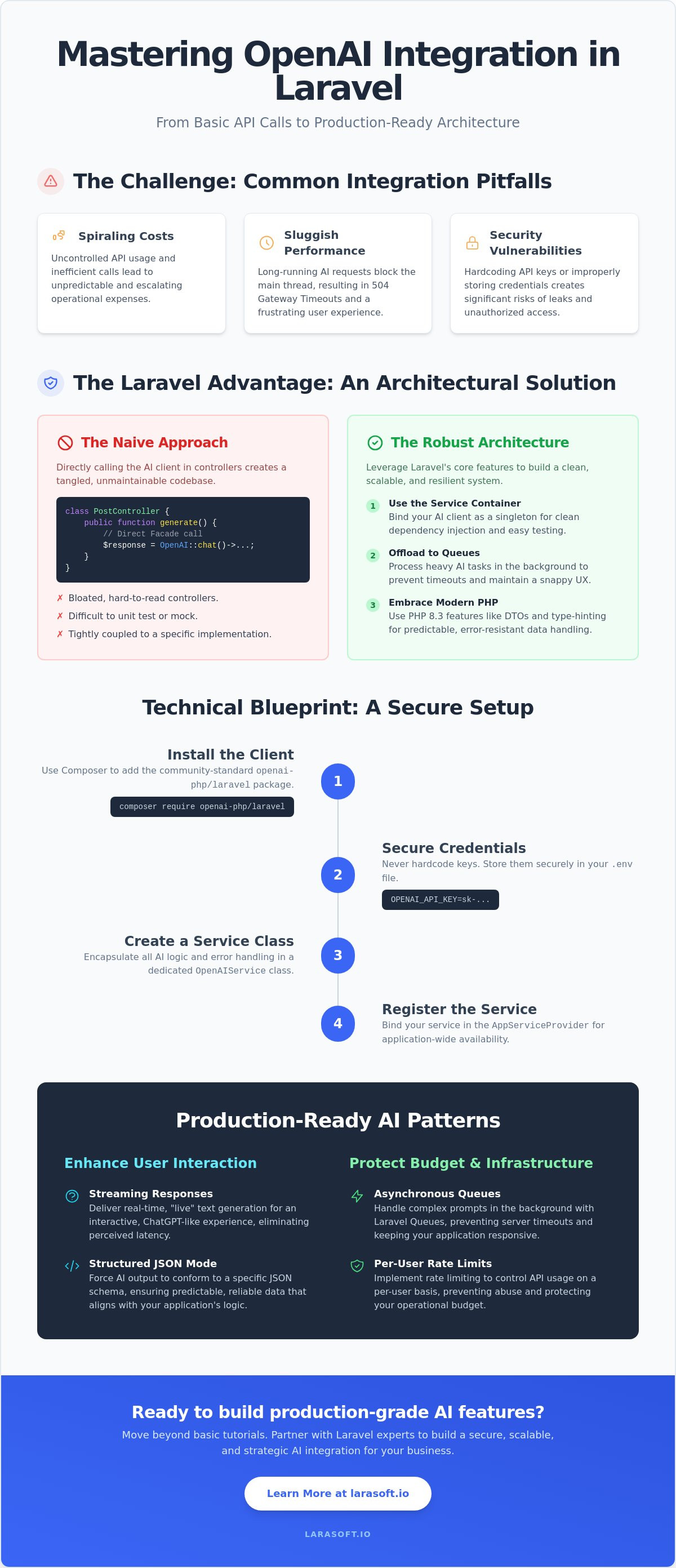
Laravel provides a robust foundation for building modern AI workflows. Developers often ask how to integrate openai with laravel without creating a tangled mess of spaghetti code. The answer lies in the framework's core architecture, which is designed to handle the complexities of external services with elegance and precision. By utilizing the Service Container, you can bind your AI client as a singleton, ensuring that your Application Programming Interface (API) calls are centralized and easily mockable during testing. This prevents your controllers from becoming bloated with configuration logic and makes your codebase significantly easier to maintain.
One of the most significant challenges with LLM integration is latency. OpenAI responses can take several seconds, which is an eternity in web performance terms. Laravel’s built-in Queue system solves this "timeout" problem by allowing you to offload heavy AI tasks to background workers using Redis or SQS. This preserves a snappy user experience while the model processes complex prompts in the background. In 2026, the community-maintained openai-php/laravel package (v0.19.2) remains the gold standard for this work. It provides a fluent wrapper that feels native to the framework, allowing you to focus on business logic rather than low-level boilerplate.
Laravel 13 requires PHP 8.3, which offers powerful features for handling AI data. We use readonly properties to create immutable Data Transfer Objects (DTOs) for AI responses. This structure ensures that once data returns from the model, it remains consistent throughout your application. Since AI outputs can be unpredictable, type safety is your primary defense against runtime errors. Type-hinting OpenAI responses prevents production crashes by catching malformed objects or unexpected null values before they reach your frontend logic.
Bespoke integration is about building a foundational asset for your company, not just renting a feature. Custom-built AI features allow you to inject proprietary business logic that off-the-shelf wrappers simply cannot replicate. This approach is particularly effective when applied to legacy code modernisation strategies. By wrapping old data structures in an AI-driven layer, you can breathe new life into aging platforms without a full-scale rewrite. This creates a data-driven ecosystem where your software doesn't just store information; it understands it and acts upon it to drive growth.
Establishing a robust connection is the first hurdle in mastering how to integrate openai with laravel effectively. We begin by pulling in the community-supported PHP client via Composer: composer require openai-php/laravel. Once the package is installed, use the vendor publish command to generate your configuration file. This file acts as the primary bridge between your application logic and the OpenAI infrastructure, allowing you to define default models and request parameters globally.
Security is paramount during this phase. Never hardcode your credentials within your codebase. Store your OPENAI_API_KEY and OPENAI_ORGANIZATION in your .env file. For teams managing high-volume platforms, consider using a secret manager to prevent accidental leaks in version control. Aligning your development with ethical AI principles ensures that your data handling remains responsible and transparent from the first line of code.
Don't call the OpenAI facade directly from your controllers. Instead, create a dedicated OpenAIService class to encapsulate your prompt logic and error handling. Register this service within the register method of your AppServiceProvider. This pattern allows you to inject the service wherever needed, maintaining the clean, testable architecture we discussed previously. If you need assistance structuring these complex layers, our team provides specialized API integration services to ensure your system is built for scale.
LLM requests aren't typical API calls. Slower reasoning models like GPT-5.5 require extended request timeouts. Adjust your HTTP client configuration to allow for 60 to 90 seconds of processing time. If you use a proxy or a local gateway for cost monitoring, you can also define a custom base URL in your config to redirect all outgoing traffic through your control layer. This level of granularity is essential for enterprise-grade how to integrate openai with laravel workflows.
Production-ready code requires deterministic tests. Use Laravel’s OpenAI::fake() method to simulate model responses without hitting the actual API. This approach prevents your CI/CD pipeline from consuming expensive tokens during every build. Mocking AI responses is the only way to ensure your application logic behaves predictably when the model returns unexpected or empty data.
Basic integrations often suffer from high latency. When users wait ten seconds for a response, retention drops and the application feels sluggish. Learning how to integrate openai with laravel at an advanced level requires moving toward asynchronous and streaming architectures. This shift transforms a static application into a responsive, intelligent platform that feels alive and interactive. By moving beyond simple request-response cycles, you can build features that handle complex reasoning without compromising the user experience.
To achieve the "typing" effect seen in modern AI interfaces, we use Server-Sent Events (SSE). This involves configuring your Laravel controller to stream chunks of the response as they arrive from OpenAI's API rather than waiting for the entire block of text. This approach works exceptionally well with Vue.js frontend development, where reactive components can update the UI instantly as tokens arrive. Handling these partial chunks securely on the backend requires careful buffer management to ensure the stream remains consistent even under high traffic. This drastically reduces perceived latency, as users see progress immediately instead of staring at a loading spinner.
One of the biggest hurdles in AI development is the unpredictability of natural language. Forcing the model to return valid JSON is a game-changer for automated data processing and database logic. By using JSON Mode or Function Calling, you can ensure that the AI's output is ready for immediate use within your application. Once the data arrives, you should validate it against Laravel’s built-in validation rules to maintain data integrity. This pattern is ideal for several use cases:
Managing conversational context is another critical architectural challenge. You can't simply send the entire history with every request without hitting token limits and inflating costs. Implementing a sliding window or a summarization agent helps maintain relevance while controlling overhead. Building a multi-agent system within Laravel involves creating specialized service classes that communicate with each other to solve complex tasks. This modular approach follows Laravel AI integration best practices, ensuring your system remains scalable and easy to debug. It's about creating a data-driven ecosystem where how to integrate openai with laravel becomes the foundation for proprietary business intelligence.
Moving a prototype into a production environment requires a shift in how we manage infrastructure resources. While the previous sections focused on the mechanics of how to integrate openai with laravel, achieving true stability at scale involves protecting your application from external API volatility. A production-ready system must handle unpredictable latency, protect your financial budget, and ensure that a single malicious or runaway user doesn't exhaust your entire API tier. This requires a multi-layered approach combining Laravel’s native queuing system with sophisticated rate-limiting strategies.
Synchronous requests are a liability for high-traffic platforms. For heavy tasks like document analysis or large-scale data categorization, we offload processing to Laravel Queues using Redis or SQS. This ensures your users aren't left staring at a 504 Gateway Timeout while the model processes a complex prompt. To maintain data integrity and visibility, you must log every interaction, monitoring token usage per request. This creates an essential audit trail for both debugging and financial forecasting. If you are looking to build a resilient, scalable backend, our experts specialize in Laravel AI integration designed for high-availability environments.
When a task is dispatched to the background, the user experience shouldn't suffer. We use Laravel Echo to provide real-time updates to the frontend, notifying the user the moment an AI job is complete. This asynchronous pattern is particularly effective for non-real-time workloads where you can leverage the OpenAI Batch API for a 50% discount on input and output tokens. Managing job failures is equally critical; implementing dead-letter queues allows your team to inspect and retry failed requests without losing data during API downtime. Using circuit breakers prevents your application from repeatedly hammering a failing endpoint, preserving your server resources until the service is restored.
Strategic model selection is the most effective lever for cost control. While GPT-5.5 offers peak performance at $5.00 per 1 million input tokens, many administrative tasks are better suited for GPT-5.4 mini, which costs only $0.75 per 1 million tokens. Implementing a tiered "token budget" system ensures that your API costs scale predictably with your revenue. The ROI of caching AI responses for static data queries is realized through the immediate elimination of redundant token costs and a significant reduction in time-to-first-byte for recurring user requests. For instance, using cached inputs on GPT-5.5 drops the price from $5.00 to just $0.50 per 1 million tokens, representing a 90% saving on repeated prompts.
Building a successful AI feature is a significant milestone, but scaling that feature into a core business asset requires a different level of technical discipline. While initial tutorials focus on how to integrate openai with laravel at a surface level, the transition to a complex, data-driven ecosystem demands architectural foresight. This is where a specialized laravel development agency becomes indispensable. We move beyond simple API wrappers to create proprietary systems that leverage your unique business data, turning a standard framework into a competitive advantage.
The AI landscape moves at an aggressive pace. The deprecation of the OpenAI Assistants API by August 26, 2026, serves as a stark reminder that software maintenance is a non-negotiable component of any AI strategy. A dedicated partner ensures your platform remains resilient against model deprecations and API changes, providing the structural integrity needed to support long-term growth without technical debt accumulation. It's about building for the future of your digital platform, not just the requirements of today.
Modern applications require more than static prompts. We specialize in integrating Retrieval-Augmented Generation (RAG) with your existing Laravel databases, allowing the AI to provide context-aware responses based on your internal documentation. For UK-based applications, this process must be handled with extreme care regarding data privacy and GDPR compliance. By future-proofing your infrastructure against evolving regulations and model shifts, we ensure that your how to integrate openai with laravel strategy remains a foundational asset rather than a liability.
Larasoft brings a persona of quiet competence to every project. We don't just write code; we act as technical artisans who take pride in the cleanliness and efficiency of your system. Our collaborative approach involves defining clear AI roadmaps that align with your specific commercial goals, ensuring every technical intervention translates into business returns. This methodology allows us to bridge the gap between high-level implementation and practical growth. Whether you're modernizing a legacy platform or building a new digital asset, we provide the expertise to move from a proof-of-concept to a scalable, production-ready environment that performs perfectly under pressure.
Effectively mastering how to integrate openai with laravel marks the transition from simple experimentation to building a resilient, data-driven asset. We've explored how leveraging Laravel's Service Container and Queue system ensures your application remains responsive while managing the inherent latency of modern large language models. By prioritizing security, structured data extraction, and proactive cost management, you transform a standard integration into a sophisticated engine for commercial growth.
Building these systems requires a blend of high-level architectural knowledge and meticulous execution. As a UK-based technical authority, we bring specialized expertise in custom Laravel AI solutions and legacy code modernisation to every partnership. We're ready to help you navigate the complexities of the 2026 digital landscape with discipline and precision. Discuss your Laravel AI integration project with our expert team to begin turning your technical vision into a scalable production asset. The tools for innovation are at your fingertips; it's time to build with confidence.
You handle timeouts by increasing the request duration in your HTTP client configuration or offloading the request to a background job. Slower models often require 60 to 90 seconds to process complex reasoning tasks. By moving these calls into Laravel Queues, you prevent the user's browser from timing out while waiting for a response. This architectural choice ensures your application remains responsive even during peak API latency.
The openai-php/laravel package remains the industry standard in 2026 for those learning how to integrate openai with laravel. It provides a fluent, developer-friendly wrapper around the OpenAI API that integrates seamlessly with Laravel's Service Container. This community-maintained package supports the latest model features, including JSON Mode and streaming, making it the most reliable choice for production-grade AI features in modern PHP 8.3 environments.
Yes, you can build real-time chat applications by combining Laravel Echo with Server-Sent Events (SSE). Instead of waiting for the entire response, you stream token chunks from the backend to a reactive frontend like Vue.js or React. This approach provides the immediate "typing" feedback users expect. Implementing this requires a robust websocket or broadcasting setup to handle the high frequency of updates without overloading your server.
You secure your API keys by storing them exclusively in your .env file and never committing them to version control. For enterprise-level security, use a dedicated secret manager like AWS Secrets Manager or HashiCorp Vault. This prevents accidental exposure in GitHub repositories or team-wide leaks. Always rotate your keys regularly and use organization-level restrictions to limit usage to specific IP addresses or service accounts.
Asynchronous requests are generally superior for production environments to prevent gateway timeouts and improve scalability. While synchronous requests work for simple, streamed UI interactions, heavy tasks like document summarization should always be handled by background workers. This separation ensures that your main web thread stays free to handle other user requests, maintaining the high-performance standards required for modern digital platforms.
You reduce costs by implementing aggressive caching for repetitive prompts and utilizing the OpenAI Batch API for non-real-time tasks. The Batch API offers a 50% discount on tokens for requests processed within 24 hours. Additionally, routing simple administrative tasks to GPT-5.4 mini instead of more expensive models can lower your input costs significantly, representing a major saving for high-volume applications.
Laravel doesn't provide a native AI streaming class, but you can easily implement it using the openai-php/laravel package and standard PHP stream wrappers. By returning a StreamedResponse from your controller, you can push chunks of text to the client as they arrive. This setup is essential for reducing perceived latency and creating a fluid user experience in AI-driven interfaces when you understand how to integrate openai with laravel.
You validate AI-generated data by enabling JSON Mode in your API request and passing the result through Laravel's built-in Validator. Forcing the model to return a specific schema ensures the output is predictable. Once the JSON is decoded, you can apply standard rules like required, integer, or email to ensure the data is safe for database insertion or further processing within your application logic.
Here’s what we've been up to recently.
Certified Quality. Great Prices