Software Project Discovery Phase Checklist: A Strategic Guide for 2026


Large software projects run, on average, 45% over budget, primarily because requirements weren't defined with precision at the outset. You've likely felt the tension of balancing stakeholder expectations against the technical realities of choosing between Laravel 11 or a React 19 frontend. It's a high-stakes environment where a single misstep in the initial architecture can lead to significant budget creep or project stagnation.
We understand that you need more than just a list of features; you need a validated roadmap. This software project discovery phase checklist allows you to de-risk your development cycle and ensure absolute technical alignment before the heavy lifting begins. By following this guide, you'll master the essential steps to secure a clear development path and a validated technical architecture. We will walk through how to navigate modern agile reporting under FASB ASU 2025-06 and establish accurate cost estimates that protect your bottom line. This structured approach transforms uncertainty into a manageable journey toward a high-performing digital asset.
The discovery phase is the critical junction where high-level business objectives intersect with technical feasibility. It's far more than a simple requirements gathering session; it's a rigorous audit designed to surface potential "deal-breakers" before they become expensive failures. Within the broader software development process, discovery acts as the foundation, ensuring that every subsequent line of code serves a strategic purpose. By validating the technical path early, you reduce the inherent uncertainty that plagues complex digital builds.
During this stage, a cross-functional team of stakeholders, business analysts, and technical architects collaborates to transform a vague concept into a validated technical blueprint. This phase is about asking the difficult questions: Can the current infrastructure support these new features? Does the proposed tech stack align with long-term scalability? By identifying these risks early, you move from a position of hope to one of calculated precision. It's the difference between a project that evolves fluidly and one that stalls due to unforeseen architectural constraints.
Skipping this preparatory work is often why large software projects run significantly over budget. Investing in a comprehensive software project discovery phase checklist can save 30-50% in long-term development costs by preventing mid-project pivots and expensive rework. It moves your team from making assumptions about user needs or technical constraints to making evidence-based decisions. This clarity establishes a shared vision between your internal team and your development agency, creating a unified roadmap that prioritises high-value features over speculative additions.
The discovery process adapts based on the project's origin. For greenfield projects, the focus is on defining the technical architecture and validating user journeys from a blank canvas. However, for existing systems, discovery is an essential tool for legacy code modernisation. In these scenarios, the phase involves a deep dive into "unseen" technical debt and identifying which legacy components are salvageable.
Architects must evaluate how modern frameworks, like Laravel 11 or Vue.js, can integrate with or replace outdated components without disrupting core business operations. Whether you're building from scratch or upgrading an aging platform, a software project discovery phase checklist ensures that you aren't just adding features. Instead, you are building a foundational asset that is designed to perform perfectly under pressure and scale alongside your business growth.
Software failure rarely stems from a lack of technical talent; it's often a failure of alignment. Moving beyond surface-level feature requests is the first step in any effective software project discovery phase checklist. If a stakeholder asks for a new dashboard, the underlying problem might actually be a fragmented data pipeline or poor internal reporting. Identifying these root issues ensures the development team builds a solution that addresses the actual pain points rather than just treating symptoms. This process requires a deep dive into business objectives to set measurable KPIs, such as specific performance benchmarks or conversion targets.
Stakeholder mapping is equally critical. It involves identifying every individual whose workflow or budget will be impacted by the new system. During discovery workshops, it's common to encounter conflicting priorities between departments. Marketing might prioritise user acquisition features, while operations focus on backend efficiency. Resolving these tensions early is a core component of strategic software project planning. By documenting a unified "Definition of Success," we create a single source of truth that prevents late-stage changes and keeps the project on track.
Uncovering hidden project requirements starts with asking the right questions. We ask decision-makers what happens if the project isn't built, or which single feature provides the most immediate ROI. These interviews help us rank features based on business value versus technical effort. When priorities clash, we facilitate a consensus that aligns with the overall company vision. This documentation ensures everyone is moving toward the same goal, providing a clear benchmark for the entire project team.
User research grounds the project in reality. We define detailed personas and map their specific frustrations in the current workflow. Visualising the user journey from entry to completion allows us to identify friction points before they are hard-coded. For example, high-performance Vue.js frontend development can significantly enhance these journeys by providing the fluid transitions and speed that modern users expect. We use low-fidelity wireframes to validate this logic, ensuring the user experience is intuitive and efficient. If you're ready to move from assumptions to a validated plan, you can partner with our technical artisans to define your strategic core.
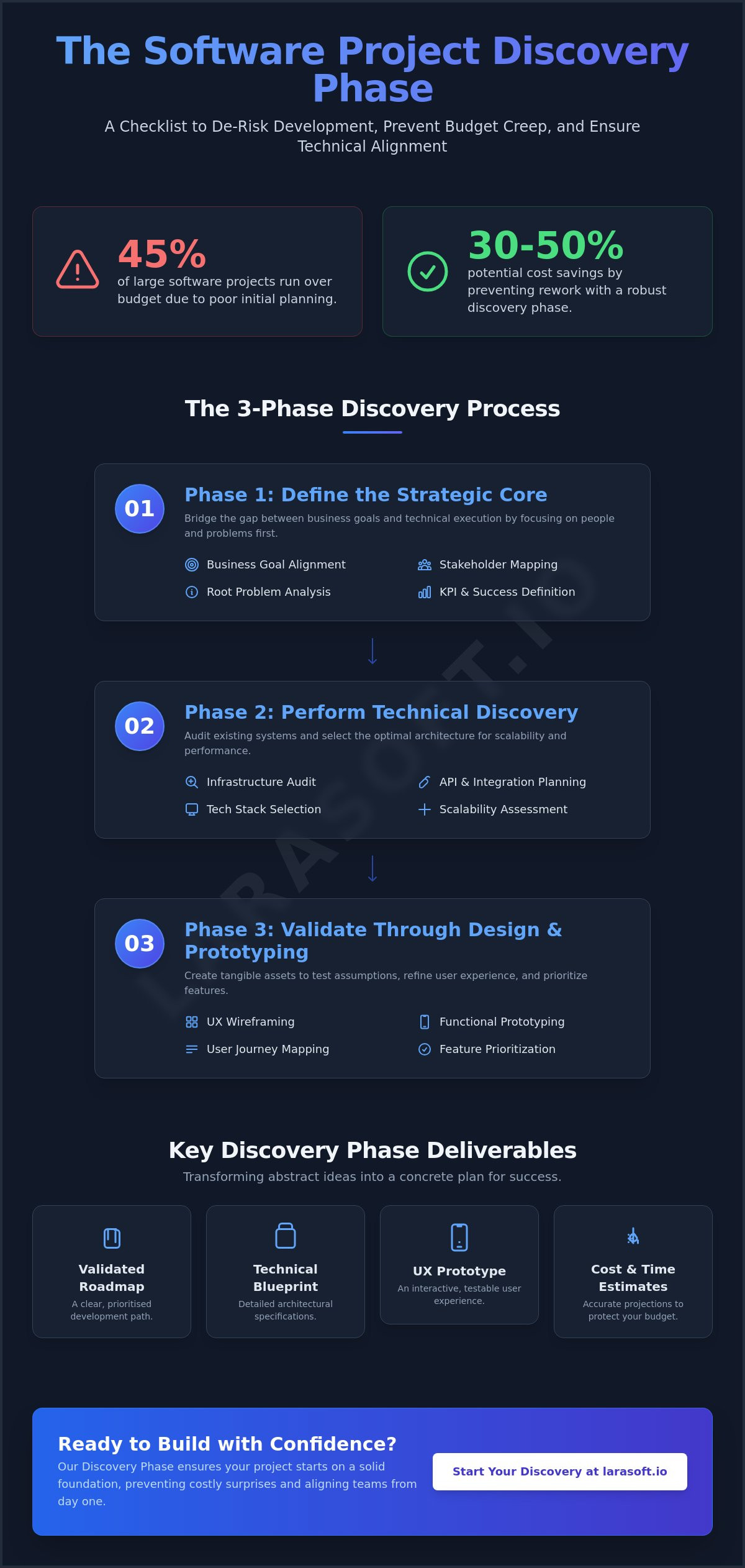
Technical discovery transforms strategic goals into a functional blueprint. This stage involves a rigorous technical audit of your existing infrastructure to identify constraints that could hinder future growth. While many guides focus exclusively on new builds, a professional software project discovery phase checklist must address legacy system modernisation. We evaluate your current codebases to uncover technical debt; identifying these "unseen" risks early prevents them from compromising new feature development. This audit ensures that the final architecture is a foundational asset rather than a temporary fix.
Choosing the right architectural pattern is a pivotal decision that dictates your system's longevity. We assess whether a monolithic, microservices, or headless setup best serves your business objectives. Monolithic architectures often provide speed and simplicity for initial launches, while microservices offer the granular scalability required for high-traffic platforms. A headless approach provides the flexibility needed for omnichannel delivery. According to industry data, projects with detailed technical specifications at the start typically overrun their budgets by only 15-20%, compared to 40-60% for those without clear specs. This data highlights why a structured risk assessment is non-negotiable for protecting your investment.
Selecting a tech stack requires balancing performance with developer efficiency. Partnering with a specialized laravel development agency ensures your backend is built with structural integrity and long-term maintainability in mind. We also evaluate frontend frameworks like React 19, which holds over 40% market share, against Vue.js to determine which provides the best user experience for your specific needs. For mobile requirements, we assess the feasibility of native development versus cross-platform solutions to ensure your app performs perfectly under pressure while remaining cost-effective.
Mapping your digital ecosystem is essential for fluid transitions between your new software and existing tools. We identify potential bottlenecks in legacy API endpoints that could slow down data exchange or compromise security. A forward-thinking data strategy also includes planning for Laravel AI integration. By automating internal business processes through AI-native frameworks, we build systems that are not just reactive but intelligently proactive. This level of technical foresight ensures your platform is prepared for the technological landscape of 2026 and beyond.
A structured software project discovery phase checklist is the most effective tool for mitigating risk before development begins. It moves the project beyond general ideas into a series of actionable phases that ensure technical and business alignment. By following this sequence, you ensure that every feature developed has a clear purpose and a validated technical path. This disciplined approach is what separates high-performing systems from those that suffer from persistent budget creep.
In 2026, compliance isn't an afterthought; it's a foundational requirement. We ensure your project meets UK GDPR and data protection standards by design, protecting both your users and your business from legal risk. This includes planning for WCAG 2.2 accessibility standards to ensure your platform is inclusive and legally compliant. A discovery compliance audit is a mandatory step for UK businesses to maintain operational integrity and avoid costly post-launch corrections. If you want to ensure your system is built on a secure, compliant foundation, you can consult with our technical architects today.
We use the MoSCoW method to categorise features into Must-have, Should-have, Could-have, and Won’t-have. This prioritisation allows us to define a clear Minimum Viable Product (MVP), which accelerates your time-to-market without compromising core functionality. Under the updated FASB ASU 2025-06 guidelines, having this level of detailed roadmap is also beneficial for modern agile accounting practices. Instead of relying on hope, we create a realistic project timeline based on actual technical complexity and resource availability. This results in a transparent, predictable development cycle that delivers high-value results on schedule.
At Larasoft, we view discovery as a technical audit rather than a simple administrative task. Our process is led by technical artisans who prioritise structural integrity and business returns above all else. We don't just fill out a software project discovery phase checklist; we interrogate your vision to ensure it's technically sound and commercially viable. This rigorous approach transforms a high-level concept into a high-performing digital system designed to perform perfectly under pressure. By focusing on the "why" behind every feature, we ensure your investment translates into a foundational asset for your company's future.
The outputs of our discovery phase provide the granular detail needed for complex execution. You receive a comprehensive Software Requirements Specification (SRS), a detailed Technical Blueprint including data schemas and API maps, and a functional UX Prototype. These aren't just documents; they are the roadmap for your project's success. Whether we're moving into custom Laravel Web Development or building a Native Mobile App, these deliverables ensure the transition is fluid. This clarity eliminates the guesswork that often leads to budget creep, allowing our developers to focus on high-quality execution from the very first sprint.
A successful discovery phase looks far beyond the initial launch. It directly informs our approach to long-term Software Maintenance, ensuring the architecture remains stable as your user base grows. We also integrate our SEO Services during this early stage. By addressing technical SEO requirements and site structure at the architectural level, we build platforms that achieve better organic visibility from day one. Choosing a technical partner who understands the full software lifecycle means your system is built for longevity. We don't just deliver a product; we build a scalable platform that evolves with your business needs.
Validating your software vision before writing code is the most effective way to protect your capital. In 2026, the cost of mid-project pivots is too high to ignore. By executing a professional software project discovery phase checklist, you secure a clear roadmap and a validated technical architecture. Now is the time to move from uncertainty to a structured journey toward growth. Our team is ready to provide the technical authority and business-centric reassurance your project deserves. Speak to our technical experts at Larasoft to start your discovery phase today.
Building a high-performance digital platform requires more than just code; it demands a disciplined architectural foundation. By following a structured software project discovery phase checklist, you eliminate the ambiguity that leads to budget overruns and technical debt. Moving from assumptions to a validated roadmap ensures that every technical decision aligns with your long-term business objectives. Whether you are launching a new React 19 interface or modernising a complex backend, this preparatory stage is your most effective risk-reduction tool.
Our UK-based technical artisans specialise in bespoke Laravel development and high-performance frontends designed for scalability. We bring a proven track record in legacy code modernisation to every partnership, ensuring your software remains a foundational asset. It's time to move from speculation to a validated blueprint that protects your investment. Book a Technical Discovery Consultation with Larasoft to start your journey with a partner dedicated to technical excellence. Let's build a system that performs perfectly under pressure.
A discovery phase typically spans two to six weeks depending on the project's architectural complexity. Smaller builds might conclude in fourteen days, while enterprise-level systems requiring extensive API integration or legacy audits often take longer. This timeframe ensures a thorough investigation without delaying the momentum of the development cycle.
Skipping discovery is a significant risk even with a detailed brief. A brief outlines what you want, but discovery determines how to build it with structural integrity. It validates your assumptions against technical realities like Laravel 11 capabilities or React 19 performance, preventing expensive pivots once the build is underway.
The primary outputs include a Software Requirements Specification (SRS), a technical blueprint, and a functional UX prototype. These documents serve as the foundation for your build, detailing the database schema, third-party integrations, and user journey logic. This documentation is a core part of any professional software project discovery phase checklist.
The investment for a discovery phase reflects the depth of technical expertise required to audit your vision. While costs vary based on the scope of the architectural design and stakeholder mapping, this phase typically saves multiples of its value by preventing budget creep. It's a strategic allocation that transforms speculative costs into a predictable development budget.
Your internal team should include key decision-makers who define business objectives and subject matter experts who understand day-to-day operational workflows. Involving these stakeholders ensures the technical architecture aligns with commercial goals. This collaborative approach prevents late-stage requirement changes that often cause project delays.
If discovery reveals an idea isn't technically feasible, we work with you to pivot or refine the concept. Identifying these deal-breakers early is a success, not a failure, as it prevents wasting resources on a flawed architecture. We provide alternative technical interventions that achieve your business goals while remaining within the limits of modern frameworks.
Discovery is essential for both new builds and legacy code modernisation. It allows technical artisans to audit existing codebases, identify technical debt, and plan for fluid transitions to modern stacks like Vue.js. This process ensures new features integrate seamlessly with your current infrastructure without causing system instability.
A rigorous software project discovery phase checklist leads to more accurate cost estimates for the full development cycle. By defining the MVP scope and identifying technical risks early, we reduce the likelihood of the budget overruns common in large software projects. This transparency allows for better financial planning and higher ROI.
Here’s what we've been up to recently.
Certified Quality. Great Prices