Custom Rental Marketplace: A Buyer’s Guide for 2026

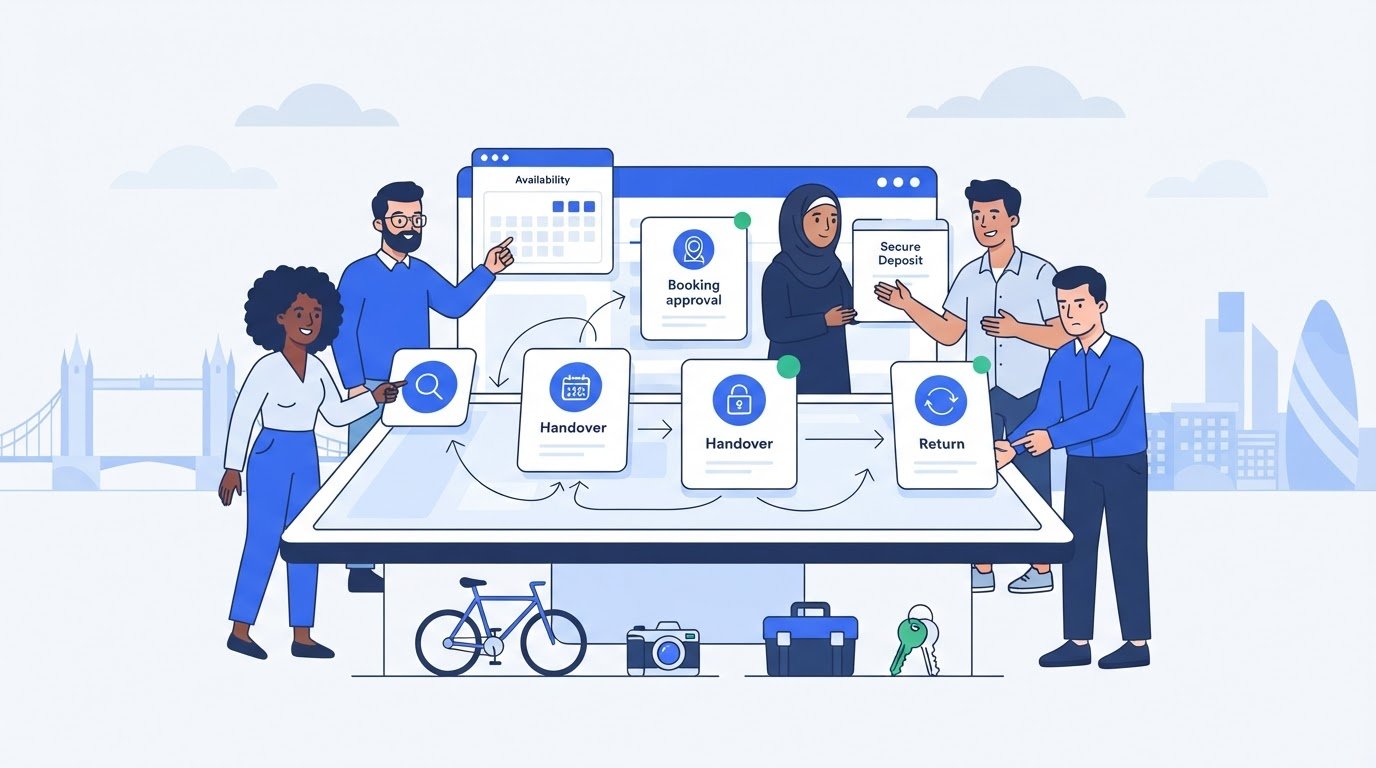
A rental marketplace can look like a familiar booking site, but its real complexity sits behind the search bar: availability rules, booking approvals, handovers, deposits and returns all shape how the platform must work. That’s why custom rental marketplace development should start with your rental model and user workflows, not a generic feature list.
It’s understandable to want a clear scope before commissioning a build, especially when owners, renters and administrators have different needs. This guide explains how to define those requirements, compare technical proposals and assess decisions that affect architecture, integrations, testing and long-term support.
We’ll look at rental-specific workflows and the architecture they call for, then cover how to plan delivery and protect your investment. Larasoft builds bespoke Laravel applications around distinct business rules and provides a staging server for client testing during development. Under the standard service agreement, code ownership transfers fully to the client, and long-term support is available through service level agreements (SLAs). The goal is a practical framework for commissioning a marketplace that fits your business today and can evolve as it grows.
Custom rental marketplace development means creating software around an operator’s rental business model, participants and operating rules. It describes how the business works, not a preset catalogue of features. A property marketplace, for example, may need different booking and fulfilment rules from a platform for tools or vehicles, even if both let users search listings and request dates.
A marketplace brings multiple parties together: renters looking for temporary access, owners or suppliers providing inventory, and administrators overseeing the platform. The operator sets the rules connecting them, such as who can list items, how bookings are accepted and who handles fulfilment. This model is part of the wider sharing economy platforms concept, where people access goods or services temporarily rather than owning them outright.
That differs from a single-provider rental booking site. In a single-provider site, one business controls the inventory and typically manages its own listings and bookings. A marketplace must also support the operator’s relationship with multiple suppliers while defining what those suppliers manage themselves. This distinction affects permissions, responsibilities and the journeys the platform needs to support.
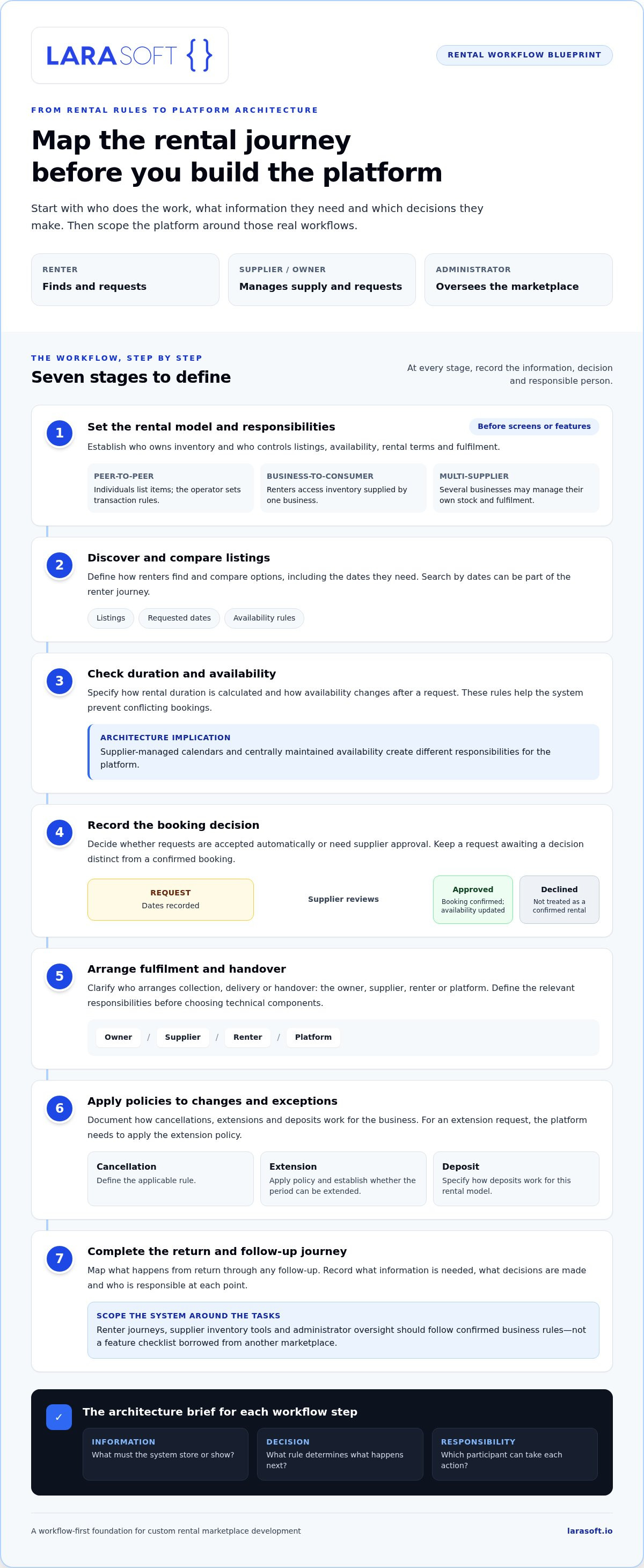
Start by identifying who owns the inventory and who is responsible for getting it to the renter. In a peer-to-peer model, individuals list items such as vehicles or equipment, while the operator defines the rules that govern listings and transactions. In a business-to-consumer model, the platform connects renters with inventory supplied by one business. A multi-supplier model brings several businesses together, each potentially managing its own stock and fulfilment.
These models can apply to property, vehicles, equipment or other products, but the right fit depends on how supply is controlled and rentals are fulfilled. A model with supplier-managed calendars needs different responsibilities from one where the operator maintains availability centrally.
A rental listing is tied to a period of time. A renter’s requested dates must be checked against availability, rental duration and any rules that affect whether the booking can proceed. The platform may need to distinguish a request awaiting a decision from a confirmed booking. These relationships shape the workflow, rather than simply adding a calendar to a product listing.
Inventory management also has two levels. Suppliers need tools to maintain their own listings and availability, while administrators need oversight across the marketplace, including supplier access and platform-wide policies. Define rules for booking decisions, changes and fulfilment before selecting screens or technical components. This gives the project team a practical basis for deciding what the first version must support and what can wait.
Architecture should follow the work each person needs to complete, not a checklist of features borrowed from another marketplace. Map the renter, supplier and administrator journeys from discovery through booking, fulfilment, return and any follow-up. At each step, record the information needed, the decision being made and who is responsible. Those details help define what the system must store and which actions each role can take.
This is the foundation of custom rental marketplace development: translating confirmed business rules into connected platform components. A renter might search by dates, compare listings and request a booking. A supplier may need to maintain inventory and respond to requests. Administrators may need to oversee accounts and booking activity across the whole service. Scope capabilities around these defined tasks.
Specify how rental duration is calculated, how availability changes after a request and which booking states matter. Then define how cancellations, extensions, deposits and handovers work for your business. These aren’t minor interface details. They determine how the application records a reservation, prevents conflicting bookings and presents the next available action to each participant.
For example, imagine a renter requests equipment for a set period, but the supplier must approve each request. The system needs to record the requested dates and a pending status, show the supplier the request, then update the booking and availability if it’s approved. If it’s declined, the dates should not be treated as a confirmed rental. Your policy determines the exact rules; the workflow makes those rules operational.
Consider exceptions as well as the standard path. If a renter asks to extend a booking, the platform needs to apply your extension policy and establish whether the additional period is available. Define these cases before selecting screens and technical components, so design and development reflect the real process.
Separate role permissions from the tasks themselves. Renters need access to their own searches and booking information. Suppliers need to manage their listings and availability, while administrators need the oversight and account controls required to operate the marketplace. This separation establishes who can view or change each record without assuming every participant needs the same dashboard.
For a browser-based platform with interactive search or booking steps, a separate frontend can support a focused user experience. Larasoft’s guide to Vue.js frontend development explores that approach. Add APIs or mobile applications to scope when a defined operational need calls for them, rather than simply because they’re common in other platforms. A clear role-and-workflow map gives your development team a sound basis for shaping the architecture. Explore bespoke Laravel development as a route to implementing those requirements in a custom web application.
Compare each route against the workflows you’ve defined, the control your team needs and the changes you expect to make. A packaged platform may suit a business whose rental process fits its existing capabilities. A configurable solution can be a practical middle ground if its settings cover the key rules. Custom rental marketplace development may be a stronger fit when your policies, supplier processes or integrations require more control.
There’s no universal winner. The useful question is whether an approach supports your operating model without forcing unnecessary workarounds. Don’t choose a custom build just to copy a competitor’s features. Start with the operational problems your marketplace needs to solve, then use a clear initial scope to judge complexity and delivery proposals.
| Approach | Practical implications | Questions for stakeholders |
|---|---|---|
| Packaged | Uses an existing product structure, which may suit established, straightforward workflows. The business may need to adapt its processes to the platform. | Can our booking, availability and supplier rules work within its standard model? |
| Configurable | Allows selected settings or extensions while retaining a pre-existing foundation. Suitability depends on whether configuration can support the workflows that distinguish the business. | Which rules can we configure, and where would workarounds or custom changes be needed? |
| Custom | Shapes the application around defined roles, policies and processes. It gives the project more control over structure, while requiring clear decisions about scope and future development. | Which operational requirements justify a tailored build, and what belongs in the first release? |
A tailored build is worth considering when rental policies, supplier responsibilities or required integrations don’t align with a packaged workflow. For example, a marketplace may need a distinct approval process or a specific way to coordinate inventory across suppliers. Document the rule and the people affected before treating it as a software requirement. That helps separate genuine business needs from features that merely appear on competitor platforms.
A useful proposal connects deliverables to your requirements. Check that it describes assumptions, client and development responsibilities, and how proposed changes to scope will be assessed. The architecture should reflect marketplace roles and workflows, with a credible path for planned growth rather than vague promises of scalability. Compare how each proposal approaches testing, handover and post-launch support. For wider partner-evaluation criteria, consult this Laravel development agency selection guide.
These points make delivery and ownership part of the comparison, not details to leave until launch. To understand how a tailored Laravel application could reflect your requirements, explore Larasoft’s bespoke development approach.
A concise, well-structured brief helps turn a rental business idea into a scope that can be assessed. It doesn’t need to settle every technical detail. It should make the intended outcomes, user journeys, priorities and constraints clear enough for a development team to understand what the first release must do.
Describe the operating model in practical terms. Who creates listings, approves bookings, answers renter questions and handles exceptions? Write down policies for availability, cancellations, extensions and returns, then note any existing systems or data the marketplace may need to connect with. These details give the project team a clear starting point for shaping requirements around the actual business.
Build the brief in four steps:
Focus on the end-to-end tasks the marketplace must support before adding secondary conveniences. Identify any requirement that depends on another capability as a dependency, rather than quietly separating it from the workflow. For instance, a booking flow can’t be assessed in isolation if the business’s approval process determines whether requested dates become reserved.
Keep a short decision log alongside the priorities. Note unresolved policy questions, who will decide them and any assumptions used to describe the proposed workflow. This reduces ambiguity during scoping and gives stakeholders a practical way to assess trade-offs as the project takes shape.
Validate the proposed journeys with renters, suppliers and operations stakeholders. Suppliers can clarify how inventory and availability are managed; renters can identify where instructions or decisions need to be clear; operations staff can expose exceptions that a simple happy-path diagram might miss. Their feedback helps distinguish essential workflow requirements from preferences.
Share the resulting brief with the development team to support a relevant fixed-price scope proposal. A clear scope makes deliverables and assumptions easier to discuss before agreeing a delivery plan. Larasoft provides a staging server for client testing during development. Under the standard service agreement, code ownership transfers fully to the client, and long-term support is available through service level agreements (SLAs).
Ready to shape your requirements into a bespoke application? Discuss your rental marketplace project with Larasoft.
Larasoft builds bespoke Laravel web applications and custom web and mobile applications around the requirements set out in your project brief. For a rental marketplace, that means translating agreed user journeys and business rules into software shaped for your operation, rather than starting from a generic feature list. A clear scope gives the team a shared reference point for decisions as the work progresses.
Client input during development helps validate that the proposed workflows make sense in practice. Larasoft provides a staging server for client testing during development, giving you a place to review the application as it takes shape and share feedback before launch. Test against the agreed requirements: check whether the right people can complete their tasks and whether the marketplace responds as expected to key decisions and exceptions.
Keep scope, decisions and feedback visible to the project team. When a requirement changes or a new need emerges, record its rationale and assess how it affects the agreed work. This gives stakeholders a clearer basis for discussing priorities and reduces the risk of informal changes creating conflicting expectations.
Already started building? Larasoft can take over partially completed projects at any development stage. A handover can include the current codebase and project context, helping the team understand what’s in place and how it relates to your requirements before work continues.
Launch is a transition into live operation, not the end of the software’s lifecycle. Long-term support is available through service level agreements (SLAs), so ongoing support can be included in your plans for maintaining and developing the marketplace. Under the standard service agreement, code ownership is fully transferred to the client. You retain ownership of the codebase, with the option of continued support through an SLA.
Larasoft’s credentials and experience include “Official Laravel Certified Company”, “99 % Satisfaction” and “24 / 7 Support”. The team has “Laravel developers since 2012” and has built “almost a hundred web and mobile apps”. Larasoft also reports “£100 k + Sales”. These proof points provide context for a partnership focused on delivering and supporting custom software.
For a project with multiple participant journeys, a useful next step is to bring your brief, priorities and open decisions into a discussion about the proposed scope. This creates a practical starting point for aligning your marketplace requirements with bespoke Laravel development. Discuss your rental marketplace project with Larasoft and outline what the first release needs to achieve.
Your next move is to turn the requirements you’ve identified into a shared plan for delivery. A practical brief gives the development team a foundation for shaping the first release, while leaving room for the marketplace to evolve as you learn from its operation. Keep the focus on what users and your team need to accomplish, and treat technical choices as decisions that should serve those outcomes.
For a project that needs a partner with proven delivery experience, Larasoft was named “Most Reliable Web Development Agency in the UK Enterprise category for the SME Awards 2021”. The right technical collaboration can help you move from business rules to a platform structure that supports your model and future growth.
Bring your priorities and open questions into a conversation about custom rental marketplace development. Discuss your custom rental marketplace project with Larasoft and take the next step towards a marketplace built around your business.
The investment depends on the agreed project scope, including user roles, rental rules, integrations and the delivery requirements. A useful comparison starts with a defined brief and a clear list of launch priorities, rather than a generic feature count. Larasoft provides fixed-price project quotes after receiving project scope; do not add an estimated price or an unlisted fee. For example, document any required data migration and how supplier-specific workflows will be tested.
The schedule depends on the agreed scope, decisions, integrations and testing requirements, so avoid quoting a generic duration as a promise. A defined first release can make priorities and dependencies easier to assess. During development, Larasoft provides a staging server for client testing, helping stakeholders review the work as the project progresses. Include decision owners and feedback periods in planning, since delayed approvals can affect sequencing.
Yes. A custom platform can be designed around the requirements of the selected business model, such as peer-to-peer rentals or rentals managed by a supplier business. The important step is to define who controls listings, availability, bookings and fulfilment. Those rules determine the workflows and platform requirements; the article should not imply every model needs identical features. For example, supplier-owned stock may require different permissions from centrally managed inventory.
Larasoft can inherit partially completed projects at any development stage. The team can review the existing work and establish the project’s current position before agreeing the next steps and scope. Taking over a project is an available service, without a promised turnaround, outcome or cost. A concise handover should capture completed features, known defects, access to relevant code and outstanding decisions, so the next scope reflects the actual starting point.
The choice depends on how renters, suppliers and administrators need to use the platform. A responsive web application may suit browser-based workflows, while a mobile application can be considered when the project requirements call for it. Define the user journeys and operating needs first, then scope the interfaces and technology around those requirements. For example, consider whether supplier tasks happen away from a desk and whether renters need to complete key steps in a browser.
Under Larasoft’s standard service agreement, code ownership is fully transferred to the client. Make this point explicit when discussing project control and future flexibility. The agreement is the basis for the ownership terms, so don’t add claims about licensing, third-party assets or additional rights beyond the stated ownership arrangement. For project planning, record this ownership arrangement alongside the agreed deliverables and handover expectations, so both parties work from the same contractual basis.
Yes. Long-term support is available through service level agreements (SLAs). The appropriate support arrangement should be explained in relation to the client’s ongoing needs, without inventing response times, service coverage or included work. A clear post-launch plan helps the business understand how maintenance and support fit into the wider lifecycle of its custom platform. Before launch, list expected maintenance tasks and upcoming changes to help focus support discussions on operational priorities.
Here’s what we've been up to recently.
Certified Quality. Great Prices