Software Project Risk Management Plan: 2026 Guide

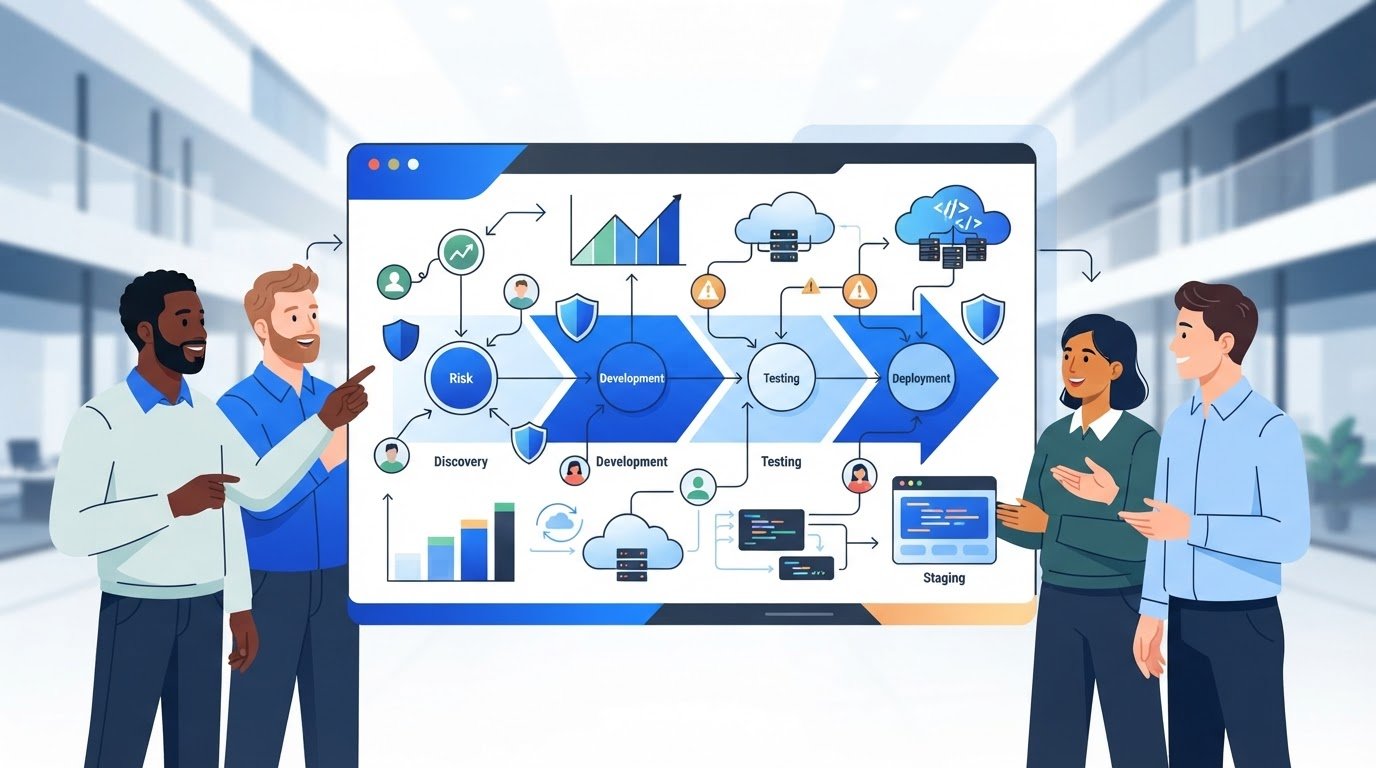
A risk register that lists problems but names no decision-maker is documentation, not risk control. A usable software project risk management plan connects each material risk to evidence, an accountable owner, a trigger and a proportionate response, so the team can act before delivery is affected.
Technical risks often come up in team meetings, while changing requirements and external dependencies quietly reshape the plan. The challenge is to turn those conversations into clear decisions without creating a process that slows development. This guide explains how to identify and prioritise software risks, assign owners, define responses and set escalation triggers. It also shows how to keep the plan current as scope, technology and delivery conditions change. From discovery through development, testing and deployment, the aim is practical: give the team a shared view of what could happen, what signals to watch and when to adjust course.
A software project risk management plan sets out how a team identifies, assesses, responds to and reviews uncertainty that could affect delivery. It defines a consistent way to surface concerns, decide which need attention and act when warning signs appear. The aim isn’t to predict every outcome or guarantee success. It’s to give the team and stakeholders enough visibility to make informed decisions as the work evolves.
A project risk is an uncertain future event; an issue is a problem that’s already happening. For example, a third-party service changing its interface is a risk if it might disrupt an integration. If that change has already broken a test environment, it’s an issue that needs active management.
These artefacts have distinct jobs. The plan is the agreed method: it records roles, assessment thresholds, review cadence and reporting approach. It should clarify who can accept a risk, who needs to be informed and when a concern must be escalated. That shared process helps prevent technical risks from staying informal conversations with no clear next step.
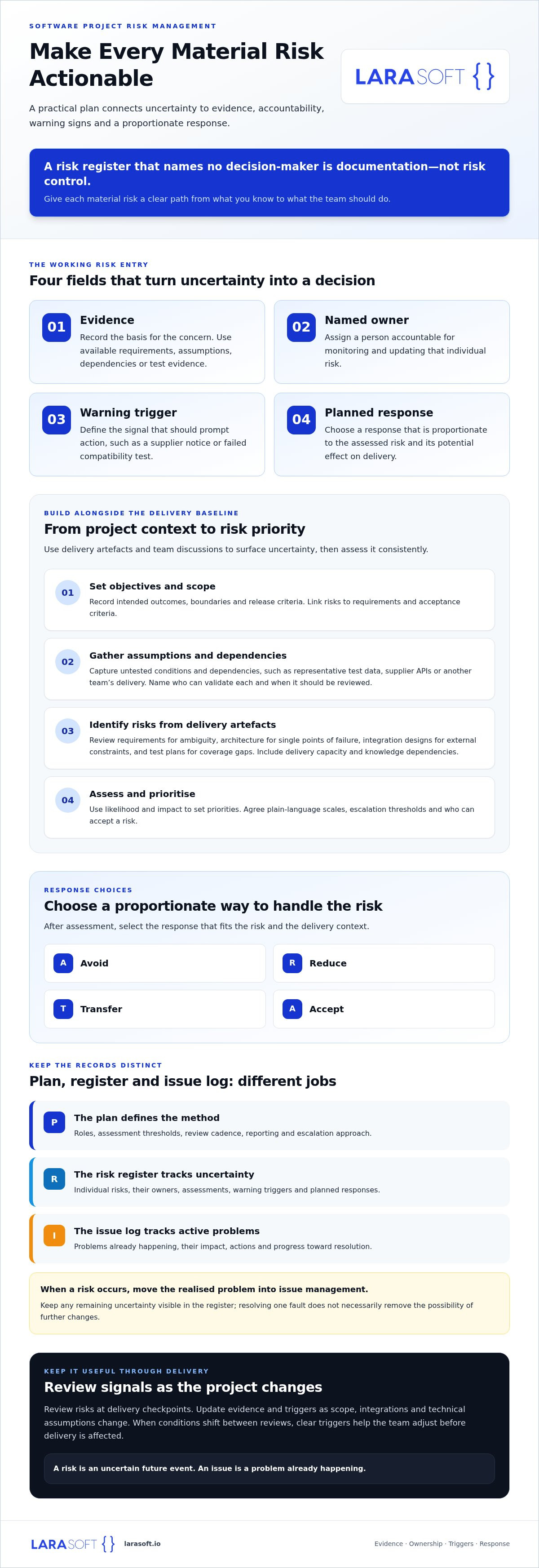
The risk register is the working record of individual uncertainties. Each entry should capture a concise description, owner, assessment, warning trigger and planned response. For example, an entry could state that an external API might change before release, name the integration lead as owner, and identify a supplier notice or failed compatibility test as a trigger. The issue log, by contrast, tracks active problems, their impact, actions and progress towards resolution.
When a risk occurs, move the realised problem into issue management so the team can coordinate corrective work. Keep any remaining uncertainty visible in the register: resolving one API fault, for instance, doesn’t necessarily remove the possibility of further changes. This distinction is central to a usable software project risk management plan, because it keeps future threats separate from current work.
Software uncertainty shifts as a project moves from discovery into architecture, development, testing and release. Requirements may change after users review a prototype. An integration may behave differently from its documentation. Data quality, security assumptions or a technology choice may also need reassessment as the design takes shape. A plan written once and left untouched can quickly stop reflecting delivery reality.
Use the plan to guide decisions, not to present uncertain events as predictions. A risk assessment is a structured judgement based on available evidence, not a promise that an outcome will or won’t happen. The overview of Software Project Management and Risk also situates risk management within broader project planning, from the business case through contingency planning.
Keeping risks visible helps teams compare priorities, explain trade-offs to stakeholders and identify conditions that could affect release readiness. If a dependency becomes less reliable, for example, the team can review its response before it threatens a release decision. The plan stays useful when owners update evidence and triggers as scope, integrations and technical assumptions change.
Build the plan alongside the delivery baseline, not as a separate document after work has started. Requirements, architecture decisions, test evidence and release plans all reveal uncertainty. A practical software project risk management plan turns that evidence into decisions the team can revisit as the product takes shape.
First, define what the plan covers: project phases, teams, suppliers, integrations and releases. Name the person responsible for maintaining it, agree who owns individual risks, and set out who escalates material changes. Choose plain-language likelihood and impact scales, decide which combinations warrant escalation, and set a review cadence that fits delivery checkpoints. The goal is consistent judgement, not false precision.
Use requirements reviews, architecture discussions and focused workshops to examine security, performance, data, integrations, user needs and release assumptions. Describe each risk as a cause, an uncertain event and a potential consequence. “Slow database” is a vague label; “If expected data volumes exceed the design assumption, reporting may miss the agreed response time” gives the team something specific to investigate.
Every material risk needs a named owner, a trigger and a response. Record those alongside the cause, event, consequence, assessment, evidence, status and next review date in one consistent register. For custom software, connect this discipline to delivery arrangements too: Larasoft provides a staging server for client testing during development. Code ownership is fully transferred to the client under the standard service agreement, and long-term support is available through service level agreements (SLAs). Teams planning bespoke delivery can explore Larasoft’s custom software development as part of that conversation.
Assessment should help the team decide what deserves attention, not make uncertainty look mathematically exact. Likelihood asks how plausible a risk is given the available evidence. Impact asks what would happen if it occurred, including effects on delivery, service operation, data, security and business objectives. A risk with modest likelihood but serious consequences may need more attention than a likely inconvenience that causes only local rework.
Use the same qualitative scale across the project and define it in project terms. For example, low impact might mean a contained change with no effect on a milestone; medium might disrupt a key workflow or planned delivery; high might threaten a release, critical service operation, sensitive data or an essential business objective. Define likelihood as unlikely, plausible or likely based on evidence and current assumptions. These labels support consistent discussion without implying precision the team can’t justify.
Record the reasoning behind each assessment. Note whether it comes from a tested prototype, a supplier commitment, an architecture review or an assumption that still needs validation. Where evidence is thin, mark confidence as low and identify what would improve it. Prioritise by considering likelihood and impact together, then account for urgency: a risk that could affect the next release decision may need action before a more severe but distant uncertainty.
Assess inherent risk before planned controls, then estimate residual risk after those controls are in place. If an integration could fail under expected demand, load testing may reduce the chance of discovering the limit late. The inherent assessment describes the exposure before testing; residual risk describes what remains after the test and any resulting design changes. Record control assumptions, such as representative test data being available, and revisit the rating if they prove false.
Choose a response based on potential impact, urgency, evidence and the cost or disruption of acting. Avoid applying heavyweight controls to every uncertainty. The right response may change as the design, evidence or release plan changes.
| Response | When it fits | Software example |
|---|---|---|
| Avoid | Change scope or design to remove an unacceptable source of exposure. | Defer a non-essential integration if its dependency creates unacceptable release uncertainty. |
| Reduce | Apply controls that lower likelihood or impact. | Prototype an unfamiliar API, add focused security testing or release a feature in phases. |
| Transfer | Allocate defined responsibility or consequences to another party, while monitoring what remains. | Use supplier terms to allocate responsibility for a specified integration failure; the project still tracks service and dependency exposure. |
| Accept | Retain the risk when further action isn’t proportionate, with a rationale and contingency where needed. | Accept a minor reporting delay, assign an owner and define a trigger for a workaround. |
For each choice, document the owner, rationale, action, trigger and residual assessment in the register. A software project risk management plan becomes decision-ready when stakeholders can see which risks rank highest, why the response is proportionate and what evidence would prompt a change.
Agile delivery changes as teams learn from working software, stakeholder feedback and technical evidence. Risk reviews should follow those changes. A software project risk management plan stays useful when it informs real choices about scope, dependencies and releases, rather than becoming a register the team updates only for reporting.
Use planning checkpoints to revisit risks affected by a proposed change in scope, estimates or dependencies. A new requirement might alter an architectural assumption, while a delayed supplier response could affect the next increment. Focus discussion on what has changed and what decision is needed; unchanged entries don’t need a full review at every meeting.
Before a release, reassess risks against evidence gathered during development and testing. A successful integration test may reduce uncertainty, while a failed performance test may increase exposure or change the release decision. Also consider operational readiness: unresolved data migration questions or incomplete support arrangements could affect how safely the team proceeds. Capture the decision, its rationale and any remaining exposure.
A trigger is an observable change that signals a planned response may be needed. Make triggers specific enough that an owner can recognise them without waiting for a scheduled meeting. Examples include a missed dependency date, a failed test against an agreed acceptance criterion, or an external requirement changing in a way that affects the design.
Each material risk needs an accountable owner who can monitor its trigger, update its status and coordinate the agreed response. If a trigger occurs, the owner should record what changed, what action is under way and whether the original assessment still holds. Escalate when agreed thresholds are crossed, such as when a risk threatens a release objective or requires a decision beyond the team’s authority. Record who made the decision and what residual exposure remains.
Keep reporting brief and decision-focused. A useful update highlights:
Between reviews, triggers provide an early prompt to investigate and act. They don’t automatically dictate a decision: the owner checks the evidence, applies the response and escalates if the agreed threshold is met. This keeps the process proportionate and responsive without turning every new observation into a formal project crisis.
For a delivery approach that makes room for clear checkpoints, client feedback and considered release decisions, discuss your custom software project with Larasoft.
A risk plan is most useful when it shapes how a software project is discussed and delivered, not just how risks are documented. Larasoft builds bespoke software from design and development through deployment and support. That gives the team practical points to make assumptions visible, review decisions and respond to evidence as the product takes shape. The goal isn’t to claim that uncertainty can be removed. It’s to create a clearer basis for collaboration and informed delivery decisions.
Agree the scope and key decisions, then keep them accessible as requirements and technical choices develop. If a workflow depends on a particular user role, for example, client testing can reveal that the expected permissions don’t match how people need to use the application. That feedback may prompt a requirements change, a risk review or further testing. Recording the decision and its rationale helps the team understand what changed and which assumptions need another look.
Larasoft provides a staging server for client testing during development. It gives clients an environment to review work before deployment and share feedback against agreed requirements. Testing can uncover mismatches or new questions, but it doesn’t eliminate defects or delivery risk. Capture findings, assign follow-up actions and consider whether they alter the project’s risk assessment or release readiness.
Delivery planning should also cover what happens when development work is complete. Under the standard service agreement, code ownership is fully transferred to the client. Clear ownership establishes who holds the code as a business asset after handover.
Long-term support is available through service level agreements (SLAs). Including post-launch support in lifecycle planning helps the project consider how ongoing maintenance and future changes will be handled, rather than treating deployment as the end of the conversation. The support arrangement can form part of the delivery discussion and should align with the software’s needs and operational context.
Across discovery, development, testing and deployment, a software project risk management plan can give the client and development team a shared structure for surfacing uncertainty and making decisions. Larasoft’s approach brings that structure into custom Laravel and web application delivery, with client testing during development, clear ownership under the standard service agreement and support available beyond launch. It’s a practical foundation for building software that can evolve with the organisation.
Discuss your software project with Larasoft and outline the goals, assumptions and delivery considerations that matter to your team.
The next step is to make risk ownership part of delivery conversations from the outset. Bring your priorities, constraints and open assumptions into discovery, then keep decisions connected to the work as the application develops. A software project risk management plan can provide that shared structure, helping everyone discuss emerging evidence and decide what needs attention without treating uncertainty as a reason to stand still.
Larasoft is an Official Laravel Certified Company, with Laravel developers since 2012. It has built almost a hundred web and mobile apps. Its stated credentials include 99 % Satisfaction, 24 / 7 Support and £100 k + Sales, and it was recognised as “Most Reliable Web Development Agency in the UK Enterprise category for the SME Awards 2021”. A staging server is provided for client testing during development, and long-term support is available through service level agreements (SLAs). Code ownership is fully transferred to the client under the standard service agreement.
If you’re planning a custom application, start with the outcomes it needs to support and the uncertainties that could shape its delivery. Discuss your software project with Larasoft to outline your goals, assumptions and delivery considerations, and explore a considered path from requirements to a maintainable solution.
A risk management plan defines the process, roles, assessment approach and review method. The risk register records the individual uncertainties the team identifies, assesses and responds to. The register is maintained under the plan; it does not replace it. Keeping the two distinct helps teams understand both how risk work is governed and what specific risks require attention. A software project risk management plan sets the rules; the register tracks a particular vendor dependency.
Start with project objectives, requirements, architecture, dependencies, data, security, testing and deployment assumptions. Use team workshops and reviews to ask what could change, fail or delay delivery, and what the consequence would be. Record risks as causes, uncertain events and possible effects. Revisit the list when scope, technical evidence, external dependencies or release plans change. For example, link a payment-provider timeout risk to the checkout requirement and its acceptance test.
Review it often enough to support decisions, with timing suited to the project's pace and exposure. Revisit relevant entries when scope or dependencies change, at delivery planning checkpoints and before significant releases. Triggers should prompt action between scheduled reviews. The goal is not to repeatedly discuss unchanged entries; it is to update exposure, ownership and responses when evidence or conditions change. For a long integration cycle, schedule a review before supplier milestones.
Use agreed qualitative likelihood and impact scales, and define what each rating means for the project. Record the evidence and assumptions behind an assessment rather than implying a precise prediction. Consider effects on delivery, security, data, service operation and business objectives. Where uncertainty is high, identify what evidence would improve the assessment and set a review point. For instance, mark an API estimate as low confidence until a sandbox test confirms behaviour.
Project risk management is shared, but accountability should be explicit. The project lead or agreed coordinator maintains the process and keeps reporting consistent; each risk should have an owner responsible for monitoring its indicators and coordinating its response. Subject-matter experts contribute evidence, while sponsors or decision-makers resolve escalations that exceed the team's authority or agreed thresholds. A data migration risk, for example, may sit with the technical lead while business owners validate mapping rules.
Update its status and move it into the project's issue-management process when the uncertain event occurs. Record the actual impact, immediate actions, decision owner and any remaining exposure. The risk register can retain a link or closure note for traceability, but it should not treat an active problem as if it were still only a possibility. Review related risks for similar causes. If several share incomplete test data as a cause, link their follow-up without treating them as one issue.
Here’s what we've been up to recently.
Certified Quality. Great Prices