Humans vs AI in Software: Finding the Strategic Balance

Did you know that by early 2026, over 51% of all code committed to GitHub was generated or substantially assisted by artificial intelligence? This shift has intensified the debate surrounding humans vs AI in software, leaving many leaders torn between the promise of rapid delivery and the fear of accumulating unmanageable technical debt. You want the efficiency of modern automation, but you also need the assurance that your systems are built on a foundation of structural integrity and long term value.
We believe that while AI generates syntax, humans architect value. True innovation requires a strategic balance where AI tools accelerate routine tasks while senior engineers maintain the creative problem solving and ethical judgment that machines cannot replicate. Managing this transition requires more than just new tools; it requires a disciplined approach to system design that prioritizes reliability and performance under pressure.
This article provides a clear framework for integrating AI into your development process without sacrificing quality. You'll discover how to maximize the ROI of human led architecture and gain the confidence to select partners who prioritize longevity over quick, fragile fixes. We'll show you how to turn AI from a potential liability into a foundational asset for your future growth.
The year 2026 has solidified a fundamental shift in how digital platforms are built. We no longer view artificial intelligence as a replacement for human intellect; instead, it's become a high velocity co-pilot. For modern UK businesses, the debate of humans vs AI in software has moved past speculation into a practical reality of technical orchestration. Developers have transitioned from manual line by line coding to overseeing complex systems, acting as the strategic conductors of an automated orchestra.
This evolution represents a clear divide between disposable code and foundational software assets. While AI can churn out functional snippets at an unprecedented rate, those snippets often lack the structural integrity required for long term scalability. The Evolution of Software Development shows that while tools change, the need for architectural discipline remains constant. Relying solely on automated output risks creating a house of cards. True value lies in the human ability to ensure that every automated component serves a specific, durable business purpose. The shift involves several key changes for the modern developer:
AI excels at the mechanics of syntax. It acts as a force multiplier by handling repetitive boilerplate generation and drafting unit tests in seconds. Recent data suggests that 67% of developers expect a productivity increase of at least 25% due to these efficiencies. Real time debugging has also improved, significantly reducing common syntax errors before they reach production. However, these tools operate primarily on pattern recognition. They struggle with unique business logic that hasn't been documented in their training data. AI can write a function, but it doesn't understand why your specific customer journey requires a bespoke API integration.
Human developers provide the "why" behind the code. We are the architects of purpose, responsible for translating vague stakeholder requirements into precise technical specifications. This requires a level of empathy and nuance that machines cannot simulate, particularly in Vue.js or React frontend development where user experience is paramount. A technical artisan understands that code must be clean, readable, and maintainable for years, not just days. This quiet competence in architecture is what prevents a system from collapsing under its own weight as it scales. We ensure that the humans vs AI in software balance remains tipped toward strategic longevity, treating software as a foundational asset rather than a temporary fix.
While AI excels at generating functional snippets, it frequently falters when asked to conceptualise large scale system design. This is where the humans vs AI in software debate becomes most critical. AI models are trained on patterns, not principles. They can "hallucinate" architectural patterns, suggesting solutions that look correct on the surface but fail to account for the intricate interdependencies of a bespoke application. This lack of macro level understanding leads to fragmented systems that are difficult to scale and even harder to debug.
The security implications are equally concerning. Data published in February 2026 revealed that 29.1% of Python code generated by GitHub Copilot contained potential security weaknesses. Without rigorous human vetting, these vulnerabilities can be baked into the core of your infrastructure. Trust in automated accuracy is declining; by June 2026, only 29% of developers reported trusting AI outputs to be accurate. This context gap is dangerous. AI solves for the immediate prompt, but it cannot understand your five year business roadmap or the specific regulatory requirements of your industry.
Maintenance debt is another looming concern. If an AI model writes a complex module today, who is responsible for fixing it when that model is updated or the underlying libraries change? Code that isn't understood by its maintainers becomes a "black box" that stifles innovation. For businesses looking to secure their existing systems, our software maintenance services provide the human oversight necessary to mitigate these automated risks.
AI often fails to grasp the nuances required for legacy code modernisation. Older systems are filled with unconventional logic and undocumented "quirks" that pattern matching tools simply cannot interpret. An AI might suggest a modern "patch" that inadvertently breaks a critical dependency elsewhere. Human led refactoring ensures that modernisation is strategic and holistic, rather than a series of disconnected fixes that increase technical debt.
Designing for 10x growth requires foresight that current AI agents lack. AI prioritises the "now," often choosing the path of least resistance to satisfy a prompt. A professional laravel development agency workflow integrates AI to speed up boilerplate tasks while humans remain the gatekeepers of structural integrity. We ensure that API integrations remain robust even when third party requirements shift, providing a level of reliability that autonomous tools cannot yet guarantee.
Bespoke software isn't just about code that works; it's about systems that mirror the unique DNA of a business. In the debate of humans vs AI in software, the distinction between generic automation and intentional craftsmanship is stark. AI operates within the boundaries of existing datasets. This makes it excellent for standard patterns but ill-equipped for the "edge cases" that define a competitive advantage. Human ingenuity steps in when standard patterns fail. We find a "third way" that balances technical feasibility with specific business logic, ensuring the final product solves the actual problem rather than a generic version of it.
We view ourselves as technical artisans. This persona is defined by a commitment to clean, efficient, and readable code that survives long after the initial deployment. It's about more than just solving a ticket. It's about the pride taken in the cleanliness of the architecture and the satisfaction of building systems that perform perfectly under pressure. This human element also provides a vital ethical layer. We ensure that software serves human needs without the subtle biases often found in large language models. Unlike AI, which lacks a moral compass, human developers evaluate the social and operational implications of an algorithm before it's merged into your core infrastructure.
Creating an interface that feels intuitive requires more than just a functional layout. Professional vue.js frontend development requires a human touch to ensure fluid transitions and a cohesive user experience. AI generates components. It cannot replicate the nuance of brand voice or the emotional resonance of a well designed digital interface. Accessibility (WCAG) is another area where machines fall short. It's a moral and legal requirement that demands human empathy. We ensure digital platforms are usable by everyone, regardless of their physical or cognitive abilities, which is a level of detail AI often overlooks in its quest for speed.
A significant risk of AI assisted development is over engineering. Without a deep understanding of the "why" behind a feature, automated tools might suggest overly complex solutions for simple problems. We act as a technical ally. We invest in your project's success by managing stakeholder expectations through clear, human communication. This partnership ensures every technical intervention is grounded in the practical realities of business returns. By maintaining this strategic alignment, we prevent the accumulation of unnecessary features. We ensure your software remains a lean, foundational asset for future growth, rather than a bloated collection of AI generated functions.
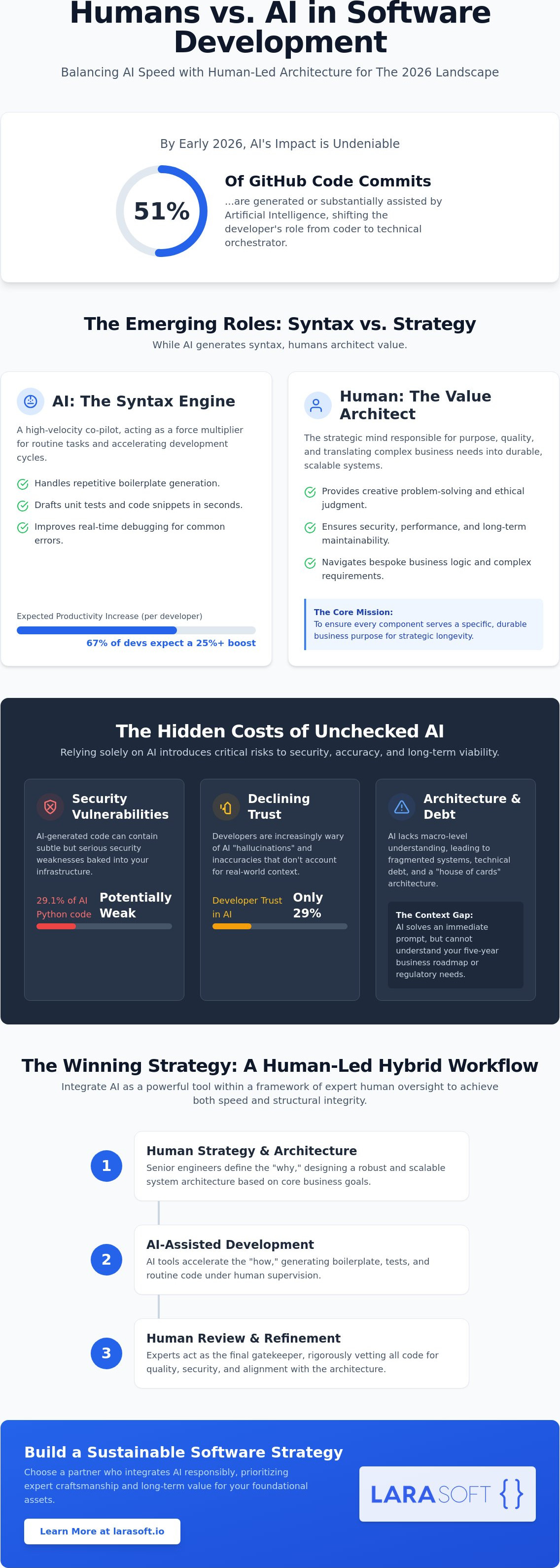
Efficiency isn't just about how fast code is written; it's about how long that code remains functional without intervention. When evaluating humans vs AI in software, we must distinguish between velocity and value. AI can generate code at a rate that suggests a 25% increase in developer productivity, but this speed often masks a hidden cost. If the generated code lacks structural integrity, the maintenance phase becomes a cycle of expensive refactoring. True efficiency comes from a hybrid workflow where AI handles the repetitive legwork, allowing human experts to focus on the high level architecture that drives business returns.
Elite agencies use AI to enhance craftsmanship rather than replace it. This involves a disciplined approach where tasks are triaged based on risk. For instance, creating boilerplate code or initial data structures is an ideal task for an AI assistant. However, any task that involves sensitive data handling or complex business logic requires meticulous human review. By identifying where AI driven errors are unacceptably high, we mitigate the risk of system failure. The ROI of human led architecture is most visible in the longevity of the software; well architected systems require less frequent "emergency" maintenance and scale more fluidly as your user base grows.
We use AI for rapid prototyping to give stakeholders a tangible feel for a product early in the cycle. While AI mocks up the interface, our engineers build the production core using proven architectural principles. This ensures a zero defect delivery. While automated testing covers the basics, human QA remains essential for catching logical flaws that machines overlook. We also leverage AI to assist with the content structure of web apps, ensuring that technical SEO is baked into the platform from day one without sacrificing the speed of the build.
In frameworks like Laravel, the core architecture is designed for elegance and security. A Laravel AI integration should enhance application capabilities, such as intelligent search or predictive analytics, without compromising the underlying framework standards. Similarly, in mobile development, the choice between native and cross platform solutions requires a human understanding of your long term product vision. AI might suggest the fastest route to a prototype, but a human ally ensures the final build is compliant with GDPR and other critical security standards. Explore our Laravel web development services to see how we combine AI efficiency with human led architectural discipline.
The future of software isn't a competition between biological and artificial intelligence. It's about the synthesis of both. Choosing a development partner in 2026 requires looking beyond simple productivity claims. You need a team that balances rapid innovation with the disciplined execution required for enterprise grade stability. Our approach at Larasoft focuses on this exact equilibrium. We treat software not as a one off product, but as a foundational asset that must scale alongside your business goals.
In the shifting landscape of humans vs AI in software, longevity has become the primary metric of success. While many agencies have pivoted toward fully automated workflows to cut costs, we've remained committed to the role of technical artisans. This means we use AI to handle the mundane, but we never let it touch the architectural core without human supervision. Moving from a mere service provider to a long term technical ally means we take responsibility for the cleanliness and efficiency of your systems, ensuring they perform perfectly under pressure.
A sustainable strategy also requires a shift in how we measure value. It's no longer enough to just "ship fast." We must ask how easily a system can be maintained and refactored three years from now. By prioritizing human led architecture today, you avoid the crushing weight of technical debt that often follows unvetted AI code generation. We provide the business centric reassurance that your digital platform is built to last, not just to exist.
We implement Laravel AI solutions to drive operational efficiency without compromising the framework's inherent security. Our commitment to clean code means that every automated output is reviewed, refactored, and integrated with structural integrity in mind. We don't just ship code; we build durable systems. This is why human led software maintenance is a non negotiable part of our process. It provides the long term stability that autonomous agents simply can't guarantee, protecting your investment from the "black box" syndrome of unvetted AI generation.
The first step toward a sustainable strategy is evaluating your current tech stack for AI readiness and modernisation. Many legacy systems aren't equipped to handle the fluid transitions required by modern digital platforms. We help you navigate this structured, logical journey, ensuring that your transition to an AI augmented workflow is manageable and results oriented. If you're ready to move past the hype and build something with lasting value, it's time to partner with Larasoft for expert bespoke development. We'll ensure your software remains a high performing asset, built by experts who find satisfaction in technical perfection.
The transition toward AI-augmented development is inevitable. It doesn't have to be a risk to your system's integrity. Innovation requires discipline. We've explored how the true value of modern software lies in the balance between high-velocity automation and disciplined human oversight. By treating AI as a syntax engine and humans as the architects of purpose, you can achieve rapid delivery without sacrificing the scalability of your digital assets. The landscape of humans vs AI in software in 2026 demands a partner who understands that clean, maintainable code is a non-negotiable requirement for business growth.
At Larasoft, we act as your dedicated technical ally. We specialise in bespoke Laravel and high-performance frontend solutions that stand the test of time. As UK-based technical artisans, we focus on clean, scalable code that performs perfectly under pressure. Whether you require legacy code modernisation or strategic AI integration, our approach is always innovative and disciplined. Don't let the pressure of "fast" development compromise your future. Build your future-proof software with Larasoft and ensure your technology remains a high-performing foundation for years to come. We're ready to help you turn technical complexity into a structured journey toward success.
No, AI cannot replace human developers because it lacks the capacity for strategic system design and creative problem solving. Machines are efficient at generating syntax, but they don't understand business requirements or ethical implications. In 2026, the role of a developer has shifted toward technical orchestration. Humans provide the architectural discipline needed to ensure that automated components serve a durable purpose without creating unmanageable technical debt.
The primary risks involve security vulnerabilities and the accumulation of maintenance debt. When navigating humans vs AI in software, it's clear that AI often prioritises the path of least resistance. This leads to fragmented systems that are difficult to scale. Since AI lacks macro level context, it may suggest patterns that look correct but introduce unvetted weaknesses. Without professional oversight, these modules become liabilities that stifle innovation.
We use Laravel AI integration to accelerate repetitive tasks like drafting unit tests and generating boilerplate code. This hybrid workflow allows our technical artisans to focus on high level architectural decisions and bespoke logic. Every AI generated snippet undergoes a rigorous manual review and refactoring process. This ensures that the final build adheres to our strict standards for cleanliness, efficiency, and structural integrity.
AI generated code isn't inherently compliant with UK GDPR or other international security standards. These tools operate on patterns found in training data, not on an understanding of specific legal frameworks like the EU AI Act. Ensuring compliance requires a human expert to audit data handling processes and transparency requirements. Meticulous human review is the only way to guarantee that your software meets both moral and legal obligations.
Human architecture requires a higher initial investment because it involves deep strategic alignment and custom built solutions. While AI driven development offers a lower entry cost, it often ignores the long term roadmap of a bespoke application. Investing in human led design ensures that your system is built for 10x growth. This reduces the true cost of software by preventing expensive emergency maintenance and refactoring in the future.
You can identify over reliance by looking for a lack of architectural reasoning. If an agency struggles to explain the technical purpose behind an API integration or if the system feels generic, they may be using AI as an autonomous pilot. A professional partner should provide business centric reassurance through clear communication. They should demonstrate a deep understanding of the structural integrity and scalability of your specific project.
AI is a useful tool for identifying patterns in older systems, but it cannot handle legacy code modernisation without human oversight. Legacy applications are often filled with unconventional logic and undocumented dependencies that pattern matching tools misinterpret. Human engineers are needed to navigate these quirks strategically. We ensure that modernising one module doesn't inadvertently break a critical function elsewhere in your business infrastructure.
Human empathy is the cornerstone of intuitive frontend development. While AI can generate React or Vue.js components, it cannot replicate brand voice or the emotional resonance of a well designed interface. Humans ensure that accessibility standards like WCAG are met with genuine care for the user experience. This human touch ensures that your digital platform is inclusive, fluid, and strategically aligned with your brand's unique identity.
Here’s what we've been up to recently.
Certified Quality. Great Prices