How to Write a Software Development Brief: A Strategic Guide for 2026


Recent data from Xergy Group reveals that only 50% of software projects in 2026 are rated as fully successful. When you consider that enterprise IT spending is hitting $6.15 trillion, the cost of a failed launch is more than just financial. It's a lost competitive advantage. Mastering how to write a software development brief is your primary defense against this risk. A well-constructed brief isn't a simple wishlist. It's a sophisticated strategic document that translates your business goals into a framework for technical excellence.
We understand the pressure of defining a complex project scope when you don't speak the language of API integrations or legacy code modernisation every day. It's common to fear that a small miscommunication will spiral into a budget overrun. This guide will show you how to draft a brief that aligns your stakeholders and secures the interest of high-quality agencies. You'll gain a clear, professional template designed to trigger faster response times and highly accurate estimates. We'll explore how to define your requirements so your next Laravel or Vue.js project is built on a foundation of structural integrity and measurable ROI.
A development brief is more than a list of features; it's the architectural blueprint that governs your entire project. In the context of the software development lifecycle, this document acts as the single source of truth for every stakeholder. It bridges the gap between your high-level business vision and the granular technical execution required to build it. When you master how to write a software development brief, you remove the guesswork that often leads to friction between product owners and engineering teams.
Precision at this stage drastically reduces the duration of the Discovery Phase. Instead of spending weeks explaining basic context, you provide your partner with the clarity they need to start architectural planning immediately. This proactive approach ensures that everyone involved understands the project’s boundaries, which is the most effective way to mitigate scope creep. When requirements are documented and agreed upon from the start, "feature bloat" is much harder to justify mid-development. It transforms the relationship from a simple service transaction into a structured journey toward growth.
Ambiguity in a brief represents a high level of risk for an agency. To protect their own margins, many firms will add significant "buffer" costs to their quotes to cover potential unknowns. If your requirements are vague, you're essentially paying a premium for your own lack of clarity. Mid-project pivots caused by missing requirements are even more damaging; they often require undoing completed work and refactoring existing codebases. Investing 10 hours in a meticulous briefing process prevents 100 hours of costly technical debt and rework later.
Top-tier developers and a specialized laravel development agency are selective about the projects they take on. They prioritize clients who demonstrate a clear understanding of their own needs and respect the development process. Professional documentation signals that you are a serious partner who values efficiency and structural integrity. This level of preparation commands respect for your specialized business knowledge.
The clarity of your brief directly correlates with the quality of the technical proposal you receive. When an agency understands exactly what you're trying to achieve, they can move beyond generic estimates and provide a sophisticated, outcome-driven strategy. Learning how to write a software development brief ensures you attract partners who are as invested in the project’s longevity and scalability as you are.
A high-impact brief is a structured narrative that provides more than just a list of features. It starts with your company mission and market position to give developers the context they need to make informed architectural decisions. This background helps a technical partner understand if the product needs to be a disruptive startup tool or a robust enterprise solution designed for long-term scalability. When you're learning how to write a software development brief, remember that clarity in these foundational elements is what separates an accurate quote from a vague estimate.
A problem statement is the heart of the document. "I want an app" is a request, not a requirement. A real problem statement identifies a specific bottleneck, such as "Our current manual data entry process leads to a 15% error rate in inventory management." This gives engineers a clear target to hit. Listing functional requirements for a Minimum Viable Product (MVP) is the next logical step. Distinguishing between core functionality and "nice-to-have" additions prevents budget inflation and keeps the focus on immediate business returns.
Instead of describing the solution, describe the pain. If your customers can't complete a purchase on mobile without frustration, state that clearly. Use quantifiable metrics where possible, such as wanting to reduce checkout friction by 20%. Be honest about internal blockers or failed previous attempts. This level of transparency allows your technical ally to build a more resilient architecture that addresses the root cause of the issue rather than just the symptoms.
You must differentiate between internal administrators and external end-users because their needs are fundamentally different. An administrator requires data integrity and efficient backend workflows, while an end-user needs a frictionless, intuitive interface. Implementing high-performance vue.js frontend development ensures these interactions feel fluid and modern. Ask yourself: what is the single most important action a user must take? If they can't do that within three clicks, the user journey needs refinement.
Brand guidelines aren't just about colors and logos; they're about the emotional response you want from the user. Provide examples of platforms you admire to give the design team a stylistic anchor. This prevents wasted cycles on aesthetic directions that don't align with your brand identity. Understanding how to write a software development brief requires a shift in perspective from features to solutions, ensuring every design choice supports a specific business goal. If you're struggling to define these technical components, partnering with a specialised development team can help translate your business vision into a functional roadmap.
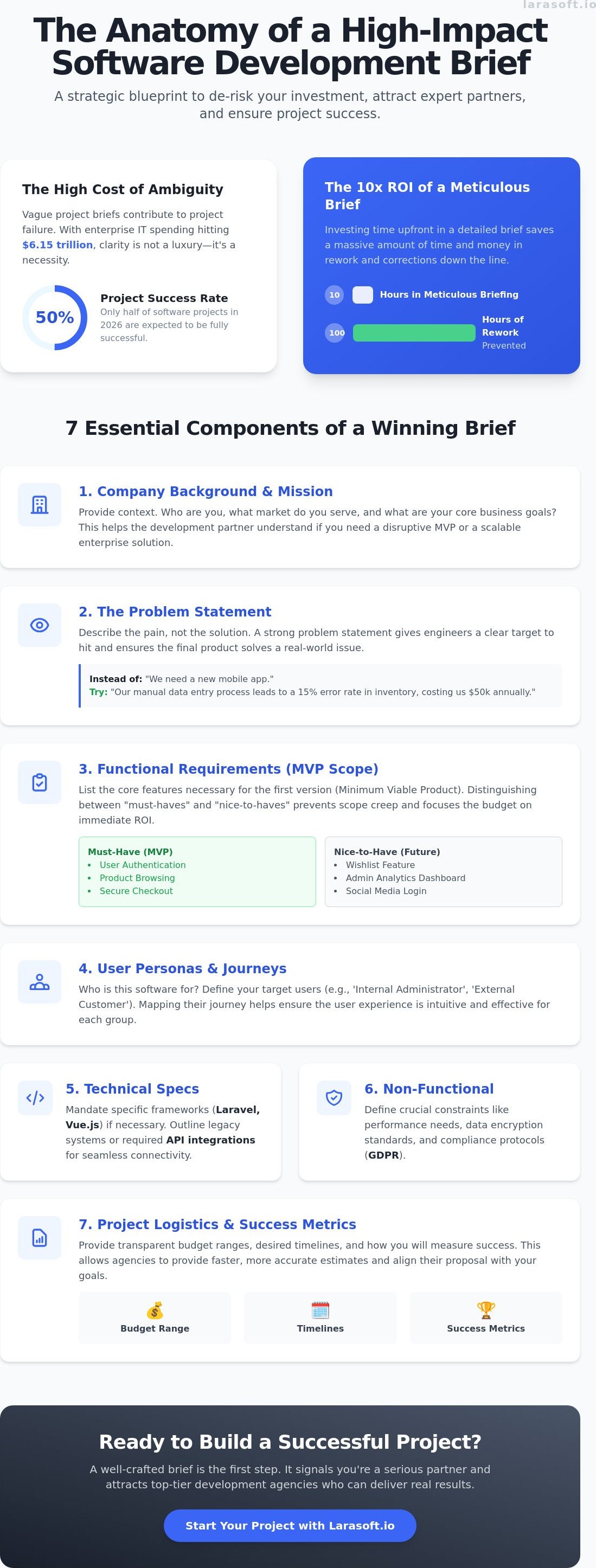
Technical specifications are the engine room of your document. While the previous sections focused on the "why" and "who", this stage defines the "how". When considering how to write a software development brief, you must decide whether to mandate a specific tech stack or remain platform-agnostic. If your existing infrastructure relies on specific frameworks, specifying Laravel or React is sensible. However, if you're starting from scratch, describing the desired outcomes allows a technical partner to propose the most efficient architecture for longevity and performance.
Data migration is a critical requirement that is frequently overlooked during the initial briefing stage. Moving years of structured or unstructured data from an aging system into a modern cloud-native platform requires meticulous planning. If your project involves replacing an old system, you must define the volume of data, its current format, and the level of "cleaning" required before it can be imported. Neglecting this detail often leads to significant delays during the final stages of the project lifecycle.
If you aren't building from scratch, you're likely dealing with technical debt. You need to be explicit about the current state of your codebase. Detail your current PHP version, framework iterations, and any third-party libraries currently in use. A successful strategy for legacy code modernisation depends on identifying specific pain points like slow query speeds, security vulnerabilities, or a lack of documentation. Clear communication here ensures your partner understands whether they are performing a surgical refactor or a complete system overhaul.
Modern software doesn't exist in a vacuum. Your brief must list every external system that needs to communicate with your new platform, including CRMs, ERPs, and payment gateways. Specify whether you require standard API integration or if the project demands custom API development to connect disparate systems. Providing existing API documentation is the most valuable attachment you can include with any brief. It allows engineers to assess the complexity of the data exchange immediately, resulting in a more realistic and transparent technical proposal.
Effective interoperability ensures your software remains a foundational asset for your future growth. By documenting these constraints early, you allow your technical ally to build a system that performs perfectly under pressure while integrating seamlessly with your existing business ecosystem. This level of detail is what separates a generic brief from a strategic roadmap that minimizes technical risk.
Features attract users, but non-functional requirements (NFRs) are what keep them. When you're determining how to write a software development brief, these quality attributes must be prioritized to ensure the system doesn't buckle under pressure. Security, compliance, and performance are not "extras" to be tacked on at the end. They are the structural constraints that dictate how the code is written from day one. Failing to define these early often leads to expensive refactoring once the platform begins to scale.
Start by defining your security standards with precision. This includes specifying data encryption protocols for both rest and transit, such as AES-256. You should outline requirements for user authentication, including multi-factor authentication (MFA) and role-based access control (RBAC). These details protect your intellectual property and your users' sensitive data, providing the business-centric reassurance that stakeholders demand. Clear security briefing allows developers to build a hardened environment that can perform perfectly under pressure.
GDPR is non-negotiable for UK-based organizations and must be considered at the architectural level rather than as a final checklist item. This involves briefing for "Privacy by Design" principles, where data protection is integrated into the system's core logic. You should also specify data residency requirements. If your industry requires servers to be located within the UK for legal reasons, your brief must state this explicitly to avoid expensive infrastructure migrations later. This level of detail ensures your technical ally builds a compliant foundation from the start.
Performance benchmarks give your developers a concrete target for speed and reliability. Define success using measurable metrics like Google Lighthouse scores above 90 or specific load times under two seconds for core pages. Accessibility is equally vital. Aim for WCAG 2.1 or 2.2 compliance to ensure your platform is usable by everyone, which is often a legal requirement for public-facing digital assets in the UK. When you master how to write a software development brief, you prevent the "fix it later" mentality that drains long-term budgets.
Scalability is about planning for the future. If you expect your user base to double by year three, your architecture must support that growth without a total rewrite. Regular software maintenance is essential to preserve these performance gains and security patches over time. A professional brief should also outline how the system should handle concurrent user spikes during peak periods. If you need a partner to help bake these high standards into your next platform, explore our custom software development services to see how we build for longevity and structural integrity.
The final stage of mastering how to write a software development brief involves defining the practical constraints of the project. Logistics, timelines, and financial boundaries are the guardrails that keep development on track. Without these, even the most technically brilliant concept can fail due to resource exhaustion or missed market opportunities. A strategic brief must clearly state how success will be measured six months after deployment. Whether your KPIs are centered on user acquisition rates, system uptime, or a reduction in manual processing time, these metrics allow your technical partner to align their efforts with your long-term business returns.
Defining the timeline requires a distinction between a desired launch date and a hard deadline. A hard deadline is often driven by external factors like regulatory changes or industry trade shows. Providing this context helps an agency determine if a phased rollout or a simplified MVP is necessary to meet your goals. When evaluating potential partners, look for those who challenge your assumptions and offer a transparent selection process based on technical merit and strategic alignment. This disciplined approach ensures you secure a partner who is a deeply invested technical ally rather than a mere service provider.
Hiding your budget often results in misaligned proposals that either overshoot your capacity or undershoot your requirements. A transparent budget range allows agencies to propose the most efficient tech stack and features for your price point. For complex builds, a phased approach is often the most disciplined way to manage costs; it allows you to validate the core product before investing in secondary features. You should also allocate 15-20% of the initial build cost for annual maintenance to ensure the longevity and security of your asset. This foresight protects your software as a foundational asset for your future growth.
At Larasoft, we treat your brief as the starting point for a deep-dive Discovery Workshop. This collaborative phase transitions your high-level vision into a granular Technical Specification, ensuring every stakeholder is aligned before the first line of code is written. We take immense pride in the cleanliness and efficiency of our work, focusing on how to write a software development brief that translates into high-performance Laravel or React applications. Our process is designed to be steady, transparent, and highly organized, guiding you through a manageable, structured journey toward technical excellence.
Ready to discuss your project? Send your brief to our expert team today.
A precision-engineered brief is the difference between a system that merely functions and one that drives measurable business growth. By defining your problem statement, technical constraints, and non-functional requirements early, you eliminate the ambiguity that leads to budget overruns. Mastering how to write a software development brief ensures your project starts with total stakeholder alignment and a clear roadmap for execution.
We specialize in turning these strategic documents into robust digital platforms. As UK-based Laravel experts, our team provides the technical authority needed for complex builds, including specialists in legacy code modernisation and bespoke Vue.js or React frontends. We don't just build software; we create foundational assets designed for longevity and scalability. If you're ready to move from vision to implementation, our tools can help you bridge the gap with confidence.
Download our Software Development Brief Template and start your project today. Let’s build something that performs perfectly under pressure and scales with your ambition.
A software development brief should typically range between five and ten pages depending on the complexity of your requirements. It needs to be long enough to provide a single source of truth for your business objectives, user journeys, and technical constraints without becoming an unreadable manual. Focus on high-density information that provides clear context for your technical partner rather than redundant descriptions that obscure your core goals.
Providing a realistic budget range is essential for receiving accurate and feasible technical proposals from high-quality agencies. Transparency allows developers to suggest the most appropriate tech stack, such as Laravel or React, and prioritize features for your Minimum Viable Product. Without a budget anchor, you risk receiving quotes that are either too basic for your needs or financially unattainable for your organization.
You don't need deep technical knowledge to master how to write a software development brief effectively. Your role is to define the business problem and the desired outcomes while leaving the specific technical implementation to the experts. Focus on describing what the software must do and who will use it; a specialized agency will translate these business requirements into a robust architectural plan.
Include two or three examples of competitors to provide a clear benchmark for functionality and user experience. Highlight specific features they execute well or areas where their platforms fail to meet user needs. This context helps your development team understand the market standard and identify opportunities to build a superior, custom-built solution that provides a genuine competitive edge in your niche.
Functional requirements describe the specific actions the software must perform, such as processing a payment or generating a report. Non-functional requirements define the system's operational qualities, including security standards, GDPR compliance, and performance benchmarks. Both are critical for structural integrity; functional requirements drive the user journey while non-functional ones ensure the system performs perfectly under pressure and remains scalable.
Signing a Non-Disclosure Agreement (NDA) is a standard and recommended practice before sharing sensitive intellectual property or proprietary business logic. Most professional agencies have a standard NDA template ready for use to protect both parties. This creates an atmosphere of trust and ensures that your strategic vision remains protected while you evaluate potential technical partners for your project.
A software brief is a living document that can evolve through a structured change control process as the project progresses. While the core objectives should remain steady, granular details often shift during the Discovery Phase or as a result of early user testing. Utilizing a phased approach or hybrid Agile model allows for these fluid transitions without compromising the project's overall structural integrity or long-term timeline.
Success should be defined by measurable Key Performance Indicators (KPIs) that align with your initial business problem. Learning how to write a software development brief involves setting targets such as a 20% increase in user engagement or achieving specific Lighthouse performance scores above 90. Establishing these metrics ensures the final product delivers a tangible return on investment and acts as a foundational asset for your future growth.
Here’s what we've been up to recently.
Certified Quality. Great Prices