Laravel for High-Traffic Websites: An Architectural Strategy for 2026


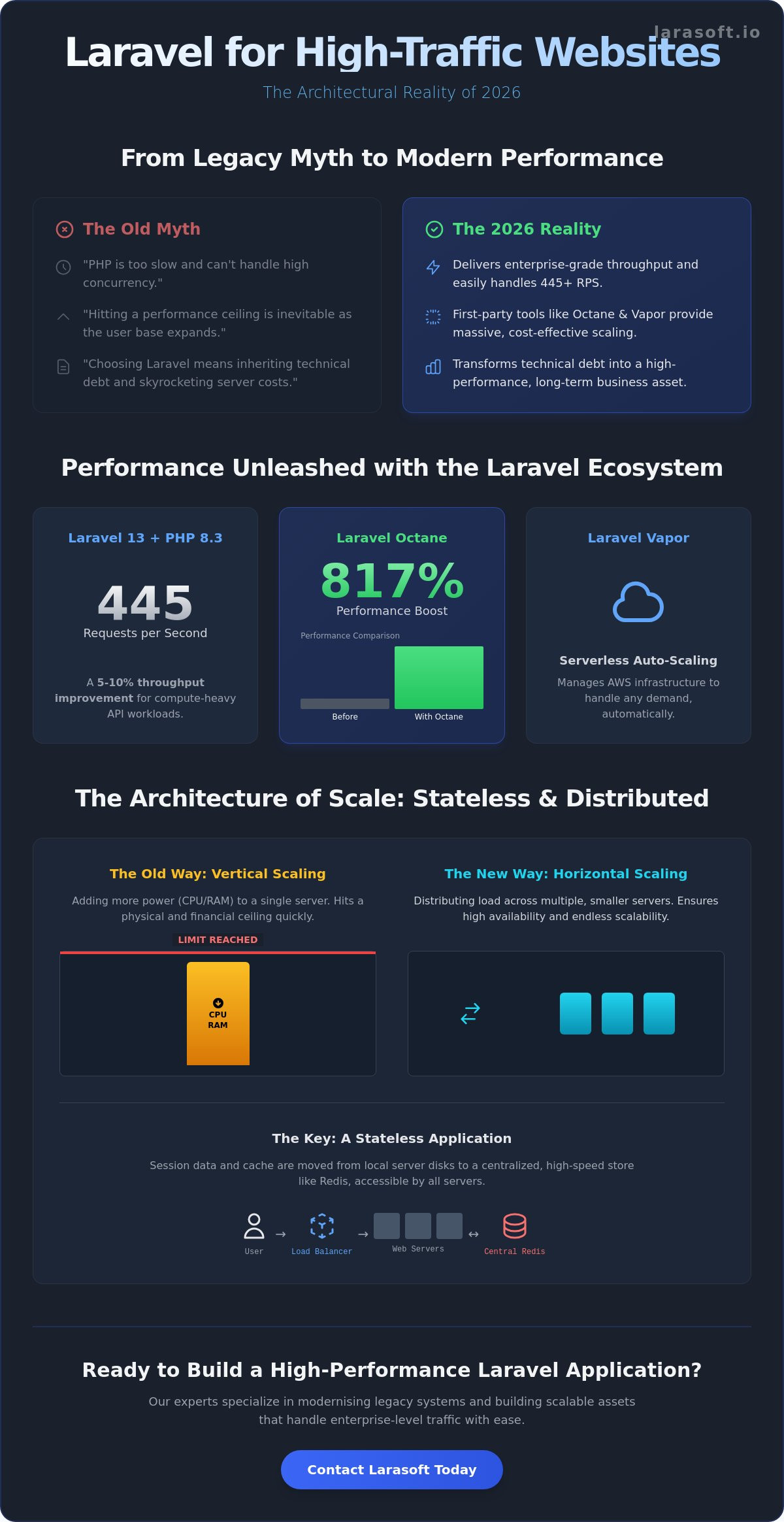
The assumption that Laravel cannot compete with Node.js or Go for high-concurrency systems is a legacy myth that ignores the architectural reality of 2026. Many decision-makers fear that choosing PHP means inheriting technical debt or hitting a performance ceiling as their user base expands. You likely worry that slow page load times during traffic spikes or skyrocketing server costs are inevitable trade-offs for developer productivity. However, utilizing laravel for high traffic websites is no longer a compromise between speed and elegance. With the release of Laravel 13 and its requirement for PHP 8.3, the framework delivers enterprise-grade throughput that handles approximately 445 requests per second for API endpoints with ease.
We understand the pressure of building a platform that must remain stable under massive loads while keeping infrastructure costs manageable. This article provides a clear architectural roadmap for scaling your application using Laravel's modern ecosystem. You'll discover how tools like Laravel Octane can boost performance by up to 817 percent and how serverless deployment via Laravel Vapor simplifies global scaling. We will break down the transition from monolithic structures to stateless, high-performance architectures that turn your software into a long-term business asset rather than a liability.
The perception of high traffic has shifted significantly. In 2026, we define enterprise-level load not by monthly visitors, but by sustained requests per second (RPS) and the ability to manage thousands of concurrent users without latency. The Laravel framework has evolved alongside these demands. With the release of Laravel 13, the ecosystem leverages PHP 8.3 to achieve a 5 to 10 percent improvement in throughput for compute-heavy workloads. This isn't the PHP of a decade ago. Modern execution speeds and sophisticated memory management mean that utilizing laravel for high traffic websites is a viable, high-performance strategy for global platforms.
The "PHP is slow" narrative is an outdated relic. When compared to other interpreted languages, Laravel often matches or exceeds performance in real-world scenarios, especially when properly optimized. Major global brands have utilized components of the framework to handle millions of interactions. The strategic advantage lies in its security-first ecosystem. It provides a mature foundation for rapid, reliable growth that many newer frameworks haven't yet matched.
Laravel facilitates a transition from rigid monoliths to flexible, modular systems. Through Composer and Service Providers, developers can isolate core logic and prevent the application from becoming an unmanageable mess. For high-performance API endpoints, we often strip away unnecessary MVC overhead to ensure maximum speed. This is where bespoke application development becomes critical. By tailoring the framework to your specific business logic, we eliminate the bloat found in off-the-shelf software. Every line of code serves a purpose.
Security cannot be an afterthought when scaling. Laravel provides built-in protection against SQL injection, cross-site request forgery (CSRF), and cross-site scripting (XSS) by default. These safeguards remain robust even during massive traffic surges. The authentication layer handles thousands of simultaneous logins through efficient session management and hashed password storage. Ultimately, the scalability of laravel for high traffic websites is a deliberate architectural choice rather than a native limitation of the framework itself.
Scaling laravel for high traffic websites requires a fundamental shift from vertical to horizontal infrastructure. Vertical scaling, or simply adding more RAM and CPU to a single server, eventually hits a physical and financial ceiling. We recommend horizontal scaling once you anticipate traffic that exceeds the capacity of a single high-performance instance. This approach allows you to distribute load across multiple web servers, ensuring that if one node fails, the others continue to serve traffic without interruption. It's the standard for maintaining high availability in enterprise environments.
To support this distribution, your application must be stateless. This means the server shouldn't store any data locally that other servers might need to access. We move session data and cache drivers off the local disk and into a centralized store like Redis. Redis acts as a lightning-fast, in-memory data structure store that ensures every server in your cluster has access to the same user state. Utilising Content Delivery Networks (CDNs) further optimizes this by offloading static asset delivery to edge locations, keeping your application servers focused on processing dynamic requests.
For those seeking a modern, hands-off approach, Laravel Vapor offers a serverless environment that auto-scales based on real-time demand. It manages the underlying AWS infrastructure, allowing your application to handle thousands of concurrent requests without manual intervention. For businesses looking to transition away from fragile, unoptimized infrastructure, our team provides expert Laravel web development to ensure your platform remains resilient under pressure.
Heavy tasks like sending emails or generating complex reports shouldn't happen during the request-response cycle. We use Laravel Horizon to provide real-time monitoring for high-volume background jobs. By offloading these processes to asynchronous workers, the user experience remains snappy even during traffic spikes. Effective queue management also involves handling "backpressure," where we strategically throttle job processing to prevent overwhelming downstream services or your primary database.
The database is often the first point of failure under stress. We implement read/write splits, directing all data modifications to a primary database while distributing read queries across multiple replicas. Within the code, we prioritize Eloquent eager loading to eliminate the N+1 query problem, which can otherwise trigger hundreds of unnecessary database hits per page load. Strategic database indexing remains the single most effective quick win for resolving performance bottlenecks in slow laravel for high traffic websites.
Choosing the right technology stack is a strategic decision that directly affects your bottom line. While some teams chase the latest trend, successful UK businesses prioritize framework maturity and developer velocity. Laravel's primary advantage is how quickly a team can build and scale complex features without reinventing the wheel. This speed directly reduces the Total Cost of Ownership (TCO) when deploying on enterprise clouds like AWS or Azure. When you're managing laravel for high traffic websites, every hour saved in development translates to faster market responsiveness and lower operational overhead.
Unlike Node.js, where developers often piece together disparate libraries for basic functionality, Laravel offers a "batteries included" ecosystem. Tools like Pulse for health monitoring and Horizon for queue management are first-party products. They're designed to work together perfectly. This cohesion is vital for maintaining performance, as it eliminates the integration friction that often causes bottlenecks in other stacks. Furthermore, finding expert Laravel developers in the UK is significantly easier than sourcing specialists for niche or emerging frameworks. This talent availability ensures your project remains maintainable for years. You aren't just building a product; you're creating a foundational asset for your company's future.
Laravel Octane bridges the performance gap between PHP and Node.js. By utilizing high-performance application servers like Swoole or RoadRunner, Octane keeps your application in memory, eliminating the overhead of booting the framework for every request. Benchmarks show an 817 percent increase in requests per second and an 84 percent drop in response time. It's an essential tool for high-concurrency API requests, though it's best reserved for projects where raw throughput is the primary requirement.
Native security features in Laravel protect against common vulnerabilities without the manual configuration required in frameworks like Express or Django. This standardization is a massive advantage during rapid scaling, as it prevents human error from exposing data. If you're working with older systems, investing in legacy code modernisation is a strategic move to close security gaps before they become liabilities under heavy load. This proactive approach ensures that laravel for high traffic websites remains a secure, reliable choice for 2026 and beyond.
Preparing laravel for high traffic websites requires a systematic approach that moves beyond basic code fixes. You must start with a comprehensive performance audit. We use specialized profiling tools to identify exact bottlenecks, whether they're unoptimized database queries or memory-intensive loops. Once you've mapped the pressure points, the next step is implementing multi-layer caching. This involves configuring OpCache for PHP script execution, using Redis for application data, and leveraging database query caching to reduce the load on your primary storage engine. These layers act as a buffer, ensuring your server doesn't repeat the same expensive computations for every visitor.
The transition to a high-performance environment also involves optimizing your deployment pipeline. We recommend zero-downtime deployments using tools like Laravel Forge or Envoyer. This ensures that pushing new code doesn't interrupt active user sessions or cause temporary site outages during peak hours. Finally, establishing real-time monitoring and automated alerting systems allows you to respond to issues before they impact your users. It's about moving from reactive fixes to a proactive, disciplined maintenance cycle that protects your digital assets.
Decoupling your frontend is a strategic move to reduce server-side rendering load. By utilizing Vue.js frontend development, you shift the UI processing to the user's browser, which significantly lowers the payload on your Laravel backend. For high-traffic dashboards, we often choose between Inertia.js for seamless development or a full SPA architecture for maximum client-side performance. Efficient JSON API design further ensures that your server only sends the data the user needs, keeping response times low even as your user base grows. If you're ready to build a system that scales without friction, our team provides the specialized Laravel web development required for enterprise success.
Visibility is the key to managing laravel for high traffic websites effectively. We utilize Laravel Pulse to track slow routes, heavy database users, and server health in real-time. This data allows us to set up automated scaling triggers based on CPU and memory usage, ensuring your infrastructure expands automatically during a traffic spike and shrinks during quiet periods to save costs. Before any major product launch, we conduct rigorous load testing to simulate thousands of concurrent users. This stress testing reveals how the system behaves under extreme pressure, allowing us to fine-tune the architecture for maximum reliability.
Standard software licenses often fail because they are built for the average user, not the enterprise outlier. At Larasoft, we recognize that off-the-shelf solutions frequently buckle under the weight of unique business logic and high concurrency. Our focus is on engineering custom-built laravel for high traffic websites that prioritize structural integrity over generic features. By stripping away framework bloat and focusing on clean, efficient code, we ensure your platform remains responsive when it matters most. This approach transforms your software from a recurring expense into a foundational business asset that supports sustainable growth.
We also leverage Laravel AI integration to handle high-volume data processing. As your user base expands, manual data management becomes a bottleneck. Our AI-driven solutions automate these complex tasks, allowing your core system to remain lean and fast. This isn't just about adding new features; it's about building intelligence into the architecture to maintain performance at scale. Combined with our commitment to long-term software maintenance and technical SEO, we provide a comprehensive strategy that keeps your application at the cutting edge of the UK digital landscape. We don't just build for today; we build for the traffic levels you expect in 2026 and beyond.
Many UK enterprises struggle with performance debt. This is the accumulated lag caused by outdated libraries and unoptimized queries in older systems. Our methodology for legacy code modernisation focuses on identifying these hidden bottlenecks without disrupting your current operations. We specialize in migrating high-traffic systems to modern Laravel versions, ensuring a seamless transition that eliminates technical debt. We have successfully transformed struggling legacy platforms into scalable market leaders by refactoring core database interactions and implementing modern, stateless architectures that thrive under pressure.
We position ourselves as a deeply invested technical ally rather than a simple service provider. This partnership model means we take immense pride in the cleanliness and efficiency of our work. Clean code isn't just a matter of professional pride; it directly reduces long-term maintenance costs and improves system stability under high load. We find genuine satisfaction in building systems that perform perfectly when the stakes are highest. If your current application is struggling to keep pace with your growth, the next step is simple. We invite you to request a comprehensive technical audit to identify the precise architectural shifts required to secure your platform’s future as a leader in laravel for high traffic websites.
The transition to a high-concurrency environment requires more than just a framework; it demands architectural discipline and a commitment to clean code. By leveraging the performance gains of Laravel 13 and implementing a stateless, horizontally scalable infrastructure, you transform your application into a resilient business asset. We've established that laravel for high traffic websites is a reality when you combine modern PHP 8.3 execution with strategic caching and asynchronous queue management. These structural choices ensure your system remains stable while keeping infrastructure costs manageable as your user base expands.
As UK-based Laravel specialists since 2018, we've spent years refining our expertise in legacy code modernisation and high-performance Vue.js frontends. We specialize in bespoke, scalable software architecture designed to handle the unique pressures of enterprise-level traffic. Our team acts as a dedicated technical ally, ensuring your digital platforms are both innovative and disciplined. Discuss your high-traffic Laravel project with our expert team to begin building a system that performs perfectly under pressure. Your journey toward a faster, more reliable application starts with a single architectural shift.
Laravel is highly capable of handling millions of visitors when the underlying architecture is designed for statelessness. By moving sessions and cache to Redis and using horizontal scaling, the framework supports massive concurrency without degradation. Many enterprise platforms choose laravel for high traffic websites because it balances this performance with rapid development cycles and a secure, mature ecosystem.
Laravel Octane boosts performance by keeping the application in memory between requests, which eliminates the boot-up overhead of traditional PHP-FPM. Using high-performance servers like Swoole, Octane can increase requests per second by up to 817 percent. This makes it an essential tool for high-concurrency API endpoints and compute-heavy tasks that require near-instant response times.
Laravel handles real-time data processing efficiently through first-party tools like Laravel Reverb and Echo. These tools manage WebSocket connections to push updates to thousands of users simultaneously without refreshing the page. In Laravel 13, the introduction of a database driver for Reverb has further simplified the scaling process for real-time features in smaller to mid-sized applications.
The best hosting environment for a high-load application is a cloud-native setup on AWS or Azure managed via Laravel Forge or Vapor. Serverless deployment with Laravel Vapor is particularly effective as it auto-scales infrastructure in response to real-time traffic spikes. This setup ensures high availability while reducing the manual effort required to manage server clusters and load balancers.
Laravel scales as effectively as Node.js for enterprise applications while offering superior developer velocity and a more cohesive ecosystem. While Node.js has historically led in raw I/O throughput, laravel for high traffic websites now closes that gap using Octane. The framework's standardized structure also reduces the risk of technical debt, making it a more stable choice for long-term project longevity.
You can identify bottlenecks using real-time monitoring tools like Laravel Pulse, which tracks slow routes and heavy database users. Telescope and external profilers also help locate N+1 query issues or memory-intensive processes that slow down execution. Regular performance audits are necessary to ensure that your code remains optimized as your user base and data volume grow.
Maintenance costs are generally lower for Laravel applications due to the framework's standardized syntax and extensive documentation. While scaling any high-traffic site involves infrastructure costs, Laravel's first-party tools like Horizon and Pulse help you optimize resource usage. Investing in specialized software maintenance ensures your code stays clean, preventing the performance debt that leads to expensive emergency fixes later.
We usually recommend a modular monolith for scaling unless your organization has multiple independent teams that require decoupled deployments. Laravel's service providers and directory structure allow you to build a majestic monolith that is easy to manage and test. Microservices often introduce unnecessary network latency and complexity that can actually hinder performance for most high-traffic business applications.
Here’s what we've been up to recently.
Certified Quality. Great Prices