Headless CMS with Laravel Backend: Architectural Guide & Framework Comparison

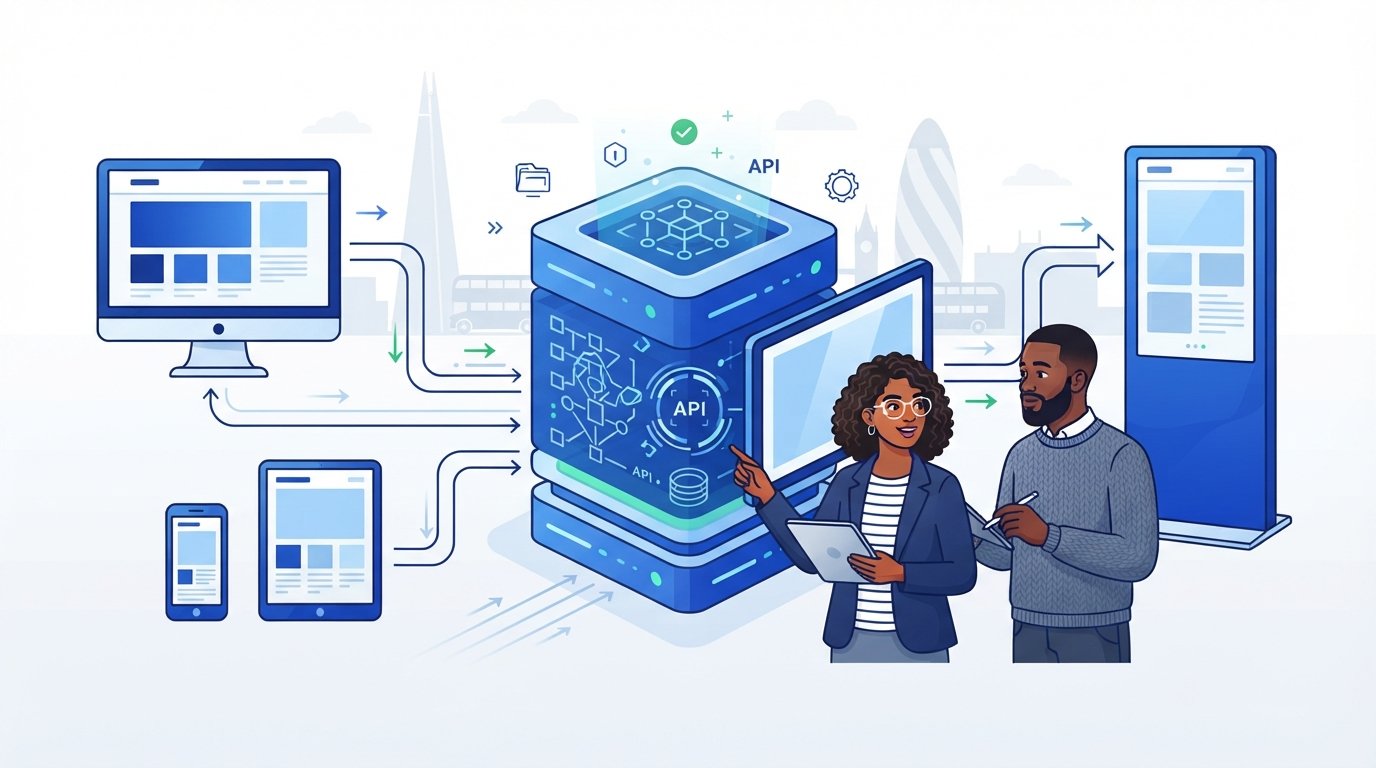
Monolithic architectures are no longer just throttling page performance; they're actively holding back product development. You've likely felt the friction of forcing complex business logic into rigid plugins, or watching SaaS subscriptions spiral while third-party vendors lock away your core data. Adopting a headless cms with laravel backend resolves this compromise. It unifies the structural elegance and security of PHP's flagship framework with the absolute freedom of decoupled, multi-channel presentation.
You'll discover how pairing a headless CMS with a Laravel backend empowers engineering teams to build scalable, high-performance digital platforms that serve your business for years to come. We compare the leading architectural patterns, evaluating purpose-built platforms like Statamic against admin engines like Filament and bespoke REST or GraphQL APIs. Along the way, we explore the caching pipelines and webhook invalidation strategies required to achieve sub-second content delivery across web, native mobile, and third-party endpoints.
A decoupled setup fundamentally reimagines how content moves from your database to your users. Instead of coupling template rendering with data persistence, a headless content management system separates editorial workflows from presentation logic entirely. The backend functions as an API-first engine, exposing structured JSON payloads across digital channels without dictating layout or design.
Deploying a headless cms with laravel backend gives engineering teams complete control over their architectural foundation. Rather than wrestling with the limitations of generic SaaS vendors, you gain an adaptable ecosystem where content, custom business logic, and transactional data coexist cleanly. Laravel handles core operations like data sanitisation, relational modeling, and authentication, while your client applications consume and render that data independently.
This decoupling offers tangible business advantages:
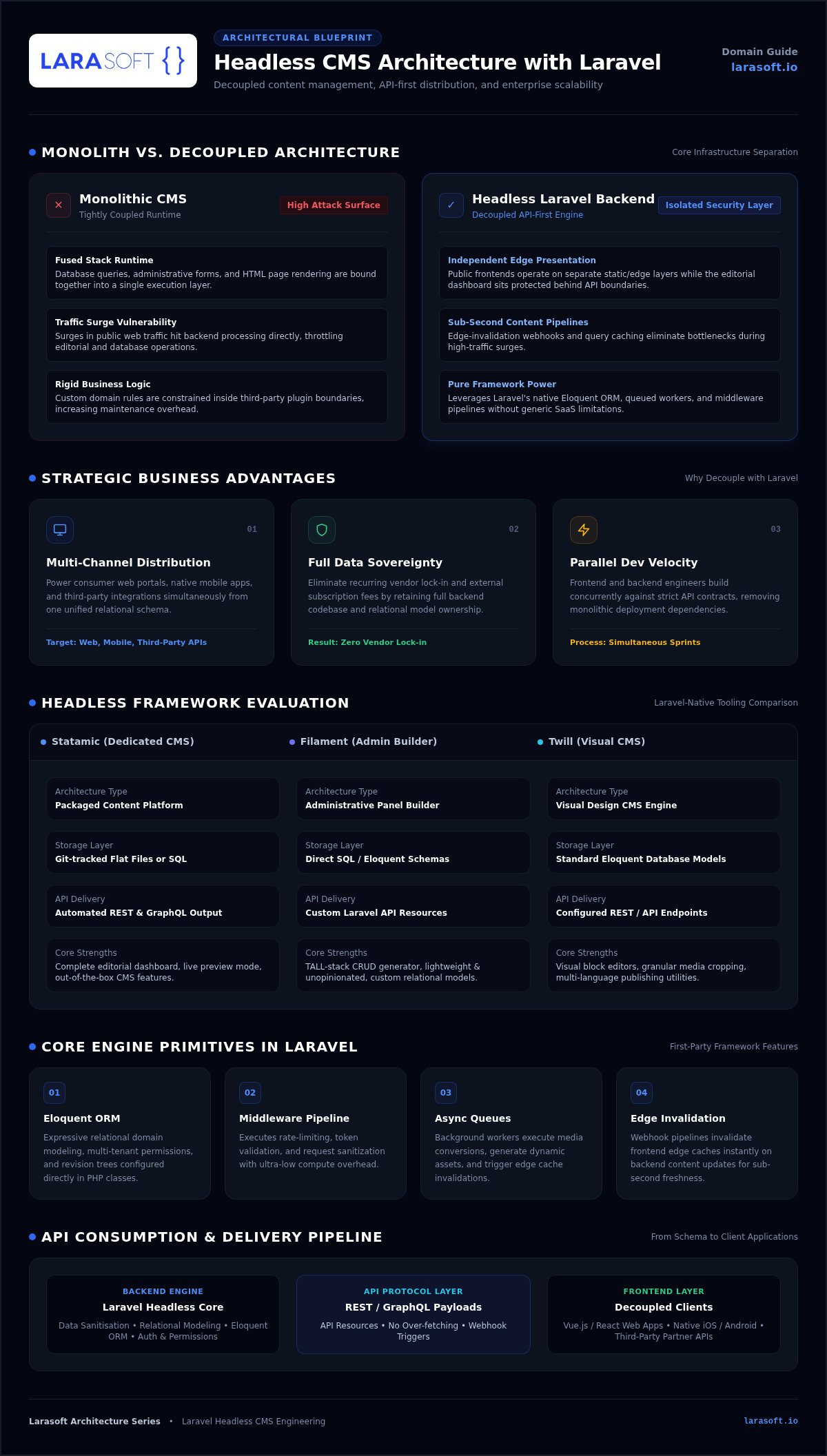
Monolithic systems fuse database queries, administrative forms, and HTML page rendering into one tightly coupled runtime. When high traffic surges hit the public interface, backend processing stalls. A headless architecture isolates these concerns. The public frontend lives on a separate edge or static layer, while your editorial dashboard sits securely behind a protected API boundary. This separation dramatically shrinks the public attack surface, removing the vulnerabilities that routinely plague traditional monoliths.
Laravel provides an enterprise-ready foundation tailored for high-volume API distribution. With its expressive Eloquent ORM, teams can construct intricate domain relationships that extend far beyond standard blog posts or marketing pages. Complex relational hierarchies, multi-tenant permission layers, and granular revision trees are configured cleanly using standard PHP classes.
Building a headless cms with laravel backend also grants access to first-party architectural primitives. Robust middleware pipelines handle rate-limiting and token verification with minimal overhead. Asynchronous queue workers process media conversions, generate dynamic assets, and dispatch edge invalidation webhooks in the background. Your content delivery endpoints stay lean, resilient, and ready to scale under peak demand.
Engineering teams assessing a headless CMS with Laravel backend face an architectural fork: install a packaged content framework or engineer a bespoke solution directly on top of the framework's primitives. While third-party JavaScript solutions often treat relational data as an afterthought, Laravel offers mature, PHP-native engines designed to suit distinct operational scales.
Choosing the right approach comes down to your content structures, publishing cadence, and custom logic requirements.
Statamic acts as a dedicated content management system out of the box. Supporting both Git-tracked flat files and standard SQL databases, it includes an established editorial UI, live previews, and automated REST and GraphQL output. Twill takes a visual design approach, offering block editors, granular media cropping, and multi-language publishing utilities on top of standard Eloquent models.
Filament operates differently. It is an administrative panel builder rather than a traditional CMS. Built on the TALL stack, Filament rapidly generates CRUD interfaces straight from your database schema. It doesn't ship with visual page builders or preview systems natively, but its lightweight, unopinionated structure provides an exceptional admin dashboard for custom Eloquent data.
How you distribute your content matters just as much as how you manage it. Teams configuring their API layer typically evaluate two core paradigms:
Decoupled environments require robust network hygiene regardless of the protocol. Your engineering team must configure Cross-Origin Resource Sharing (CORS) securely within Laravel to handle preflight OPTIONS checks and protect session cookies when communicating across distinct domains.
Packaged options excel when your primary requirement is marketing copy and editorial articles. However, enterprise platforms frequently need custom calculation engines, complex third-party ERP synchronisation, and bespoke data sanitisation rules that rigid CMS plugins fight against.
Building a custom headless cms with laravel backend guarantees zero licensing overhead, removes unused dependencies, and lets you craft database indexes strictly for your access patterns. If you are weighing whether to adopt a pre-built tool or engineer proprietary architecture, working with a vetted laravel development agency can clarify the long-term maintenance implications. For teams ready to evaluate their custom architecture, partnering with the engineers at Larasoft ensures your platform is built for scalable, lasting performance.
Separating content presentation from business logic unlocks complete creative and technical freedom. While legacy systems restrict your frontend to rigid templating engines, an API-driven presentation layer lets engineering teams deploy whatever client technology best serves the user experience. A well-architected headless cms with laravel backend serves as an agnostic data hub, streaming structured payloads to server-rendered web applications, mobile screens, or public kiosks.
Operating across decoupled environments demands strict network hygiene. When structuring endpoints, aligning your implementation with the OWASP REST Security Cheat Sheet ensures authentication tokens, request payloads, and rate limits remain fortified against client-side exploitation.
Search visibility requires fast initial page loads and crawlable markup. Pairing Laravel with server-side rendering (SSR) frameworks like Nuxt or Next.js addresses this requirement directly. These runtimes consume Laravel endpoints during server execution to generate static HTML, hydration scripts, and dynamic metadata.
Client applications communicate via lightweight fetch clients backed by strict TypeScript interfaces. For a deeper breakdown of crafting performant client architectures, explore our guide to vue.js frontend development. For reactive interfaces, Laravel Echo broadcasts database events directly to the frontend over WebSockets, updating UI components without manual page refreshes.
A headless architecture eliminates the redundant work of maintaining separate content feeds for distinct operating systems. A single Laravel API fuels iOS, Android, and web platforms simultaneously:
/api/v1/) isolate mobile app releases, ensuring legacy mobile clients continue functioning smoothly as content schemas evolve.Decoupled systems often frustrate editorial teams when changes cannot be reviewed prior to publishing. Bridging this gap requires dedicated preview routing. Editorial dashboards generate short-lived, signed preview tokens that instruct the decoupled frontend to bypass static caches and fetch draft records directly from an authenticated Laravel endpoint.
Once content is approved, Laravel model observers dispatch HMAC-signed webhooks to edge runtimes. This triggers on-demand incremental static revalidation (ISR), updating specific routes globally within milliseconds without requiring full site rebuilds.
A decoupled architecture is only as dependable as its backend infrastructure. When client applications query your content pipeline concurrently across global networks, raw database throughput and API hardening dictate overall stability. Operating an enterprise-grade headless cms with laravel backend requires proactive cache orchestration, strict query discipline, and zero trust across external network boundaries.
Scaling high-volume content delivery relies on engineering systems that eliminate runtime overhead long before requests reach your database.
Every dynamic query represents potential latency. To preserve responsive API throughput under extreme traffic spikes, configure multi-tiered caching strategies:
Cache-Control and ETag headers so edge CDNs can serve unmutated content paths directly, bypassing PHP runtime boot cycles.For demanding environments, deploying Laravel Octane keeps the framework bootstrapped in memory. This eliminates per-request bootstrapping penalties, dropping raw application latency to single-digit milliseconds.
Headless setups inherently limit public vulnerability by shielding administrative interfaces behind private networks. However, your exposed API endpoints still require uncompromising protection. Enforce granular role-based access control (RBAC) across administrative endpoints using Laravel Policies, ensuring authors and reviewers modify only authorized content fragments.
Apply rate-limiting middleware to shield your infrastructure from automated scraping, credential stuffing, and volumetric denial-of-service attempts. Sanitise incoming API payloads through dedicated Form Request classes to neutralize cross-site scripting risks before persistent storage occurs.
Transitioning from an unstable legacy monolith to an API-first platform doesn't necessitate an all-at-once rewrite. Engineering teams can deconstruct older systems incrementally using the strangler-fig pattern, extracting distinct content models into clean Eloquent representations one domain at a time.
This phased migration preserves critical data relationships and maintains daily business continuity. To plan your system transition safely, explore our strategic approach to legacy code modernisation. When you are ready to modernise your core architecture without operational downtime, consult our engineering team to map out a seamless, high-performance migration plan.
Engineering a decoupled architecture demands rigorous preparation before the first line of code is committed. Monolithic projects often tolerate ambiguous requirements because frontend views and database queries evolve together. With a headless cms with laravel backend, your APIs serve as public-facing contracts. Unplanned modifications to field types or relational nesting break downstream consumers instantly. Careful domain scoping protects your delivery schedule and system integrity.
Treating your content structure as an isolated domain model allows your engineering teams to parallelise development across web, mobile, and administrative interfaces without bottlenecks.
A structured implementation pipeline keeps complex decoupled deliveries predictable. We recommend executing in four defined phases:
A headless setup represents a long-term software asset, not a static marketing installation. The development partner you select must demonstrate deep competency across API design, caching infrastructure, database indexing, and modern JavaScript frontends. Agencies that only build standard theme-based sites often struggle with state management, CORS debugging, and decoupled authentication lifecycles.
Look for partners who emphasise clean code architecture, strict data sanitisation, and structured software maintenance. They should view your platform as an evolving system requiring routine dependency updates, query profiling, and automated regression testing. Ready to architect your platform? Collaborate with Larasoft on your custom Laravel project to build an agile, scalable digital foundation tailored to your business operations.
Monolithic constraints and rigid SaaS subscriptions shouldn't dictate your digital roadmap. Transitioning to a headless cms with laravel backend hands architectural ownership back to your business. Whether you deploy pre-built engines like Statamic or craft tailored REST and GraphQL pipelines around Eloquent, decoupling isolates your editorial workflows from frontend presentation. Paired with disciplined database indexing and strategic caching layers, your infrastructure stays fast and reliable under heavy multi-channel traffic.
Realising these performance gains requires deep technical alignment across backend database design and modern frontend runtimes. As a dedicated UK engineering team focused entirely on custom Laravel platforms, we bring a proven track record of delivering high-throughput API integrations, legacy refactoring, and clean reactive interfaces. We take pride in building maintainable software assets that stand up under pressure.
Architect your bespoke Laravel headless CMS with Larasoft and establish an agile, high-performance foundation built to support your long-term commercial growth.
Yes, Laravel provides an exceptional foundation for engineering an API-driven content architecture. It includes native database abstraction through Eloquent ORM, robust background queue workers, expressive routing, and battle-tested authentication tools out of the box. Pairing a headless cms with laravel backend allows engineering teams to merge custom content structures with proprietary business logic, complex database relationships, and granular permissions without the constraints of rigid legacy monoliths.
Statamic is a pre-packaged CMS built on Laravel that provides ready-to-use authoring interfaces, visual layout tools, and automated REST or GraphQL output. In contrast, a custom headless Laravel API is engineered from the ground up around your exact database schema using Eloquent models and dedicated API Resources. Statamic speeds up delivery for editorial teams, while custom APIs provide absolute architectural autonomy with zero licensing overhead.
Yes, multi-channel distribution is one of the primary advantages of decoupling. Because Laravel outputs structured, platform-agnostic JSON payloads, a single set of API endpoints can simultaneously feed server-rendered web applications alongside native iOS and Android apps. By maintaining versioned route prefixes, your engineering team can evolve content schemas and add fields without disrupting older mobile application builds still running in the wild.
Previewing draft content requires a secure handshake between the backend CMS and the detached frontend application. When an editor requests a preview, Laravel generates a signed, short-lived verification token and redirects the browser to a dedicated preview route on the frontend. The frontend application validates the token against the Laravel API, retrieves unpublished draft records, and renders an isolated live preview without exposing unapproved edits publicly.
SaaS platforms offer convenient cloud dashboards, but they introduce compounding subscription costs, API request caps, and total vendor lock-in. A bespoke headless cms with laravel backend ensures absolute data sovereignty and eliminates recurring user fees. You retain the ability to execute custom relational database queries, integrate proprietary algorithms, and run the backend within infrastructure that aligns directly with internal security and compliance requirements.
Decoupling delivers major performance and search visibility gains when paired with server-side rendering or static generation runtimes like Nuxt and Next.js. These frameworks pre-render static HTML and hydration bundles at the edge, generating sub-second Time to First Byte and strong Core Web Vitals scores. Laravel serves data via cached API endpoints, meaning traffic surges on public pages won't exhaust backend database connection pools.
The optimal authentication approach depends on the consuming client application. For decoupled single-page applications sharing a root domain, Laravel Sanctum using stateful, HTTP-only session cookies delivers robust protection against script injection vulnerabilities. For native mobile applications and external third-party endpoints, Sanctum issues cryptographically hashed personal access tokens. All private routes should pair these credentials with strict rate-limiting middleware and role-based policies.
Here’s what we've been up to recently.
Certified Quality. Great Prices