Legacy System Data Migration: 2026 Strategic Guide


According to Gartner research, 83% of data migration projects either fail outright or significantly overrun their original budgets and timelines. This staggering figure highlights the inherent risks of moving mission-critical information out of aging infrastructure. It's natural to feel concerned about potential data loss or the prospect of prolonged system downtime while executing a data migration from legacy system strategy. You're likely managing a complex web of messy, undocumented data that needs to fit into a modern schema without triggering a compliance nightmare under the Data (Use and Access) Act 2025.
We understand that a successful transition requires more than just moving records; it demands a precise architectural evolution. This guide provides a clear, risk-mitigated roadmap to help you master these complexities while ensuring absolute data integrity and business continuity. We'll explore how to move away from high-risk "Big Bang" transitions toward modern, event-driven synchronisation. You'll discover how a structured approach using Laravel 13 creates a scalable, AI-ready foundation that turns your legacy debt into a high-performance asset.
A robust data migration from legacy system strategy acts as the architectural blueprint for moving information between disparate storage types or formats. It's not a mere copy-paste exercise. Instead, it's a calculated transition that ensures your business logic remains intact while your infrastructure evolves. Without a clear framework, data remains trapped in legacy silos, where it's inaccessible to modern tools like Laravel AI integration. These silos hinder business growth by preventing a unified view of customer behaviour and operational efficiency.
The hidden costs of technical debt are substantial. McKinsey research indicates that approximately 40% of enterprise IT budgets are spent solely on patching and maintaining legacy applications. These systems aren't just expensive; they're security liabilities that lack the scalability required for 2026 market demands. Aligning your migration with long-term business objectives ensures that every step of the data migration lifecycle contributes to a faster, more resilient organisation.
Legacy infrastructure is inherently fragile. Manual data transfers often trigger catastrophic system failures because old databases struggle under the load of bulk exports. Beyond hardware risks, "dirty data", characterised by duplicates and inconsistent formatting, can cripple modern analytics and machine learning models. If your source data is flawed, your AI-driven insights will be equally unreliable. Compliance is another critical factor. Under the UK's Data (Use and Access) Act 2025, legacy systems that fail to meet modern encryption or lineage standards expose businesses to ICO penalties of up to £17.5 million or 4% of global turnover.
Successful transitions rely on measurable KPIs. You must establish strict uptime requirements, data integrity benchmarks, and performance targets before the first script is written. Prioritising data assets is equally important; focus on business-critical records and those required for regulatory necessity first. This phased approach reduces the blast radius of any potential issues. Data integrity is the absolute assurance that information remains accurate, complete, and consistent throughout its entire journey from the source system to the new Laravel-based architecture.
Selecting the correct pattern is the most critical decision in your data migration from legacy system strategy. It determines the length of your maintenance window and the pressure on your technical teams. The chosen pattern must align with your business continuity requirements and the underlying health of your source data. The choice between these patterns should be a central pillar of your data migration from legacy system strategy, balanced against your tolerance for downtime.
The "Big Bang" approach involves a full transfer of all data in a single, defined window. While it offers the fastest route to decommissioning old hardware, it carries a high-risk "all-or-nothing" profile. Conversely, phased migrations break the transition into manageable modules or sprints. Parallel migration involves running the old and new systems simultaneously to ensure data parity and zero downtime. Many UK organisations opt for hybrid strategies, using iterative steps for complex modules while executing a single cutover for simpler, isolated data sets.
While often discouraged for large enterprises, the Big Bang method remains viable for specific scenarios. If you're managing small data volumes or non-critical systems with low traffic, this approach can be cost-effective. Success hinges on exhaustive pre-migration testing. You must have a robust rollback plan ready; if the cutover fails, you need to revert to the legacy state within minutes to avoid operational paralysis. Following the GOV.UK legacy technology guidance helps assess whether your infrastructure is stable enough for this high-intensity transfer.
A phased approach reduces operational risk by migrating individual business processes one at a time. This allows your team to validate data integrity in a live environment without risking the entire organisation's output. It facilitates continuous feedback, letting you refine the new system based on real-world performance. This iterative cycle is central to effective legacy code modernisation, ensuring the final architecture is resilient and fit for purpose. If you're unsure which pattern fits your specific tech stack, our team can help you evaluate your migration readiness.
The technical engine of any successful data migration from legacy system strategy is the ETL (Extract, Transform, Load) process. This three-stage framework is where the actual re-engineering of your data happens. Legacy systems often rely on rigid, outdated relational schemas that don't align with the flexible, object-oriented structures found in modern Laravel environments. Schema mapping serves as the bridge between these worlds, defining how legacy fields correlate to modern attributes without losing historical context or transactional logic.
Before records reach their new destination, data cleansing is non-negotiable. This phase involves identifying and purging duplicates, resolving formatting inconsistencies, and reconciling orphaned records that no longer have a parent reference. It's about ensuring your new system starts with a clean slate. For UK organisations, maintaining data lineage is equally vital for compliance. You must establish a transparent audit trail that tracks every record from its source to its final destination, ensuring you can satisfy ICO inquiries under the Data (Use and Access) Act 2025.
Mapping shouldn't rely on guesswork or incomplete documentation. Advanced data profiling involves analysing the quality of legacy data to identify potential transformation bottlenecks before they stall the project. We use automated tools to uncover hidden relationships and dependencies within undocumented databases that manual audits often miss. By defining strict validation rules at this stage, we prevent the "garbage in, garbage out" scenario. This disciplined approach mirrors the GAO legacy system modernization practices that prioritise risk management and clear milestones during complex system retirements.
Technical friction frequently occurs during data type conversions and character encoding transitions, such as moving legacy records into a universal UTF-8 standard. These transformations are critical for ensuring that special characters and international datasets remain readable across your new platform. While the migration itself focuses on the move, API integration plays a supporting role by bridging legacy data with modern frontend solutions during the transition. Data migration is the one-time process of moving data from a source system to a target system, whereas data integration is the continuous practice of synchronising data between disparate systems in real-time.
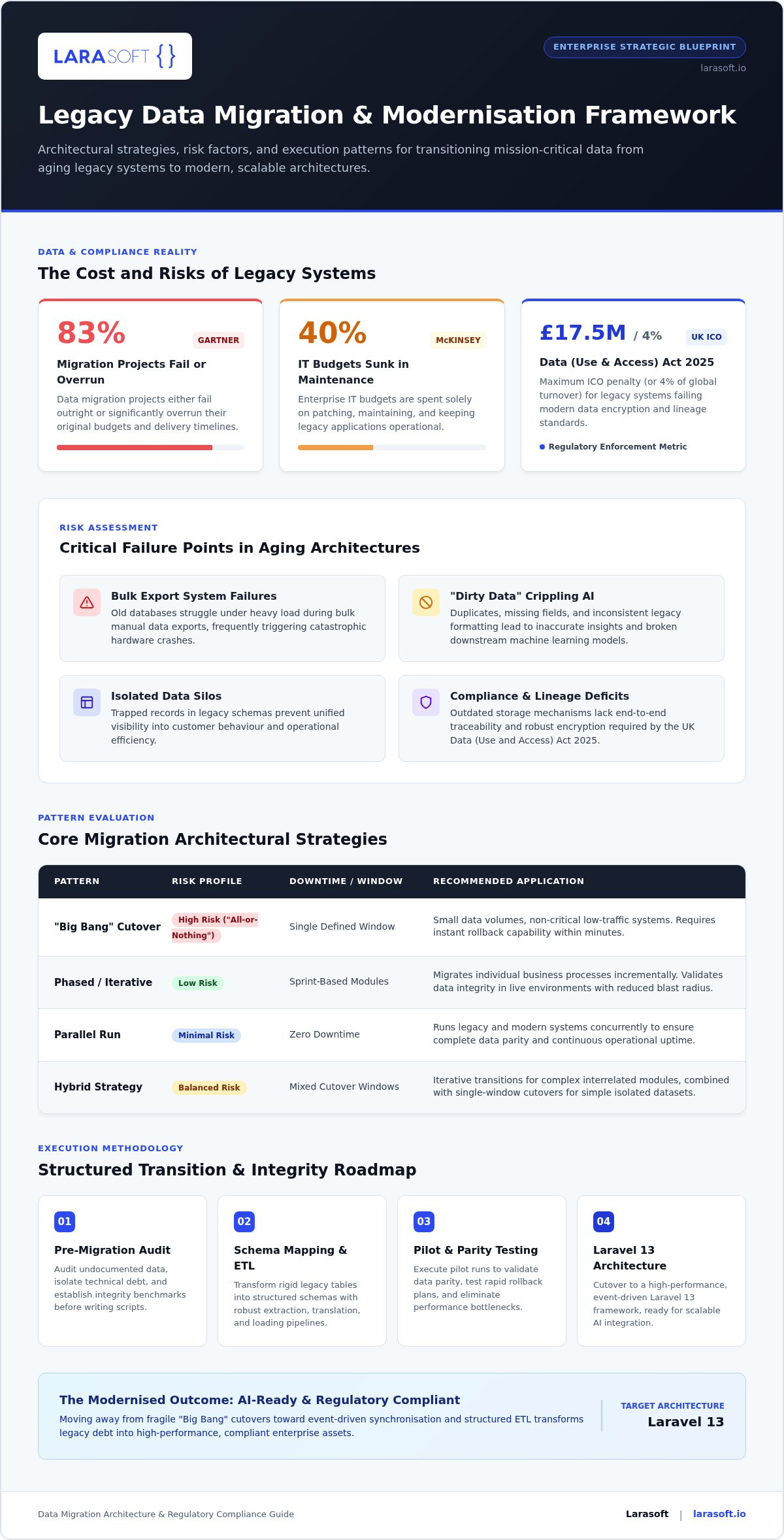
Execution translates your data migration from legacy system strategy into a functional reality. It starts with Phase 1: a comprehensive pre-migration audit. This involves cataloguing every data point, table relationship, and third-party dependency within your aging infrastructure. You cannot migrate what you don't fully document. This phase identifies the "ghost data" that often haunts legacy platforms, ensuring only valuable, clean information moves forward.
Phase 2 focuses on environment setup and pilot migration. Here, we test the transformation logic on a subset of real data in a staging environment. This allows us to identify edge cases and performance bottlenecks before the live event. Phase 3 is the execution phase, where we manage the live cutover or iterative rollout based on the patterns selected earlier. Finally, Phase 4 involves post-migration validation and decommissioning. We verify data parity across both systems before sunsetting the legacy platform to ensure no records were lost in transit. This structured approach is essential for any resilient data migration from legacy system strategy.
Meticulous testing prevents post-migration paralysis. We start by unit testing transformation scripts to ensure individual data fields map correctly. This is followed by integration testing of API endpoints to confirm the new architecture communicates effectively with external services. User Acceptance Testing (UAT) is perhaps the most vital step; it ensures your staff can perform critical business tasks without friction in the modernised environment. We also conduct performance testing to verify that the new system maintains high throughput under live data loads.
For UK organisations, governance is a legal necessity rather than an operational choice. Throughout the transfer of sensitive customer records, we ensure strict adherence to the Data (Use and Access) Act 2025. This involves implementing robust data encryption both at rest and in transit. We provide comprehensive documentation of the entire process, creating a clear audit trail for regulatory reporting and internal compliance reviews. If you need a partner to lead this high-stakes transition, contact our UK modernisation team to discuss your roadmap.
Laravel 13 has transformed the enterprise landscape, providing a first-class environment for complex transitions. Its ecosystem offers a distinct advantage when executing a data migration from legacy system strategy, primarily through built-in tools like Migrations and the Eloquent ORM. These features allow our developers to version-control database changes and manage intricate relationships with a level of precision that legacy PHP or COBOL systems simply cannot match. By using Eloquent, we translate messy legacy tables into clean, readable code that any modern developer can maintain.
Bespoke development provides a longevity that off-the-shelf software licenses never achieve. Proprietary platforms often force your unique business logic into a restrictive container, eventually creating new forms of technical debt. A custom Laravel build ensures your system scales with your specific operational needs. This flexibility is vital for Laravel AI integration. By moving your legacy data into a modern, structured format, you're not just moving records; you're creating a high-quality dataset ready for semantic search, vector databases, and predictive modelling.
We don't just move data; we revitalise the entire user experience. By pairing a robust Laravel backend with modern Vue.js or React frontends, we transform clunky legacy interfaces into high-performance digital platforms that staff actually enjoy using. Our experience includes complex projects like migrating a UK-based broadcaster to a modern ad management platform. This required a meticulous data migration from legacy system strategy to preserve decades of transactional records while introducing real-time scheduling and reporting. Successful modernisation doesn't end at the cutover. Ongoing software maintenance is essential to ensure your new foundation remains secure and optimised as new PHP versions and security standards emerge.
Transitioning away from legacy debt requires a partner who understands the intersection of business logic and technical execution. Consulting with a specialised Laravel development agency allows you to assess your current legacy estate and identify high-risk dependencies before they cause a failure. We work closely with your stakeholders to develop a custom modernisation roadmap that prioritises business continuity and data integrity. This structured approach ensures that your transition is a manageable journey toward growth rather than a chaotic technical hurdle. Ready to secure your data's future? Contact Larasoft for a strategic legacy audit and take the first step toward a scalable, modernised architecture.
Successful migration is more than a technical hurdle; it's an opportunity to rebuild your business on a resilient, high-performance foundation. By prioritising meticulous data mapping and selecting the right architectural patterns, you eliminate the risks of catastrophic downtime and data loss. Implementing a robust data migration from legacy system strategy ensures your organisation is ready for the demands of 2026, from strict compliance with the Data (Use and Access) Act to advanced AI integration.
Larasoft is your dedicated technical ally in this journey. As UK-based Laravel experts with a proven track record in technical modernisation, we specialise in complex API and AI integrations that turn aging systems into scalable assets. We take pride in the cleanliness and efficiency of our work, ensuring your transition is structured, transparent, and manageable. It's time to move beyond the limitations of legacy debt and build a system that performs perfectly under pressure. Partner with Larasoft to modernise your legacy systems today and secure your data's future with confidence.
The timeline varies based on the volume of records and the complexity of your current infrastructure. Small to mid-sized migrations typically span three to six months; however, enterprise-scale transitions often require nine to eighteen months. Factors like the quality of your source data and the specific requirements of your data migration from legacy system strategy influence this duration. We prioritise a structured roadmap to ensure every phase remains predictable and aligned with your business goals.
Research from Gartner indicates that 83% of migration projects either fail or significantly exceed their original budgets. The primary causes include flawed data profiling, undocumented system dependencies, and a lack of upfront validation. Many organisations underestimate the effort required to clean "dirty data" before the transfer begins. Without a rigorous strategy that accounts for these technical hurdles, projects often stall during the final cutover phase, leading to costly delays and operational disruption.
Achieving near-zero downtime is possible through modern techniques like Change Data Capture (CDC) and parallel system operation. Instead of a high-risk "Big Bang" cutover, we synchronise data incrementally between the legacy platform and the new Laravel architecture. This approach allows your team to validate data parity in real-time while keeping your daily operations active. It's a sophisticated method that minimises the maintenance window from several days to mere minutes or seconds.
A migration is a critical moment for your compliance posture. Under the Data (Use and Access) Act 2025, UK businesses must ensure strict data lineage and encryption during any transfer of personal information. Transitioning to a modern framework like Laravel 13 allows you to implement superior security primitives that legacy systems often lack. We document the entire process to satisfy Information Commissioner's Office (ICO) audits, turning a technical necessity into a regulatory advantage.
A "lift and shift" approach simply moves your existing application and its messy data to a new server without changing the underlying code. While fast, it doesn't solve technical debt. Full modernisation involves re-architecting your system using modern frameworks like Laravel and React. This strategic choice allows you to leverage API integrations and AI capabilities. It transforms a fragile legacy asset into a scalable, high-performance platform that supports long-term business growth.
We address undocumented data through advanced profiling and automated discovery tools. These technologies identify hidden relationships and inconsistencies within your legacy tables that manual reviews might miss. Once the data is mapped, we apply rigorous cleansing rules to remove duplicates and resolve formatting errors. This ensures that your new system isn't contaminated by "garbage in" scenarios. It's a disciplined part of a successful data migration from legacy system strategy.
While any new system requires an adjustment period, modernising with Vue.js or React frontends typically results in a more intuitive user experience. Staff often find these contemporary interfaces easier to navigate than clunky legacy software. We focus training on the new strategic features and improved workflows rather than basic navigation. Because the system is custom-built to match your specific business logic, the learning curve is significantly shorter than with off-the-shelf alternatives.
Yes, we provide an end-to-end service that encompasses both complex data migration and full-stack modernisation. Our team specialises in building bespoke Laravel backends paired with high-performance React or Vue.js frontends. We don't just move your data; we revitalise how your users interact with it. From initial pre-migration audits to post-migration software maintenance, we act as your dedicated technical partner to ensure your new platform performs perfectly under real-world pressure.
Here’s what we've been up to recently.
Certified Quality. Great Prices