GDPR Web Development: Architect’s Guide for 2026


With over €7.1 billion in cumulative penalties issued across the UK and EEA since 2018, the financial risk of regulatory oversight is no longer a theoretical concern for technical leaders. You're likely managing the mounting pressure of complex third-party data processors while wrestling with legacy systems that simply weren't built for modern privacy demands. Achieving true gdpr compliant web development requires moving beyond superficial fixes to address the structural integrity of your application. It's a shift from reactive patching to a disciplined, privacy-by-design architecture that protects both your users and your bottom line.
We understand the technical anxiety that comes with shifting mandates like the EU Cyber Resilience Act and evolving data residency requirements. This guide offers a clear technical roadmap to master the architectural strategies needed for 2026. You'll learn how to modernize legacy code, implement secure server-side tagging, and build scalable systems that turn compliance into a competitive advantage. We'll break down the transition from monolithic data handling to decoupled, secure vaults that foster genuine user trust through high-performance, reliable execution.
In 2026, data privacy is no longer a legal layer added to a finished product. It's a fundamental requirement of the system's architecture. Achieving gdpr compliant web development means ensuring that every line of code and every database schema prioritises the rights of the user. For UK businesses, this involves aligning with the evolved UK GDPR standards that demand higher levels of transparency and stricter controls over automated processing. While off-the-shelf software often relies on generic, "one-size-fits-all" data handling, bespoke development allows for the precise mapping of data flows required for modern auditing.
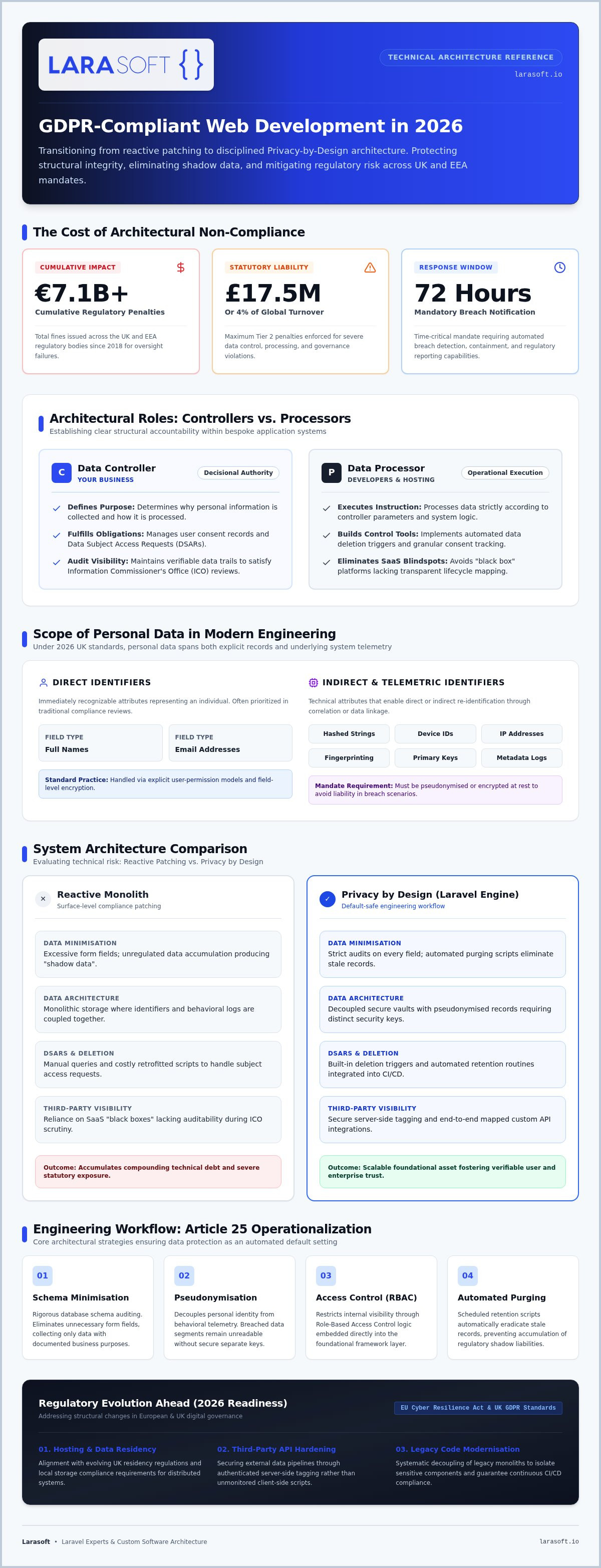
A critical part of this process is distinguishing between Data Controllers and Data Processors. Your business usually acts as the controller, deciding why and how data is processed. The developers and hosting providers act as processors. In custom architecture, we build the tools you need to fulfill your controller obligations, such as automated data deletion triggers and granular consent logging. Relying on third-party SaaS platforms often creates "black boxes" where you lack the visibility needed to prove compliance during an ICO audit. Custom builds using frameworks like Laravel provide the structural integrity needed to maintain full oversight of your data lifecycle.
Modern web applications collect vast amounts of information that many architects overlook. Beyond names and emails, your database likely stores indirect identifiers like hashed strings, browser fingerprinting telemetry, and device IDs. Under 2026 UK standards, personal data is any information that allows for the direct or indirect identification of an individual, encompassing everything from database primary keys to browser fingerprinting telemetry. We identify these identifiers early in the design phase to ensure they're pseudonymised or encrypted at rest. This prevents metadata and IP addresses from becoming liabilities in the event of a system compromise.
The risks of ignoring compliance during the initial build extend far beyond the Tier 2 fines of up to £17.5 million or 4% of global turnover. Architecture that treats privacy as an afterthought accumulates massive technical debt. Retrofitting a legacy system to support Data Subject Access Requests (DSARs) or the 72-hour breach notification mandate is significantly more expensive than building those capabilities into the core CI/CD pipeline. Larasoft integrates these requirements at the architectural level, utilizing the Privacy by Design framework to ensure data protection is a default setting rather than a post-launch patch. This disciplined approach builds user trust and ensures your application remains a scalable, foundational asset for your business future.
Privacy by Design (PbD) serves as the structural blueprint for gdpr compliant web development. It requires that data protection is embedded into the system architecture from the first line of code. Following the EDPB guidelines on Article 25 compliance, architects must ensure that privacy is the default setting. The seven core principles of PbD, such as being proactive rather than reactive and ensuring end-to-end security, are operationalised through specific engineering choices. We achieve this by implementing Role-Based Access Control (RBAC) to restrict internal data visibility and by automating data retention schedules directly within the application logic. This ensures the system doesn't require user intervention to protect their data; the protection is built into the foundation.
Effective database architecture begins with a strict audit of every form field. If a data point doesn't serve a specific, documented business purpose, it shouldn't be collected. In custom Laravel environments, we use pseudonymisation to decouple identifying information from behavioral data. This ensures that even if a database segment is exposed, the records remain non-identifiable without a separate, highly secure key. We also build automated purging routines. These scripts identify and delete stale data based on your specific retention policies, preventing the accumulation of "shadow data" that increases your liability. If you're struggling with bloated systems, our Legacy Code Modernisation services can help restructure your data layers for better safety.
Consent management must be more than a frontend banner. It requires a robust backend audit trail. Every time a user adjusts their preferences, the system should log the version of the privacy policy they agreed to, the specific timestamp, and the IP address. This programmatic approach ensures you can provide definitive proof of compliance during an audit. Additionally, we treat the Right to Erasure and Right to Access as core API endpoints. Instead of manual database queries, we build automated workflows that allow users to trigger data exports or account deletions. This reduces administrative overhead while ensuring your gdpr compliant web development strategy is both scalable and transparent.
Data residency remains a cornerstone of gdpr compliant web development. By 2026, UK businesses must ensure that personal data is stored within jurisdictions providing adequate protection levels. While the EU-US Data Privacy Framework remains legally valid following the General Court's decision in September 2025, it stays under appeal throughout 2026. We recommend maintaining Standard Contractual Clauses (SCCs) and Transfer Impact Assessments (TIAs) as essential architectural fallbacks. This redundant approach ensures your application remains compliant even if high-level political agreements shift, providing the business-centric reassurance needed for long-term growth.
Choosing a cloud provider with dedicated UK data centres is non-negotiable for low-latency, compliant operations. However, infrastructure is only as secure as its upkeep. Continuous server-side security patching and proactive software maintenance are required to defend against evolving threats. Following the ENISA data protection engineering guidance, we implement strict encryption standards, ensuring all data at rest and in transit utilises TLS 1.3 or higher. This level of structural discipline prevents unauthorised access and meets the rigorous technical standards expected during an ICO audit.
Third-party integrations often represent the weakest link in a web application's security perimeter. Research indicates that a median of 21% of external scripts are dynamically injected at runtime by tag managers or widget providers, creating significant joint-controller blind spots. To mitigate this risk, we audit every external service, from analytics suites to payment gateways. We ensure these services meet UK GDPR requirements before they're integrated into your custom build.
We implement proxy layers to sanitise data payloads before they leave your environment. This technique removes sensitive identifiers from the data stream, ensuring third-party APIs only receive the minimum information necessary to function. By combining this with Content Security Policies (CSP) and Subresource Integrity (SRI), we protect your application from DOM scraping and unauthorised script tampering. This creates a secure, resilient ecosystem where data flows are transparent and strictly controlled, allowing you to scale without compromising on privacy.
Most UK businesses aren't building from a clean slate. They're managing monolithic legacy systems that were architected long before modern privacy standards became mandatory. These older applications often represent the greatest obstacle to achieving gdpr compliant web development. Monolithic structures frequently hide "shadow data"—redundant or forgotten personal information residing in unencrypted tables or undocumented log files. Operating on these systems creates significant friction when attempting to meet the 72-hour breach notification mandate or responding to complex Data Subject Access Requests (DSARs). Without a clear map of your data flows, compliance remains an expensive, manual struggle rather than a streamlined process.
The technical risks are equally severe. Research shows that organisations require an average of 358 days to patch external and open-source vulnerabilities. In a legacy environment, this delay is often caused by the fear that updates will break fragile, interdependent code. This creates a dangerous security gap that regulators now view as a failure of "technical and organisational measures" under Article 32. Modernising your codebase isn't just about performance; it's a necessary step for regulatory safety and structural integrity.
We begin by mapping data flows within undocumented codebases to identify exactly where personal data enters, resides, and exits the system. This audit often reveals hard-coded identifiers and insecure storage practices that have persisted for years. We prioritise refactoring tasks based on regulatory risk, focusing first on the most exposed data points. This methodical approach ensures that your transition to a secure environment is logical and transparent, providing a clear audit trail for stakeholders. It turns a complex development challenge into a structured journey toward a more reliable, scalable application.
Migrating to a modern framework like Laravel provides immediate security benefits that simplify the compliance lifecycle. Laravel’s built-in encryption helpers and Eloquent ORM allow us to bridge legacy data into hardened, encrypted storage solutions with minimal downtime. By leveraging legacy code modernisation as a competitive advantage, you gain the ability to implement automated data retention policies and granular access controls that legacy monoliths cannot support. This transition ensures your software performs perfectly under pressure while building long-term user trust. If you're concerned about hidden liabilities in your current codebase, you can request a professional technical audit of your legacy systems to identify and remediate high-risk compliance gaps.
Compliance is not a static milestone. It's a living part of your software lifecycle. As of August 2, 2026, the EU AI Act has activated full investigative powers and transparency obligations for generative AI and chatbots. If you're implementing Laravel AI integration, your architecture must sanitize data before it ever reaches external models. This ensures your gdpr compliant web development strategy accounts for modern risks like prompt injection or accidental data leakage into third-party training sets. We treat these emerging regulations as technical requirements rather than administrative burdens, integrating them into the core of your application.
Technical SEO also plays a vital role in maintaining a secure site structure. Beyond keywords, a compliant architecture requires properly configured security headers, the elimination of PII from URL strings, and strict control over how metadata is indexed. A secure, well-structured site is a searchable site. By aligning your SEO strategy with your privacy framework, you create a digital asset that is both visible to your audience and resilient against regulatory scrutiny.
Maintaining a compliant state requires a steady rhythm of security audits and dependency patching. With the average supply-chain vulnerability remediation taking 358 days, a proactive approach to software maintenance is the only way to meet the 72-hour breach notification window required by Article 33. We monitor your system dependencies and update your privacy protocols as UK and EU regulations evolve. This disciplined approach ensures that your application maintains high performance while adhering to the strict data controls necessary for 2026.
For organizations in the industrial sector, this maintenance extends to specialized digital ecosystems like BRIO, where the integrated management of safety, hygiene, and maintenance operations must align with overarching data protection standards to ensure total regulatory safety.
We combine high-performance Vue.js frontend development with hardened backends to create seamless, secure user experiences. Our systems are built to be scalable, allowing your infrastructure to grow alongside your compliance requirements without requiring expensive retrofits. Larasoft’s commitment to Technical Artisanship ensures that every line of code is written with a focus on structural integrity and the long-term protection of your digital assets. We act as a deeply invested technical ally, transforming complex regulatory hurdles into a manageable, structured journey toward sustainable growth.
Building for the regulatory landscape of 2026 requires a shift from superficial frontend fixes to deep architectural discipline. True gdpr compliant web development is achieved through Privacy by Design, secure UK-based hosting, and the elimination of shadow data within monolithic legacy systems. We've seen how modernising your codebase and implementing automated data retention policies turn complex legal requirements into a scalable business asset. These technical interventions don't just mitigate risk; they foster the user trust necessary for long-term growth.
Larasoft acts as your dedicated technical ally, providing specialist expertise in legacy code modernisation and comprehensive software maintenance plans. Our team of UK-based expert Laravel developers takes pride in the cleanliness and efficiency of every build, ensuring your application remains secure and high-performing as mandates evolve. By treating compliance as a foundational pillar rather than a post-launch patch, you're investing in the longevity of your digital ecosystem.
Secure your application with Larasoft’s bespoke development services. Taking these proactive architectural steps today ensures your business is ready to navigate the complexities of tomorrow with confidence.
Compliance is defined by the integration of technical and organisational measures that protect personal data throughout its lifecycle. This includes implementing end-to-end encryption, granular consent management, and automated data deletion triggers. A compliant build ensures that data processing is limited to specific, documented purposes. It also requires the ability to fulfill Data Subject Access Requests (DSARs) within the statutory one-month window, providing a transparent audit trail for all processing activities.
Yes, UK businesses must adhere to the UK GDPR, which remains the primary framework for data protection in 2026. While the UK has the autonomy to deviate from EU standards, the core principles of accountability, transparency, and data minimisation remain identical. Maintaining alignment is also essential for businesses that serve users in the EEA to avoid severe Tier 2 violations, which can reach up to €20,000,000 or 4% of total worldwide annual turnover.
Laravel is a highly secure framework that provides the built-in tools necessary for gdpr compliant web development. It includes native features for data encryption, secure authentication, and protection against common vulnerabilities like SQL injection. While the framework itself is compliant, the ultimate responsibility lies with the architect to configure these tools correctly. We use Laravel to build custom logic for automated data retention and pseudonymisation, ensuring the application meets specific regulatory requirements.
Data residency dictates the physical location where your user data is stored and processed. For UK-based applications, using UK-specific data centres is the most reliable way to ensure compliance with national standards. It simplifies the legal complexities of international data transfers, especially as adequacy decisions like the EU-US Data Privacy Framework face ongoing legal challenges in 2026. Choosing domestic hosting also reduces latency and improves application performance for your primary audience.
You can often achieve compliance through targeted legacy code modernisation rather than a total rebuild. This process involves auditing the existing codebase to identify shadow data and insecure storage practices. We refactor specific modules to implement modern encryption and automated data purging routines. This approach remediates high-risk vulnerabilities and bridges your data to secure frameworks like Laravel, allowing you to meet regulatory standards without the disruption of a complete system overhaul.
Privacy by Design is an engineering approach where data protection is embedded into the system architecture from the outset. Instead of being a post-launch addition, privacy becomes the default setting of the application. This involves technical strategies such as data minimisation, where only essential information is collected, and the use of Role-Based Access Control (RBAC). It ensures that user rights are protected automatically through the system core logic and structural integrity.
We recommend conducting a comprehensive technical audit at least once a year or whenever significant changes are made to the application architecture. Regular audits help identify new vulnerabilities in third-party dependencies and ensure that your data processing activities still align with current UK GDPR standards. Ongoing software maintenance is essential here; it provides a structured rhythm for security patching and protocol updates, preventing the accumulation of technical debt that leads to non-compliance.
Third-party APIs significantly impact your compliance because you are often considered a joint controller for the data shared with these services. Failing to sanitise data payloads before they reach external analytics or payment gateways can lead to unauthorised data leaks. To ensure gdpr compliant web development, we implement proxy layers that strip sensitive identifiers from API requests. This ensures that external providers only receive the minimum data required to function, protecting your liability.
Here’s what we've been up to recently.
Certified Quality. Great Prices