Custom Property Management Software: 2026 Buyer's Guide

Why are you still paying a monthly "success tax" on every new unit you add to your portfolio? For many UK property managers, portfolio growth often triggers a frustrating climb in SaaS subscription fees, leaving you with software that feels more like a landlord than a partner. You shouldn't have to compromise your established workflows or settle for fragmented data just to keep your operations running.
We understand the pressure of managing complex portfolios with tools that refuse to talk to your accounting or CRM systems. Transitioning to custom property management software allows you to reclaim full ownership of your data and your internal processes. This guide outlines how a bespoke system can eliminate operational bottlenecks and provide a truly scalable foundation for your business. We'll explore the strategic shift from renting restrictive platforms to owning a foundational asset that integrates with your existing APIs and automates your team's specific requirements for 2026 and beyond.
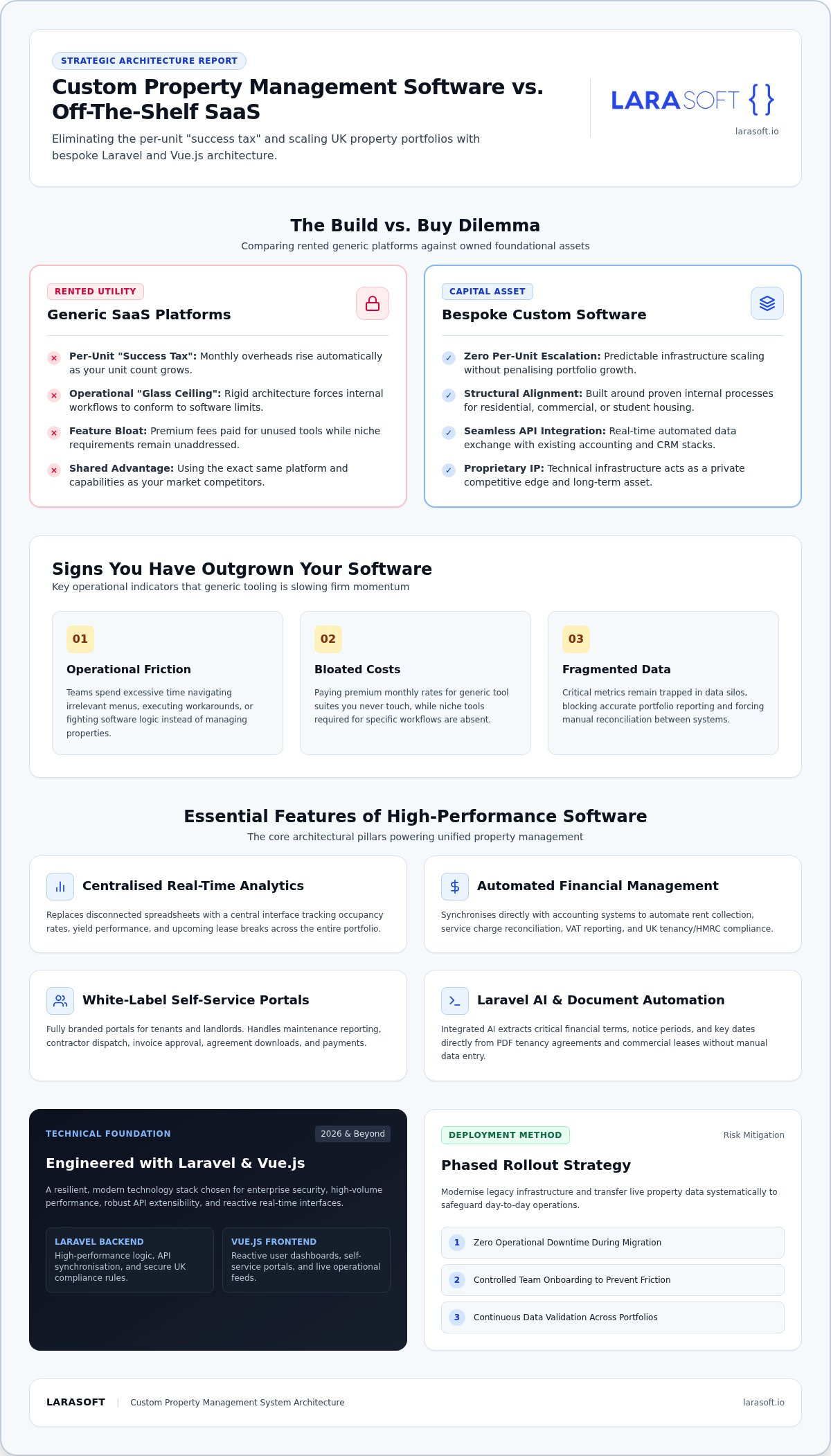
Scaling a property management firm in the UK often leads to a confrontation with the "glass ceiling" of standard SaaS platforms. While off-the-shelf products offer a quick start, they eventually impose a success tax through per-unit pricing. As your portfolio grows, your monthly overheads climb regardless of whether you are using the new features being rolled out. This creates a scenario where your software costs scale faster than your operational efficiency.
Choosing custom property management software represents a shift from renting a tool to owning a foundational business asset. Standard platforms force you to adapt your proven internal processes to fit their rigid architecture. This often results in workarounds that waste time and introduce human error. When your software dictates how you work, you've lost your competitive edge. Owning your intellectual property ensures that your technical infrastructure remains a secret weapon rather than a shared utility used by your competitors.
Recognising when to move away from generic platforms is vital for maintaining momentum. If your operations feel sluggish, consider these indicators:
A bespoke system isn't just about adding features; it's about structural alignment. Whether you manage student housing, commercial estates, or residential blocks, the software should reflect your specific workflow. By focusing on custom property management software, you can eliminate manual data entry through seamless API integrations with your preferred accounting or CRM tools. This ensures that data flows automatically across your entire technical stack, providing real-time clarity for decision-makers. Bespoke software serves as a long-term capital asset that secures your firm's intellectual property and operational independence.
Moving to a custom build allows you to automate the unique team structures you've spent years perfecting. Instead of settling for a one-size-fits-all approach, you create a system that performs perfectly under the specific pressures of your market. This transition marks the point where your technology finally catches up to your business's ambition.
High-performance custom property management software acts as the central nervous system for your real estate operations. It replaces fragmented spreadsheets with centralised dashboards that provide real-time portfolio analytics. You can track occupancy rates, yield performance, and upcoming lease breaks from a single interface. This level of visibility is essential for making informed investment decisions and identifying underperforming assets before they impact your bottom line.
Automated financial management is a core pillar of this architecture. By synchronising with your accounting systems, the software handles rent collection, service charge reconciliation, and VAT reporting automatically. This reduces the risk of human error in complex calculations. While many firms look to UK private renting guidelines and legislation as a benchmark for compliance and reporting standards, your bespoke system should be built specifically to handle HMRC requirements and UK-specific tenancy laws.
White-label portals for tenants and landlords elevate your brand's professional image. Unlike generic SaaS portals, these are fully branded to your firm. Tenants can report maintenance issues, download tenancy agreements, and make payments; meanwhile, landlords access high-level performance reports. This self-service model reduces the administrative burden on your property managers. Integrated maintenance modules further streamline operations by connecting your team directly with approved contractors, tracking every repair from the initial report to final invoice approval.
Leveraging custom property management software allows for the inclusion of Laravel AI integration. This technology automates time-consuming tasks like lease summarisation and document processing. Instead of manually extracting data from PDF contracts, the AI identifies key dates and financial terms for you. Predictive maintenance alerts use historical repair data to forecast when a boiler or roof might require attention. This shift from reactive to proactive management protects the long-term value of your assets. If you want to modernise your stack, exploring bespoke development can help you identify which processes are ready for automation.
Your software shouldn't exist in isolation. High-performance systems use API integrations to connect with UK-specific banking services for instant payment reconciliation. This ensures that your books are always up to date without manual bank statement uploads. Connectivity with portals like Rightmove and Zoopla allows for automated listing management, pushing new vacancies to the market the moment a tenant gives notice. Data flows smoothly between your CRM, marketing tools, and core management platform, ensuring a single version of truth across your entire business structure.
Laravel has established itself as the premier framework for building custom property management software due to its focus on structural integrity and enterprise-grade security. In an industry where financial transactions and sensitive tenant data are handled daily, Laravel’s built-in protections against SQL injection and cross-site request forgery (CSRF) provide a secure foundation. This framework isn't just about security; it’s about performance. By pairing Laravel with modern frontend libraries like Vue.js or React, developers create highly responsive interfaces that feel instantaneous. This speed is critical for property managers who need to toggle between complex lease agreements and financial reports without waiting for page refreshes.
Scalability is another non-negotiable requirement. A system designed for a portfolio of 100 units must function with the same precision when that portfolio expands to 10,000. Laravel’s modular nature allows for horizontal scaling, ensuring that your infrastructure grows alongside your business. For UK-based firms, security is synonymous with GDPR compliance. Custom builds allow for granular control over data encryption and access permissions, ensuring that sensitive information is stored and processed according to strict legal standards.
A clean codebase is the difference between a system that lasts a decade and one that becomes obsolete in three years. By adhering to strict coding standards, developers reduce technical debt, which keeps future maintenance costs predictable. Adopting a headless architecture further future-proofs the system by decoupling the backend logic from the frontend presentation. This flexibility allows you to update your user interface or integrate new digital channels without rebuilding your entire database. When embarking on this journey, choosing a specialised Laravel development agency is vital to ensure your architecture meets these high enterprise standards.
Property management doesn't only happen behind a desk. Effective custom property management software must extend to the field through native or cross-platform mobile applications. These apps allow managers to conduct site inspections and log maintenance issues directly from their smartphones. Offline functionality is a critical feature for managers working in basement units or areas with poor connectivity; data is stored locally and syncs automatically once a connection is restored. Real-time push notifications ensure that urgent repair requests reach the right contractor immediately, reducing response times and protecting asset value.
Investing in custom property management software requires a strategic shift from viewing technology as a monthly expense to treating it as a capital asset. A thorough Total Cost of Ownership (TCO) analysis is the first step in this evaluation. While off-the-shelf SaaS platforms appear cost-effective initially, their per-unit pricing models often create a "success tax" that penalises growth. In contrast, a bespoke build involves a higher upfront investment but eliminates recurring licensing fees, allowing your profit margins to expand as your portfolio scales. For UK firms managing hundreds or thousands of units, the point where custom development becomes more economical than SaaS often arrives sooner than expected.
Defining the scope is equally critical to project success. We recommend starting with a Minimum Viable Product (MVP) that addresses your most significant operational bottlenecks, such as automated rent reconciliation or tenant onboarding. This approach allows you to deploy the system faster and gather real-world feedback before investing in secondary features. A typical timeline for a custom PMS project involves a rigorous discovery phase followed by several months of development, depending on the complexity of your existing data and required integrations. To ensure your project stays on track, consult with an expert development partner who understands the intricacies of proptech logic.
Evaluating an agency requires looking beyond their portfolio of web designs and into their ability to handle complex backend logic. You should ask specific questions to gauge their technical maturity:
The discovery phase is the architectural blueprint of your software. It involves mapping every user journey, from a tenant reporting a leak to a financial director generating a year-end report, before a single line of code is written. This stage identifies potential bottlenecks in your current manual processes and ensures the technical specification aligns with your business growth targets for 2026. By documenting these requirements early, you reduce the risk of expensive mid-project pivots and ensure the final custom property management software performs exactly as your team requires. This meticulous planning is what separates high-performance systems from generic tools that fail under pressure.
The transition from conceptual design to live deployment requires a disciplined methodology. We prioritise collaborative development, ensuring that stakeholders are involved at every milestone through transparent communication. This approach prevents the "black box" development cycle where requirements are misunderstood. By maintaining a steady rhythm of feedback, the final system aligns perfectly with the operational realities of your team and the specific demands of the UK market.
A phased rollout strategy is often the most effective way to introduce custom property management software. Instead of a "big bang" launch that risks overwhelming staff, we deploy core modules first. This allows your team to master essential functions, like rent collection or property listing, before moving to advanced automation features. Comprehensive staff training and onboarding sessions ensure that adoption remains high across all levels of the organisation, from site managers to financial controllers. This structured journey reduces friction and allows for immediate efficiency gains.
Post-launch, the focus shifts to performance monitoring and SEO. For public-facing portals or marketing sites, search visibility is crucial for attracting new landlords and tenants. We implement technical SEO best practices during the build to ensure your platform ranks effectively for relevant searches. Continuous monitoring allows us to refine the user experience based on real-world interactions, ensuring the system remains fast and intuitive as your data load increases.
Moving away from fragmented spreadsheets or restrictive SaaS requires a surgical approach to data migration. We focus on mapping data fields accurately to ensure no historical records or financial audits are lost. For those moving from outdated architecture, our strategic guide to legacy code modernisation provides deeper insights into the technical hurdles involved. Our goal is always to achieve zero downtime, ensuring your business remains operational throughout the switch to your new bespoke platform.
Software is a living asset that requires ongoing care to remain effective. Regular software maintenance is essential to maintain high performance and security as browser standards and device hardware evolve. We plan for future iterations based on real-world user feedback, allowing the system to adapt to new UK regulations or market shifts. This continuous improvement cycle ensures your technology never becomes a bottleneck again. Bespoke automation provides the definitive competitive advantage needed to scale your portfolio with confidence.
Moving from restrictive SaaS to a custom-built solution is a strategic investment in your firm's long-term scalability. By choosing custom property management software, you eliminate the recurring per-unit fees that penalise growth. You replace those costs with a high-performance asset you fully own. We've explored how a robust technical foundation using Laravel ensures security while providing the flexibility to integrate with essential third-party APIs.
Transitioning doesn't have to be a disruptive process. With a disciplined discovery phase and a phased rollout, you can modernise your operations without compromising current productivity. Larasoft acts as a dedicated technical ally for UK real estate firms ready to break through the SaaS glass ceiling. Our UK-based team specialises in complex Laravel architecture and maintains a proven track record in legacy system modernisation. We build systems that perform perfectly under pressure, allowing you to focus on portfolio expansion.
Don't let your technology dictate your business processes. Take the first step toward a scalable, automated future and Request a Bespoke Software Consultation with Larasoft today.
Costs for bespoke systems depend entirely on the technical scope and the number of integrations required. Unlike off-the-shelf software, which typically charges per unit, a custom build represents a one-off capital investment. This approach eliminates monthly licensing fees that scale with your portfolio. Most UK firms find that the long-term savings on subscription costs eventually offset the initial development expenditure, especially when managing high-volume residential or commercial portfolios.
A typical timeline for a custom project starts with a rigorous discovery phase to map user journeys. Developing a functional Minimum Viable Product (MVP) usually takes several months, while a full enterprise-grade platform with complex API integrations may take longer. We follow a structured development cycle that ensures each milestone is tested before moving to the next. This phased approach allows your team to begin using core features while secondary modules are still in development.
Seamless connectivity is a primary benefit of custom property management software. We specialise in API integrations that allow your management platform to communicate directly with tools like Xero, Sage, or specialised UK banking APIs. This ensures that rent payments, service charges, and VAT reports are synchronised in real-time. Automating these data flows eliminates the need for manual reconciliation and reduces the risk of human error across your entire financial reporting structure.
Custom builds provide a higher level of security because they aren't vulnerable to the same mass-market exploits as generic SaaS platforms. By using the Laravel framework, we implement enterprise-grade protections against SQL injection and cross-site request forgery. You also maintain full ownership of your data architecture. This allows you to enforce strict GDPR compliance and create custom access levels that match your team's specific internal hierarchy and data handling policies.
We manage the entire data migration process to ensure a smooth transition from your existing SaaS provider. This involves cleaning and mapping your historical records, tenant details, and financial audits into a new, structured database. Our expertise in legacy code modernisation ensures that no critical information is lost during the switch. We prioritise a strategy that aims for zero downtime, allowing your property managers to continue working without any operational disruption.
You don't need to hire internal developers to maintain your system. Larasoft provides ongoing software maintenance and technical support to ensure your platform remains stable and secure. We handle all server updates, security patches, and performance optimisations on your behalf. This allows your team to focus on property management while we act as your specialised technical ally, ensuring the software evolves alongside your business requirements and new technological standards.
Bespoke systems excel at managing mixed portfolios because they don't rely on rigid, one-size-fits-all templates. We can build specific workflows for residential, commercial, and student housing all within one platform. This allows you to track different yield metrics, lease structures, and maintenance requirements simultaneously. A centralised dashboard provides a unified view of your entire portfolio, giving you the flexibility to scale into new property sectors without needing additional software licenses.
Laravel is the framework of choice for custom property management software due to its structural integrity and performance capabilities. It allows for easy integration of advanced features like Laravel AI for document processing and lease summarisation. The framework is designed for scalability, meaning your system won't lag as you add thousands of units. Its clean codebase also simplifies future updates, ensuring that your software remains a high-value asset for years rather than becoming obsolete.
Here’s what we've been up to recently.
Certified Quality. Great Prices