Building a Membership Platform with Laravel: The Complete Technical Guide (2026)

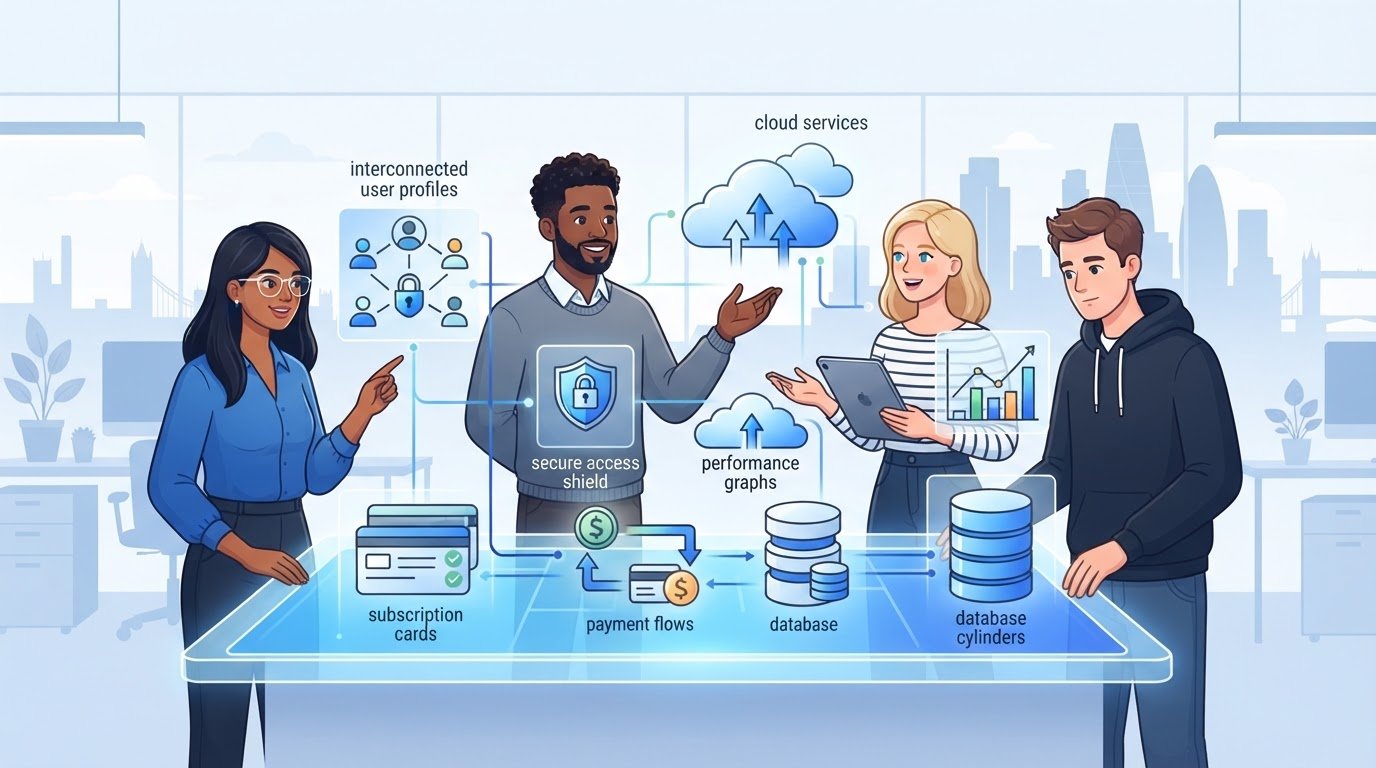
Off-the-shelf membership plugins and closed SaaS suites inevitably penalise commercial growth. You've likely felt the operational friction firsthand: brittle webhook handling that breaks subscriber access, silent synchronisation errors during dunning cycles, and sudden database bottlenecks when members log in simultaneously for live events. You aren't just fighting technical limitations; you're handing away margins and sacrificing control over your member data. Building a membership platform with Laravel fundamentally changes this dynamic, replacing fragile plugin ecosystems with clean, enterprise-grade architecture designed around your exact business model.
In this comprehensive guide, you'll discover how to architect, secure, and scale a bespoke platform using Laravel's modern ecosystem. You'll learn how to eliminate recurring revenue-share fees, safeguard sensitive user records under strict UK privacy standards, and deliver an uncompromising subscriber journey. We'll walk through resilient subscription state machines, asynchronous payment pipelines, and the high-concurrency caching patterns needed to support hundreds of thousands of active members reliably without performance degradation.
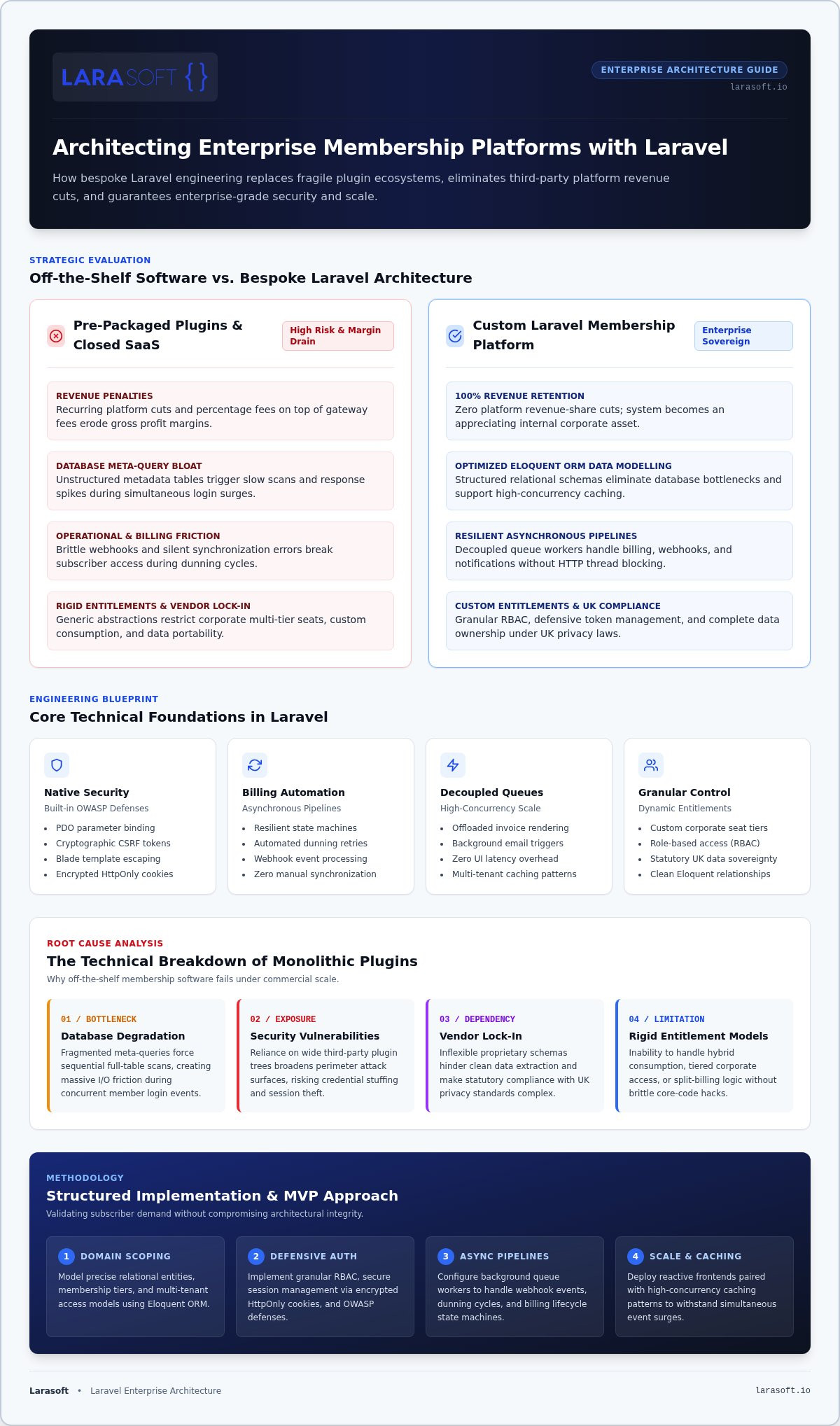
Pre-packaged membership software often promises a rapid path to market, but it introduces acute operational compromises as your user base expands. Off-the-shelf SaaS tools and WordPress plugins rely on generic abstractions to serve every possible use case. Consequently, when you attempt to deploy hybrid entitlements, tiered corporate access, or tailored consumption models, the underlying software breaks down. Building a membership platform with Laravel sidesteps these constraints entirely by providing a modular, enterprise foundation built precisely around your operational rules.
From a commercial standpoint, third-party membership aggregators and SaaS platforms actively erode profitability. Many providers levy platform cuts or tiered percentage fees on top of standard merchant gateway costs. At enterprise volume, these recurring deductions drain gross margins that should be reinvested into platform enhancement. Transitioning to custom engineering establishes total sovereignty over your revenue streams, private member data, and platform codebase, making your platform an appreciating internal business asset.
Monolithic membership plugins fundamentally compromise database performance and platform security. They store complex user relationships across congested, unstructured metadata tables, creating massive input/output friction during concurrent traffic surges. As an organisation grows, this structural bloat produces several acute operational liabilities:
Modernising your digital platform through bespoke Laravel web development replaces fragmented plugin workarounds with clean, structured application design. Laravel's Eloquent ORM enables highly expressive, maintainable data modelling, allowing you to map complex multi-tiered relationships and dynamic entitlement scopes without sacrificing query efficiency.
Scalability relies heavily on architectural separation. Laravel includes asynchronous queuing services that decouple resource-heavy transactions, such as dispatching invoices, webhooks, and event notifications, from the primary HTTP lifecycle. This architectural decoupling ensures lightning-fast page loads for active members. When engineering a modern subscription business model, building a membership platform with Laravel allows your engineering team to adapt workflows quickly, ensuring your system handles transactional spikes without downtime or erratic behavioural side effects.
Protecting subscriber data and proprietary digital assets requires defensive backend engineering. Membership platforms are primary targets for credential stuffing and session hijacking. When building a membership platform with Laravel, security is deeply integrated into the framework lifecycle rather than patched on with third-party extensions. The framework provides native defenses against SQL injection through PDO parameter binding, cross-site request forgery via cryptographically secure CSRF tokens, and cross-site scripting via Blade templating engine escaping.
Enterprise platforms must align their authentication design with established international benchmarks like the OWASP Top 10. This means enforcing secure session handling through encrypted, HttpOnly cookies rather than storing raw bearer tokens in volatile browser storage. It also requires a clean, granular permission model that isolates member tools, team accounts, and administrative operations.
Granular authorization prevents broken object-level access across complex membership tiers. Laravel Policies and Gates encapsulate business logic cleanly, ensuring permissions evaluate directly against the authenticated user model before any controller executes:
Meeting UK GDPR obligations demands architectural transparency across every database migration. Platforms must treat subscriber consent, data portability, and automated erasure as core system functions rather than administrative afterthoughts. Laravel simplifies these compliance requirements by enabling native field-level database encryption for sensitive personally identifiable information (PII).
Queue-backed asynchronous workers allow you to automate data portability and deletion pipelines efficiently. When a member requests their personal data, queued background workers aggregate records across audit logs, subscription events, and interaction histories into a secure archive without freezing web threads. For businesses scaling complex portals across the United Kingdom, partnering with an experienced team for Laravel web development ensures these critical security architectures and compliance pipelines are built reliably from day one.
Recurring billing failures represent a major source of involuntary churn for digital communities. While basic checkouts simply capture an initial payment, a commercial membership platform requires automated subscription state machines that handle billing anomalies gracefully. Building a membership platform with Laravel gives engineering teams complete control over recurring revenue workflows, mid-period upgrades, and dunning cycles without relying on fragile third-party connectors.
Reliable financial architecture demands absolute defensive rigor, mirroring standards outlined in NIST's Secure Software Development Framework (SSDF). By decoupling billing mechanics into isolated application services, you can verify transactions, record audit logs, and protect your subscriber revenue from silent gateway sync failures.
Laravel Cashier provides an expressive interface to enterprise payment gateways like Stripe and Paddle Billing. Cashier handles the boilerplate of recurring billing management while letting you store subscription states cleanly within local Eloquent models:
Payment webhooks are inherently asynchronous and prone to delivery failures. If an HTTP connection times out while a gateway notifies your application of a successful charge, your database falls out of sync with your payment processor. Robust webhook design prevents this by verifying cryptographic payload signatures, logging raw payloads, and delegating processing immediately to queued jobs.
Dunning workflows protect cash flow when automated renewals encounter expired cards or insufficient funds. Instead of instantly locking out subscribers, queued background workers initiate progressive retry schedules while notifying members through targeted transactional emails. If payments fail repeatedly across the designated recovery window, the system automatically transitions the user record to a restricted tier without corrupting historical billing ledgers. Building a membership platform with Laravel ensures these financial edge cases are handled predictably, keeping your cash flow and member relationships intact.
Subscriber retention hinges on interface performance. If a paid portal feels sluggish or disjointed during daily usage, members disengage quickly. Modern digital communities expect the fluid interactivity of native software rather than traditional full-page reloads. Building a membership platform with Laravel allows you to pair battle-tested backend architecture with snappy, reactive client-side experiences, ensuring high member satisfaction across every device.
Delivering sub-second response times under peak concurrent loads requires thoughtful orchestration between data transfer contracts and server caching layers. When hundreds of users simultaneously access live community streams or exclusive asset drops, your frontend and backend must work in perfect synchronization to avoid saturating server memory.
Modern frontend engineering bridges the gap between complex application logic and effortless user experiences. By pairing Laravel with component-driven frameworks, you create dynamic membership interfaces that update states instantly without jarring page refreshes:
For a detailed breakdown of crafting reactive client interfaces, consult our guide to Vue.js frontend development for high-performance interface strategies.
High-concurrency events quickly expose weak query structures. Unoptimized Eloquent calls trigger compounding N+1 query loops that lock database threads under heavy traffic. Enforcing strict eager loading across related models ensures subscriber profile data, tier permissions, and entitlement records load within single, indexed database round-trips.
Strategic caching turns volatile compute cycles into static in-memory lookups. Storing global system configurations, member privilege trees, and serialized course structures within Redis reduces database load to near zero. Background queue workers handle compute-heavy operations such as rendering dynamic PDF accreditation certificates, compiling export archives, and dispatching multi-channel alert sequences.
If your team currently wrestles with an aging system that buckles under peak traffic, read how modernising legacy systems resolves compounding performance debt and database bottlenecks. When building a membership platform with Laravel, establishing clean data pipelines from day one prevents performance degradation at scale. Ready to engineer a bespoke portal tailored to your operational goals? Consult with our Laravel engineering specialists to design your custom platform.
Delivering an enterprise subscription platform requires structured technical discovery rather than rushed implementation. Without clear specifications for subscription transitions, access control boundaries, and external APIs, custom software builds risk scope creep and unmaintainable codebases. Building a membership platform with Laravel succeeds when business objectives translate into defined milestones, establishing a stable foundation before scaling outward.
Adopting an MVP methodology allows you to launch core monetisation features quickly without taking on structural debt. By validating audience retention and subscription conversion with a focused initial deployment, your team gathers real-world usage data while keeping your core architecture clean and flexible for future enhancement.
A rigorous product roadmap separates primary subscription mechanics from secondary features like community forums or gamified reward tiers. Early engineering efforts must prioritize core operational durability:
Bespoke software represents a foundational company asset that demands disciplined engineering standards. When evaluating technical partners, assess their architectural maturity, experience with high-concurrency Laravel systems, and approach to code maintainability. Explore our strategic guide to choosing a Laravel development agency for detailed evaluation criteria.
Launch day marks the beginning of your platform's operational lifecycle, not the end. Enterprise platforms require continuous software maintenance, proactive framework dependency updates, and SLA-backed monitoring to maintain high availability as subscriber numbers expand across the United Kingdom. When you're ready to engineer a resilient, high-performance portal, partner with Larasoft. Building a membership platform with Laravel alongside a dedicated engineering team ensures your technical foundation scales seamlessly alongside your business growth.
Scaling a digital community demands complete independence from arbitrary plugin constraints and recurring platform revenue taxes. By adopting a bespoke architecture, you secure proprietary subscriber records, automate complex billing state machines, and deliver reactive frontend dashboards that never falter during traffic surges. Building a membership platform with Laravel transforms your member portal from a rented software service into an appreciating commercial asset that scales reliably under pressure.
Long-term reliability depends on disciplined technical execution. At Larasoft, our specialised Laravel and modern frontend engineers bring proven expertise in complex API integrations and custom subscription workflows. Backed by dedicated nationwide software maintenance and SLA agreements, we ensure your application remains fast, secure, and fully aligned with your business roadmap. Ready to build an asset tailored precisely to your community? Partner with Larasoft to engineer your bespoke Laravel platform and take full ownership of your subscriber journey.
Laravel offers granular architectural control that WordPress plugins cannot match. WordPress relies on a generic database structure that stores membership metadata across congested postmeta tables, causing severe slowdowns at scale. Building a membership platform with Laravel gives you custom relational schemas, isolated business logic, and enterprise-grade security. You eliminate third-party plugin conflicts, reduce vulnerability surfaces, and avoid licensing fees, resulting in a cleaner, faster experience built around your exact commercial model.
Yes, Laravel comfortably scales to hundreds of thousands of active subscribers when paired with disciplined engineering. By combining Redis for session handling and query caching with queue workers for background processing, server memory remains free during sudden traffic surges. Laravel's Eloquent ORM prevents database bottlenecks through eager loading and read-write connection splitting. This ensures live community streams, restricted content releases, and concurrent logins load with sub-second response times without infrastructure crashes.
Laravel Cashier connects directly with enterprise payment gateways like Stripe and Paddle to automate complex recurring lifecycles. It synchronises local database records with gateway states, executing mid-period plan upgrades and calculating proration balances via built-in methods. For failed renewals, Cashier captures asynchronous webhook alerts to initiate dunning rules, providing grace periods and automated payment update notifications before access is revoked, protecting your recurring revenue stream from unnecessary churn.
Yes, migrating existing members and active payment tokens is entirely feasible without interrupting ongoing billing. Customer records and historical data are extracted, mapped, and imported into Laravel using structured database migration scripts. Payment tokens can be transferred directly between gateways or linked via gateway customer IDs, ensuring subscribers don't need to re-enter credit card details. Staged cutovers and comprehensive test dry runs ensure zero billing disruption during the transition.
Ensuring UK GDPR compliance requires embedding privacy standards directly into your application architecture. When building a membership platform with Laravel, sensitive user records are protected using native field-level database encryption. Automated background jobs handle "right to be forgotten" requests and data exports across related database tables safely. Additionally, granular role-based permissions and encrypted HttpOnly session cookies ensure only authorized staff can inspect subscriber personal records, fully satisfying statutory data protection principles.
Yes, Laravel serves as an ideal headless backend for both native and cross-platform mobile applications. By using Laravel Sanctum or Passport, the platform issues secure API tokens that synchronize subscriber entitlements across web and mobile seamlessly. A unified backend guarantees that access rules, payment statuses, and user activity stay completely aligned, allowing members to switch between browser portals and dedicated mobile apps without friction or conflicting session states.
A custom membership platform requires proactive software maintenance rather than occasional break-fix attention. Ongoing support encompasses scheduled Laravel framework and security patch updates, payment gateway API version tracking, database optimization, and performance monitoring. Partnering with a dedicated engineering agency under structured service level agreements guarantees immediate bug remediation, preventing technical debt from accumulating and ensuring your platform remains secure, compliant, and highly available as your subscriber base expands nationally.
Here’s what we've been up to recently.
Certified Quality. Great Prices