Building a Marketplace Website with Laravel: The Strategic Technical Guide


What if the very platform designed to launch your business is the one currently holding it back? Many founders realize too late that off-the-shelf solutions often fail to handle intricate multi-vendor payment logic or the high-performance demands of a rapidly scaling user base. If you're feeling the limitations of rigid ecosystems like Shopify or Magento, you're at a common crossroads. It's the point where the need for structural integrity and custom-built precision outweighs the temporary convenience of a template, making building a marketplace website with laravel a strategic necessity for long-term growth.
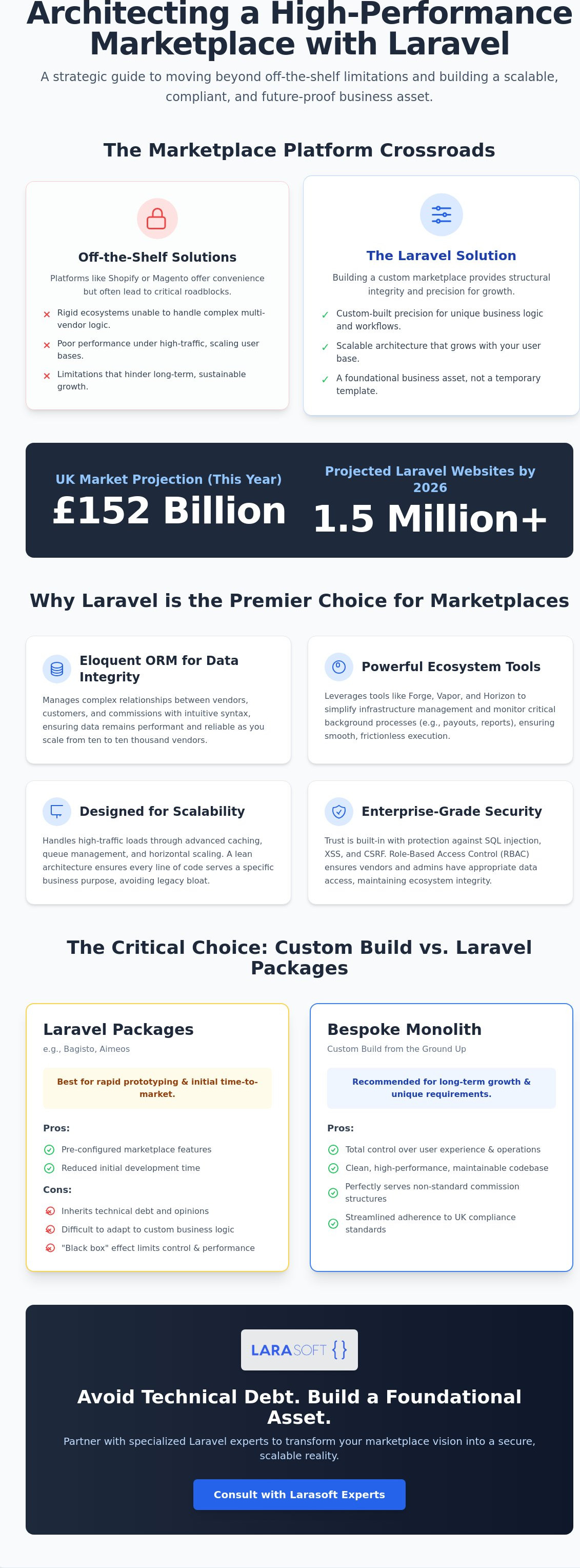
This guide provides a clear, technical roadmap for architecting a platform that doesn't just function, but scales into a foundational business asset. You'll discover how to develop a secure system that handles complex vendor relationships while leveraging the latest Laravel 13 features on PHP 8.3. With Laravel projected to power over 1.5 million websites by the end of 2026, we'll examine the trade-offs between different architectural patterns, address upcoming UK regulatory shifts regarding VAT and product safety, and identify where strategic AI integration can provide a genuine competitive edge in a market projected to reach £152 billion this year.
Choosing the right foundation determines whether your platform will thrive or buckle under the weight of its own success. The Laravel framework has emerged as the premier choice for enterprise-grade applications because it balances developer productivity with rigorous structural integrity. For decision-makers, building a marketplace website with laravel means investing in a codebase that is expressive, maintainable, and inherently designed for the complexities of multi-tenant environments.
Marketplace data is notoriously interconnected. You aren't just managing a list of products; you're orchestrating a web of relationships between vendors, customers, tiered commissions, and logistics providers. Laravel’s Eloquent ORM (Object-Relational Mapper) acts as a sophisticated translator, allowing developers to interact with these complex database structures using intuitive syntax. This reduces the risk of data corruption and ensures that as your vendor list grows from ten to ten thousand, the system remains performant and reliable.
The ecosystem surrounding the framework provides an additional layer of strategic advantage. Tools like Laravel Forge and Vapor simplify infrastructure management, while Laravel Horizon offers real-time monitoring for your queue workers. This ensures that critical background processes, such as processing multi-vendor payouts or generating bulk inventory reports, execute without friction. These tools transform a standard web application into a high-performance engine capable of handling the heavy lifting of a modern digital economy.
High-traffic marketplaces demand more than just efficient code; they require a robust strategy for resource management. Laravel handles these loads through advanced caching mechanisms and sophisticated queue management, which offloads time-consuming tasks to background processes. Horizontal scaling in a Laravel marketplace involves adding more web server instances behind a load balancer to distribute traffic, ensuring the platform remains responsive as the user base expands. Unlike off-the-shelf software that often carries legacy bloat, a custom Laravel build allows for a lean architecture where every line of code serves a specific business purpose.
Trust is the primary currency of any marketplace. When building a marketplace website with laravel, security isn't an afterthought; it's baked into the framework's core. Laravel provides built-in protection against SQL injection, cross-site request forgery, and cross-site scripting. To manage the different layers of access, we implement Role-Based Access Control (RBAC), ensuring that vendors only interact with their specific data while administrators maintain oversight of the entire ecosystem. Our approach focuses on long-term reliability through consistent software maintenance, ensuring your platform evolves alongside emerging security threats and technological shifts.
Founders often face a critical crossroads when building a marketplace website with laravel: should they install an existing package or engineer a bespoke solution? Rapid prototyping tools like Bagisto or Aimeos offer a tempting shortcut. These packages provide a pre-configured set of marketplace features that can significantly reduce your initial time-to-market. However, this speed often comes at the cost of technical debt. Relying on a third-party package means inheriting its architectural opinions, which may not align with your specific business logic as you scale.
The bespoke monolith approach provides total control over the user experience and internal operations. By building from the ground up, you ensure that every database query and business rule serves your unique requirements. This path is ideal for platforms with non-standard commission structures or complex vendor onboarding workflows. It eliminates the "black box" effect of third-party extensions, allowing your team to maintain a clean, high-performance codebase. Adhering to UK compliance standards becomes a more straightforward process when you have full visibility into how data is processed and stored.
For organizations targeting an omnichannel presence, building a marketplace website with laravel as a headless system is often the superior choice. This involves using Laravel as a robust API to power decoupled Vue.js or React frontends. This separation improves mobile performance by reducing the payload sent to the browser and allows for a more fluid, app-like user experience. It also future-proofs your platform. Once your API is established, integrating a native mobile app or a voice-commerce assistant becomes a matter of connecting new endpoints rather than rebuilding your entire backend.
Off-the-shelf extensions frequently lead to performance bottlenecks because they are built to be "one size fits all." They often include unnecessary features that consume server resources and complicate the database schema. Custom-built solutions bypass this bloat by implementing only the logic your marketplace requires. Bespoke code reduces long-term maintenance costs by eliminating the need to debug or patch third-party dependencies that aren't core to your business. If you aren't sure which path fits your current growth stage, consulting with a specialized partner can clarify the technical trade-offs before you commit to a specific architecture.
Operational efficiency is the invisible engine that drives a successful digital platform. When building a marketplace website with laravel, the focus shifts from basic storefront functionality to the sophisticated orchestration of multi-party interactions. High performance isn't just measured by page load speeds. It's defined by the fluidity with which vendors manage inventory and the precision of the underlying financial logic.
A robust vendor onboarding process is the first point of contact for your partners. Dashboards must be intuitive, providing real-time insights into sales data, stock levels, and customer feedback. By leveraging Laravel's modular architecture, we build custom management portals that allow vendors to operate autonomously while giving platform owners full oversight. This autonomy is supported by integrated communication tools that facilitate direct buyer-seller interactions, reducing the administrative burden on your support team.
Discovery is equally critical. Customers expect instantaneous, relevant results. Integrating advanced search engines like Algolia or Elasticsearch with your Laravel backend ensures that even with millions of SKUs, filtering remains lightning-fast. These tools allow for faceted search and typo tolerance, which are essential for maintaining high conversion rates in a competitive landscape.
AI has moved beyond simple chatbots into the realm of agentic commerce. Implementing Laravel AI solutions allows your platform to provide hyper-personalised product recommendations based on real-time user behaviour. Beyond the storefront, AI automates the heavy lifting of content moderation. Sentiment analysis and automated image recognition can flag prohibited items or fraudulent vendor descriptions before they ever reach the public. This proactive approach maintains the structural integrity of your brand while reducing manual oversight costs.
Managing the flow of funds is perhaps the most technically demanding aspect of building a marketplace website with laravel. We utilise Stripe Connect or Adyen to handle split-payment functionality, ensuring that funds are automatically distributed between the vendor and the platform at the point of sale. This technical precision is vital for compliance. With the UK government consulting on extending VAT liability to online marketplaces for sales by UK-based businesses, a period closing on August 18, 2026, your system must be flexible. Our builds include dynamic tax engines that adapt to these shifting regulatory requirements, providing secure API integrations for real-time financial reporting and audit trails.
Building a marketplace website with laravel requires a disciplined approach to the development lifecycle. It begins with a discovery phase where we map the entire ecosystem, from vendor payout cycles to customer journey maps. This technical scoping ensures that every requirement is documented before a single line of code is written. By aligning business goals with technical constraints early, we avoid the architectural pivots that often derail complex projects and lead to technical debt.
Our agile methodology focuses on delivering iterative builds that prioritise clean, scalable code. This isn't just about speed; it's about structural integrity. Every sprint concludes with rigorous testing, including automated unit tests and manual security audits. We simulate high-traffic loads to ensure the platform remains stable when vendor numbers or transaction volumes spike. Once verified, we utilise continuous integration and deployment (CI/CD) pipelines to push updates. This approach allows for zero-downtime deployments, ensuring your marketplace remains accessible to global users around the clock.
Operating in the UK means adhering to strict data protection requirements, including the Network and Information Systems (NIS) Regulations 2018 and the anticipated Cyber Security and Resilience Act. Managing vendor and customer data requires more than a simple checkbox; it demands bespoke encryption and robust "Right to be Forgotten" protocols. Unlike SaaS platforms that offer generic privacy settings, a custom Laravel build allows for granular control over data residency and access logs. This ensures your platform isn't just compliant today but is prepared for the evolving UK regulatory landscape, such as the proposed rewrites to product safety and enforcement frameworks.
A marketplace lives or dies by its organic reach. Architecting URL structures that can handle thousands of dynamically generated vendor and product pages is a significant technical challenge that off-the-shelf software often handles poorly. We focus on optimising Core Web Vitals to ensure fast-loading frontends that rank well in search results. By leveraging our specialised SEO services, you can drive organic vendor acquisition and customer growth simultaneously. If you're ready to move from a generic solution to a high-performance asset, contact us to discuss your technical roadmap.
Selecting a development partner is as critical as the technology itself. While generalist agencies may handle standard e-commerce stores, building a marketplace website with laravel involves architectural complexities that demand specialized knowledge. Generalists often overlook the nuances of multi-vendor data isolation or the long-term implications of technical debt. A specialized partner brings the foresight needed to prevent these bottlenecks, ensuring that your platform remains a foundational asset rather than a liability as your vendor count grows.
Expertise in Laravel must be paired with a deep strategic understanding of your business goals. It's not enough to write clean code; your developers should act as technical allies who understand how specific features impact your bottom line. This collaborative approach ensures that the platform's structural integrity supports your growth trajectory, and integrating a plan from Fireheart Digital can provide the comprehensive marketing strategy required for long-term success. Whether you are launching a new venture or transitioning from a legacy system, the transition to a modern architecture must be handled with surgical precision to avoid disrupting current revenue streams or compromising data integrity.
Live marketplaces require constant vigilance and proactive software maintenance. The digital landscape evolves rapidly, with new security threats and performance standards emerging regularly. A dedicated partner provides the ongoing support necessary to keep your platform performant under pressure. This includes regular security patches, database optimisation, and the integration of new features that keep you ahead of competitors who may be stuck in the rigid ecosystems of off-the-shelf software.
We approach every project with the mindset of technical artisans who take immense pride in the efficiency of our work. Our focus is on creating clean, maintainable code that powers high-performance frontends. For established businesses, we specialize in legacy code modernisation, transforming outdated systems into modern, scalable assets without losing historical data. Collaborating with us means moving beyond simple service delivery toward a partnership focused on sustainable business growth and technical excellence.
The journey toward a successful marketplace begins with identifying your core requirements and selecting the right tech stack to meet them. In a competitive digital landscape, the value of a technical ally who can navigate complex API integrations and AI-driven enhancements cannot be overstated. We're here to help you architect a system that performs perfectly under pressure and scales alongside your ambitions. If you're ready to take the next step in building a marketplace website with laravel, consult with Larasoft’s Laravel experts today to discuss your technical roadmap.
Building a marketplace website with laravel is more than a technical project; it's a strategic investment in your organization's future foundation. We've explored how the framework's structural integrity and modularity provide a reliable path for scaling complex vendor ecosystems. By prioritizing bespoke architecture over rigid, off-the-shelf packages, you ensure your platform remains agile. This flexibility is essential for integrating agentic AI features, managing intricate global payout logic, and staying ahead of shifting UK compliance standards.
Success in today's digital economy requires a technical ally who balances artisan-level code with clear business objectives. At Larasoft, we specialize in high-performance frontends, AI integration, and the modernization of legacy systems to ensure your marketplace performs perfectly under pressure. We take immense pride in the cleanliness of our work, treating every line of code as a building block for your long-term returns. Let's transform your vision into a secure, scalable reality that commands respect in your industry.
Build your scalable marketplace with Larasoft’s expert Laravel developers
Development timelines typically range from three to nine months depending on the platform's complexity. A basic MVP focusing on essential vendor onboarding and payment logic can often launch in the shorter window. Enterprise-grade platforms with custom AI integrations and complex multi-party workflows require a more extensive development cycle to ensure structural integrity and performance.
Yes, Laravel is architected to manage massive datasets with ease. By utilizing Eloquent ORM efficiently and implementing advanced database indexing, the framework maintains high performance across millions of SKUs. When paired with external search engines like Elasticsearch and horizontal scaling strategies, Laravel provides a robust foundation for even the largest global marketplaces.
The decision depends on your long-term growth strategy and specific business logic. Packages offer a faster initial launch but often introduce technical debt and rigid architectural opinions. Building a marketplace website with laravel as a bespoke solution provides total control over the user experience and ensures the codebase can scale without the limitations of third-party dependencies.
Multi-vendor payments are best managed through specialized gateways such as Stripe Connect or Adyen. These services allow you to automate complex split-payment logic, ensuring funds are distributed between vendors and the platform at the point of sale. This approach simplifies financial reporting and ensures your marketplace remains compliant with UK tax and anti-money laundering regulations.
Headless architecture separates your backend data from the frontend presentation layer, providing superior performance and omnichannel flexibility. This decoupling allows you to build high-performance frontends using Vue.js or React while maintaining a single, secure API. It also future-proofs your platform, making it easier to launch native mobile apps or voice-commerce features later.
Development costs are determined by the technical scope, including the number of custom integrations and the complexity of the vendor management system. Factors such as advanced AI features, bespoke payment logic, and the level of security required will influence the total investment. A detailed technical scoping phase is necessary to provide an accurate estimate based on your specific requirements.
Laravel is one of the most secure PHP frameworks available today. It includes built-in protection against SQL injection, cross-site request forgery, and cross-site scripting by default. When building a marketplace website with laravel, these core features are supplemented with custom role-based access controls and encryption to protect sensitive vendor and customer transaction data at every level.
AI integration is typically achieved through secure API connections to machine learning models or large language models. You can utilize these integrations to automate content moderation, provide personalized product recommendations, or implement dynamic pricing models. These tools allow your platform to execute complex tasks autonomously, providing a significant competitive advantage in the modern digital landscape.
Here’s what we've been up to recently.
Certified Quality. Great Prices