Technical SEO for Laravel Applications: The Definitive 2026 Engineering Guide

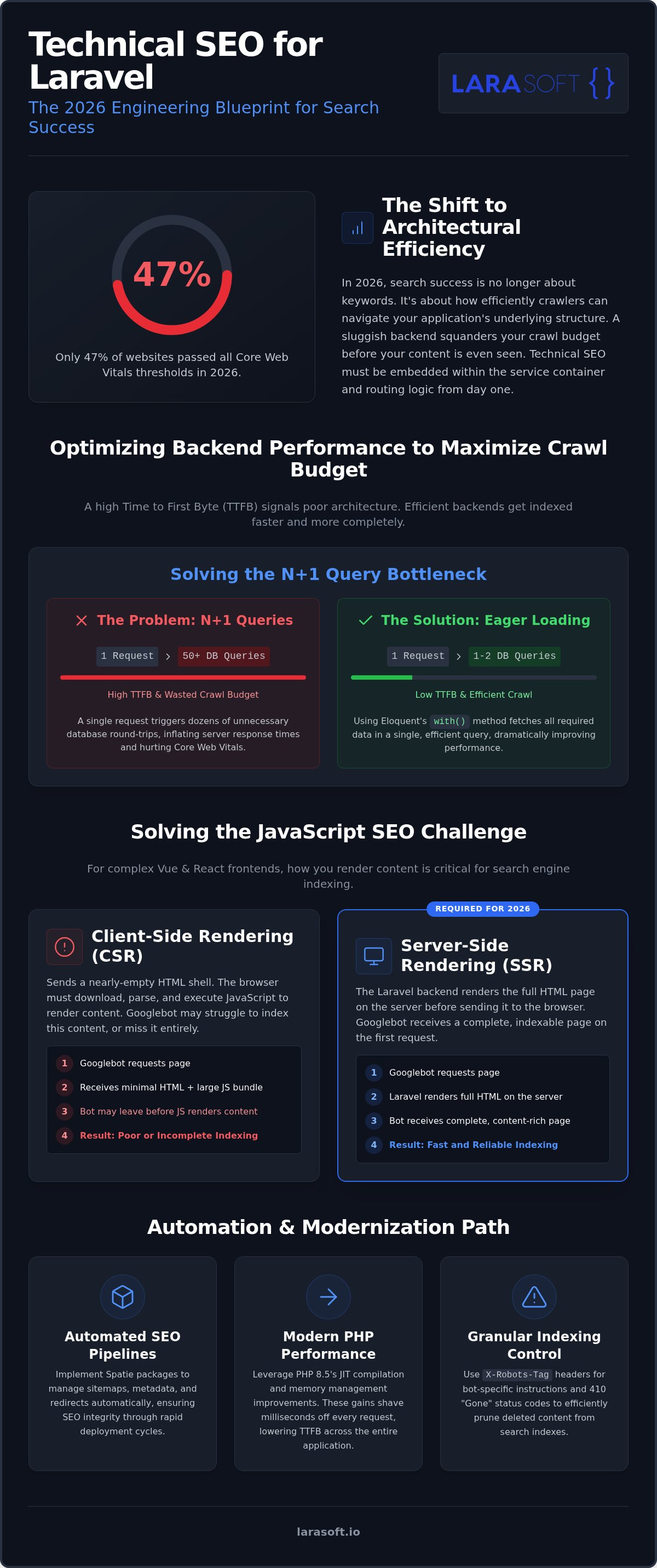
Only 47% of websites globally are passing all three Core Web Vitals thresholds in 2026. For engineers managing complex builds, the gap between a functional application and a search engine powerhouse usually comes down to the underlying architecture. It's frustrating to watch a high-performance Vue or React frontend struggle with indexing, or to see unoptimised Eloquent queries push your Time to First Byte into the danger zone. Mastering technical seo for laravel applications is no longer an optional extra; it's a core requirement for any scalable digital asset.
This guide provides the definitive engineering blueprint to turn your backend optimisations into a competitive advantage. We'll show you how to ensure your site is perfectly crawlable while maintaining the structural integrity of your code. We'll explore how to navigate the 2MB Googlebot fetch limit, configure Laravel 13 for PHP 8.5 performance, and build automated SEO workflows that don't break during deployments. We're moving beyond basic meta tags to focus on the deep architectural shifts required for modern search success and long term growth.
Technical seo for laravel applications in 2026 isn't a layer added at the end of development; it's a foundational discipline embedded within the service container and routing logic. While traditional Search engine optimization (SEO) often focuses on front-facing content, the engineering side prioritises how efficiently a crawler can navigate the application's underlying structure. Google’s 2026 algorithms have shifted heavily toward Architectural Efficiency. This means the speed at which your Laravel service providers boot and your routes resolve directly impacts your search visibility. If your backend architecture is sluggish, your crawl budget is squandered before the bot even reaches your content.
For large-scale bespoke applications, we focus on Crawl Budget ROI. If your application logic is bloated, search bots waste processing power on unnecessary overhead rather than indexing your high-value pages. Laravel’s middleware provides a powerful entry point to manage this interaction. By identifying bots early in the request lifecycle, you can serve streamlined responses that preserve server resources. This ensures your most important content is indexed quickly, turning your technical seo for laravel applications into a scalable business asset.
Laravel’s routing engine is a primary tool for maintaining a clean site structure. Using Route Model Binding allows you to generate semantic, human-readable URLs automatically. This ensures that search engines understand the hierarchy of your data without manual intervention. Laravel’s routing engine prevents duplicate content issues by default by enforcing single, authoritative paths to your resources. To handle global canonicalisation, we implement custom middleware that manages trailing slashes and forces HTTPS across all entry points. This architectural approach ensures that search bots don't waste crawl budget on redundant URL variations or insecure paths.
Granular control over indexing requires more than just a robots.txt file. Within Laravel, you can configure X-Robots-Tag headers at the application level to provide specific instructions to crawlers for non-HTML assets or dynamically generated routes. When pages are removed, handling 404 and 410 status codes gracefully within the Laravel exception handler is vital. A 410 "Gone" status tells bots to stop returning to a deleted resource, which is far more efficient than a standard 404. For complex migrations, we use the Laravel Redirector to manage deep-link transitions, preventing the redirect loops that often plague legacy codebases during modernisation.
Backend performance is the engine room of technical seo for laravel applications. Google’s crawl budget is a finite resource; if your server takes too long to respond, bots will simply abandon the crawl before indexing your most valuable pages. Time to First Byte (TTFB) serves as a primary signal for architectural efficiency. A high TTFB often indicates that Laravel is struggling with unoptimised logic before the first byte of HTML even reaches the crawler. By leveraging PHP 8.4 or 8.5, you benefit from JIT compilation and memory management improvements that shave milliseconds off every request. These small gains accumulate across thousands of pages, directly improving your site's search visibility.
Eloquent is a powerful tool, but it's often the source of significant performance bottlenecks if left unmonitored. The N+1 query problem is a classic example where a single request triggers dozens of unnecessary database round-trips. Using Eager Loading via the with() method ensures that all required data is fetched in a single, efficient query. This is essential for maintaining sub-100ms response times at scale. Beyond simple queries, your indexing strategy must account for the complex relationships typical in bespoke Laravel builds. Slow database execution doesn't just affect crawlers; it also negatively impacts the Interaction to Next Paint (INP) metric by delaying the server's ability to process user inputs.
Serving dynamic content at static-like speeds requires a robust caching layer. Redis and Varnish are indispensable for high-traffic applications, allowing you to bypass expensive application logic for frequently accessed routes. In production environments, you should always implement route:cache and config:cache to eliminate the overhead of parsing routes and configuration files on every request. Application-level caching reduces server load during intense bot crawls, ensuring your infrastructure remains stable even when being indexed by multiple search engines simultaneously. This layer is a critical component of technical seo for laravel applications, as it ensures consistent performance regardless of traffic spikes.
Tools like Laravel Pulse are excellent for identifying real-time bottlenecks that might be hurting your rankings. While backend speed is the foundation, understanding how bots render the final output is equally vital, as detailed in Google's guide to JavaScript SEO. If your current build feels sluggish, a professional technical SEO audit can pinpoint exactly where your code is acting as a bottleneck for search engine visibility.
Client-Side Rendering (CSR) presents a significant risk for data-heavy platforms. While Googlebot's ability to render JavaScript has improved, it remains a resource-intensive two-stage process that often leads to delayed indexing. In 2026, relying solely on the client to build the DOM frequently results in a "partial index" state where critical content is missed. This makes Server-Side Rendering (SSR) a non-negotiable component of technical seo for laravel applications. By delivering fully rendered HTML on the initial request, you ensure search engines receive the complete content immediately, which is vital for managing your crawl budget effectively. Googlebot's 2MB fetch limit for HTML means that bloated JavaScript containers often fail to deliver content before the crawler moves on.
Choosing the right frontend partner for Laravel depends on your architectural needs. Inertia.js SSR is often the preferred choice for teams wanting to maintain a monolithic structure while using Vue or React. It allows you to keep your routing and controllers within Laravel while serving fully rendered pages. Alternatively, decoupled frameworks like Nuxt or Next.js offer robust SEO features but introduce complexity in API management. Regardless of the stack, you must address the "Hydration Mismatch" problem. This occurs when the server-rendered HTML differs from the initial client-side state, triggering a full re-render. This discrepancy causes layout shifts that damage your Cumulative Layout Shift (CLS) score, which must remain at 0.1 or less to pass 2026 Core Web Vitals.
Setting up an SSR server for Inertia involves running a Node.js process alongside your Laravel application. This process intercepts requests and pre-renders the Vue or React components into static HTML. To manage metadata, use the built-in <Head> component to inject dynamic titles, descriptions, and Open Graph tags directly into the server-rendered output. You can verify this by using the "Inspect URL" tool in Google Search Console. If the rendered snapshot shows your full content rather than a blank "loading" div, your SSR configuration is working correctly. This setup is a cornerstone of modern technical seo for laravel applications, ensuring that bots see exactly what users see without the rendering delay.
Not every page requires full SSR. For high-traffic marketing pages, Static Site Generation (SSG) provides the fastest possible response times by serving pre-built HTML files from a CDN. For more complex interfaces, consider "Island Architecture" or partial hydration. This approach only hydrates the interactive parts of a page, such as a search filter or a checkout button, while leaving the rest as static HTML. This strategy balances user interactivity with the need for immediate HTML delivery. It reduces the total JavaScript execution time, helping you meet the 200ms "Interaction to Next Paint" (INP) threshold required for a "Good" rating in 2026.
Manual SEO checks are a liability in a continuous deployment environment. To ensure your rankings don't plummet after a major update, you must integrate SEO audits directly into your development lifecycle. We use Lighthouse CI to establish performance and SEO baselines before any code reaches production. A robust automation pipeline includes:
If a pull request causes an SEO score to drop below your defined threshold, the build fails. This proactive approach ensures that technical seo for laravel applications remains a constant priority rather than a periodic afterthought. By automating these checks, you protect your long-term search visibility from human error and architectural drift.
Leveraging industry-standard tools like Spatie’s Laravel SEO and Sitemap packages allows for the seamless management of dynamic content. These tools integrate directly with your application’s service providers, ensuring that as your database grows, your search engine instructions grow with it. This creates a scalable foundation where new products or articles are indexed without manual intervention. It's the difference between a static site and a living, search-optimised platform.
For applications managing millions of records, a single sitemap file is insufficient and often leads to crawler timeouts. We implement multi-index sitemaps that partition data logically, ensuring search engines can process your entire catalogue efficiently. This is paired with automated image optimisation via the Laravel Media Library. By programmatically generating alt-text and serving modern formats like WebP or Avif, you satisfy Core Web Vitals while improving accessibility. For UK-based firms operating globally, we automate Hreflang tags to ensure search engines serve the correct regional version of your site to international users.
High-quality structured data is essential for AI-driven search in 2026. We use Laravel View Composers to map Eloquent models directly to the latest Schema.org version 30.0 specifications, published in March 2026. This ensures that every Product, Article, or Organisation entity is clearly defined for both Googlebot and emerging AI agents. Testing this data during the build process prevents rich snippet errors before they reach production. To empower your team, we often build custom SEO dashboards within Filament or Laravel Nova, allowing non-technical stakeholders to monitor metadata health without touching the codebase.
If your current workflow lacks this level of automation, our SEO services can help you build a resilient, search-first architecture that scales with your business.
Technical debt is a silent killer for search rankings. Outdated PHP versions and legacy Laravel builds often act as a bottleneck, making your application invisible to modern search engines that prioritise speed and architectural cleanliness. Bots in 2026 expect the sub-100ms response times and refined headers provided by current standards. If your stack is stuck in a legacy state, you're paying a performance tax that squanders your crawl budget on overhead rather than content. Modernising your codebase isn't just a maintenance task; it's a strategic driver for organic growth.
Refactoring legacy controllers is a primary step in improving Time to First Byte (TTFB). Old code often contains deeply nested logic and inefficient service calls that delay the initial server response. By modernising these components and cleaning up the service container, you create a direct path to better search visibility. Technical seo for laravel applications requires this structural integrity to succeed in a competitive search environment. Moving away from technical debt allows your application to respond with the precision that modern search algorithms demand.
Migrating from Laravel 6 or 7 to the latest version, Laravel 13.26.0, unlocks critical performance features. PHP 8.5's refined JIT compilation and Fibers allow your application to handle concurrent tasks more efficiently, which is a major factor in passing Core Web Vitals. This transition ensures your application remains compatible with the sophisticated crawling requirements of generative search engines. Using a legacy code modernisation strategy provides the necessary foundation for high-performance search engine results.
We audit and refactor Laravel applications by first identifying the high-impact bottlenecks that affect search performance. Our process moves beyond surface-level fixes, diving into the architectural changes needed for long-term organic growth. We focus on:
In a recent engagement for a national UK platform, refactoring a legacy build led to a significant traffic surge, primarily driven by a 60% improvement in server response times. This structural shift turned a stagnant asset into a search engine powerhouse. If you're ready to transform your stack, contact Larasoft for a technical SEO audit of your Laravel application and begin your journey toward search excellence.
Technical SEO in 2026 is no longer about surface-level tweaks. It's about the efficiency of your service container and the speed of your server-side rendering. We've explored how backend performance directly dictates your crawl budget and why automating your SEO workflows is the only way to prevent regression in a fast-paced deployment environment. Mastering technical seo for laravel applications requires a deep understanding of both the framework's internals and the evolving requirements of modern search engines.
As UK-based Laravel specialists, Larasoft focuses on bespoke high-performance builds that bridge the gap between complex engineering and organic growth. Whether you're struggling with a slow Time to First Byte or need expertise in legacy code modernisation, we provide the technical audit and refactoring required to succeed. Partner with Larasoft for Expert Laravel Technical SEO to ensure your application remains a foundational asset for your business's future. Your platform has the potential to lead your industry; it just needs the right architectural foundation to get there.
Laravel provides an excellent foundation for search visibility through clean routing and semantic URL structures. However, achieving elite technical seo for laravel applications requires intentional configuration of the service container and middleware. Out of the box, it handles basic requirements like canonicalisation and redirects efficiently. To pass 2026 thresholds, developers must layer in advanced caching and structured data mapping to ensure the application meets modern architectural standards.
You handle meta tags in Inertia by using the built-in <Head> component within your Vue or React components. This allows you to define dynamic titles, descriptions, and Open Graph tags that are correctly rendered during the Server-Side Rendering (SSR) process. By passing SEO data from your Laravel controllers as props, you ensure that search bots receive the correct metadata in the initial HTML payload rather than waiting for client-side execution.
Using Vue.js only hurts SEO if you rely exclusively on Client-Side Rendering (CSR). In 2026, search engines prioritise sites that deliver content immediately. If your Vue frontend isn't server-side rendered, Googlebot may encounter indexing delays or fail to render the full DOM. Implementing SSR ensures your JavaScript-heavy frontend remains fully crawlable while maintaining the high-performance interactivity your users expect from a modern Laravel build.
Improving TTFB starts with upgrading to PHP 8.4 or 8.5 to leverage the latest performance benchmarks. You should also eliminate N+1 query bottlenecks in Eloquent and implement Redis for application-level caching. Using route:cache and config:cache in production environments further reduces the bootstrap time. These optimisations ensure your server responds in under 100ms, which is critical for maintaining a healthy crawl budget for large applications.
The most reliable tools in 2026 remain the Spatie ecosystem, specifically spatie/laravel-sitemap and spatie/laravel-seo. These packages provide a structured way to manage dynamic metadata and large-scale sitemaps. Additionally, spatie/laravel-media-library is essential for automating image SEO through WebP conversion and alt-text management. Integrating these into your build process allows for automated SEO workflows that scale alongside your application's growth.
To manage millions of pages, you must generate a sitemap index file that points to multiple sub-sitemaps. Laravel allows you to chunk your database queries to prevent memory exhaustion during generation. By using a scheduled task or a background job, you can rebuild these files incrementally. This approach avoids the 50,000 URL limit per file and ensures search bots can process your entire catalogue without encountering server timeouts.
You should almost always use Server-Side Rendering (SSR) for any page that requires search engine visibility. While Client-Side Rendering (CSR) is suitable for authenticated dashboards, it creates significant indexing risks for public-facing content. SSR ensures that the 2MB Googlebot fetch limit is respected by delivering the full HTML payload immediately. This architectural choice is a cornerstone of technical seo for laravel applications, balancing user experience with crawlability.
Legacy code acts as a performance bottleneck that directly increases your TTFB and degrades Core Web Vitals. Outdated PHP versions lack the JIT compilation and memory efficiency of modern releases, leading to slower crawl rates. Additionally, technical debt often results in broken redirects and inconsistent header management. Modernising your stack is essential for restoring search visibility and ensuring your application can handle the demands of 2026 search algorithms.
Here’s what we've been up to recently.
Certified Quality. Great Prices