Technical Due Diligence for Software Projects: The 2026 Strategic Guide


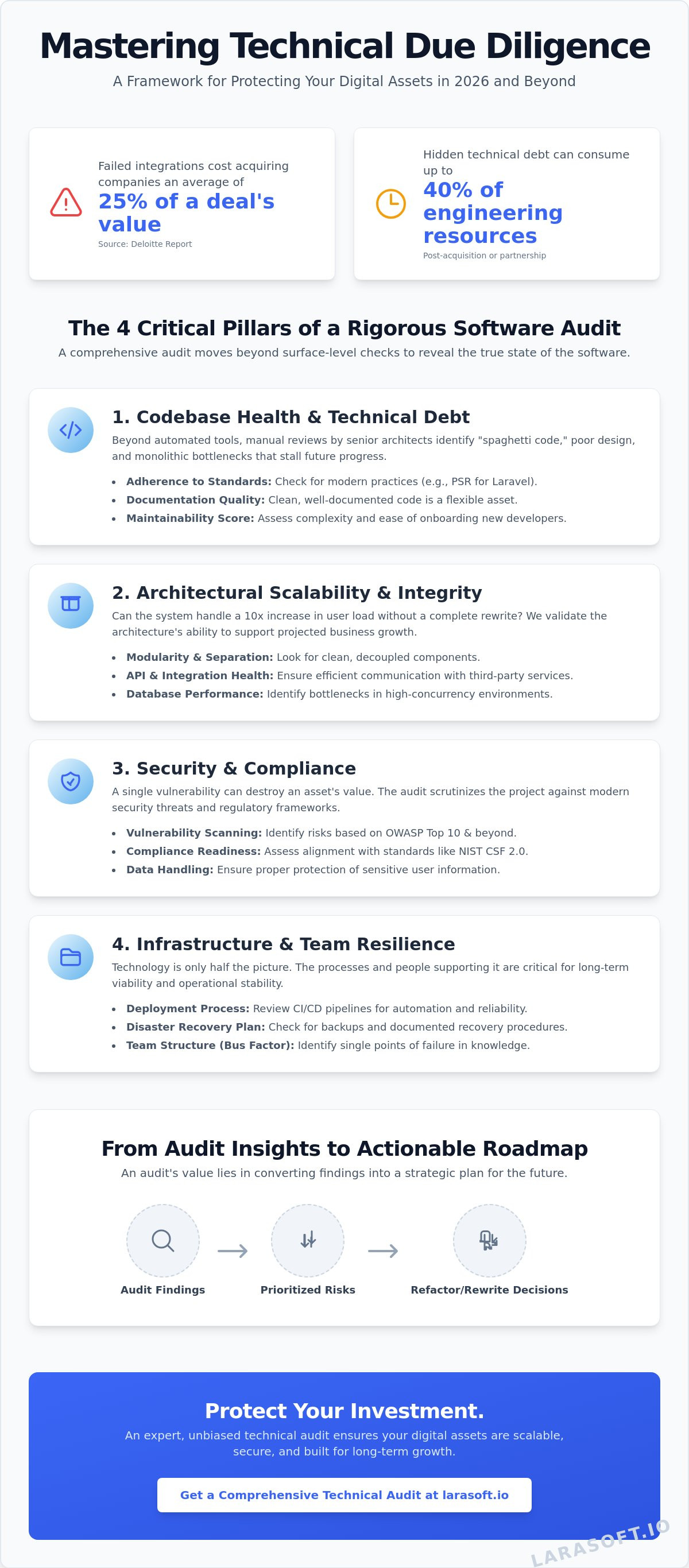
According to a Deloitte report, failed integrations cost acquiring companies an average of 25% of a deal's value, with technical oversights being the primary culprit. When you're evaluating an acquisition or a major partnership, technical due diligence for software projects isn't just a box to tick; it's a high-stakes investigation into the structural integrity of your future. You're likely worried about hidden technical debt, which can consume up to 40% of engineering resources post-acquisition, or whether the system can actually scale to meet your 2026 growth targets.
We understand that the pressure to identify every architectural flaw and compliance risk is immense, especially with the 2026 updates to NIST CSF 2.0 and the new OWASP Top 10 for Agentic Applications. You need more than a list of bugs; you need a strategic blueprint for the future. This guide provides a comprehensive framework to master software audits, helping you identify critical risks and ensure your digital assets are protected against modern security threats. We'll walk through a clear risk assessment process and show you how to build a roadmap for technical modernisation that guarantees long-term viability.
Technical due diligence for software projects is a rigorous, multi-layered audit that scrutinizes a project's codebase, architectural integrity, and operational processes. While the foundational concept of due diligence has historically focused on financial and legal scrutiny, the tech-heavy environment of 2026 demands a more granular approach. Surface-level checks no longer suffice. With the rise of autonomous agents and complex API ecosystems, stakeholders must validate not just if the code works today, but if the underlying structure can withstand the pressures of tomorrow. This deep validation ensures that every line of code contributes to a stable, scalable, and secure foundation for business growth.
It's a mistake to conflate a simple code review with full-scale technical due diligence for software projects. A code review typically focuses on syntax, style, and immediate logic errors within a specific feature. In contrast, a strategic audit assesses the entire ecosystem. It looks at long-term maintainability, security vulnerabilities like those identified in the 2026 OWASP Top 10, and how well the architecture supports overarching business goals. This process involves a collaborative effort between investors seeking to de-risk their capital, CTOs planning for seamless integration, and specialized technical partners who provide an unbiased, artisan-level perspective on system health.
A thorough audit uncovers the true cost of technical debt. This debt often hides beneath the surface, manifesting as high engineering turnover or increasingly slow feature releases. By quantifying these risks early, you avoid the unexpected financial drains that typically plague projects post-investment. Beyond risk mitigation, the audit validates that the technology stack, whether it's built on Laravel, React, or a custom mobile framework, can actually support projected business growth. It also ensures clear ownership of the codebase. This protects your intellectual property from future legal disputes or licensing complications that could derail a deal.
Pre-acquisition or merger remains the most common trigger, but smart leaders use technical audits as internal health checks. Conducting an audit before a major scaling phase helps identify bottlenecks that could cause system failure under heavy load. Additionally, preparing for exit readiness is vital. By auditing your own software before seeking a sale or a new funding round, you can proactively resolve red flags. This ensures a smoother transaction and commands respect for your specialized knowledge during negotiations. It transforms the software from a black box into a transparent, high-value asset.
A rigorous audit doesn't just look for bugs. It assesses the structural integrity of the entire digital asset. For technical due diligence for software projects to be effective, it must rest on four specific pillars: codebase health, architectural scalability, security compliance, and infrastructure resilience. We dive deep into each to ensure the technology doesn't just work, but thrives under pressure. This comprehensive approach moves beyond surface-level metrics to reveal the true state of the software ecosystem.
Automated tools are excellent for catching surface-level syntax errors, but they miss the strategic "why" behind poor design. Manual reviews by senior architects are essential to spot spaghetti code or monolithic bottlenecks that stall future progress. In legacy systems, technical debt can consume 20% to 40% of engineering resources after an acquisition. We look for adherence to modern standards, such as PSR for Laravel, to ensure the code remains maintainable for years to come. Clean, documented code is the difference between a flexible asset and a stagnant liability.
Can the system handle 10x user growth without a total rewrite? We look for modularity and clean separations of concern. Using frameworks like Laravel on the backend and React or Vue.js on the frontend provides a structured environment that supports rapid scaling. We also evaluate API integration health. A system that can't talk efficiently to third-party services is a bottleneck. Database performance is another critical check; we look for optimizations that prevent crashes in high-concurrency environments. This validation ensures the architecture supports your long-term business roadmap.
In 2026, UK GDPR compliance is a non-negotiable threshold. We audit data encryption and vulnerability management to ensure the project meets these standards. Beyond data, we look at IP evaluation and valuation methods to ensure there's no legal risk from improperly managed open-source licenses. Accessibility is also a business priority; meeting WCAG standards ensures the product is inclusive and legally sound. If your current stack feels outdated, considering legacy code modernisation can resolve these compliance gaps before they become deal-breakers.
The audit must also cover deployment pipelines and cloud resilience. We look for automated CI/CD processes that reduce human error and ensure consistent releases. Disaster recovery isn't just a document; it's a tested capability that protects business continuity. We assess how the system handles failovers and whether the cloud environment is optimized for both performance and cost. Without these operational safeguards, the software remains fragile, regardless of its initial code quality. A robust DevOps culture is a leading indicator of a mature, investment-ready software project.
Execution of technical due diligence for software projects requires a structured, five-step approach to ensure no critical vulnerability is overlooked. It begins with scoping, where we define the specific objectives of the audit. We need to determine if we're validating the potential for global scaling, assessing the impact of legacy debt, or ensuring compliance with 2026 security standards. Clear objectives prevent the audit from becoming a generic exercise and ensure it delivers actionable business intelligence.
Once the scope is set, we move to data room preparation. This involves gathering documentation, repository access, and system logs. It's during this phase that we assess supply chain security, ensuring that third-party dependencies and vendor integrations don't introduce hidden risks into the ecosystem. The third step is the deep-dive analysis. This isn't just a code scan; it involves interviews with lead developers to understand the rationale behind architectural choices. We then proceed to reporting, where risks are categorized from critical to minor. Finally, we establish a remediation plan. This phase transforms findings into a prioritised roadmap for the engineering team.
Audit preparation is as much about people as it is about code. You'll need to ensure all documentation, including Readmes, API specifications, and architecture diagrams, is current and accessible. Organise your Git repositories to allow reviewers clear visibility into the commit history and branching strategies. It's vital to frame the audit to your team as a constructive exercise in quality assurance rather than a critique of their individual talent. This reduces anxiety and fosters the transparency needed for an accurate, high-quality assessment of technical due diligence for software projects.
Objectivity is your most valuable asset during a technical audit. An internal team often has blind spots created by their daily proximity to the code. Choosing an external technical partner with specific expertise in your stack, such as Laravel or React, ensures the auditor understands the specific nuances and best practices of the framework. A specialist software agency brings a level of depth that generic IT auditors simply can't match. They act as a technical ally, providing insights that bridge the gap between technical reality and long-term business strategy.
Identifying red flags during technical due diligence for software projects is about categorising risk rather than just finding faults. Some issues are minor inconveniences; others are structural failures that threaten the entire investment. We look for patterns that suggest a lack of discipline or a failure to plan for future growth. By identifying these early, you can negotiate better terms or build a remediation plan before the deal closes. It's about moving from uncertainty to a clear, data-backed risk profile.
The "Bus Factor" is one of the most critical operational risks we encounter. If system knowledge resides with only a single developer, the project's continuity is incredibly fragile. We also scrutinise the testing culture. Manual-only testing is a significant scalability risk because it slows down release cycles and increases the likelihood of regression bugs. In a modern environment, automated test suites are non-negotiable for maintaining feature velocity. Without them, every new update risks breaking existing functionality, creating a cycle of constant firefighting.
Outdated dependencies represent a silent performance and security tax. Running on legacy versions of frameworks or old packages exposes the system to known vulnerabilities. Similarly, manual deployment practices are a major red flag. If a release depends on a developer running scripts on their local machine, the process is prone to human error and lacks the audit trail provided by automated CI/CD pipelines. These manual bottlenecks are often the first things that fail during a period of rapid growth.
A common architectural failure is tight coupling between the frontend and backend. For instance, if your React or Vue.js components are deeply intertwined with Laravel's backend logic in a way that prevents independent scaling, you've created a monolithic bottleneck. We also look for hard-coded configurations. Environment separation is essential; production credentials should never exist in the codebase. Inadequate logging and monitoring mean you're essentially flying blind in production, unable to diagnose issues before they impact your users.
Security warning signs often appear in how sensitive data is managed. Storing Personally Identifiable Information (PII) in plain text is a catastrophic failure that violates 2026 UK GDPR standards. We also check third-party API integrations for missing security patches. A lack of a formal disaster recovery or data backup plan suggests the organisation isn't prepared for a worst-case scenario. If your audit reveals these structural gaps, you may need software maintenance to stabilise the platform before attempting to scale.
The completion of technical due diligence for software projects marks the transition from assessment to action. A raw list of vulnerabilities is only valuable if it's translated into a prioritised execution plan. We categorise findings based on their immediate business impact and the technical effort required to resolve them. This allows stakeholders to address critical security flaws and performance bottlenecks first, while scheduling lower-priority structural improvements for later phases. It's a transition from a risk-mitigation mindset to a growth-oriented strategy that ensures the software remains a foundational asset.
One of the most complex decisions in the post-audit phase is determining when to refactor and when to rewrite. Refactoring is often the ideal path for systems that are fundamentally sound but suffer from localized technical debt. However, if the architecture is so tangled that it consumes 40% of your engineering resources just for basic maintenance, a strategic rewrite of specific modules may be necessary to restore velocity. In 2026, we also focus on preparing the codebase for modern Laravel AI solutions. Integrating autonomous agents or advanced data processing requires a modular, clean architecture that can handle these new computational demands without collapsing under the weight of legacy constraints.
A successful audit should lead directly into a structured software maintenance programme. Continuous attention to the codebase prevents the re-accumulation of technical debt and ensures that security patches are applied as soon as they're released. This proactive approach protects the investment made during the audit and keeps the system ready for future scaling or another round of funding. It transforms the software from a static product into a living, evolving platform that supports long-term business returns.
Effective remediation starts with "quick wins" like updating outdated dependencies or securing API endpoints. These tasks build immediate momentum and reduce the attack surface. High-impact structural changes, such as decoupling a monolithic backend from a React or Vue.js frontend, require more significant investment but offer the greatest returns in scalability. Leveraging legacy code modernisation helps your team regain the ability to ship features at speed. You must balance this stabilisation work with new feature development to ensure the product remains competitive while its foundation is being reinforced.
As a specialist Laravel development agency, we conduct deep-dive audits that go far beyond surface-level metrics. We act as your technical artisans, taking pride in the cleanliness and efficiency of every system we build or rescue. Our approach to bespoke web and mobile development is designed specifically for high-growth UK firms that value structural integrity and long-term viability. We don't just identify red flags; we provide the engineering expertise to resolve them. Book a consultation today to evaluate your software project’s health and start your journey toward technical excellence.
Technical due diligence for software projects is more than a defensive measure; it's a strategic opportunity to validate the structural integrity of your investment. By identifying critical red flags early, from hidden technical debt to scalability bottlenecks, you replace uncertainty with a precise modernisation roadmap. This process ensures that your technology remains a foundational asset capable of supporting the ambitious growth targets of 2026 and beyond.
Success depends on partnering with experts who understand the nuances of modern architecture. As UK-based Laravel and React specialists, we provide the deep-dive analysis needed to uncover risks and restore developer velocity. Whether you're navigating an acquisition or preparing for a major scaling phase, our expertise in legacy code modernisation ensures your custom builds remain high-performance and secure. Secure your software’s future with a professional technical audit from Larasoft. Let's build a resilient, scalable foundation that performs perfectly under pressure.
The primary goal is to identify hidden technical risks and validate whether the software can support projected business growth. It provides a comprehensive framework for assessing code quality, security vulnerabilities, and architectural scalability before a major investment or acquisition. This process ensures that the digital asset is a reliable foundation rather than a liability burdened by technical debt.
A typical audit usually takes between two and four weeks to complete. The timeline depends on the complexity of the codebase and the quality of existing documentation. While surface-level reviews are faster, a rigorous deep-dive requires enough time to interview lead developers and inspect the structural integrity of the entire ecosystem.
An external technical partner with specialized expertise in your specific tech stack should conduct the audit. Using an independent specialist ensures objectivity and provides a level of architectural depth that generic IT auditors often lack. This partner acts as a technical ally, bridging the gap between engineering realities and strategic business objectives.
Common red flags include a high "Bus Factor" where knowledge is siloed, a lack of automated testing, and failure to meet WCAG accessibility standards. In the UK, storing personally identifiable information in plain text is a critical compliance failure. These issues often signal a lack of discipline that can stall future scaling efforts.
For mid-sized deals valued between $10 million and $50 million, technical due diligence for software projects costs generally fall between $50,000 and $200,000. In the UK market, a typical engagement for a software audit ranges from £20,000 to £100,000. These costs reflect the depth of analysis required to protect the value of the deal.
Yes, it's a vital tool for ensuring the project meets 2026 UK GDPR and data protection standards. The audit scrutinizes data encryption, access controls, and vulnerability management. With cumulative GDPR fines reaching €7.1 billion as of early 2026, this validation is essential for mitigating legal and financial risks.
A code review focuses on immediate logic and syntax within specific features. Technical due diligence is a holistic assessment of the entire software ecosystem, including infrastructure, deployment pipelines, and long-term maintainability. It looks beyond the code to evaluate how the technology supports the overall business roadmap.
Reviewers require access to Git repositories, architecture diagrams, API specifications, and deployment logs. You should also provide up-to-date Readme files and disaster recovery plans. Having this documentation organized in a clear data room expedites the process and demonstrates a high level of technical maturity.
Here’s what we've been up to recently.
Certified Quality. Great Prices