Multi-Tenant SaaS Architecture in Laravel: The 2026 Strategic Guide

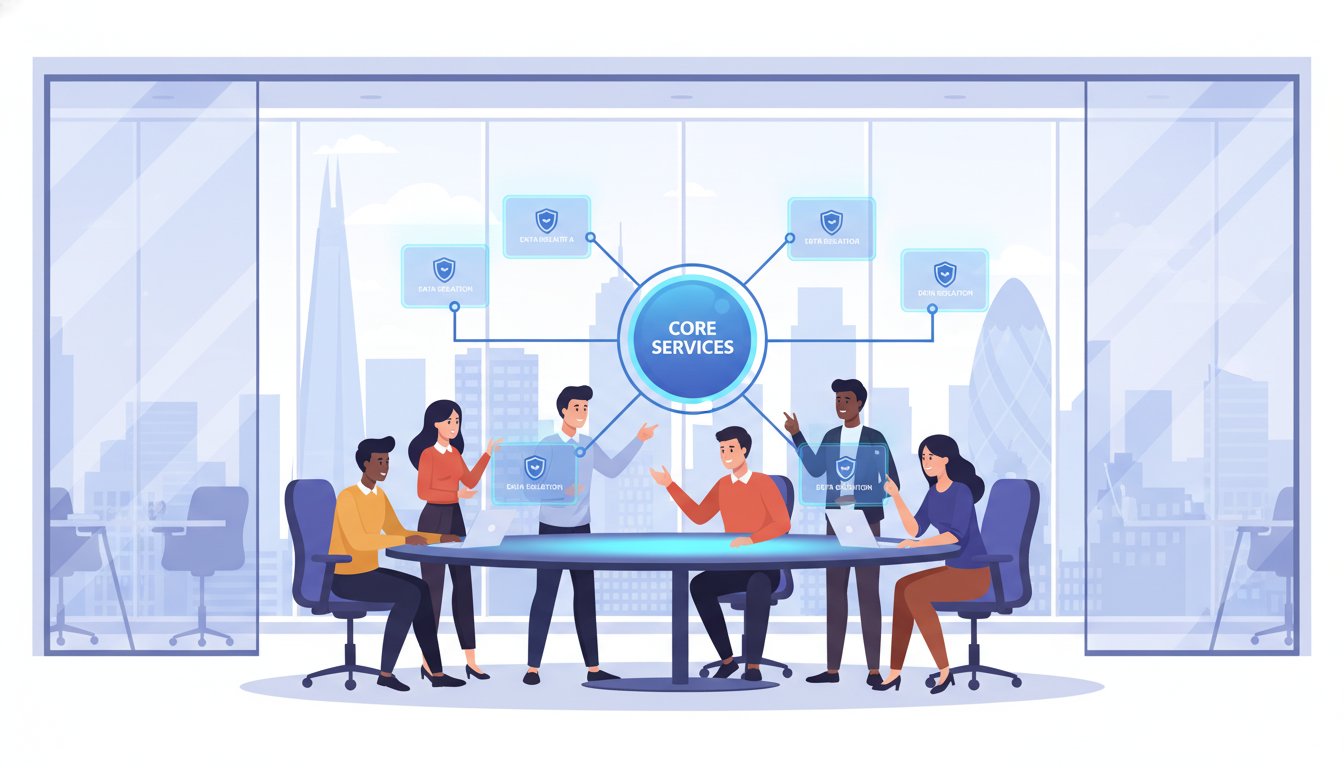
What if a single oversight in your database logic could expose your entire client base to a catastrophic data leak? You already know that building a multi-tenant saas architecture laravel involves far more than just filtering queries by a tenant ID. It's a high-stakes balancing act where you must weigh the infrastructure costs of separate databases against the complexity of shared schemas. The fear of cross-tenant data contamination is real, especially when you're responsible for maintaining strict GDPR compliance for a UK-based user base.
We understand these pressures because we view complex development as a structured journey toward growth rather than a series of technical hurdles. This guide provides the strategic roadmap you need to master the architectural decisions and security protocols required to build a world-class platform. You'll learn how to leverage the latest features in Laravel 13 to maintain clean code and implement scaling strategies that perform perfectly under pressure. We're going to break down exactly how to choose the right database strategy and ensure your application remains a high-performance, foundational asset for your future.
To understand What is Multi-Tenant SaaS Architecture?, one must look beyond simple database filtering. At its core, a multi-tenant saas architecture laravel allows a single application instance to serve thousands of customers, known as tenants, while maintaining strict logical data isolation. This model eliminates the need to deploy separate codebases for every client. Instead, it centralises maintenance and enables your team to push new features or security patches across your entire user base in one deployment cycle. It is the gold standard for modern software companies aiming for rapid market penetration without exponential infrastructure growth.
Laravel serves as the premier framework for this architectural pattern because its core features are built for extensibility. The Service Container allows for dynamic, tenant-specific bindings, while Eloquent provides the necessary abstractions for global scopes that enforce data privacy at the model level. We call this the 'Artisan' approach. It balances high developer velocity with the structural integrity required for enterprise-grade platforms. You don't have to sacrifice clean code for speed; Laravel’s middleware handles the heavy lifting of identifying and isolating requests before they ever reach your business logic.
Successful implementations rely on three technical pillars:
Efficiency is the primary driver for adopting a multi-tenant saas architecture laravel. By sharing server resources like memory and CPU across multiple tenants, you significantly reduce infrastructure overhead compared to traditional single-tenant deployments. Scalability becomes a matter of horizontal expansion rather than managing a fragmented fleet of servers. When your codebase is unified, software maintenance becomes predictable. You won't find yourself trapped in a loop of updating hundreds of individual databases or environments. This streamlined approach ensures that your platform remains a foundational asset capable of supporting thousands of users without compromising performance.
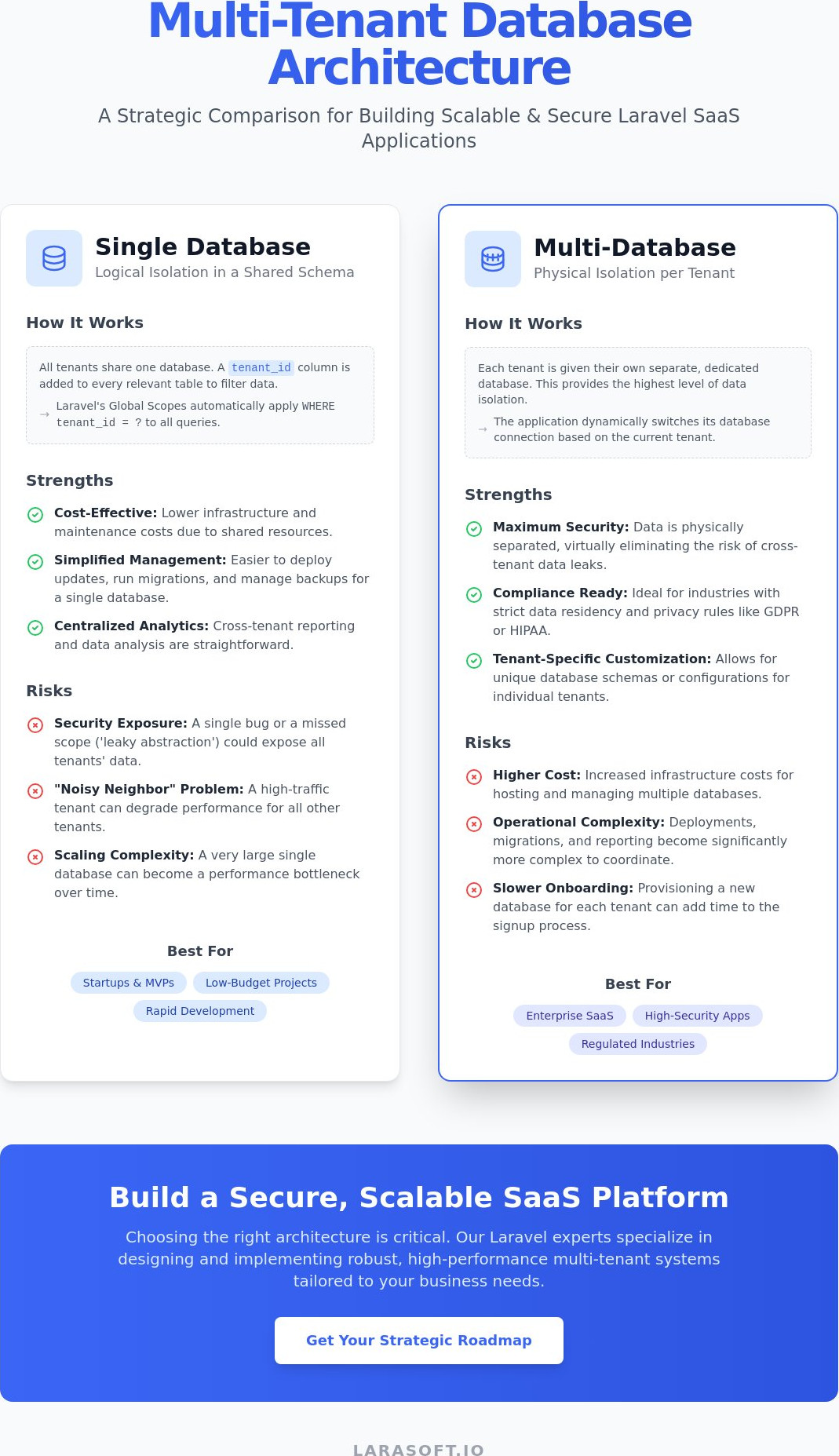
Choosing the right database strategy for your multi-tenant saas architecture laravel is a foundational decision that dictates your platform's security profile and operational costs. It isn't a one-size-fits-all scenario. You must align your technical choice with your clients' data sensitivity and your growth projections for 2026. The two primary paths involve either logical isolation within a shared database or physical isolation across multiple databases.
The single database approach relies on row-level isolation. You add a tenant_id column to every shared table. Laravel makes this manageable through Eloquent Global Scopes. These scopes automatically append a WHERE tenant_id = ? clause to every query, ensuring users only see their own data. To maintain performance as your database grows into the millions of rows, you must strictly index that tenant_id column. This approach keeps your infrastructure overhead low and simplifies global reporting.
While efficient, this method carries the risk of 'leaky abstractions'. A single developer forgetting to apply a scope or using a raw SQL query could potentially expose sensitive data across tenants. Robust automated testing and strict code reviews are non-negotiable here. If you're dealing with complex data structures, our team specializes in legacy code modernisation to ensure these scopes are implemented safely across your entire application.
For platforms serving enterprise clients or handling sensitive financial data, physical isolation is often the requirement. The multi-database approach gives each tenant their own database schema. This provides the highest level of security and makes GDPR compliance more straightforward, as you can delete or migrate a single tenant's data without touching others. It effectively eliminates the risk of cross-tenant data contamination at the database level.
Laravel handles this through dynamic connection switching. Your service provider identifies the tenant and updates the database configuration on the fly. As detailed in Microsoft's Guide to SaaS and Multitenant Architecture, physical isolation reduces the "noisy neighbor" effect where one tenant's heavy queries slow down the entire system. However, managing migrations across hundreds of databases requires sophisticated CI/CD pipelines. You don't want to run migrations manually; you need a system that iterates through every tenant connection to ensure schema parity.
Some modern SaaS platforms use a hybrid model. They keep general settings and user authentication in a shared database while moving sensitive transaction logs to tenant-specific schemas. This balances the connection overhead of multi-database setups with the query simplicity of shared tables. Connection overhead is a real factor in 2026. Each new database connection consumes memory. If you have 5,000 tenants on a multi-database setup, your infrastructure needs to handle that concurrent load. Conversely, a single database setup faces increased query complexity as tables swell. Finding the right balance is where expert Laravel web development becomes essential for long-term scalability.
Security within a multi-tenant saas architecture laravel isn't a peripheral feature; it's the foundation of your platform's commercial viability. The primary technical risk in any shared environment is cross-tenant data leakage. This occurs when a flaw in the application logic allows one customer to view or modify another's records. Preventing this requires a multi-layered defense strategy that begins the moment a request hits your server and continues through to the database layer. We treat security as a matter of structural integrity, ensuring that data boundaries are hard-coded into the application's DNA.
Laravel’s authorization ecosystem, specifically Policies and Gates, provides a robust framework for enforcing these boundaries. While global scopes handle the broad strokes of data filtering, Policies offer granular control. They ensure that even if a tenant context is correctly resolved, the specific user has the explicit right to interact with a resource. This redundant check is vital for enterprise-grade SaaS. It protects against edge cases where a direct ID reference might bypass standard filters. By combining these with tenant-aware middleware, you create a system that is secure by default.
The request lifecycle must be strictly compartmentalised. Custom middleware identifies the tenant early, typically through a subdomain or a specific request header, and binds that tenant to the service container. This prevents "context drifting" where the application might lose track of the current tenant during complex operations. Isolation must also extend to the filesystem and caching layers. If you don't prefix your cache keys with a tenant identifier, you risk serving sensitive, cached data to the wrong user. Similarly, using Laravel's Filesystem with tenant-specific disk configurations ensures that uploaded assets remain private and segregated. For organisations requiring even deeper isolation at the infrastructure level, exploring SaaS architectures on Google Kubernetes Engine can provide insights into namespace-based separation that complements your Laravel logic.
UK-based businesses face unique challenges regarding data residency and GDPR compliance. Your multi-tenant saas architecture laravel must account for where data physically resides. For many enterprise clients, storing data in specific UK regions is a non-negotiable contractual requirement. This often necessitates a multi-database approach where specific tenants are pinned to servers located in London or Cardiff. It also simplifies the execution of "Right to be Forgotten" requests. When a client offboards, you can purge their specific database or storage bucket without the risk of affecting other users or leaving orphaned records in a shared table.
Multi-database architecture simplifies GDPR audits for UK businesses by providing a clear, physical boundary for each customer's personal data. This level of compartmentalisation makes it easier to demonstrate compliance to regulators and stakeholders alike. If you're struggling with fragmented data structures that make compliance difficult, our legacy code modernisation services can help restructure your platform into a compliant, modern environment. We focus on building systems that don't just work, but perform perfectly under the scrutiny of modern data laws.
Moving a growing platform into a multi-tenant saas architecture laravel is a strategic necessity for long-term scalability. This transition often involves a deep legacy code modernisation process to ensure your current foundation can support a multi-customer environment. It isn't just about adding a column to your database; it's about decoupling your core application logic from specific tenant configurations. You need a system where the application remains agnostic of which client it is serving until the request context is resolved.
A successful migration follows a disciplined three-step roadmap to ensure structural integrity:
Achieving zero-downtime during this shift is a hallmark of high-quality execution. We often employ a 'double-writing' strategy where data is written to both the old and new structures simultaneously while the migration matures. This ensures you can roll back instantly if an issue arises, protecting your users' experience. By the time you switch over completely, the data has been validated in the new multi-tenant format without interrupting service.
As we look toward 2026, integrating Laravel AI solutions into your SaaS has become a competitive requirement. However, AI introduces new risks in a multi-tenant environment. You must ensure that your AI models are strictly tenant-aware to prevent training data contamination. A model trained on Tenant A's data should never suggest outputs based on Tenant B's proprietary information. This requires a sophisticated API layer where tenant-specific keys and webhooks manage all external interactions securely.
Larasoft integrates AI to automate tenant onboarding and support, reducing the manual overhead typically associated with setting up new enterprise accounts. This proactive approach ensures your platform remains modern and tech-forward while maintaining the highest standards of data privacy. Building these capabilities into the foundation of your multi-tenant saas architecture laravel ensures your software isn't just a product, but a foundational asset for your future growth. If you're ready to evolve your platform, our team provides the expert Laravel web development needed to manage this complex transition with precision.
Building a high-performance multi-tenant saas architecture laravel requires more than technical knowledge; it demands a partnership with artisans who understand the intersection of code and commerce. At Larasoft, we don't just deliver software. We build foundational assets designed to scale alongside your business ambitions. As a leading Laravel development agency, our focus is on structural integrity and the long-term viability of your platform. We ensure that every architectural decision, from database selection to tenant isolation, serves your specific risk profile and growth goals.
Our commitment to excellence extends beyond the initial launch. We view the development lifecycle as a continuous journey of refinement. This includes providing expert software maintenance and technical evolution to keep your platform at the cutting edge. In an era where Laravel 13 and stable AI SDKs are the new standard, having a technical ally who can modernise your systems without disrupting your service is a significant competitive advantage. We take pride in the cleanliness of our work, ensuring your codebase remains a manageable, high-performance environment as you add thousands of new tenants.
We believe that every SaaS platform has a unique DNA. Our solutions are custom-built to reflect your specific operational needs. We don't rely on generic templates; we engineer systems that perform perfectly under the pressure of enterprise-level traffic. Our approach includes:
The journey from a conceptual roadmap to a world-class SaaS platform requires disciplined execution. Our UK-based team partners with you through every phase, from the initial technical discovery to deployment and continuous, SEO-driven growth. We understand the nuances of the national market, including the strict compliance requirements that UK businesses face. By aligning your technical implementation with strategic business returns, we help you transform complex development into a structured path toward market leadership.
Your platform's success depends on the reliability of its foundation. We provide the specialized expertise needed to navigate the complexities of multi-tenancy, AI integration, and API security with quiet competence. If you're ready to build a system that is both innovative and disciplined, we're here to lead the way. Partner with Larasoft for your multi-tenant Laravel project and turn your vision into a scalable, enterprise-grade reality.
Mastering a multi-tenant saas architecture laravel is no longer just a technical choice; it's a strategic commitment to long-term scalability and data integrity. By now, you've seen how the right database strategy and robust isolation protocols protect your platform from cross-tenant leakage while ensuring UK GDPR compliance. Whether you're refactoring a legacy system or building a fresh AI-driven platform, the focus must remain on creating a codebase that is both clean and resilient under pressure.
Transitioning to a sophisticated multi-tenant environment requires an expert ally who understands the nuances of high-performance digital products. Our UK-based team of Laravel artisans specializes in complex architectures and has a proven track record in legacy code modernisation. We don't just write code; we build foundational assets that empower your business to grow without technical friction. If you're ready to transform your software into a world-class SaaS platform, we're here to guide the journey. Build Your Scalable SaaS Platform with Larasoft and secure your position at the cutting edge of digital innovation.
Single-tenant architecture involves deploying a dedicated software instance and database for every customer. In contrast, a multi-tenant saas architecture laravel serves multiple customers from a single application instance, using logical or physical isolation to keep data private. This model significantly reduces infrastructure costs and simplifies global maintenance because you only manage one codebase.
The choice depends on your specific security requirements and budget. Single-database setups are more cost-effective and easier to maintain for smaller SaaS products with shared data structures. However, multi-database architecture is superior for enterprise clients who demand physical data isolation and strict compliance. It prevents the "noisy neighbour" effect and simplifies granular data residency management.
Laravel handles isolation through a combination of tenant-aware middleware and Eloquent Global Scopes. Middleware identifies the tenant during the request lifecycle and sets the application context. Global Scopes then automatically filter all database queries to ensure users only interact with records belonging to their specific tenant ID, preventing accidental data exposure across the platform.
You can migrate an existing application, but it requires a structured refactoring process to ensure data integrity. This involves auditing your database for tenant-specific data points and implementing traits on your Eloquent models to enforce automatic scoping. Most businesses benefit from a legacy code modernisation strategy to ensure the transition is seamless and doesn't introduce security vulnerabilities.
Management is achieved through dynamic routing and custom middleware that parses the request URL. Laravel’s routing system can capture subdomains as variables, which the application then uses to resolve the tenant from the database. For custom domains, you'll need a central domain resolver that maps external URLs to the correct tenant record during the boot process.
Multi-tenancy is fully compliant with UK GDPR if you implement strict data isolation and residency protocols. A multi-tenant saas architecture laravel allows you to host tenant-specific databases in specific geographical regions if required. This compartmentalisation makes it easier to handle "Right to be Forgotten" requests and provides a clear audit trail for data processing activities.
You manage large-scale migrations by using automated console commands that iterate through each tenant's database connection. Rather than running migrations manually, you use a central script to loop over all active tenants and apply schema updates in sequence. This ensures all databases remain in sync without manual intervention, maintaining structural integrity across your entire infrastructure.
The industry standard packages as of 2026 are stancl/tenancy and spatie/laravel-multitenancy. These packages provide the foundational logic for tenant identification, database switching, and filesystem isolation. Using these established tools allows your development team to focus on building unique business features rather than reinventing the core architectural plumbing from scratch.
Here’s what we've been up to recently.
Certified Quality. Great Prices