Laravel Security Best Practices 2026: The Definitive Guide for UK Businesses


With 8.58 million cybercrime incidents recorded in the UK throughout 2025, the digital perimeter for your application has never been more porous. As AI-driven bot attacks now routinely bypass traditional web application firewalls, maintaining standard configurations is no longer enough to protect your brand reputation. This guide outlines the essential laravel security best practices 2026 to help you move beyond reactive patching and into a state of architectural resilience. We focus on the high-level structural integrity required to keep your systems performing perfectly under pressure.
You likely feel the pressure of managing technical debt in legacy systems while racing to meet the June 2026 deadline for the Data (Use and Access) Act's new complaints procedures. It's a complex balancing act between rapid innovation and the rigorous "secure by design" standards mandated by the new Cyber Security and Resilience Bill. We understand that for UK businesses, security isn't just a technical checkbox; it's a foundational asset for future growth and operational uptime.
This blueprint provides a clear roadmap to harden your production environments, integrate AI-based defense tools, and ensure your complex API ecosystems remain fully compliant with evolving UK GDPR requirements. We'll examine how to leverage Laravel 13 features to neutralize modern threats and secure your digital supply chain against the next generation of vulnerabilities.
The UK government's 2025 Cyber Security Breaches Survey revealed a stark reality: annual incidents rose to 8.58 million. For technical decision-makers, this data signals that traditional perimeter defences are failing under the weight of sophisticated automation. In 2026, laravel security best practices 2026 require a fundamental shift from reactive patching to proactive architectural integrity. It's no longer about fixing bugs as they appear. It's about building systems that are structurally resistant to automated exploitation from the very first line of code.
Maintaining UK GDPR compliance now requires navigating the Data (Use and Access) Act 2025 reforms. With the ICO's enhanced enforcement powers, a single data breach isn't just a technical failure; it's a significant regulatory and reputational risk. Protecting your brand reputation and operational uptime depends on how deeply security is woven into your application's DNA. We view security not as an add-on, but as a foundational asset for your future growth.
Threat actors now use LLM-assisted brute force to bypass standard security filters. Credential stuffing has evolved into a sophisticated, context-aware process where AI-driven botnets mimic human behaviour to evade traditional rate-limiting. Automated scraping has also become more aggressive, targeting specific API endpoints to extract sensitive business intelligence or find entry points for lateral movement. To counter this, we rely on the framework provided by the Open Web Application Security Project (OWASP) to identify and mitigate the most critical risks. A Layered Defence is the only viable security philosophy for 2026, ensuring that if one barrier is breached, multiple others remain intact.
Released in March 2026, Laravel 13 sets a new benchmark for enterprise-grade protection. By targeting PHP 8.5, the framework utilizes enhanced security primitives that provide deeper memory safety and stricter type checking. Adopting these laravel security best practices 2026 ensures your application benefits from the latest architectural safeguards. The shift toward slimmer application structures is a deliberate move to reduce the attack surface; fewer files and a more streamlined core mean fewer entry points for malicious actors.
Laravel 13 also introduces AI-native tooling that integrates directly into the development workflow. These tools provide real-time code vulnerability detection, allowing our artisans to identify potential flaws during the build phase rather than after deployment. This level of foresight is essential for maintaining the structural integrity of modern digital platforms that must perform perfectly under pressure.
Laravel 13's arrival in March 2026 mandates a shift in how we approach code integrity. By targeting PHP 8.5, the framework introduces advanced security primitives that allow for deeper memory safety and improved performance. In this environment, laravel security best practices 2026 are defined by the total elimination of ambiguity. We move away from code that simply "works" toward systems that are mathematically certain. This level of structural integrity is vital for maintaining operational uptime in a high-threat climate.
Configuring Larastan at level 9 is no longer a developer preference; it's a critical security requirement. High-level static analysis catches logic flaws that traditional testing might miss before they ever reach production. By integrating these checks into your CI/CD pipeline, you ensure every pull request meets a rigorous standard of type-safety. This prevents data leakage by ensuring variables and return types are strictly defined. It leaves no room for the unexpected type juggling that often leads to exploitable vulnerabilities. If your current codebase feels fragile, our team specializes in legacy code modernisation to bring your systems up to these modern standards.
Passwords are increasingly becoming a liability as automated LLM-assisted brute force attacks grow more efficient. For UK businesses, implementing Multi-Factor Authentication (MFA) is now a non-negotiable baseline. We leverage Laravel Fortify and Jetstream to deploy robust authentication patterns, but the 2026 standard is moving toward Passkeys and WebAuthn. Transitioning to passwordless authentication significantly reduces the risk of credential theft and phishing. This approach aligns with the OWASP Top 10 security risks, specifically targeting "Identification and Authentication Failures" at the source.
Database security in 2026 requires more than just using Eloquent. While Laravel's ORM provides built-in protection, complex queries and raw expressions still pose risks if handled incorrectly. Advanced SQL injection prevention involves using strict parameter binding and ensuring any dynamic query building is handled through verified architectural patterns. By enforcing strict typing at the database layer, we create a secondary barrier that protects your data even if the application logic is partially compromised. This disciplined approach ensures your platform remains secure as it scales to meet new business demands.
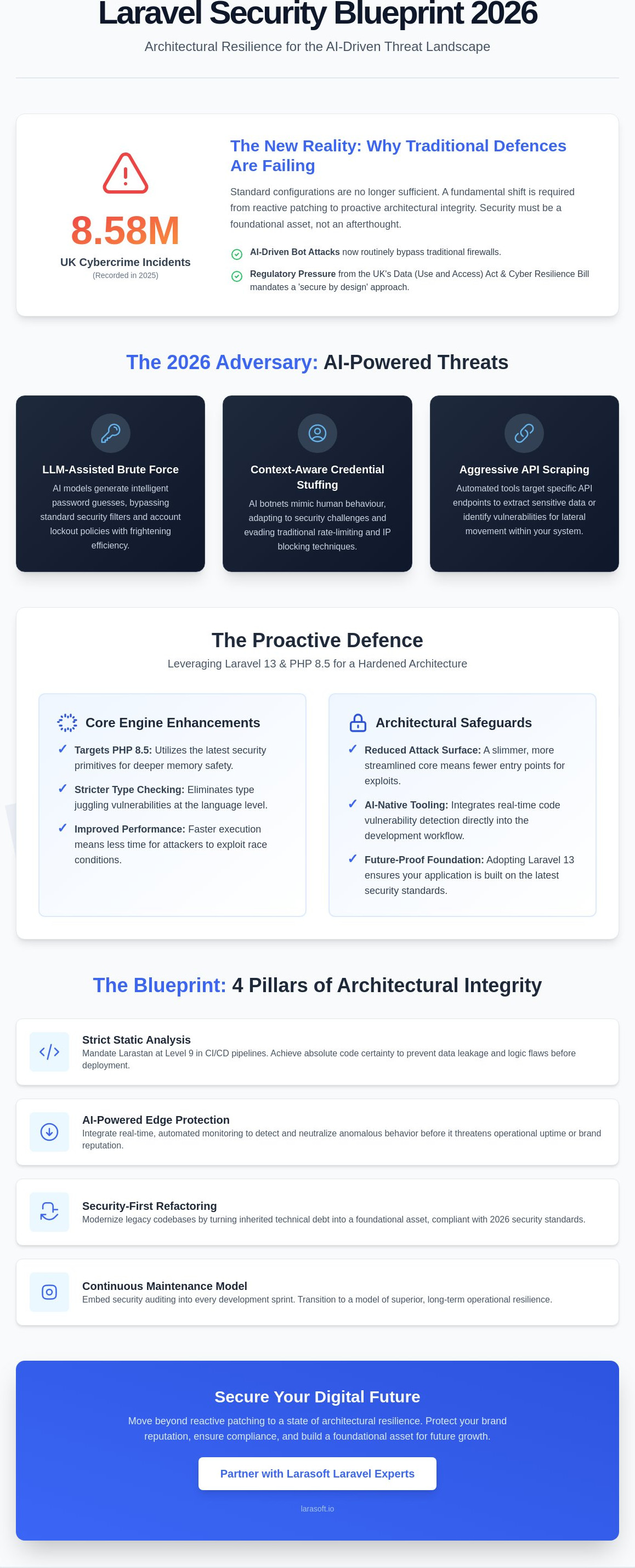
Manual penetration testing, while useful for compliance, cannot keep pace with the velocity of 2026’s automated threats. With UK cybercrime incidents reaching 8.58 million in 2025, your defence strategy must move to the network edge. Integrating Cloudflare Bot Management with custom Laravel middleware allows your application to differentiate between legitimate users and LLM-driven scrapers in milliseconds. This real-time filtering is a cornerstone of laravel security best practices 2026, ensuring that malicious traffic is neutralized before it ever touches your application server. It's a shift from observing attacks to actively preventing them at the point of entry.
Deploying WAF rules specifically tuned for Laravel routes prevents common vulnerabilities like cross-site scripting from reaching your controllers. By using Cloudflare Turnstile, we eliminate bot friction without the frustration of traditional CAPTCHAs, maintaining a fluid user experience while hardening the perimeter. We've found that this edge protection significantly reduces server load and prevents DDoS attacks by absorbing the impact at the global network level. This ensures your platform remains responsive even during high-intensity traffic spikes or coordinated bot attacks.
Traditional logging often results in a deluge of data that hides critical signals. We implement AI-powered ELK Stack monitoring to filter noise from actual security incidents, identifying anomalous behaviour such as suspicious API consumption patterns. This system aligns with secure access control best practices by ensuring that every request is validated against expected user intent. If the system detects a breach, an automated Kill Switch can immediately isolate compromised accounts, preserving the structural integrity of the wider platform while your team investigates the source.
Security is a continuous process that requires persistent vigilance. Utilizing GitHub Advanced Security or Snyk for real-time dependency scanning ensures that your vendor directory remains free of known vulnerabilities. As we integrate Laravel AI integration services into modern platforms, these automated tools act as an essential safety net, catching risks in third-party libraries as soon as they are disclosed. Automated rate limiting now also goes beyond simple IP tracking; it evaluates user intent and session history to prevent sophisticated scraping attempts. This proactive approach transforms security from a weekly checklist into a persistent, automated guardian of your brand reputation and business returns.
Many UK businesses still operate on Laravel 8 or 9, unaware that these versions carry significant inherited debt. While these platforms may still function, they lack the native security primitives found in Laravel 13. Adopting laravel security best practices 2026 requires more than just a version bump; it demands a deep architectural audit to identify vulnerabilities hidden within outdated controllers and middleware. We treat modernisation not just as a technical upgrade, but as a strategic intervention to protect your brand's future. It's about transforming a liability into a foundational asset.
Identifying "Security Smells" in older codebases is the first step toward a resilient system. These smells often manifest as loose variable typing, reliance on deprecated third-party packages, or insufficient request validation. Outdated dependencies are particularly dangerous in 2026, as automated scanners can now identify and exploit unpatched vulnerabilities in minutes. For a deeper look at this process, see our legacy code modernisation pillar. Managing the upgrade path involves a disciplined, step-by-step refactoring that prioritizes high-risk entry points like authentication and data handling modules. This structured journey ensures that security is baked into the code, not just bolted on as an afterthought.
Complex API ecosystems are the primary target for modern supply chain attacks. Hardening Laravel Sanctum for mobile app and SPA communication is essential for maintaining a secure data flow. We implement scope-based access control to ensure that each token has the minimum permissions necessary for its specific task. This prevents a single compromised key from granting access to your entire database. Auditing third-party integrations is equally critical; if an external service you rely on is compromised, your application could become an unintentional gateway for malicious actors. We focus on structural integrity to ensure every connection is verified and every data packet is legitimate.
Meeting 2026 compliance standards also requires a rigorous approach to data encryption both at rest and in transit. The Data (Use and Access) Act 2025 has raised the bar for how sensitive information is handled within the UK. We ensure that your integration layers use the latest TLS protocols and that sensitive fields are encrypted using modern cryptographic standards before they ever reach storage. If your current system feels like a liability rather than an asset, our team can help you modernise your legacy codebase to ensure it remains secure and compliant in an increasingly hostile digital environment.
Annual penetration testing is a relic of a slower era. In a landscape where 24% of UK data security incidents are now classified as cyber incidents, waiting 12 months to identify a flaw is a risk your brand can't afford. The 2026 standard for high-performance applications is the continuous maintenance model. We integrate security checks into every weekly sprint, ensuring that new features don't introduce regression vulnerabilities. This proactive stance is the only way to adhere to laravel security best practices 2026 while maintaining a competitive pace of innovation. It transforms security from a stressful, one-off event into a steady, manageable rhythm that protects your operational uptime.
Scheduling regular dependency updates is no longer a chore; it's a critical defence mechanism. Automated regression testing plays a vital role here, ensuring that security patches don't disrupt your core business logic. This is where Larasoft’s Laravel development services excel, as we prioritise long-term stability and structural integrity over quick, fragile fixes. We treat your codebase as a foundational asset that requires consistent, expert care to remain resilient against evolving threats. By automating the mundane aspects of maintenance, your team can focus on building features that drive business growth.
A comprehensive audit requires a disciplined look at both code and configuration. Use this checklist to evaluate your current standing:
Navigating the Cyber Security and Resilience (CS&R) Bill requires a transparent, highly organized approach to supply chain security. As legislation expands to cover more digital services, your roadmap must account for how third-party integrations affect your overall risk profile. We help you prioritise fixes by evaluating the potential for data loss and operational downtime. This strategic foresight ensures you're not just reacting to threats, but actively shaping a secure digital future. Viewing these laravel security best practices 2026 as an investment allows you to build a platform that commands respect and trust in the UK market. To begin your journey toward a more resilient future, contact Larasoft for a professional Laravel security audit today.
Maintaining a competitive edge in 2026 requires a shift from reactive patching to a philosophy of proactive resilience. By embracing the native security primitives of Laravel 13 and the predictive power of AI-driven monitoring, you protect more than just data; you safeguard your brand’s reputation. Implementing these laravel security best practices 2026 ensures your application remains a high-performance asset capable of navigating the complexities of the UK’s evolving regulatory landscape. Security is no longer a one-off task but a continuous journey toward structural integrity.
Our UK-based team of technical artisans takes immense pride in the cleanliness and efficiency of our work. Whether you require specialized Laravel AI integration or expert legacy code modernisation, we're dedicated to building systems that perform perfectly under pressure. We invite you to secure your application with a Larasoft Laravel Security Audit to identify vulnerabilities before they impact your bottom line. It's time to turn your technical debt into a scalable foundation for future growth. We look forward to partnering with you on this journey toward total operational peace of mind.
Laravel remains the premier choice for enterprise UK applications due to its robust, built-in security features. Laravel 13 provides an advanced foundation that simplifies compliance with the Cyber Security and Resilience Bill. Its architectural integrity allows our artisans to build systems that perform perfectly under pressure. When combined with laravel security best practices 2026, it offers a level of reliability that off-the-shelf software cannot match.
We recommend a continuous maintenance model rather than annual audits. Integrating security checks into your weekly development cycle ensures that new vulnerabilities are caught before they reach production. Since UK cybercrime incidents reached 8.58 million in 2025, waiting for a yearly review is a significant risk. This steady rhythm maintains your operational uptime and protects your brand reputation more effectively than reactive patching.
The most frequent threats in 2026 involve AI-driven botnets and sophisticated supply chain attacks. Credential stuffing has become more effective through LLM-assisted brute force, bypassing basic rate limiting. Vulnerabilities often hide in unpatched third-party packages or legacy controllers that lack strict typing. Adopting laravel security best practices 2026, such as level 9 static analysis, is essential to neutralizing these automated threats before they exploit your data.
PHP 8.5 introduces enhanced memory safety and stricter type checking that directly benefits your application's structural integrity. These primitives reduce the risk of type-juggling exploits and memory-related vulnerabilities. By forcing developers to be explicit about data types, the language helps eliminate the ambiguity that malicious actors often target. This creates a more predictable and secure environment for complex enterprise platforms.
AI tools can identify potential flaws and suggest patches, but they cannot replace the judgment of a specialized artisan. These tools are excellent for filtering noise in logs or scanning for known vulnerability patterns in real-time. However, they lack the deep architectural understanding required to fix complex logic errors without introducing regressions. We use AI to enhance our efficiency, ensuring your platform remains innovative and disciplined.
Specialized agencies provide a level of technical authority and framework-specific knowledge that generalist developers often lack. Security in Laravel isn't just about closing ports; it's about leveraging the framework's internal Gates, Policies, and middleware correctly. An expert partner understands how to modernize legacy codebases without compromising stability. This specialized focus ensures your application is built as a foundational asset for long-term growth.
Beyond the immediate loss of brand trust, the financial penalties under the UK GDPR and the Data (Use and Access) Act 2025 are severe. Organizations can face fines of up to £17.5 million or 4% of their global annual turnover, whichever is higher. The Information Commissioner's Office (ICO) received 3,242 data security incident reports in Q2 2025, signaling a tougher enforcement environment for businesses that neglect their security obligations.
Compliance requires staying ahead of legislative changes like the Data (Use and Access) Act 2025. You must establish a data subject complaints procedure by the June 2026 deadline and ensure all data processing is transparent and secure. We focus on building "secure by design" systems that automate compliance tasks. This approach makes complex regulatory journeys manageable while protecting your business returns and operational continuity.
Here’s what we've been up to recently.
Certified Quality. Great Prices