Software Development for Dubai: A Strategic Growth Guide

With software spending in the Middle East and North Africa projected to reach $20.4 billion by 2026, the digital opportunity in dubai is no longer just a prospect; it's a structural reality. You likely recognize that the UAE represents a major growth lever for your UK-based firm, yet the technical hurdles of international expansion can feel like a significant barrier. It's natural to feel uncertain about right-to-left (RTL) interface support or whether your current tech stack aligns with the ambitious D33 economic agenda. You need a transition that's both disciplined and high-performing.
This guide provides a strategic framework for localising UK software for the Middle Eastern market. You'll discover how bespoke software architecture serves as the essential bridge to regional success, ensuring your platform is ready for a market where 97% of corporations already utilize cloud technology. We will outline the requirements for technical scalability, the nuances of local digital integration, and how a specialized partner can turn complex development into a structured journey toward sustainable growth.
Dubai's economic narrative has undergone a fundamental transformation. While historically recognized for its logistics and retail sectors, the city is now positioning itself as the primary digital gateway between the West and the East. This shift is intentional and highly structured. For UK businesses, the UAE represents a sophisticated market where digital trade isn't just an add-on but a core pillar of national strategy. The transition from a service-based economy to a knowledge-based digital powerhouse is creating an environment where technical innovation is the primary currency.
The Dubai Economic Agenda, known as D33, sets a clear objective to double the size of the economy by 2033. This plan prioritizes digital transformation across fintech, logistics, and AI-driven commerce, creating a massive opening for high-integrity software solutions. With total IT spending in the MENA region projected to reach $169 billion in 2026, the scale of investment is significant. The D33 agenda acts as a primary catalyst for custom software demand by mandating a tech-first approach to all commercial operations. This legislative push ensures that businesses aren't just adopting digital tools but are building their entire operational models around them.
Central to this growth are specialized zones like Dubai Internet City and Dubai Silicon Oasis. These hubs provide the infrastructure required for international firms to scale without the friction of local partnership requirements, offering 100% foreign ownership in many cases. UK firms find a unique synergy here; they bring technical innovation and mature development practices that align perfectly with the UAE's appetite for modernisation. Building for this environment requires a focus on scalable architecture that can handle the rapid expansion these hubs facilitate. The concentration of global talent in these zones makes dubai a magnet for companies that prioritize structural integrity in their codebases.
UK enterprises are choosing the UAE for SaaS launches because the technical readiness of the region is unparalleled. With 97% of corporations in the UAE utilizing cloud technology as of 2026, the baseline for digital adoption is remarkably high. This eliminates much of the "education phase" typical of new market entries. Instead, the focus shifts immediately to performance and localisation. Businesses don't just need software; they need platforms that can integrate with regional payment gateways and handle high-concurrency user loads from day one. The corporate tax structure, which maintains a 0% rate on taxable income up to AED 375,000, further lowers the barrier for innovative UK firms looking to establish a digital footprint in the region.
Success in the Middle Eastern digital landscape requires more than just a translated user interface. It demands a fundamental shift in how you approach interface design and system architecture. While the UAE's Digital Economy Strategy highlights the region's rapid growth, succeeding in dubai hinges on solving specific technical challenges that many Western-centric platforms overlook. You aren't just moving data; you're adapting to a mobile-first culture with unique linguistic and regulatory requirements.
Right-to-Left (RTL) support is the most visible hurdle. It isn't merely about flipping text; it's about mirroring the entire user experience. This includes repositioning sidebars, adjusting the flow of progress bars, and ensuring that icons with directional meaning, such as arrows or back buttons, are correctly inverted. If your architecture doesn't support RTL at a foundational level, you'll face significant technical debt when trying to patch it in later. Performance is equally critical. The UAE market is heavily mobile-dependent, and users expect low-latency interactions even during high-concurrency events like flash sales or regional festivals.
Architecting for Arabic script requires a flexible frontend. Using modern frameworks allows for reactive layout management where the entire UI can switch its orientation based on the user's locale. Specifically, Vue.js frontend development simplifies this process through scoped styles and direction-aware components. By utilizing CSS logical properties instead of fixed directional values, such as using 'margin-inline-start' instead of 'margin-left', developers can build layouts that automatically adapt. This ensures your software maintains its structural integrity regardless of the language being displayed.
Localisation extends deep into the backend. Your software must integrate seamlessly with local logistics providers and fintech services to remain competitive. In the retail and service sectors, integrating 'Buy Now, Pay Later' (BNPL) platforms like Tabby or Tamara is essential for conversion. These integrations must be handled with precision to ensure data consistency across international borders. Larasoft specializes in managing these complex connections, ensuring that your UK-built systems communicate effectively with Middle Eastern payment gateways and delivery networks. If you're looking to scale in dubai, our team can help you navigate these bespoke API connections as part of your international growth strategy.
Compliance and data residency also play a major role. Navigating UAE-specific digital regulations means your software must be capable of handling data according to local laws, which may require specific hosting configurations or encryption standards. This isn't a one-size-fits-all process. It requires a partner who understands both the UK's development standards and the UAE's operational realities. We ensure your transition is manageable and structured, turning complex regional requirements into a foundational asset for your company's future.
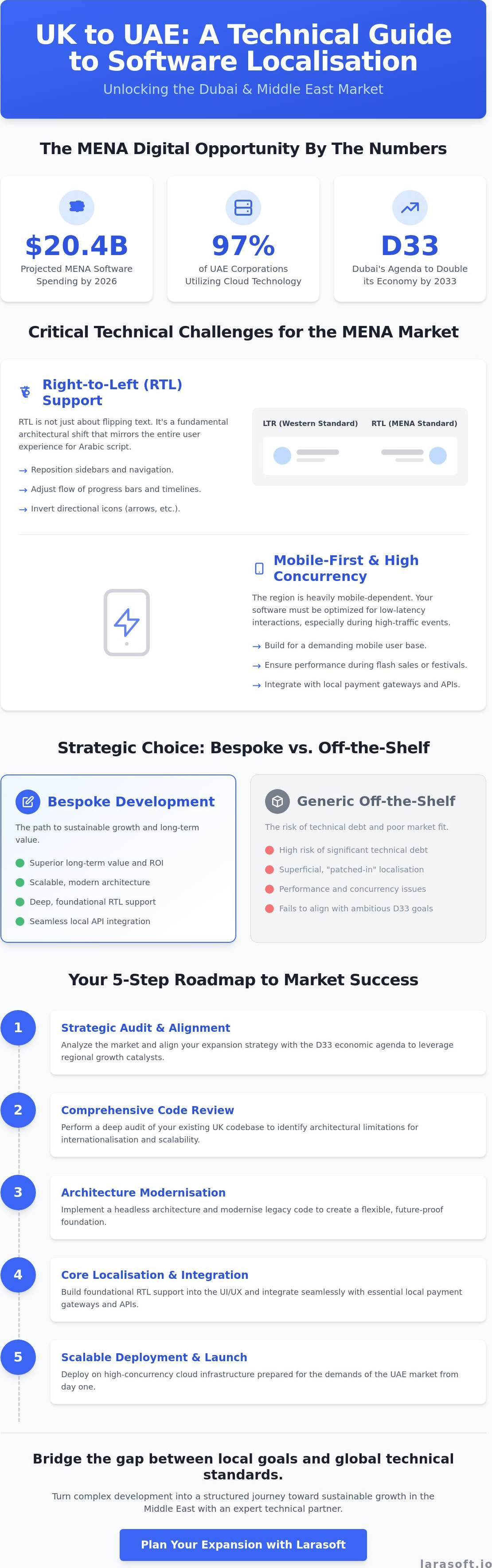
When entering a market as competitive as dubai, the temptation to use existing off-the-shelf software is high. However, generic licenses often carry hidden costs that manifest as technical debt. These platforms are typically built for Western markets and struggle with the structural demands of the Middle East. Whether it's rigid database schemas that don't support regional naming conventions or the inability to integrate with local fintech providers, off-the-shelf solutions frequently become a bottleneck rather than an accelerator. Custom development ensures your platform is a foundational asset, not a temporary fix.
You might wonder if you can simply port your existing UK platform. While technically possible, it's often inefficient. UK-based systems usually lack the architecture for seamless Right-to-Left (RTL) transitions and may not comply with the UAE's Digital Economy Strategy regarding data handling and security. Bespoke development allows you to retain full ownership of your Intellectual Property (IP). This is critical for firms looking to scale in the Gulf, as it provides the freedom to pivot and innovate without vendor lock-in or recurring licensing fees that erode your margins over time.
For UK businesses targeting the UAE, Laravel provides a sophisticated balance of security and speed. Partnering with a specialized laravel development agency ensures your application is built on a framework that prioritizes structural integrity. Laravel's built-in security features, such as protection against SQL injection and cross-site request forgery, align perfectly with the high digital standards expected in dubai. Its modular nature also means you're prepared for 10x user growth, allowing your system to expand as your market share increases across the region.
| Feature | Bespoke Development | Generic SaaS / Off-the-Shelf |
|---|---|---|
| Flexibility | Total control over features and UI. | Limited to vendor-defined modules. |
| Cost-over-time | High initial build; low long-term fees. | Lower entry cost; high per-user scaling fees. |
| Localisation Ease | Native RTL and local API support. | Often requires clunky, third-party plugins. |
| Performance | Optimized for specific user loads. | Bloated with unused generic features. |
Generic templates frequently collapse in RTL environments because they lack the logical property foundations required for seamless interface mirroring. By choosing a custom build, you gain a significant competitive edge. Your platform will feel like a local product rather than a translated one, which is essential for building trust with a Middle Eastern audience. This disciplined approach to development ensures that every line of code serves a specific business objective, resulting in a more efficient, high-performing system.
Transitioning a UK-centric digital product for use in the Middle East requires a disciplined sequence of technical interventions. It's not a simple translation project; it's an architectural evolution. Success in dubai depends on how well your software adapts to local user behaviors and infrastructure requirements. We follow a structured five-step roadmap to ensure your transition is manageable and your platform remains a foundational asset for your firm's future.
For many established UK firms, the primary barrier to expansion is technical debt. Legacy code modernisation is the critical first step in this journey. By refactoring outdated components, you prepare your system for the demands of a high-speed digital economy. This process isn't just about cleaning code; it's about re-engineering your platform to support global scalability and high-performance integrations. Modernising your core systems before entering dubai ensures that your expansion is built on a stable, secure foundation rather than a fragile patchwork of fixes.
The Gulf market operates on a mobile-first philosophy that often exceeds the mobile dependency seen in the UK. With 97% of UAE corporations already utilizing cloud technology as of 2026, the expectation for instant, high-quality mobile access is standard. Choosing between native and cross-platform mobile development is a strategic decision that impacts your speed to market and user experience. Your mobile application must reflect the efficiency and sophistication expected in the region. If you're planning a regional launch, explore our bespoke mobile development services to ensure your app meets these high standards from day one.
Expanding into dubai requires a partner who understands both the rigid standards of UK engineering and the specific architectural demands of the UAE. Larasoft acts as this bridge. We translate your strategic business goals into a structured technical roadmap, ensuring that your transition into the Middle Eastern market is seamless. By maintaining a focus on structural integrity, we turn complex regional requirements into manageable development milestones. We provide the technical authority needed to navigate the Gulf's digital landscape while remaining a local, accessible ally for your internal teams.
Our expertise is anchored in high-performance frameworks including Laravel, Vue.js, and React. These tools allow us to build global applications that are both reactive and secure. When we modernize a platform, we don't just update the UI; we re-engineer the core to handle international scaling. For instance, we recently modernised a UK-based platform for international success by refactoring its core architecture to support high-concurrency users. This approach to legacy code modernisation significantly improves load times across international server environments, ensuring your software performs perfectly under pressure.
Choosing a UK-based agency provides a layer of quality control and communication that is often lost in fully offshore models. You benefit from shared business hours, clear accountability, and a deep understanding of the regulatory environment in which your primary business operates. Our role is to be a deeply invested technical ally rather than a mere service provider. We take immense pride in the cleanliness and efficiency of our work. This creates an atmosphere of trust, where complex development processes are presented as a manageable, structured journey toward growth.
We view ourselves as technical artisans who prioritize architectural integrity. Clean code matters. Our problem-solution framework starts with your specific challenge and concludes with a high-performing technical intervention. We don't build one-off products. Instead, we create foundational assets for your firm's future. This persona is forward-thinking and modern, yet grounded in the practical realities of business returns. If you're ready to begin your digital expansion in dubai, we invite you to request a consultation with our senior architectural team.
A successful launch is only the beginning. To ensure long-term ROI, your platform must be visible and reliable. We integrate comprehensive SEO services from the architectural level up. This ensures your platform is optimized for regional search visibility. Beyond the launch, our dedicated software maintenance plans provide the ongoing support needed to manage regional updates and security patches. Our approach is disciplined. This ensures your international application remains stable as you grow. Contact Larasoft today to discuss how we can support your journey into the UAE's high-growth tech landscape.
The D33 economic agenda has transformed the region into a primary gateway for digital trade. Succeeding in dubai requires more than a surface-level translation; it demands a deep architectural commitment to Right-to-Left (RTL) support and high-concurrency performance. By choosing bespoke development over generic software licenses, you protect your intellectual property and ensure your platform can scale alongside the UAE's rapid digital transformation. A disciplined approach to internationalisation today prevents costly technical debt tomorrow.
Larasoft provides the technical authority needed to navigate this transition. Our specialized Laravel and Vue.js architects bring extensive expertise in RTL and internationalisation, ensuring your code is as efficient as it is scalable. You benefit from UK-based quality control with a global reach, turning complex modernisation into a manageable, structured journey. We take pride in building clean, resilient systems that perform perfectly under the pressure of international expansion.
Partner with Larasoft for your global software expansion and transform your digital platform into a foundational asset for international growth. We're ready to help you build a high-performing future in one of the world's most dynamic tech hubs.
Yes, it's an exceptional growth market due to its high digital adoption and strategic location. With software spending in the region expected to grow by 13.9% in 2026, UK firms find a receptive audience for high-quality engineering. The lack of personal income tax and the ability to operate in free zones with 100% foreign ownership make it a commercially attractive destination for sustainable expansion.
Localisation extends beyond language to include specific UI/UX standards and regional integrations. You must account for Right-to-Left (RTL) script support and high-concurrency mobile usage. Additionally, integrating with local payment gateways like Tabby or Tamara and logistics providers is essential for commercial success in dubai. These systems require a bespoke approach to ensure seamless data flow and a high-quality user experience.
Implementing RTL support requires a fundamental shift to CSS logical properties and flexible frontend frameworks. You should replace fixed directional values like 'left' and 'right' with 'start' and 'end' to allow the layout to mirror automatically. Using Vue.js or React allows for reactive state management where the direction of the entire application can be toggled based on the user's selected locale without breaking the underlying architecture.
The D33 agenda is a government blueprint aimed at doubling the city's economy by 2033 through digital transformation. For software providers, this means a massive increase in demand for custom solutions in fintech, AI, and logistics. Aligning your product with these priorities ensures you're building for a market that has significant institutional backing and a clear, long-term growth trajectory for digital services.
Laravel is an excellent choice for the UAE market because of its inherent security and scalability. It handles complex API integrations and high user loads efficiently, which is critical for the region's mobile-first audience. When paired with a headless architecture, Laravel provides the stable backend required to serve multiple frontend localisations, including Arabic RTL interfaces, while maintaining high performance under peak regional traffic.
A UK-based partner often provides superior quality control and alignment with Western business standards while handling internationalisation. You benefit from shared time zones and clear communication during the development phase. A partner like Larasoft bridges the gap between your UK goals and Middle Eastern technical needs, ensuring your software meets global standards without the friction of managing remote teams across vast cultural differences.
The cost of localising an application depends on the complexity of your current codebase and the depth of integration required. You should budget for a technical audit, RTL interface development, and API connections for local payment and logistics services. While specific figures vary based on project scope, investing in bespoke modernisation rather than a superficial translation layer provides better long-term ROI and lower technical debt.
Software in dubai must comply with UAE-specific digital regulations and data residency laws. Depending on your sector, you may need to host data locally or follow specific encryption protocols. It's essential to consult with a technical partner who understands these requirements to ensure your platform remains compliant as regulations evolve. This is particularly relevant for businesses involved with virtual assets or financial services requiring specific regulatory licensing.
Here’s what we've been up to recently.
Certified Quality. Great Prices