Custom Subscription Billing System: Features, Architecture and Build Decisions

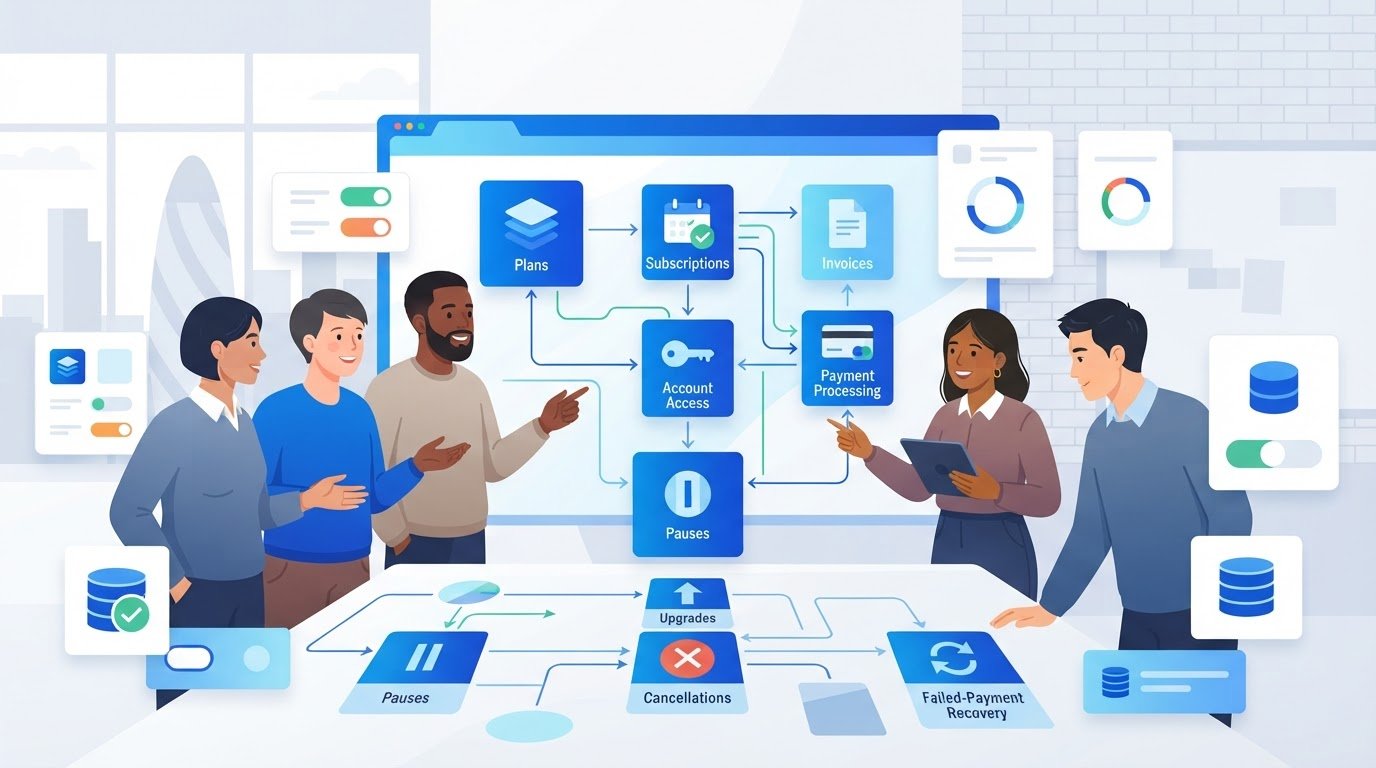
Buying more billing software may not fix a subscription model that keeps breaking the customer journey. A custom subscription billing system can give you control over unusual pricing and account rules, but it also means taking responsibility for the system’s reliability and ongoing maintenance.
If upgrades, pauses, failed payments and customer entitlements are difficult to coordinate, the underlying issue may be how billing connects to the rest of your business. The right solution needs to support your actual rules, keep payment and account data in sync, and give customers a clear experience. That doesn’t always mean building everything from scratch.
This guide explains the essential capabilities and architectural boundaries to consider, then compares bespoke development with platform-based and hybrid approaches. You’ll also learn how to assess whether your billing rules justify a custom build and plan for integrations, payment recovery and maintainability from the outset. For businesses whose documented requirements don’t fit existing platforms cleanly, a structured approach to bespoke Laravel development and API integration can help create a solution that’s built around today’s needs and ready to evolve.
A custom subscription billing system applies a business’s own rules to recurring charges and coordinates the records and actions those charges trigger. It is distinct from payment processing, which securely handles a payment attempt, and accounting, which records financial activity for reporting and reconciliation.
In a subscription business model, customers pay on an ongoing basis for continued access to a product or service. Billing software connects that commercial arrangement to operational steps: it stores subscription details, calculates what is due, creates invoice records, requests payment through a processor and communicates whether access should continue or change.
Subscription billing software manages recurring plan rules, billing events and the records needed to coordinate charges with customer access. It typically sits between the customer-facing account experience, the payment processor and accounting systems. The processor reports whether a payment attempt succeeded or failed; the billing system uses that result to update the subscription and related records. Accounting tools then receive the relevant financial data, according to the organisation’s requirements.
For example, if a customer changes to a higher-tier plan partway through a billing period, the system needs to apply the agreed change rule to the next invoice and update the customer’s entitlements. If those actions happen in separate systems without reliable coordination, the customer could be charged for one plan while receiving access to another.
Bespoke development may be appropriate when a business has distinctive pricing, contract terms or account rules that standard workflows can’t represent cleanly. The signal isn’t simply that billing feels complicated. It’s that documented requirements repeatedly force teams into workarounds, manual adjustments or exceptions that make the customer experience harder to manage.
Integration gaps can strengthen the case. If subscription changes must be copied between billing, customer account and finance systems, staff may spend time reconciling inconsistent records. A carefully designed integration can connect those systems around a clear source of truth, but proposed payment providers and accounting connections should be confirmed against the business’s actual needs.
Custom development also creates ownership. The organisation must plan for testing changes to billing rules, maintaining integrations, handling failures and supporting the software as its model evolves. That responsibility can outweigh the value of flexibility if a platform already handles the requirements. A sound decision weighs differentiation and workflow fit against the ongoing commitment to business-critical software.
A subscription lifecycle is a sequence of linked decisions, not just a recurring card charge. The system records what a customer has agreed to, calculates what is due, receives payment outcomes and applies the business’s access rules. Keeping these steps coordinated helps prevent a mismatch between a customer’s invoice, payment status and service entitlements.
The journey usually begins when a customer selects a plan and completes sign-up. Once the required checks and payment setup are complete, the subscription becomes active and the system records its terms and renewal date. At renewal, billing rules determine the amount due and an invoice record is created. A payment provider then reports the attempt’s outcome.
Customers may also upgrade, downgrade, pause, cancel or later reinstate a subscription. Each event needs a defined effect on billing and access. For example, a business must decide whether an upgrade takes effect immediately, whether the next invoice is adjusted, and how a changed billing date affects future renewals. These are policy choices, not universal defaults. Record them explicitly so customers and staff receive consistent outcomes.
A failed payment is not the same as a cancellation. The system should record the failure, apply the agreed retry or communication process, and change access only according to the business’s stated policy. A successful payment likewise updates payment status, but entitlement changes should follow the relevant subscription rules rather than being assumed.
The payment provider is an external dependency. The billing application requests or schedules a payment through its integration; the provider processes it and returns a result. Webhooks or an equivalent event mechanism can notify the application of events such as successful or failed payments. The application should validate incoming events and handle retries or duplicate notifications safely, so one payment event doesn’t create conflicting updates.
A simple system boundary might look like this:
Customer action → subscription record and billing rules → invoice record → payment request to external provider → payment event returned → subscription status and customer entitlements updated → relevant data sent to accounting or other systems
Keep a clear record of each event and its effect. If the payment succeeds but an update to account access fails, the system needs a way to identify and resolve that inconsistency. The right design may use a queue, direct API calls or another integration pattern, depending on expected workflows and the systems involved. A Laravel development and API integration partner can help assess those connections as part of a bespoke build.
Tax treatment, invoice content and payment-security requirements depend on the business model and how the system handles data. Verify applicable obligations with qualified advisers and confirm each proposed provider and integration against your requirements before implementation.
The choice isn’t simply between buying software and building it. A subscription platform can provide established billing workflows, while bespoke development gives you greater control over how your own rules and customer journeys work. A hybrid approach can combine these: use specialist services for defined billing functions and build the application or workflows that need to fit your business more closely.
Keep the categories clear. A payment provider processes payment transactions; a subscription platform manages subscription and billing workflows, often connecting to payment providers. They aren’t interchangeable, and choosing one doesn’t automatically address every billing, integration or customer-account requirement.
Platform-based: Often a good fit when standard workflows cover your plans and changes. It can reduce the amount of billing functionality you need to build and maintain, but check whether its rules, customer experience and integrations suit your requirements.
Fully bespoke: Offers control over business-specific rules and system behaviour. Your organisation also owns the design, testing, integration work and ongoing maintenance of this business-critical software.
Hybrid: Keeps suitable specialist billing capabilities while custom-building selected workflows, integrations or customer-facing features. It can balance fit and control, but introduces dependencies that need clear boundaries and reliable coordination.
An established platform may already support common subscription operations, reducing the need to create and maintain those workflows yourself. That doesn’t guarantee a fit. Unusual pricing, contract exceptions, data requirements or customer journeys may require workarounds, and essential integrations may not behave as expected.
Assess each option against the same requirements: pricing-rule flexibility, integration needs, control of data and workflows, delivery effort, and who owns ongoing maintenance. Verify current features, contract terms and integration capabilities directly with each vendor. Document gaps rather than assuming they can be resolved later.
Custom development becomes more compelling when documented rules are central to how the business operates or differentiates its offer, and standard workflows cannot represent them cleanly. Complexity alone isn’t enough. The expected operational value must justify building, supporting and adapting the solution over time.
Decision matrix:
For every route, make assumptions visible: which system is authoritative for subscription status, what happens when an integration fails, and who maintains each component. Those answers matter as much as initial flexibility when choosing an approach that can be sustained.
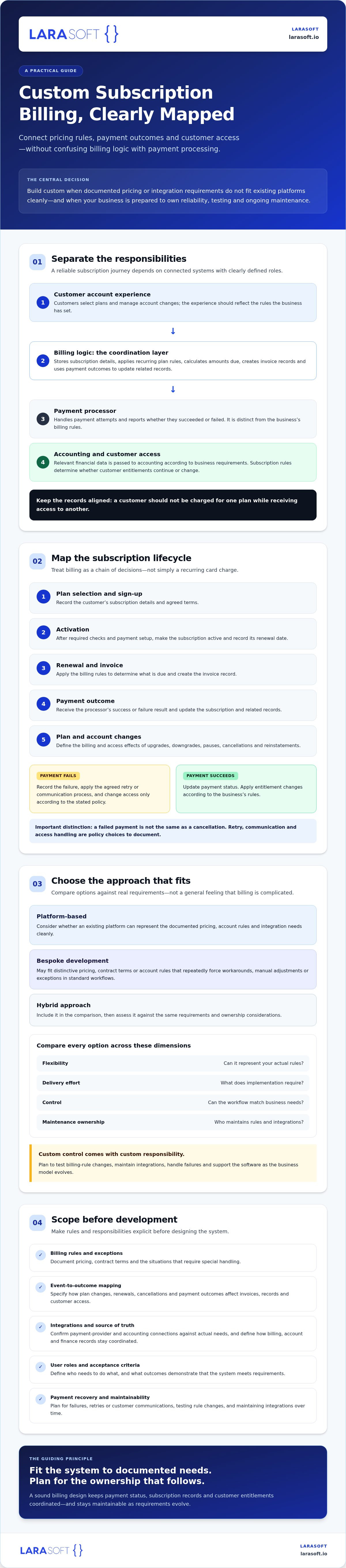
A clear brief turns billing policies into buildable requirements. Before development starts, map how subscriptions work today, identify where records or decisions fall out of sync, and agree which problems the new system must solve. This keeps a custom subscription billing system focused on business needs rather than a list of features without clear priorities.
Use a structured discovery process to move from current workflows to testable outcomes:
If billing is separate from the customer-facing experience, define how that frontend reads and updates subscription information. A separate Vue.js interface may be appropriate for some projects; for background on that option, see The Strategic Guide to Vue.js Frontend Development for Modern Businesses. The specific approach should follow the product’s users, integrations and operational requirements.
Test the rules on paper first. Walk through concrete examples, such as a mid-cycle upgrade, a failed renewal or a cancellation followed by reinstatement. Agree what the invoice, subscription record and customer access should show in each case. Resolve disagreements before they become competing interpretations in code.
Include integration failure paths in the test plan. Check what happens when payment events arrive late, arrive more than once, report failure or need to be retried. Define recovery steps so staff can identify and resolve a mismatch rather than relying on manual guesswork.
Finally, assign ownership for monitoring, technical documentation, updates and post-launch support. For help shaping requirements into a maintainable Laravel application and integration plan, discuss your billing system requirements with Larasoft.
A bespoke billing project needs more than code that calculates recurring charges. It needs a clear model of subscription rules, dependable connections to payment and business systems, and an agreed plan for maintaining the software as requirements change. Larasoft builds bespoke Laravel web applications and provides API integration, capabilities that may suit organisations whose documented billing workflows don’t fit existing platforms cleanly.
Larasoft offers software development services, not a named or ready-made subscription billing product. The work would be shaped around your requirements, with the system boundaries, integrations and ownership decisions defined before implementation begins.
Ask how the team will translate your rules into system behaviour. They should be able to discuss how subscription states, payment events, customer entitlements and integration failures will be represented, and how data ownership will be handled across connected systems. Ask what will be tested, how technical decisions will be documented, and who will be responsible for planned maintenance after launch.
Replacing an older billing application also calls for a careful transition plan. Consider how existing records and dependencies will be assessed before deciding whether to replace, integrate or modernise the current system. Legacy Code Modernisation: A Strategic Guide for UK Business Leaders is a relevant topic to explore when planning that work.
Prepare a concise project pack before speaking with a development partner. Include representative customer journeys, billing rules and exceptions, required integrations, current-system constraints, and the outcomes that would define a successful first release. Note any unresolved questions too. They help focus early discussions on risk and decision-making.
A collaborative delivery path can then move through requirements and architecture, prioritised development, integration testing and an agreed maintenance approach. A phased plan can separate essential launch capabilities from later enhancements, while testing scenarios such as duplicate payment notifications, failed transactions and recovery paths before they affect live customer accounts.
Larasoft’s software maintenance and integration capabilities are relevant considerations for teams planning beyond the initial build. If you’re evaluating whether bespoke development fits your billing requirements, discuss your custom software requirements with Larasoft. A focused discussion can help clarify the rules, architecture options and delivery phases to assess next.
A custom subscription billing system is most valuable when documented business rules or integration needs don’t fit existing platforms cleanly. Complexity alone isn’t a reason to build: weigh the flexibility you need against the responsibility of maintaining business-critical software.
Whichever approach you choose, keep subscription rules, payment outcomes and customer access aligned. Scope the work around real customer journeys, explicit exceptions and clear acceptance criteria. Prioritise what’s essential for launch, then plan how integrations, testing and ongoing ownership will support the system as requirements evolve.
Larasoft provides bespoke Laravel web application development, API integration and software maintenance. These capabilities may suit a project that needs a tailored billing application connected to other business systems, with maintainability considered from the start. Larasoft offers development services, not a ready-made billing product.
If you’re assessing the next step, discuss your custom software requirements with Larasoft. A clear conversation about your workflows and constraints can help you evaluate a practical path forward. Build with care, and your billing architecture can grow alongside the business.
A custom subscription billing system is software built to manage subscription records and apply a business’s billing rules. It coordinates plans, renewal dates, invoice records and customer entitlements, while a separate payment provider processes transactions. For example, when a subscriber changes plan, the system can apply the agreed billing rule and update account access. The precise responsibilities depend on the business’s workflows and connected systems.
Consider bespoke development when documented pricing, contract or account rules can’t be represented cleanly by existing platforms, or when integration gaps repeatedly create manual work and inconsistent customer experiences. Complexity by itself isn’t enough to justify a build. Compare the business value of greater control with delivery effort and the ongoing responsibility for maintaining reliable, business-critical software. A platform or hybrid approach may be a better fit.
Yes. A custom billing application can connect to a payment provider through its API, sending payment requests and receiving outcomes through webhooks or an equivalent event mechanism. The provider processes the transaction; the billing system uses the reported result to update subscription records and follow the relevant business rules. Confirm the provider’s capabilities, integration requirements and fit with your workflows before selecting an architecture.
It records the failed payment and follows defined recovery rules, which may include retrying the payment and notifying the customer. A payment failure should be distinguished from cancellation: the system shouldn’t automatically remove access unless that matches the business’s stated policy. Teams should also test delayed or duplicate payment notifications and define how to resolve mismatches between payment status, subscription records and customer entitlements.
Core capabilities typically include plan and subscription records, recurring invoice creation, payment-provider integration, and support for plan changes, pauses and cancellations. The system should also coordinate payment outcomes with customer access, keep useful records of billing events and provide reporting that meets operational needs. The right feature set depends on business rules, integrations and customer-service workflows, so define requirements before deciding what belongs in the first release.
Not inherently. An existing platform may provide established billing workflows and reduce the amount of bespoke functionality your team needs to maintain. A custom build may offer a closer fit for distinctive rules or integrations, but requires ongoing ownership, testing and maintenance. A hybrid approach can retain specialist billing capabilities while customising selected workflows. Compare options against your documented needs, vendor terms, integration fit and long-term responsibilities.
Start by mapping customer journeys and documenting plans, billing rules, exceptions, roles and reporting needs. Identify payment, accounting and other required integrations, along with current-system constraints and any data migration assumptions. Then define testable acceptance criteria and separate launch-critical capabilities from later enhancements. Validate real scenarios, including failed payments and recovery paths, before development. Agree who will own documentation, updates, integration monitoring and software maintenance after launch.
Here’s what we've been up to recently.
Certified Quality. Great Prices