Software Development Brief Template: The Ultimate Guide for 2026


What if the difference between a high-performance digital asset and a £50,000 budget sinkhole isn't the code itself, but the document you wrote before a single line was typed? Most business leaders feel the sting of "translation fatigue" and struggle to find a software development brief template that actually works. You have a vision for a scalable platform, but somewhere between the initial idea and the technical spec, the requirements often get muddled. It's frustrating to watch scope creep erode your margins simply because of misunderstood requirements.
You need a way to turn complex business logic into a manageable, structured journey. This guide provides a professional framework designed for the 2026 landscape, where AI-native architecture and API-first design are the standard. By mastering this documentation, you'll secure accurate project quotes and build a roadmap that ensures your software performs perfectly under pressure. We'll explore how to define technical requirements for modern frameworks like Laravel 13, ensuring your project remains a foundational asset for your future growth.
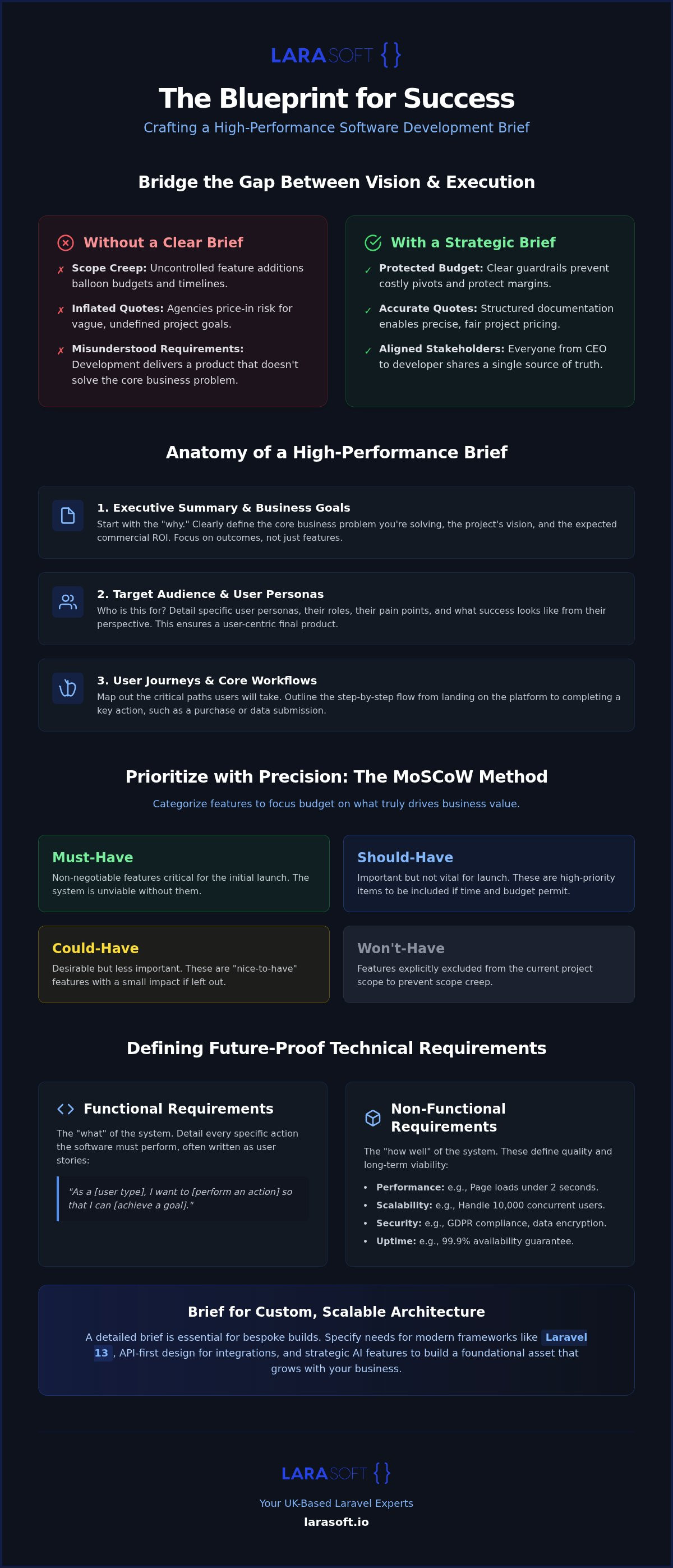
A software development brief template is more than a simple checklist; it's a strategic asset that bridges the gap between commercial vision and technical execution. This document serves as the project's foundation, ensuring that every stakeholder understands the core objectives before a single line of code is written. Without this alignment, projects often fall victim to scope creep, where minor feature additions gradually balloon into significant budget overruns and missed deadlines. A professional brief acts as a guardrail, keeping the development team focused on high-impact requirements.
High-quality development agencies prioritise clients who provide structured documentation. A vague request for "a new app" often leads to inflated quotes because developers must price in the risk of the unknown. By using a structured template, you signal that your business is prepared for a professional partnership. It's also vital to distinguish between a project brief and a full Software Requirements Specification. While the brief outlines the vision and business goals, the specification provides the granular technical details required for the actual build phase.
Aligning stakeholders early prevents costly pivots later in the development cycle. By defining the "why" before the "how," you ensure that the technical team understands the commercial impact of their work. This clarity reduces time-to-market by streamlining the discovery phase, allowing developers to move directly into architectural planning. Ultimately, the brief creates a measurable benchmark for project success, making it easier to calculate the eventual ROI of your custom build within the UK market.
Generic software often forces your business to adapt to its limitations. In contrast, bespoke builds using frameworks like Laravel 13 allow the software to adapt to your specific workflows. This requires a more detailed software development brief template because every feature is built from the ground up to provide a competitive advantage. You aren't just buying a tool; you're building a scalable asset. Your brief must address long-term growth and future-proofing, ensuring the system can handle increased loads or new API integrations as your business expands. Focusing on custom architecture ensures that your software remains a foundational asset rather than a temporary fix.
A robust software development brief template acts as the architectural blueprint for your digital product. It begins with an Executive Summary that prioritises the core business problem over technical jargon. Instead of simply listing features, focus on the project vision and the commercial ROI you expect to achieve. This is followed by a detailed breakdown of your Target Audience. Mapping user personas and their specific pain points ensures the final build solves real-world challenges. A desired user journey should outline the fluid transitions from landing on the platform to completing a key conversion. You can find various starting points online, such as a software project brief template, but a bespoke technical document requires deeper granularity to be effective.
Functional requirements represent the "what" of your software system, detailing every action the application must perform. To avoid ambiguity, describe these using user stories. For example: "As a warehouse manager, I want to see real-time stock levels so I can prevent over-ordering." We recommend prioritising these features using the MoSCoW method. This framework categorises requirements into Must-have, Should-have, Could-have, and Won't-have. Using this structure prevents scope creep and ensures your initial budget focuses on the most critical business drivers. If you're unsure how to prioritise these, partnering with a technical ally for a discovery session can clarify your roadmap before development begins.
Non-functional requirements are often overlooked but dictate the long-term viability of your platform. You must specify clear performance targets, such as page load speeds under two seconds and 99.9% uptime requirements. For UK businesses, addressing data protection and GDPR compliance is non-negotiable. Your brief should outline mandatory security protocols, including multi-factor authentication (MFA) or single sign-on (SSO) integrations. Additionally, ensure your document references the latest WCAG 2.2 accessibility standards to remain compliant with UK regulations. These constraints, along with your hard deadlines and budget ranges, provide the necessary boundaries for a successful, high-performance build.
Your choice of technology stack fundamentally alters the requirements of your software development brief template. In 2026, Laravel 13 has solidified its position as the premier framework for scalable, secure web applications. When briefing for a Laravel build, you must specify the need for an API-first architecture and PHP 8.3 compatibility. This ensures your backend remains modular and capable of supporting future growth. Similarly, your frontend preferences shouldn't be an afterthought. Whether you opt for the reactive capabilities of Vue.js or the extensive ecosystem of React, the brief needs to define how these frameworks will handle complex data states and user interactions to provide a fluid experience.
Choosing the right mobile strategy is equally critical. While cross-platform frameworks like React Native have become the dominant choice for many business applications due to cost efficiency, native development remains the gold standard for high-performance apps requiring deep hardware access. Your brief must clearly state whether you require a unified codebase or device-specific builds for iOS and Android. This decision impacts your project's long-term maintenance costs and its ability to leverage the latest mobile hardware features.
Addressing existing technical debt is a major gap in most generic briefing documents. If your project involves updating an older platform, your brief must document known bottlenecks and the current system's architectural limitations. You need to define a clear migration strategy, deciding between a "Big Bang" replacement or a more controlled, incremental refactoring process. This level of detail prevents unforeseen complications during the build. For a deeper look at managing these transitions, refer to our Legacy Code Modernisation: A Strategic Guide, which outlines how to protect your existing data while transitioning to modern frameworks.
When briefing for mobile, you must define which device-specific features are mandatory for your user journey. This includes hardware integrations like GPS, biometric authentication, or camera access. Beyond hardware, consider the operational environment of your users. If your staff or customers need to access data in areas with poor connectivity, the brief must specify offline functionality and robust background sync requirements. These technical nuances ensure the development team builds a resilient solution that performs reliably under real-world UK network conditions, rather than just a simple web wrapper.
Modern digital platforms rarely operate in isolation. Your software development brief template must account for a complex web of interconnected services, from payment gateways and CRMs to bespoke internal databases. Mapping this ecosystem early prevents technical debt and ensures your architecture supports fluid data exchange. By documenting every external touchpoint, you provide developers with the clarity needed to build a resilient, interoperable system that scales alongside your business. This level of foresight is what separates a generic product from a high-performance digital asset.
API integration acts as the bridge between your custom software and the wider digital world. When briefing for these connections, you should list every required endpoint and define the direction of data flow. Is the connection read-only, or does your software need to push updates to external platforms? Your brief must also address authentication methods, such as OAuth or dedicated API keys, and specify rate limiting to prevent system overloads. Treating APIs as a central product decision, rather than a simple plug-and-play component, ensures the structural integrity of your platform and prevents future integration bottlenecks.
With approximately 70% of applications now utilizing AI in some capacity, your brief should explicitly define how machine learning will enhance your specific product. Within a Laravel environment, this might involve integrating AI for predictive analytics, automated customer support, or complex data processing. You must specify the data sources intended for training and address the privacy considerations required for UK compliance. Additionally, ensure the brief accounts for the specific computational resources required, as AI-driven features often demand more robust infrastructure than standard web functions. If you're ready to explore these capabilities, you can consult our team on Laravel AI integration to define your technical roadmap.
Clear documentation of these technical requirements is essential for long-term software maintenance. As API demand continues to rise, driven by the growth of Large Language Models, having a well-documented contract ensures your system remains adaptable. Security protocols for data exchange must be rigorous, utilizing encrypted channels and strict validation rules to protect sensitive user information. This level of detail in your initial brief protects your investment, ensuring that future updates or integrations don't compromise the stability of your foundational asset.
Completing your software development brief template is a critical milestone, but it's only the beginning of the journey. At Larasoft, we view this document as the launchpad for a deep technical partnership. As a specialist UK-based agency, we don't just build to order; we interrogate your requirements to ensure the final architecture is both scalable and commercially viable. This collaborative approach transforms a static list of features into a high-performance digital engine designed for long-term growth. We act as your technical artisans, taking pride in the cleanliness and efficiency of every system we deploy.
Our team uses your brief to conduct a rigorous discovery process. We look beyond the surface to identify potential bottlenecks in your proposed API logic or data structures. By catching these risks early, we protect your budget and timeline from the hidden costs of technical debt. This phase is about more than just validation; it's about finding opportunities to enhance your project's structural integrity. For those still evaluating their options, The Strategic Guide to Choosing a Laravel Development Agency provides further insights into what to look for in a technical ally.
Once the backend logic is solidified in Laravel 13, we focus on delivering a seamless user experience. Whether your requirements call for a Vue.js or React frontend, we ensure the transition from server-side data to client-side interaction is fluid and responsive. This results-oriented focus ensures that your custom software performs perfectly under pressure, meeting the high expectations of modern UK users. We build systems that aren't just functional today but are engineered to be foundational assets for your business's future.
A successful launch isn't the finish line. To remain a valuable asset, your software requires a strategic maintenance plan to handle security updates and performance tuning. We integrate SEO services from the initial build phase, ensuring your platform is visible to your target audience from day one. Our ongoing software maintenance ensures your system stays secure, updated, and ready for future AI or API integrations. This holistic view of the development lifecycle ensures your investment continues to deliver ROI long after the initial build is complete. Ready to start your build? Contact Larasoft today to turn your brief into a high-performance reality.
A professional software development brief template is the most effective tool you have to eliminate ambiguity and protect your project's ROI. By defining your technical requirements early, you ensure that complex integrations and custom Laravel architectures are built to perform perfectly under pressure. This strategic alignment doesn't just save time; it creates a scalable asset that grows with your business. It's about moving from a vague idea to a structured journey toward sustainable growth.
Larasoft brings UK-based technical authority to every project, specialising in high-performance Laravel builds, legacy code modernisation, and strategic AI integration. We act as your invested technical ally, ensuring that every line of code serves your long-term commercial goals. Our focus on structural integrity and clean execution means your software remains a foundational asset for years to come. Download our Expert Software Development Brief Template today to align your stakeholders and start your build with confidence. Your vision deserves a technical partner who values precision and longevity as much as you do.
A comprehensive brief must include an executive summary, target audience personas, and detailed functional requirements. It should also outline non-functional requirements such as security standards and performance targets. Documenting your preferred technical stack, specific API integrations, and any legacy system constraints ensures the development team understands your commercial objectives. A well-structured software development brief template acts as a foundational asset, aligning business goals with technical execution from day one.
A typical brief usually ranges from 5 to 15 pages depending on the project's complexity. A simple MVP might only require a few detailed pages, whereas enterprise-level systems or legacy modernisation projects need more depth to cover technical debt and architectural requirements. The goal is clarity over length. Every page should add value by defining a specific requirement or business objective to prevent misunderstandings during the build phase.
You don't need to be a developer to write a brief, but you must clearly define your business goals and user needs. A professional software development brief template provides a structure for non-technical stakeholders to communicate their vision effectively. If certain technical details remain unclear, an expert agency like Larasoft can refine your initial document during a dedicated discovery phase to ensure it is build-ready and technically sound.
Generic templates often miss the nuances of high-performance frameworks like Laravel 13. While they provide a basic structure, they rarely address specific needs like API-first architecture, PHP 8.3 compatibility, or strategic AI integration. For bespoke builds, you need a template that prompts for detailed logic, security protocols, and scalability requirements. This ensures the final product is a custom-built solution that performs perfectly under real-world pressure.
A detailed brief reduces the risk premium agencies often add to quotes when requirements are vague. By providing clear functional and non-functional requirements, you allow developers to estimate the actual hours required for the build accurately. This leads to more competitive and transparent quotes, as the agency has a clear roadmap of the work involved. This clarity significantly reduces the likelihood of expensive mid-project changes or budget overruns.
Functional requirements define the specific actions the software must perform, such as "users can reset their passwords." Non-functional requirements describe how the system operates, covering performance, security, and accessibility. For example, ensuring the platform loads in under two seconds or complies with UK GDPR and WCAG 2.2 standards falls under non-functional requirements. Both are essential for creating a high-performance digital product that meets modern user expectations.
The brief is a foundational document that should remain relatively stable, but it can evolve during the initial discovery phase as technical risks are identified. Once development begins, changes should be managed through a formal change request process rather than constant updates to the original brief. This keeps the team focused on the agreed roadmap while allowing for necessary adjustments based on new data or technical opportunities discovered during the build.
Including a budget range is highly recommended as it helps agencies propose the most effective technical solution for your investment. If your budget is £50,000, an agency might suggest a high-performance Laravel MVP, whereas a £250,000 budget allows for complex AI integrations and extensive legacy refactoring. Transparency ensures you receive proposals that are commercially realistic and aligned with your financial constraints, facilitating a more productive long-term partnership.
Here’s what we've been up to recently.
Certified Quality. Great Prices