Scalable Web Application Architecture: The 2026 Strategic Guide

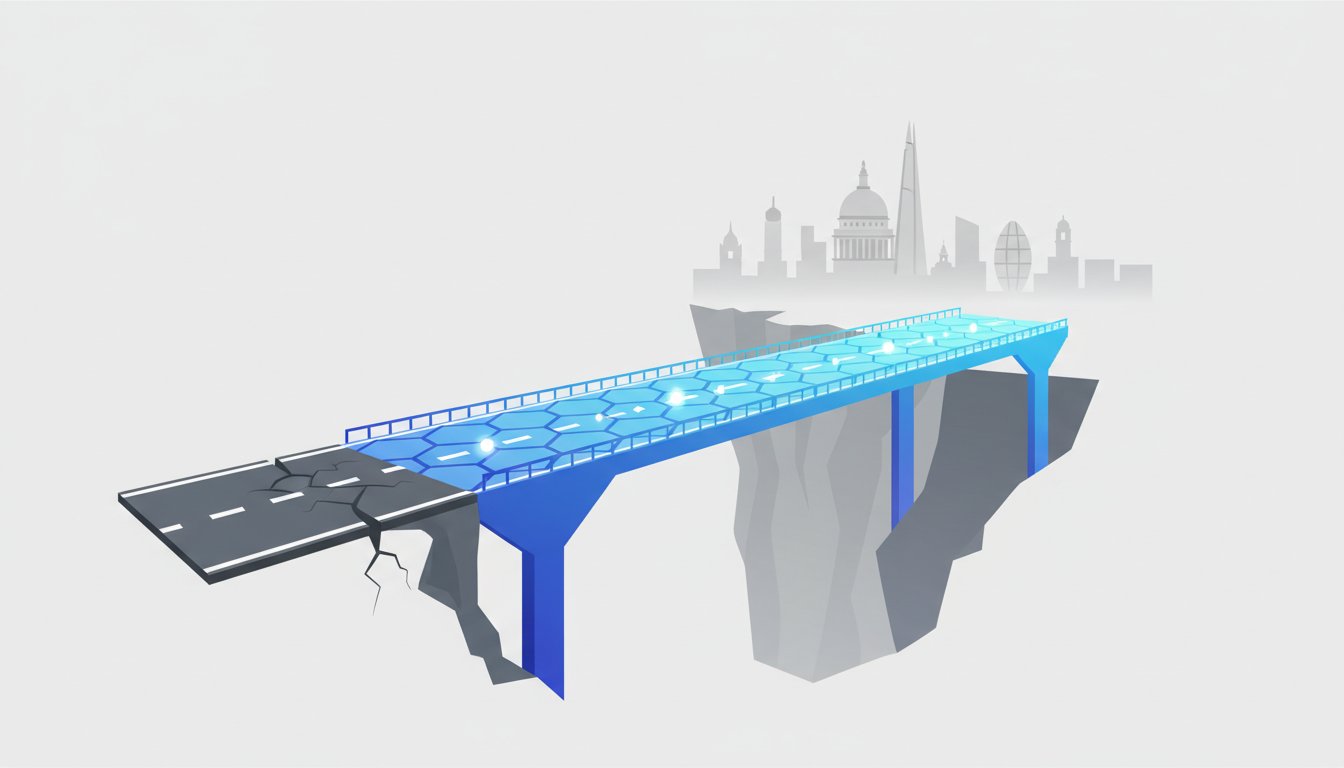
Your infrastructure costs are projected to rise by up to 10% by September 2026, yet simply adding more servers won't solve the underlying inefficiencies of a rigid system. A truly scalable web application architecture is built on the discipline of decoupled design and clean code craftsmanship, rather than just raw compute power. You've likely dealt with the stress of performance bottlenecks during peak traffic or the burden of technical debt that makes your monolithic system nearly impossible to update without risking a total crash.
We believe that your software should be a foundational asset, not a source of constant firefighting. This strategic guide offers a clear roadmap to help you master the architectural principles needed to handle millions of users while maintaining peak performance. We'll explore the critical trade-offs between various scaling strategies and help you select a modern tech stack, utilizing tools like Laravel 13 and PostgreSQL 18.3, that grows with your business. You will learn how to build a system that remains resilient, cost-effective, and ready for the shift toward agentic AI.
At its core, Scalability is the measure of a system's ability to handle growing workloads by proportionally adding resources. For decision makers, a scalable web application architecture isn't just a technical preference; it's a financial safeguard. It ensures that when your user base doubles overnight, your infrastructure doesn't buckle under the pressure. While reliability focuses on the system performing correctly and availability ensures it stays online, scalability dictates whether your application can survive its own success. Without it, your software becomes a bottleneck that stifles business growth.
In May 2026, demand patterns have shifted toward extreme volatility. We're no longer just looking for systems that can scale; we require "elastic" architectures. Elasticity allows a system to automatically expand and contract in response to real-time spikes, such as those caused by autonomous AI agents interacting with your API. Poor architectural choices lead to immediate business consequences. When performance degrades, user churn increases. A 200ms delay in response time can lead to a measurable drop in conversion rates, directly impacting your bottom line as infrastructure costs are forecasted to rise by 10% this year across major providers.
Scaling isn't a one-dimensional task. First, you must scale for throughput, which involves managing a high volume of concurrent requests per second. Second, you need to manage data volume. With the release of PostgreSQL 18.3 in February 2026, managing massive datasets without latency has become more structured, yet it still requires precise indexing and query optimization. Finally, you must scale for complexity. As you add bespoke features using Laravel 13, your code base must remain clean so that development cycles don't slow down. If adding a new feature takes twice as long as it did six months ago, your architecture is failing the complexity test.
It's a common misconception that a fast application is a scalable one. An app might respond in 50ms for a single user but crash when 10,000 users arrive simultaneously. Performance is about the response time for a single unit of work, while scalability is about maintaining that performance as the number of units increases. In modern development, the "Scale-out" approach, adding more machines to a cluster, has largely won the debate over "Scale-up" methods. To maintain control, you must monitor key metrics: latency, throughput, and resource utilization. If your CPU usage hits 80% while latency stays flat, your scalable web application architecture is doing its job. If latency spikes alongside usage, it's time to rethink your resource allocation.
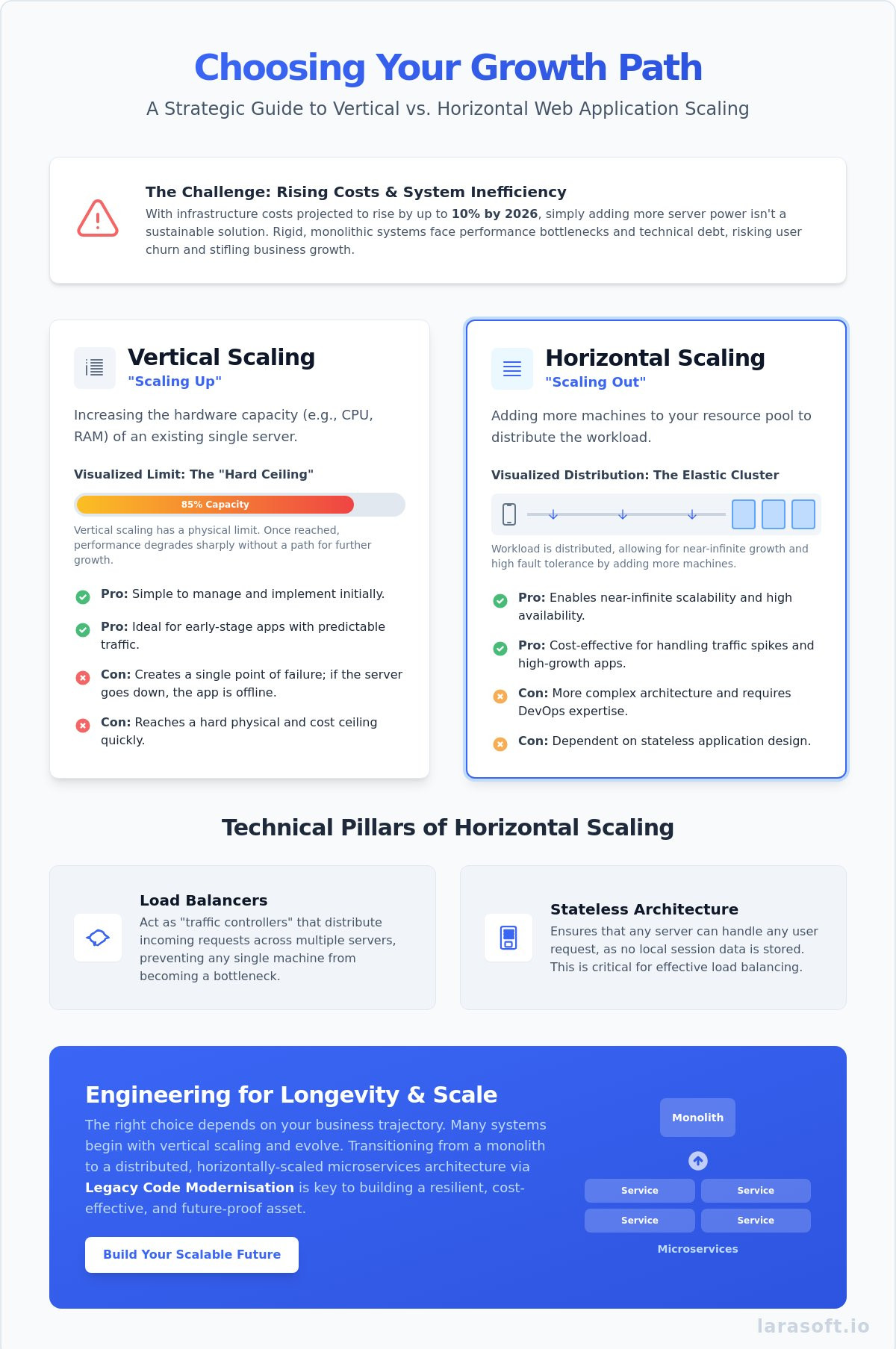
Building a scalable web application architecture requires a clear choice between two distinct paths: scaling up or scaling out. Vertical scaling, or "scaling up," involves increasing the hardware capacity of your existing server, such as upgrading the CPU or adding more RAM. Horizontal scaling, or "scaling out," involves adding more machines to your resource pool to share the workload. While both methods aim to handle increased demand, they serve different strategic objectives throughout a software’s lifecycle.
Effective horizontal scaling depends on two technical pillars: load balancers and statelessness. Load balancers act as traffic controllers, distributing incoming user requests across multiple server nodes to prevent any single instance from becoming a bottleneck. This only works if your application is stateless, ensuring that any server in the cluster can handle any request without needing local session data. Understanding IT Scalability in this context is vital for maintaining a seamless user experience as traffic grows. In 2026, with cloud providers like OVH Cloud forecasting price increases of 5 to 10 percent, choosing the most efficient scaling model is a prerequisite for maintaining healthy margins.
Vertical scaling is often the default choice for early-stage startups and MVPs with predictable traffic patterns. It's straightforward to manage and requires less initial investment in DevOps automation. However, this method eventually hits a "Hard Ceiling" where physical hardware limits are reached. If you're currently facing performance issues on a single-server setup, it might be time to consider Legacy Code Modernisation to transition toward a more flexible, distributed model before you hit that ceiling.
Horizontal scaling allows for near-infinite growth by utilizing distributed systems. This model significantly enhances fault tolerance because the failure of one server doesn't bring down the entire application. In 2026, leveraging ARM-based runtimes like AWS Graviton can provide 15 to 20 percent cost savings for these distributed workloads compared to traditional x86_64 instances. Horizontal scaling is the gold standard for modern SaaS. By decoupling your resources, you ensure that your infrastructure remains as agile as your business demands, allowing you to handle millions of users without a single point of failure.
Many guides treat scalability as a purely infrastructure problem, focusing on cloud providers like AWS or Azure. They often ignore that code quality is the actual foundation of a scalable web application architecture. A monolithic system is frequently the starting point for most applications. It's simple to deploy, easy to test, and cost-effective for initial growth. However, without strict craftsmanship, it risks becoming a "Big Ball of Mud." This is a state where every component is tightly coupled, making it impossible to scale individual features and turning every update into a high-stakes gamble for your team.
Microservices solve this by decoupling services for independent deployment and scaling. You can scale your high-traffic payment gateway without touching your low-traffic user profile service. While powerful, this adds significant operational overhead and network latency. For most businesses in 2026, the "Modular Monolith" represents the superior middle ground. It offers the performance and simplicity of a single application with the logical separation usually found in microservices. Laravel 13, launched on March 17, 2026, provides the ideal ecosystem for this approach. It allows us to build structured, modular systems that handle millions of requests without the fragmented complexity of a fully distributed network.
Modern user demand requires multi-platform delivery across web, mobile, and IoT. We recommend an API-first design that separates your core business logic from the presentation layer. By utilizing Vue.js frontend development, you offload heavy processing to the client side. This reduces the compute burden on your servers and ensures a seamless, high-performance experience across all devices. This headless approach allows your backend to serve as a single, reliable source of truth for diverse frontend consumers.
You don't always need to rebuild from scratch to achieve significant growth. If your current system is failing under pressure, legacy code modernisation is the most strategic path forward. We often employ the Strangler Fig Pattern to manage this transition. This method involves migrating specific functionality to a new, modern architecture piece by piece until the old system is eventually replaced. It's a disciplined way to address technical debt while keeping your business fully operational. Assessing the debt of your current scalable web application architecture today prevents a total system failure when your traffic inevitably spikes tomorrow.
High concurrency systems require more than just raw power. They demand a scalable web application architecture that prioritizes efficient data flow. The first point of failure is almost always the database. When your app handles millions of users, a single database instance becomes a major bottleneck. We solve this through read/write splitting, where a primary database handles updates while multiple replicas manage read requests. For even larger datasets, horizontal sharding distributes data across multiple servers, ensuring no single node is overwhelmed.
Databases are the heart of your application. While Laravel 13 makes working with SQL databases like PostgreSQL 18.3 seamless, you must choose your storage engine wisely. SQL is excellent for structured data and complex relationships, but NoSQL might be necessary for high-velocity, unstructured data streams. Sharding is the ultimate solution for horizontal database growth. It requires a disciplined approach to avoid data integrity issues, but the payoff is a system that grows indefinitely with your user base.
Caching is the most effective way to reduce database load. By implementing multi-layer caching, including opcode, object, and page caching, you ensure that frequently accessed data never hits the primary database. Redis 8.6.2 serves as a high-speed session and data store. Redis significantly improves response times for session management by storing data in-memory rather than on disk. Beyond the server, Content Delivery Networks (CDNs) distribute static assets to edge locations worldwide. This drastically reduces latency for a global audience by serving content from the nearest physical node.
In 2026, we're seeing the rise of agentic AI. It introduces unpredictable, long-running tasks into the request cycle. Traditional synchronous processing won't survive these conditions. You must offload these AI-driven workloads to asynchronous background queues. This keeps your web interface responsive while the heavy lifting happens in the background. If you're ready to integrate these advanced capabilities, our team can help with Laravel AI integration to future-proof your system. We focus on building systems that work perfectly under pressure, ensuring your vision is backed by our clean, efficient code.
Infrastructure alone doesn't guarantee growth. At Larasoft, we treat scalable web application architecture as a discipline of code craftsmanship. While cloud providers manage the hardware, the efficiency of your application logic determines your actual ROI. We reject the "quick fix" culture of off-the-shelf software licenses, which often introduce hidden technical debt and rigid limitations. Instead, we prioritize bespoke development that serves as a foundational asset for your company's future. By May 2026, the complexity of web systems has reached a point where generic solutions simply can't keep pace with the demands of high-concurrency traffic.
Choosing a specialized Laravel development agency provides a distinct advantage. We build security and scalability into the design phase, utilizing the robust features of Laravel 13 to create resilient systems. To ensure that rapid growth doesn't compromise stability, we implement automated testing and rigorous CI/CD pipelines. This means every new feature is verified before it hits production, preventing regressions that could alienate your users. We also prioritize observability, using advanced monitoring to catch performance bottlenecks before they impact your conversion rates.
Our team functions as your technical ally. We follow disciplined coding standards to prevent architectural rot, ensuring your system remains maintainable as it expands. Clear documentation is a non-negotiable part of our process, providing a roadmap for future scaling phases. We operate under the philosophy of "Your vision, our code," where we align our technical execution with your five-year growth plan. This collaborative approach ensures the software we build today is ready for the challenges of 2030 and beyond.
If your current system is struggling, the first step is a comprehensive scalability audit. We analyze your existing Laravel, Vue.js, or React applications to identify precise bottlenecks in your data flow and resource usage. From there, we create a structured roadmap for infrastructure and code modernisation. This isn't about temporary patches; it's about building a system that performs perfectly under pressure. Contact Larasoft to discuss your scalable architecture requirements and secure the technical foundation your business deserves.
Building a robust system in 2026 requires more than just reactive server upgrades. It demands a proactive commitment to clean code and modular design principles. You've seen how horizontal scaling, statelessness, and asynchronous processing provide the elasticity needed to handle millions of users without performance degradation. A well-executed scalable web application architecture is no longer a luxury. It's the baseline for surviving the volatility of modern digital markets where infrastructure costs are projected to rise by up to 10% between April and September 2026.
Success depends on choosing a technical ally that understands the nuances of long-term software health. As dedicated Laravel specialists, our bespoke UK-based engineering team focuses on building foundational assets that grow with your business goals. We bring deep expertise in legacy code modernisation to help you transition from rigid monoliths to flexible, high-performance systems. Partner with Larasoft to build your next high-performance web application and transform your technical vision into a resilient reality. Your business growth shouldn't be limited by the constraints of your code.
The database is the most frequent bottleneck in a scalable web application architecture. As traffic increases, disk I/O and complex query execution times often exceed the available resources of a single server. Implementing read/write splitting or sharding techniques allows you to distribute this load effectively. By May 2026, using PostgreSQL 18.3 has become a standard for managing these high-concurrency data requirements efficiently.
Microservices aren't always the superior choice; for many businesses, a modular monolith is a more cost-effective and less complex solution. While microservices allow for independent scaling, they introduce significant network latency and operational overhead. We often recommend a well-structured Laravel 13 monolith that utilizes modular design patterns. This approach provides the performance you need without the fragmented management burden of a fully distributed system.
Building a scalable web application architecture in the UK depends on the specific complexity of your business logic and projected user traffic. While we don't provide flat rates for bespoke engineering, you should account for rising infrastructure costs. Major providers like OVH Cloud have confirmed price increases of 5 to 10 percent between April and September 2026. Investing in clean, efficient code early prevents these external cost hikes from ballooning your total budget.
You can scale a legacy application without a total rebuild by utilizing legacy code modernisation strategies. We often apply the Strangler Fig Pattern to replace inefficient components piece by piece. This allows you to address specific bottlenecks, such as a slow API or an outdated database schema, while keeping your core business operations online. It's a disciplined way to modernize your tech stack without the high risk of a total system rewrite.
A load balancer acts as a traffic controller to ensure no single server node is overwhelmed by incoming requests. It's a prerequisite for horizontal scaling, as it distributes traffic across a cluster of healthy application instances. If one server fails, the load balancer automatically reroutes users to the remaining nodes. This ensures your application maintains high availability even during sudden traffic spikes or localized hardware failures.
Caching improves scalability by storing frequently accessed data in high-speed memory, which drastically reduces the load on your primary database. Using Redis 8.6.2 allows your system to serve data in microseconds rather than waiting for complex disk-based queries. By implementing multi-layer caching, you can handle significantly more concurrent users with the same underlying infrastructure. This efficiency is critical for maintaining performance as your user base grows.
In 2026, PHP with Laravel 13, GoLang 1.26.2, and TypeScript remain the top choices for building scalable systems. Laravel provides a robust framework for rapid development while tools like Laravel Octane offer high-performance execution. GoLang is particularly effective for microservices that require massive concurrency. We choose these tools because they balance developer productivity with the technical requirements of high-traffic web environments.
Horizontal scaling enhances disaster recovery by eliminating single points of failure within your infrastructure. By spreading your application across multiple servers or geographical regions, you ensure that the loss of one instance doesn't result in total downtime. This distributed approach allows for automated failover and seamless recovery. In 2026, leveraging ARM-based runtimes across these clusters can also reduce your redundancy costs by 15 to 20 percent compared to x86_64 setups.
Here’s what we've been up to recently.
Certified Quality. Great Prices