Laravel Third Party API Integration: A Strategic Guide for UK Businesses in 2026


What if your third-party API provider isn't just a convenient service, but a ticking clock of technical debt waiting to disrupt your core business logic? In the fast-paced UK market of 2026, a simple connection is no longer enough. You've likely seen how messy "Services" folders and unhandled downtime can break critical workflows, leaving your team to scramble through unmaintainable code. With the Data (Use and Access) Act 2025 now imposing fines of up to £17.5 million for non-compliance, the architectural integrity of your laravel third party api integration is now a matter of legal and operational survival.
We understand that you need systems that perform perfectly under pressure. This guide promises to help you master the architecture of secure, scalable, and resilient integrations within the Laravel 13 framework. You'll learn how to build a decoupled integration layer that protects your application from external volatility while maintaining strict UK GDPR standards. We will walk through the strategic transition from rigid, fragile connections to a modular, testable architecture that allows you to swap providers or scale your features without rewriting your entire codebase.
An Application Programming Interface (API) serves as the vital bridge between your bespoke platform and the broader digital economy. For UK enterprises in 2026, laravel third party api integration is no longer just a technical task; it's a strategic move toward a composable architecture. This modular approach allows businesses to assemble "best-of-breed" systems by connecting their Laravel core to specialised external ecosystems. Instead of building every feature from scratch, you're leveraging the research and infrastructure of global leaders.
The "Build vs. Buy" dilemma is a critical consideration for any CTO. Why spend £40,000 and six months developing a proprietary payment gateway when you can integrate Stripe or GoCardless in a fraction of the time? By choosing to integrate, you're not just saving capital. You're gaining access to enterprise-grade security, regulatory compliance, and features that would be prohibitively expensive to maintain in-house. This strategic shift ensures your internal development team remains focused on the unique features that drive your specific competitive advantage in the British market.
UK startups and established enterprises are increasingly adopting an API-first mindset to accelerate time-to-market. This strategy allows for a leaner launch, where core services are operational in weeks rather than months. By leveraging external expertise for non-core functions, such as identity verification or cloud communications, you reduce operational overhead and technical debt. This approach also simplifies mobile application development, as a single, well-structured API layer can serve your web frontend, native iOS apps, and Android platforms through a unified data source.
Laravel acts as the sophisticated glue for disparate business systems. While other PHP frameworks might require significant boilerplate to handle external requests, Laravel 13 provides a clean, expressive syntax that streamlines connectivity. Its built-in tools, such as the fluent HTTP Client and the production-stable AI SDK, make laravel third party api integration faster and more secure than ever before. This modular backend approach ensures your stack is future-proof. You can swap providers or upgrade individual components without disrupting your primary business logic, creating a resilient foundation for long-term growth.
Selecting the right tool for your laravel third party api integration defines the long-term maintainability of your platform. By 2026, the ecosystem has matured significantly, offering two primary paths: the expressive native HTTP Client and the robust, object-oriented Saloon library. Laravel 13, released in March 2026, continues to refine its Guzzle-backed HTTP facade, making it more powerful for developers who value simplicity and speed without sacrificing testing capabilities. For many UK businesses, the choice between these tools depends entirely on the complexity of the external ecosystem they are connecting to.
With the release of Laravel 13, the framework's native AI integration has become a game-changer for data handling. Developers can now use the built-in AI SDK to intelligently map complex, unstructured API responses into structured internal models. This capability significantly reduces the manual boilerplate typically required to synchronise data between disparate systems. It allows your team to focus on business logic rather than spending hours writing parsers for unpredictable external data formats.
The native HTTP client remains the premier choice for rapid prototyping because its zero-config setup and fluent syntax allow developers to validate external data connections in minutes rather than hours. It's an ideal solution for simple, single-endpoint integrations where the overhead of a larger library isn't justified. Because it includes easy-to-use testing helpers like Http::fake(), your team can ensure reliability from day one without writing complex mock objects or infrastructure.
When your application grows to manage dozens of external connections, Saloon v3 becomes the de-facto standard for professional development. It organises requests and connectors into a clean, reusable structure that mimics the cleanliness of your internal code. This is vital for legacy code modernisation projects, where replacing tangled Guzzle calls with structured Saloon classes can instantly reduce technical debt.
Saloon also excels at standardising authentication across multiple providers, ensuring that API integration security best practices are applied consistently across your entire stack. This reduces the risk of security vulnerabilities when handling sensitive tokens or keys. If you're looking to build a more resilient infrastructure, our specialists at Larasoft can help you architect a modular integration layer that scales with your business demands.
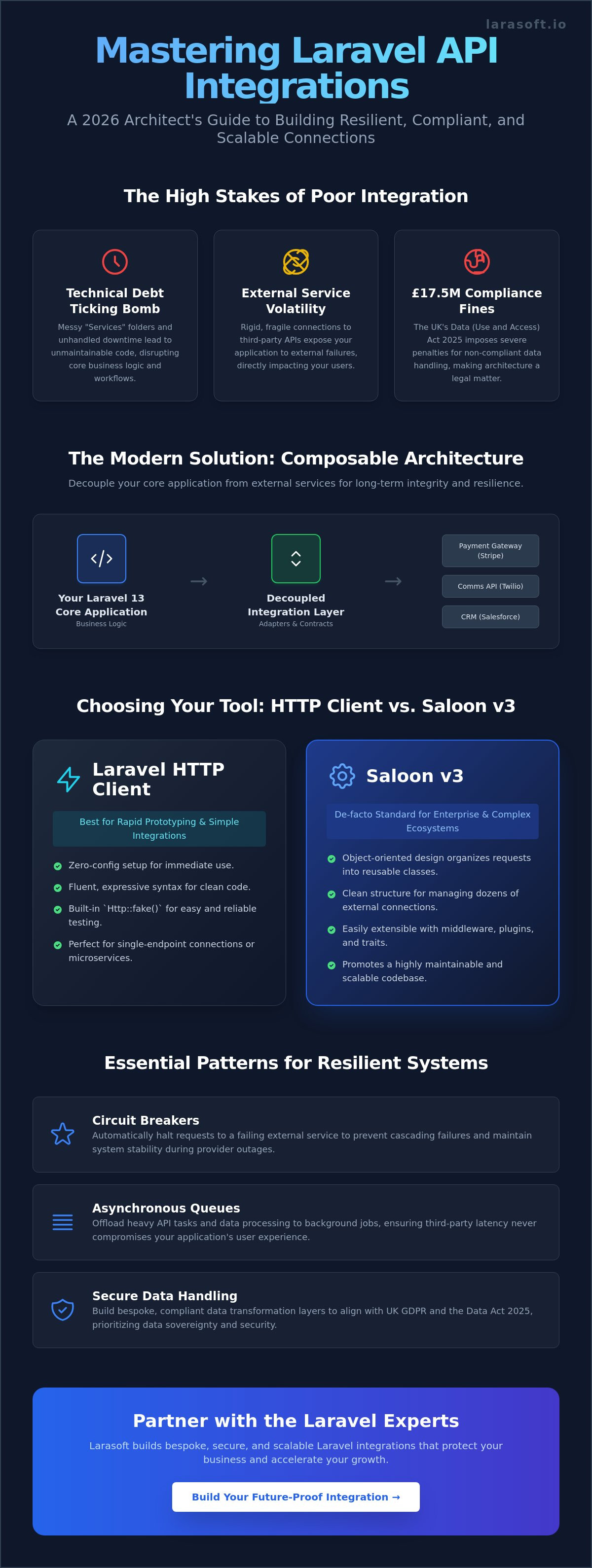
Your application's stability depends entirely on how it behaves when an external dependency disappears. Relying on a third-party service means accepting that outages, rate limits, and network jitter are inevitable. A professional laravel third party api integration must be designed to fail gracefully rather than crashing the entire user session. Building a reliable third-party API integration involves moving beyond simple request logic to implement sophisticated resilience patterns like the Circuit Breaker. This pattern monitors for consecutive failures and "trips" the circuit, preventing your application from wasting resources on a service that is currently unavailable.
Monitoring these interactions is equally vital. Tools like Laravel Pulse provide real-time visibility into slow or failing endpoints, while Sentry offers deep stack traces for unexpected response formats. When a failure occurs, the user experience shouldn't break. Graceful degradation ensures that if a non-essential service like a recommendation engine fails, the rest of your platform remains functional. You might show cached data or a friendly "service temporarily unavailable" message instead of a generic 500 error page.
Reliability is built through precise retry logic. Using exponential backoff for retrying failed requests ensures you don't overwhelm a struggling API provider, gradually increasing the wait time between attempts. It's also essential to use custom exceptions for specific error codes, allowing your code to distinguish between a temporary 429 rate limit and a permanent 401 authentication failure. To maintain transactional integrity, always ensure that database changes are only committed after a successful API response, or use Laravel's database transactions to roll back local data if the external call fails.
Security is a cornerstone of any laravel third party api integration in the UK. You should never store sensitive API keys in plain text; instead, use Laravel's encrypted environment variables to protect your credentials. With the Data (Use and Access) Act 2025 now in force, businesses must be vigilant about data residency. If you're using US-based APIs, you need to ensure that personal data transfers comply with the latest UK adequacy regulations. Maintaining detailed audit trails of every sensitive data exchange helps you demonstrate compliance to the ICO and provides a clear history for debugging complex integration issues.
Executing a laravel third party api integration within a synchronous web request is a primary cause of application latency. When your code waits for an external server to respond, the user's browser hangs, creating a poor experience and wasting server resources. Elite Laravel architecture solves this by offloading integration tasks to background queues. By using Laravel's native queue system, you can acknowledge the user's request immediately while the complex API handshake happens silently in the background.
Sanitising incoming data is equally critical for maintaining a clean codebase. You shouldn't allow raw API arrays to float around your business logic. Instead, use the Data Transfer Object (DTO) pattern to transform external payloads into structured, typed objects. This ensures that if a provider changes their response format, you only need to update a single transformation class rather than hunting through your entire application for broken keys.
Asynchronous processing requires robust monitoring to ensure no data is lost during transit. Laravel Horizon offers a sophisticated dashboard to track high-volume API jobs, allowing you to monitor throughput and retry failed attempts automatically. This is particularly important when managing rate limits and throttling from third-party providers. By implementing "sleep" or "retry-after" logic within your queued jobs, you can respect provider constraints without interrupting the primary user flow. Decoupling your database from these responses through observers ensures that your local records only update once the external transaction is fully verified.
Security is paramount when accepting incoming data via webhooks. You must verify digital signatures for every payload to prevent malicious actors from injecting fraudulent data into your system. Additionally, handling duplicate events is essential; use unique identifiers to ensure idempotency so that a single payment notification isn't processed twice. Webhook reliability serves as the indispensable backbone of modern fintech integrations, where real-time transaction updates must be processed with absolute certainty.
Building these complex layers requires a disciplined approach to development. If you're looking to upgrade your platform's connectivity, our team at Larasoft provides specialized API Integration services that prioritize structural integrity and long-term performance.
Generic online tutorials often provide the "how" but rarely the "why" or the "what if." A successful laravel third party api integration for a UK enterprise requires more than just making a successful request. It demands a deep understanding of architectural patterns that protect your business from external volatility. At Larasoft, we treat every integration as a foundational asset. We don't just connect systems; we build resilient, decoupled layers that ensure your core business logic remains untouched by third-party changes or outages.
Many of our clients come to us with "spaghetti code" integrations that have become impossible to maintain. We specialise in modernising these legacy systems through strategic API implementation. By introducing clean interfaces and modern tools like Saloon or the Laravel 13 AI SDK, we transform fragile connections into robust, scalable features. Our commitment to clean code means your software is easier to test, faster to debug, and prepared for future growth. We take pride in building systems that perform perfectly under pressure, ensuring your technical debt doesn't hinder your commercial momentum.
We believe in building "swappable" modules. This approach prevents provider lock-in, allowing you to switch services if a vendor's pricing or performance no longer meets your needs. Our team ensures business continuity by implementing the resilience patterns discussed earlier, such as circuit breakers and asynchronous queues. This technical discipline extends to the frontend, where we seamlessly integrate Vue.js frontend development with complex backend APIs to provide a fluid, reactive user experience that your customers expect in 2026.
Transitioning to a high-performance, API-first architecture starts with a comprehensive technical audit. We examine your existing stack to identify bottlenecks and security risks before moving to a full-scale implementation. Choosing a specialised Laravel development agency ensures you have a partner who understands both the technical nuances and the commercial realities of the UK market. Contact Larasoft today for a discovery session to discuss your next laravel third party api integration project and how we can help you build a more resilient digital future.
Mastering your laravel third party api integration is no longer a technical luxury; it's a foundational requirement for any UK business aiming for long-term scalability. By moving beyond basic request-response logic and adopting a decoupled, asynchronous architecture, you protect your platform from external volatility. We've explored how tools like Saloon and patterns like the Circuit Breaker ensure your system remains stable, even when your providers face downtime. As UK regulations like the Data (Use and Access) Act 2025 continue to evolve, maintaining a high-security, compliant integration layer is essential for operational survival.
At Larasoft, we specialise in turning complex technical challenges into manageable, structured journeys toward growth. Our UK-based Laravel specialists bring deep expertise in high-security API architectures and complex legacy code modernisation to every project. We take immense pride in the cleanliness and efficiency of our work, ensuring your systems are built to perform perfectly under pressure. Connect your business systems with Larasoft’s expert Laravel API integration services today to secure your digital infrastructure. Your path to a more robust and scalable backend starts with a dedicated technical ally.
You secure API keys by storing them in the .env file and using Laravel’s built-in encryption for sensitive configuration. Never hard-code credentials or commit them to your Git repository, as this creates a significant security risk. For enterprise-grade security, consider using a dedicated secrets manager like AWS Secrets Manager or HashiCorp Vault, which integrates seamlessly with Laravel's configuration system.
The choice between a package and a custom build depends on the complexity of your laravel third party api integration requirements. Use the native HTTP Client for simple, one-off requests to keep your codebase lean. For complex ecosystems with multiple endpoints and authentication methods, adopting a structured library like Saloon v3 provides better long-term maintainability and cleaner code than a generic wrapper.
Laravel manages rate limiting through its native RateLimiter facade, which allows you to define custom throttling logic for outgoing requests. You can configure these limits in the AppServiceProvider to ensure your application respects the constraints of external providers. This prevents your service from being temporarily blocked or facing additional charges due to excessive request volume that exceeds your provider's tier.
The most effective way to test integrations is by using Laravel’s Http::fake() method to mock external responses. This allows your test suite to run quickly without relying on a live internet connection or external server availability. You can simulate various scenarios, including successful data returns, 404 errors, and server timeouts, ensuring your error-handling logic is fully verified before deployment.
You can offload any non-synchronous API call to Laravel Queues to significantly improve your application’s response time. If the user doesn't need to see the external data immediately, moving the task to a background worker prevents your web server from hanging while waiting for a response. This approach also allows for automatic retries if the external service experiences a temporary failure or network jitter.
Secure webhook handling requires signature verification and idempotency checks to protect your application from fraudulent payloads. You should always validate the digital signature provided in the request headers to confirm the data originated from a trusted source. Additionally, store processed webhook IDs in your database to prevent duplicate actions if the provider sends the same event multiple times due to delivery retries.
Saloon is a popular object-oriented library that streamlines laravel third party api integration by organising requests into reusable classes. You should use it if your project involves multiple external services or complex authentication flows that would otherwise clutter your controller logic. It promotes a modular architecture that is easier to test and scale as your business requirements grow over time.
Compliance is achieved by auditing the personal data sent to external providers and ensuring data residency aligns with the Data (Use and Access) Act 2025. You must verify that your API partners have a valid Data Processing Agreement in place. If data is transferred outside the UK, ensure the recipient country has an adequacy decision or implement standard contractual clauses to protect user privacy.
Here’s what we've been up to recently.
Certified Quality. Great Prices