The True Cost of Maintaining a Legacy System: A 2026 Strategic Guide

If your developers spend 42% of their work week, roughly 17 hours, on maintenance and technical debt, you aren't just managing software; you're subsidizing a liability. The true cost of maintaining a legacy system in 2026 has evolved into an accelerating tax that compounds by up to 20% annually. For enterprises running a dozen legacy applications, direct maintenance alone can reach $800,000 before accounting for the $200 hourly rates of specialist contractors or the escalating risk of a security breach.
It's understandable to feel hesitant about overhauling a system that still functions, yet the friction of missed AI integrations and frequent downtime is likely eroding your competitive edge. This strategic guide uncovers the hidden financial drains of outdated software and provides a clear framework to quantify the ROI of modernisation for your board. We'll explore the risks of aging infrastructure and provide a structured roadmap for transitioning to modern, efficient frameworks like Laravel to secure your company's digital foundation.
A legacy system isn't defined solely by the date it was built. In a strategic context, What is a Legacy System describes a platform that, while potentially still functional, lacks the architectural support or scalability required for modern business operations. It represents a shift from a productive asset to a compounding liability. Many organisations fall into the "Safe Trap," assuming that because a system is already paid for, it's essentially free to run. This is a financial illusion. Verified data shows that 60-80% of total IT budgets are now consumed by simply keeping these aging systems operational.
The transition from functional software to technical debt happens gradually. Initially, maintenance involves routine updates and minor bug fixes. Over time, these requirements evolve into emergency interventions. As the underlying technology ages, the cost of maintaining a legacy system rises because each patch becomes more complex and risky. What used to be a simple update now requires hours of regression testing to ensure the entire fragile structure doesn't collapse. This isn't just maintenance; it's expensive, high-stakes firefighting that offers zero return on investment.
Legacy architectures are typically monolithic. They are rigid, single-tier structures where a change in one module can trigger cascading failures across the entire environment. In 2026, this manifests as "dependency hell." Old software often cannot run on modern server environments without expensive, custom-built wrappers or virtual machines. Research indicates that running 15-year-old systems on outdated infrastructure can result in $600,000 to $900,000 in unnecessary annual spending compared to modern containerised solutions. Additionally, you're often paying a premium for "tribal knowledge." When documentation is sparse, you aren't paying for software; you're paying for the few specialists who still understand the system's undocumented quirks.
The phrase "if it isn't broken, don't fix it" is a dangerous strategy for digital platforms. Operational stability is not the same as strategic agility. While your old system might process transactions today, it acts as a bottleneck that prevents you from deploying new features or responding to market shifts. The cost of maintaining a legacy system also includes a significant psychological toll on your team. Top-tier developers want to build with modern, clean frameworks like Laravel or React. Forcing your talent to patch antiquated code leads to burnout and high turnover. When your best engineers leave because they're tired of working with "spaghetti code," the cost of recruitment and onboarding new staff adds another hidden layer to your annual maintenance bill.
The financial burden of legacy software is rarely a static line item. It's an accelerating "Legacy Tax" that quietly consumes between 60% and 80% of total IT budgets just to maintain the status quo. When we quantify the cost of maintaining a legacy system, we must look beyond the surface level of server invoices. For an enterprise managing 10 to 15 legacy applications, the direct annual maintenance costs can reach $800,000. This doesn't even account for the massive infrastructure waste often found in aging setups. For instance, a 15-year-old system running on 40 virtual machines could often be consolidated into 12 modern containers, saving up to $900,000 in annual infrastructure spending alone.
Beyond internal inefficiencies, external costs are rising. Extended Security Update (ESU) fees for end-of-life systems now range from $61 to $244 per device annually, and these prices typically double every year. These figures mirror the high cost of federal legacy systems, where billions are spent annually on platforms that are increasingly difficult to secure. If your current strategy relies on these patches, you're essentially paying a premium for a declining asset. A structured approach to legacy code modernisation can help bridge this gap while you plan for a more permanent transition.
Finding talent in the UK to manage legacy code is a significant hurdle. Developers spend approximately 42% of their work week, or 17 hours, simply managing technical debt and maintenance. When that code is written in an obsolete language, you're forced to hire specialist contractors whose rates have climbed to $200 per hour. Compare this to modern frameworks where talent is more abundant and documentation is standardised. You aren't just paying for hours worked; you're paying a scarcity premium for engineers to work on "spaghetti code" that offers no professional growth, which inevitably leads to higher turnover and recruitment costs.
Legacy systems are prone to higher Mean Time to Repair (MTTR) because they lack the diagnostic tools found in modern environments. When a system goes down, your engineers aren't just fixing a bug; they're archeologists digging through layers of undocumented code. This leads to extended downtime, where the cost per hour of unavailability can devastate your bottom line. The cost of maintaining a legacy system includes these emergency response windows where every minute of lost productivity translates into lost revenue. These emergency patches are often "band-aids" that introduce new vulnerabilities, creating a cycle of reactive firefighting that prevents your team from ever reaching a state of proactive growth.
Unpatched vulnerabilities are the primary gateway for modern cyber threats in 2026. Running software that has reached its end-of-life (EOL) means your organisation is operating without a safety net. The cost of maintaining a legacy system isn't just a matter of developer hours; it's increasingly defined by the rising premiums of cyber insurance. Insurers now conduct rigorous technical audits before issuing policies. If they discover your core operations rely on unsupported frameworks, they'll either refuse coverage or implement a prohibitive risk premium that can double your annual insurance spend.
For businesses operating in the UK, the stakes are even higher. To qualify for government contracts or to partner with major enterprises, you must often demonstrate Cyber Essentials certification. Outdated codebases that cannot support modern encryption or receive security patches often fail these audits immediately. This disqualification represents a massive opportunity cost. You're effectively locked out of lucrative markets because your software architecture cannot meet baseline security standards. This hidden "compliance tax" is a direct consequence of delaying modernisation.
Many legacy platforms remain tethered to obsolete PHP versions or server environments that no longer receive security updates. Modern security tools, such as advanced Web Application Firewalls (WAFs), often struggle to protect these environments because the underlying architecture doesn't support modern security headers or protocols. If a breach occurs, the reputational damage in the UK can be permanent. Customers expect 2026-level data protection. Explaining that a data leak happened because of "old software" is no longer a valid defense in the eyes of the public or the Information Commissioner's Office (ICO).
Compliance with GDPR is a dynamic requirement, not a static checkbox. Legacy systems often struggle with the technical implementation of the "right to be forgotten" or complex data portability requests. Because these systems weren't built with "Privacy by Design" in mind, extracting or deleting specific user data often requires manual database intervention. This process is both expensive and prone to human error. The cost of maintaining a legacy system grows every time a new data regulation is introduced. Each legal change requires bespoke bridge code to keep the old architecture compliant with 2026 legal standards, creating a fragile and difficult-to-audit environment.
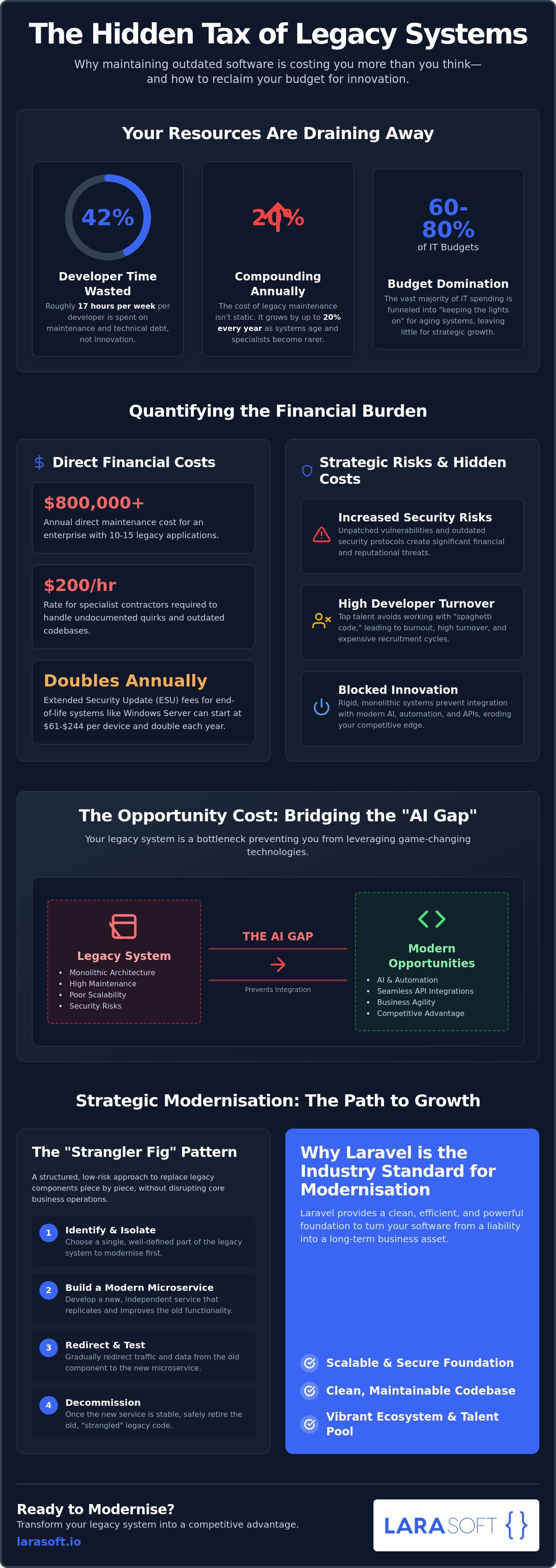
The most damaging aspect of the cost of maintaining a legacy system is the invisible ceiling it places on your growth. While direct expenses like server overheads are easy to track, the "AI Gap" represents a profound strategic risk. Modern business intelligence and automation require fluid data architectures. Legacy platforms are often rigid silos, unable to support the real-time data streaming or vector database requirements necessary for effective Laravel AI integration. When your infrastructure can't process data at the speed of modern algorithms, you're forced to watch from the sidelines as competitors automate their core operations.
User experience (UX) decay is another silent drain on your bottom line. Customers in 2026 expect seamless, responsive interfaces. If your backend is tethered to a monolithic architecture, implementing modern frontends like Vue.js or React becomes a complex, high-risk engineering project. This friction results in a significant "Time to Market" penalty; new features that should take weeks to deploy often take months of bespoke patching. This delay isn't just a technical inconvenience. It's a direct loss of market share to more agile, tech-forward organisations.
A disconnected system is a stagnant system. Connecting legacy databases to modern SaaS tools usually requires expensive "bridge" code that is brittle and difficult to maintain. By prioritising API integration, you transform your software from an isolated island into a connected asset. Without this connectivity, your staff is likely burdened by manual data entry and cross-referencing between disconnected silos. These productivity leaks are expensive. They divert your team's focus from high-value strategic work to repetitive, low-impact tasks that modern systems handle automatically.
Forcing high-calibre engineers to work with ancient tools is a recipe for talent attrition. In a competitive market, the best developers seek environments where they can build clean, scalable solutions. If your organisation is perceived as a "maintenance shop" for legacy code, you will lose the technical talent war. This recruitment struggle further inflates the cost of maintaining a legacy system, as you're forced to pay higher rates for contractors to manage the technical debt your internal team has abandoned. Modernising your stack is as much about retaining your best people as it is about upgrading your code.
If you're ready to break through this innovation ceiling, explore our approach to Legacy Code Modernisation to see how we can stabilise and scale your platform.
The cost of maintaining a legacy system is not a permanent fixture of your balance sheet. It's a strategic choice. Transitioning from a reactive maintenance posture to a growth-oriented framework requires a structured methodology. One of the most effective strategies we employ is the "Strangler Fig" pattern. This approach allows you to replace legacy functionality piece by piece. By wrapping new Laravel-based services around the old core, we ensure the legacy system is eventually phased out without the risks associated with a "big bang" migration. This minimises operational friction while ensuring every pound spent contributes to a modern, scalable asset.
Laravel has emerged as the industry standard for legacy code modernisation because of its robust ecosystem and emphasis on structural integrity. By migrating to a modern framework, you eliminate the 10-20% annual cost escalation associated with aging systems. The break-even point typically arrives when the savings from reduced infrastructure waste and lower developer premiums exceed the modernisation investment. In many cases, consolidating old virtual machines into modern containers can save up to $900,000 annually, providing a clear financial justification for the transition to the board.
Successful transitions begin with a comprehensive technical audit. We identify "high-value, low-risk" components, such as customer-facing portals or API layers, to migrate first. This provides immediate business value while the core database remains stable. You must choose between refactoring, which involves cleaning existing code, or replatforming to a modern environment. This shift ensures your software maintenance becomes proactive. Instead of fixing emergencies, your team focuses on refining features that drive revenue and improve market position.
We specialise in structural integrity and fluid transitions. Our team doesn't just write code; we build foundational assets for your company's future. By leveraging bespoke Laravel development, we eliminate technical debt and ensure your platform is ready for 2026 challenges like AI integration and advanced data governance. Long-term stability is our priority, which is why our modernisation projects include dedicated support and SEO-ready architectures. We invite you to request a technical audit to uncover your true legacy costs and start your journey toward a higher-performing digital future.
The cost of maintaining a legacy system is no longer just a predictable line item; it's an accelerating constraint on your organisation's ability to innovate and compete. By identifying the hidden drains on your budget, from developer productivity leaks to escalating security risks, you can build a compelling case for structural change. Moving away from monolithic architecture isn't just about technical cleanup. It's about reclaiming the strategic agility needed to leverage modern API integrations and AI-driven automation.
At Larasoft, our UK-based team of technical artisans specialises in bespoke Laravel modernisation. We understand that stability is paramount. That's why we focus on structural integrity and fluid transitions that protect your core business operations while eliminating technical debt. With a proven track record in complex API and AI integration, we help you bridge the gap between legacy constraints and modern scalability.
Stop subsidising your past and start investing in your company's future growth. Book a Legacy Code Audit with Larasoft today to uncover the true state of your infrastructure and define a roadmap for success. Building a resilient digital foundation is a structured journey, and we're ready to act as your dedicated technical ally.
Calculating the true cost of maintaining a legacy system requires summing both direct and indirect expenses. You must include server hosting, specialised contractor fees, and any extended security update (ESU) subscriptions. Indirect costs are equally vital; factor in the revenue lost during system downtime and the productivity hours your developers spend patching technical debt instead of building new features. Often, infrastructure waste from oversized, outdated server environments adds a significant hidden layer to this total.
Modernisation typically pays for itself within two to three years by eliminating the compounding "Legacy Tax." While the initial investment in a rebuild is higher than a month of maintenance, the annual 10% to 20% cost escalation of old software eventually makes the status quo unsustainable. Modernising becomes the more cost-effective choice when the price of missed opportunities and security risks exceeds the capital expenditure of a clean, efficient rebuild.
Talent scarcity and rising cyber insurance premiums are the most significant hidden factors for UK firms. The cost of maintaining a legacy system grows as the pool of developers willing to work on obsolete code shrinks, forcing you to pay premium rates for specialist contractors. Additionally, many UK insurers now conduct technical audits; if your infrastructure is deemed high-risk due to its age, your annual premiums can increase dramatically or coverage may be denied entirely.
Legacy systems often lack "Privacy by Design," which makes fulfilling data portability and deletion requests a manual, high-risk process. Monolithic architectures frequently struggle to isolate and purge specific user records across disconnected databases, leading to potential errors. In a 2026 regulatory environment, these technical limitations create significant audit risks. If your software cannot efficiently handle a "right to be forgotten" request, you face substantial financial penalties from the ICO.
Direct integration is usually impossible because legacy systems lack the modern API layers and real-time data streaming capabilities that AI requires. Most organisations are forced to build expensive middleware or "bridge" code to feed legacy data into AI models, which adds layers of complexity and fragility. Modernising your core with a framework like Laravel provides the clean, structured data environment necessary to leverage AI for automation and business intelligence effectively.
The Strangler Pattern is a strategic methodology where you replace specific components of an old system with new services one by one. This allows for a gradual transition rather than a high-risk, single-day migration. Over time, the new, modern services "strangle" the old functionality until the legacy platform can be retired completely. This approach ensures business continuity while allowing you to prioritise high-value features for early modernisation.
Timelines for a phased migration usually range from six to eighteen months, depending on the complexity of your existing architecture. By using a modular approach, we can often deploy the first modernised components within the first few months. This allows your business to see immediate improvements in performance and security while the rest of the legacy codebase is systematically replaced. A detailed technical audit is the only way to establish a precise schedule.
Top-tier engineers want to work with modern, efficient tools like Vue.js and Laravel that offer professional growth. Forcing your best talent to spend their week archeologising "spaghetti code" and managing technical debt leads to rapid burnout and frustration. When developers feel their skills are stagnating due to antiquated technology, they naturally seek roles in tech-forward organisations. Modernising your stack is a critical component of a successful long-term recruitment and retention strategy.
Here’s what we've been up to recently.
Certified Quality. Great Prices