Laravel Performance Optimisation Services: A Strategic Guide for 2026


Is your infrastructure budget being consumed by inefficient code that's actually driving your customers away? You likely recognize that every millisecond of latency translates directly to lost revenue and inflated cloud bills. It's a common frustration to see technical debt stall your development roadmap while competitors seem to scale effortlessly. Engaging professional laravel performance optimisation services is no longer just a technical preference; it's a fundamental requirement for business survival in a market where sub-second response times are the baseline.
You deserve a digital architecture that acts as a catalyst for growth rather than a source of friction. This guide demonstrates how professional intervention can transform your application speed, significantly reduce monthly hosting expenses, and ensure your system remains stable during peak traffic. We'll explore the strategic implementation of Laravel 13.16.1, the power of Laravel Octane, and how modern caching layers create a foundation for long-term scalability. By the end, you'll have a clear roadmap for modernising your codebase and reclaiming your competitive edge in a demanding digital economy.
Digital leaders often view speed as a technical metric. In reality, it's a financial one. In 2026, the Laravel framework powers over 1.5 million websites, yet many struggle under the weight of unoptimised code. Choosing professional laravel performance optimisation services represents a strategic shift from merely maintaining a platform to actively scaling a business asset. When your response times drop, your conversion rates rise. It's that simple.
Sub-second latency is now the baseline for UK digital platforms. If your pages take longer than a second to load, you aren't just losing time; you're losing customers to competitors who prioritise efficiency. High-speed user experiences create a sense of trust and reliability that marketing copy alone cannot achieve. Performance engineering is a proactive rather than reactive discipline that secures your architecture against future demand.
The hidden cost of inefficient software is often buried in your monthly cloud hosting bill. Many organisations attempt to solve slowdowns by upgrading their server tiers, effectively paying a recurring premium for poor code quality. This "hardware tax" is entirely avoidable. Strategic optimisation targets the architectural bottlenecks that drain resources. Through legacy code modernisation and query refinement, some technical teams report reducing their infrastructure requirements by as much as 50%. Aligning your technical execution with business KPIs ensures every line of code contributes to your bottom line rather than depleting it.
Organic search dominance in 2026 is impossible without a fast-loading frontend. Google’s Core Web Vitals remain the primary gatekeepers for visibility, specifically focusing on how quickly a page becomes interactive. A slow Laravel backend creates a ripple effect that damages your SEO rankings and increases your cost-per-acquisition. Optimising your code is the most sustainable way to ensure your application remains visible, profitable, and ready for whatever the market demands next.
Achieving sub-second response times requires more than surface-level tweaks. It demands a deep dive into the application's core architecture. High-quality laravel performance optimisation services focus on eliminating the hidden inefficiencies that accumulate as applications grow. While basic caching helps, the real gains come from mastering the Eloquent ORM and ensuring your database schema is built for the scale of 2026.
Many developers stop at basic eager loading to solve the N+1 query problem. In high-concurrency environments, we look deeper, utilising select statements to limit retrieved columns and implementing lazy eager loading only when necessary. This level of precision ensures that your server memory isn't wasted on unused data. For a comprehensive look at these technical foundations, reviewing a Laravel performance optimization checklist can help identify overlooked configurations in your production environment.
The database is often the first place performance degrades under pressure. We use tools like Laravel Telescope and New Relic to profile every request, pinpointing queries that exceed acceptable latency thresholds. For massive datasets, standard indexing isn't enough. We implement a structured approach to database health:
Modern applications are only as fast as their slowest layer. A performant Laravel backend must work in perfect harmony with the frontend. We focus on minimising JSON payload sizes and implementing efficient state management to prevent redundant API calls. Leveraging Vue.js frontend development allows us to build reactive interfaces that feel instantaneous to the user. This synergy ensures that the speed gained on the server isn't lost during browser rendering. If you're looking to refine your entire stack, our team provides specialised Laravel web development to ensure every layer is optimised for growth.
Production-ready applications must have their foundations locked down. Optimising the Composer autoloader with the `--optimize` flag and ensuring Artisan commands like `route:cache` and `config:cache` are part of every deployment pipeline is essential. These disciplined steps separate hobbyist projects from enterprise-grade platforms that perform perfectly under pressure.
Scaling an enterprise application requires more than just efficient queries. It requires a fundamental rethink of how PHP handles every incoming request. While standard configurations are suitable for moderate traffic, high-concurrency environments demand a more sophisticated approach. When businesses invest in professional laravel performance optimisation services, the implementation of Laravel Octane is often the most transformative step in their technical journey.
Laravel Octane (v2.17.5) revolutionises application speed by keeping the entire framework in memory. In a traditional PHP-FPM setup, the framework must boot up, load configurations, and initialise providers for every single request. Octane eliminates this repetitive overhead. By booting the application once and keeping it ready to serve, we can achieve near-instant execution. While traditional PHP-FPM setups often struggle with latency spikes during boot-up, Octane-powered environments consistently deliver sub-millisecond responses by maintaining the application state in memory.
Choosing the right server engine is a critical architectural decision. We typically evaluate two primary options for high-performance UK applications:
Performance isn't just about how fast a page loads; it's about how the system handles heavy tasks without making the user wait. Redis 8.8.0 serves as a high-speed backbone for more than just simple caching. We utilise it for session management and as a robust driver for asynchronous processing. By offloading time-consuming tasks like email dispatch, PDF generation, or third-party API synchronisation to background jobs, the user-facing application remains light and responsive.
Monitoring these background processes is essential for maintaining system health. We implement Laravel Horizon to provide real-time visibility into queue throughput, wait times, and job failures. This data-driven approach allows us to scale worker fleets dynamically. If a sudden surge in traffic occurs, the system can automatically provision more resources to clear the backlog, ensuring that your application doesn't crash during peak commercial periods. This level of architectural discipline ensures your platform remains a reliable asset as your user base grows.
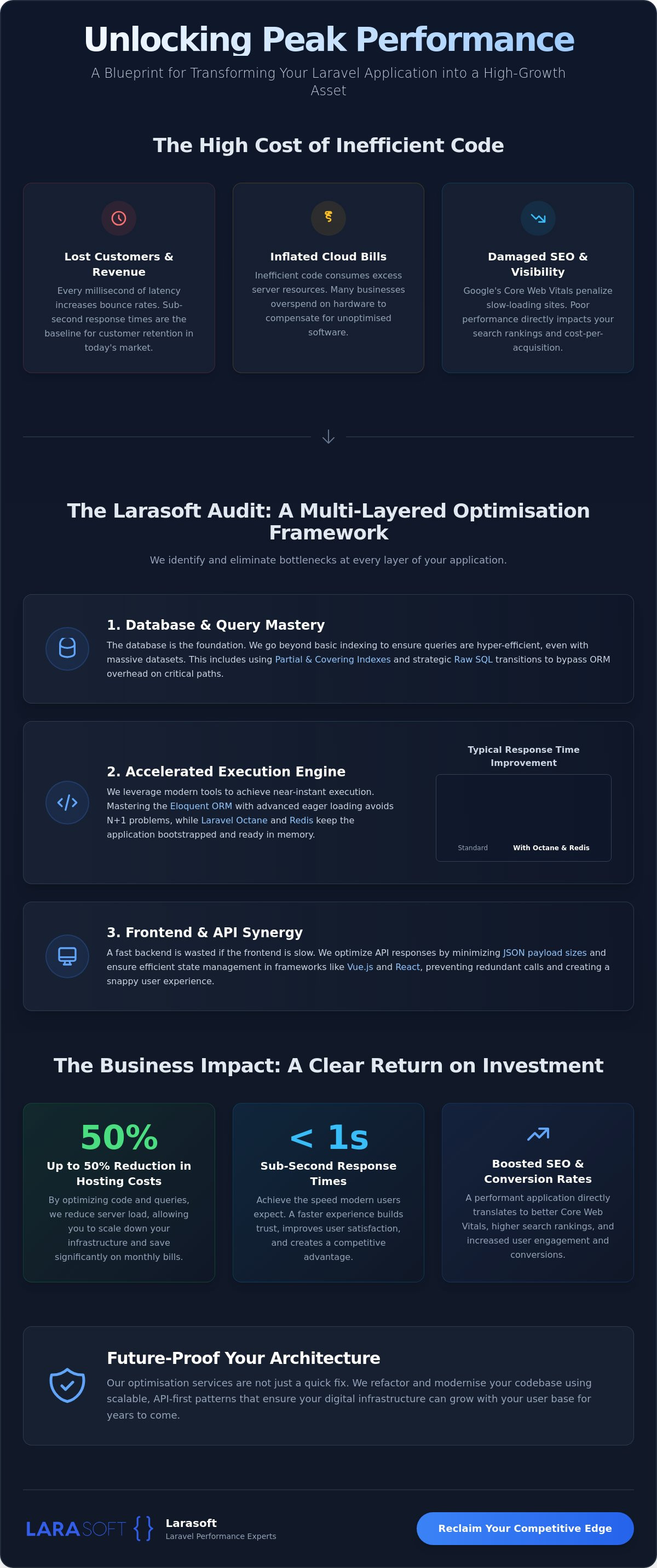
Successful scaling is never the result of guesswork. It requires a repeatable, data-driven methodology that identifies exactly where an application is struggling under its own weight. Our audit framework provides a structured journey from technical debt to sub-second performance, ensuring that every technical intervention aligns with your broader business objectives. When organisations engage professional laravel performance optimisation services, they aren't just buying a list of fixes; they're investing in a comprehensive architectural review.
The Larasoft Audit follows a rigorous five-step process to ensure no bottleneck remains hidden:
It's vital to distinguish between application-level delays, database constraints, and network-level latency. We utilise real-user monitoring (RUM) to understand how your platform performs in the wild, across different devices and connection speeds. By applying the 80/20 rule, we prioritise the 20% of technical issues that cause 80% of your performance lag. This ensures your budget is spent where it will have the most significant impact on user retention and conversion rates.
Refactoring legacy logic into modern Laravel patterns is the most sustainable way to regain speed. In 2026, staying on the latest versions of PHP 8.3 and Laravel 13 is essential to leverage the framework's native engine optimisations. Long-term stability is secured through a dedicated software maintenance plan, which keeps your dependencies current and your architecture lean. If you're ready to uncover the hidden constraints in your application, book your comprehensive Larasoft Audit to begin your transformation.
Performance is not a static destination; it's a continuous strategic posture. As we move through 2026, the applications that dominate the market are those built on a foundation of adaptability. Future-proofing your system means moving beyond immediate fixes to embrace architectural patterns that grow alongside your user base. By investing in professional laravel performance optimisation services, you transition from reactive troubleshooting to a proactive growth model where speed is a permanent feature of your digital ecosystem.
Modern performance strategy often involves adopting an API-first or headless Laravel approach. This decoupling of the backend logic from the frontend presentation allows each layer to scale independently. It prevents the "monolith bottleneck" where a heavy frontend consumes the same server resources as critical backend processes. This architecture also prepares your business for a multi-platform future, ensuring your data is ready for mobile apps, wearables, or third-party integrations without requiring a complete rebuild.
True scalability starts at the database level. Designing schemas that can handle millions of rows without degradation requires deep expertise in data normalization and indexing. For platforms serving nationwide UK traffic, we implement horizontal scaling and load balancing to distribute demand across multiple server instances. We also focus on robust API caching layers, which protect your core application from being slowed down by slow third-party service responses. These structural choices ensure that your platform remains responsive even as your data volume grows exponentially.
Integrating AI features is a major trend in 2026, but it often comes with a performance cost. Our approach to Laravel AI integration focuses on maintaining application speed by offloading heavy reasoning tasks to asynchronous processes. This ensures your users enjoy the benefits of intelligent automation without experiencing the latency traditionally associated with large language model processing.
Transitioning from a sluggish monolith to a high-performance ecosystem is a structured journey. It begins with integrating continuous performance monitoring directly into your CI/CD pipeline. This ensures that no new code deployment can accidentally introduce latency or resource leaks. Performance becomes a shared responsibility across your development team, backed by automated benchmarks that guard your user experience.
The complexity of modern web standards means that generic development isn't enough. Choosing a specialized laravel development agency is critical for ensuring the longevity of your technical assets. Experts bring a level of architectural discipline that generalists often overlook, from fine-tuning memory management to implementing advanced caching strategies. If your application is struggling to meet the demands of your users, requesting a professional performance audit is the most effective way to kickstart your journey toward sub-second response times and reduced infrastructure costs.
Performance is far more than a technical metric; it's a vital financial asset that determines your platform's ability to scale and retain users. We've explored how advanced tools like Laravel Octane and Redis can transform response times, while a structured audit process ensures that every technical intervention remains data-driven. By moving away from reactive fixes and toward a proactive architectural strategy, you secure both your user experience and your infrastructure budget.
Investing in professional laravel performance optimisation services allows you to leverage expert UK-based Laravel developers who specialise in high-concurrency environments and legacy code modernisation. Our team acts as a dedicated technical ally, helping you navigate the complexities of modern web standards with quiet competence. To ensure your broader digital ecosystem is equally resilient, learn more about SolaaS Limited and their tailored IT and telecommunications solutions. You don't have to settle for a system that struggles under pressure or costs more than it should to maintain.
Book a Professional Laravel Performance Audit with Larasoft to begin modernising your architecture and future-proofing your digital presence. It's time to turn your application speed into your greatest competitive advantage.
Costs vary based on the application's complexity and the current state of the technical debt. While general senior developer rates in the UK range from $18 to $24 per hour according to 2026 industry data, specialized architectural services are typically quoted following a preliminary audit. This ensures the investment aligns with the specific scalability needs and business goals of your platform.
Inefficient database interactions, specifically the N+1 query problem, are the primary cause of application latency. When the Eloquent ORM retrieves related models individually rather than through eager loading, server response times degrade as the dataset grows. Other frequent bottlenecks include unoptimised middleware, heavy boot-up processes, and a lack of proper caching for frequently accessed data.
Laravel Octane is compatible with most modern applications running Laravel 10.10.1 or newer and PHP 8.1+. However, because Octane keeps the application in memory, your code must be stateless to prevent memory leaks or data pollution between requests. Applications with legacy global variables or static properties may require refactoring before they can safely leverage Octane's speed.
Database indexing creates a structured lookup table that allows the engine to locate specific rows without scanning every record in a table. This reduces disk I/O and CPU usage significantly. Implementing advanced strategies, such as partial or covering indexes, ensures that mission-critical queries remain fast even when your database grows to millions of rows.
Yes, professional laravel performance optimisation services can significantly reduce your monthly infrastructure overhead. By making your code more efficient, each request consumes fewer CPU cycles and less memory. This allows you to serve more concurrent users on smaller, more cost-effective server instances, often avoiding the need for expensive vertical scaling in cloud environments.
A comprehensive performance audit usually takes between three and seven business days. This timeframe allows our team to conduct deep profiling using tools like Blackfire, review database execution plans, and audit your server configuration. We provide a detailed report that prioritises technical interventions based on their projected impact on your application’s speed and stability.
We use a combination of internal framework tools and external profiling suites to gather data. Laravel Telescope and Horizon provide immediate insights into queries and background jobs, while New Relic or Blackfire offer deep architectural profiling. We also implement real-user monitoring (RUM) to understand how latency affects your customers across different devices and network conditions.
Refactoring is generally the superior choice for established businesses as it preserves proven business logic while improving efficiency. Strategic legacy code modernisation allows for incremental performance gains without the high risk and cost of a total rebuild. We only recommend starting from scratch if the underlying architecture is fundamentally incapable of supporting your 2026 growth targets.
Here’s what we've been up to recently.
Certified Quality. Great Prices