The Critical Risks of Outdated PHP Applications: A Strategic Guide for 2026

With the average cost of a data breach in the United States hitting a record $10.22 million in 2026, the quiet stability of your legacy system might actually be its most dangerous feature. It's a common misconception that if a platform still functions correctly, it isn't a priority for an upgrade. However, the risks of outdated php applications are no longer just technical inconveniences. They're structural business liabilities that compound every day you delay. As PHP 8.2 approaches its end of life on December 31, 2026, maintaining older versions like 8.1 or 7.4 exposes your organization to critical vulnerabilities that modern patches simply won't cover.
We understand the hesitation to touch a complex system when the fear of downtime or the uncertainty of modernisation costs looms large. It's frustrating to watch technical debt stifle your team's ability to ship new features while compliance requirements like GDPR and PCI DSS become increasingly strict. This guide provides a clear look at the security, performance, and legal liabilities inherent in legacy code. You'll gain a structured roadmap for safe modernisation and the data needed to justify a maintenance budget that protects your firm's future. We will explore how to transition from reactive patching to a resilient, high-performance architecture.
PHP follows a predictable release cycle designed to balance innovation with stability. Each major version typically receives two years of Active Support for bugs and performance improvements, followed by one year of Security Support for critical vulnerabilities. Once this three-year window closes, the version reaches PHP End of Life (EOL). In 2026, the landscape has shifted significantly. PHP 8.1 reached EOL at the end of 2025, and PHP 8.2 is scheduled for total retirement on December 31, 2026. If your application still runs on these versions, it's officially classified as legacy. The risks of outdated php applications are no longer theoretical; they're immediate operational threats.
Many decision-makers rely on the metric that if the site loads, the software is healthy. This is a dangerous assumption. Software health isn't just about uptime; it's about the integrity of the environment. While a minor version patch might fix a specific bug, moving between major versions often involves deep architectural shifts that improve memory management and execution logic. Ignoring these updates doesn't just stall performance. It creates a massive gap between your current state and modern standards that eventually becomes impossible to bridge without a total rebuild.
Technical debt in PHP versioning is the accrued cost of deferred maintenance that transforms a routine update into a complex, high-risk reconstruction project. Skipping versions makes future upgrades exponentially more expensive. The delta between your code and the current stable release becomes too large to bridge easily, leading to system instability. This debt also impacts your frontend. Modern frameworks like Vue.js or React often rely on specific API responses and data handling capabilities found in PHP 8.4 or 8.5. When your backend is stuck in the past, your team spends more time writing compatibility "hacks" rather than building new features.
The day security support ends, the window for "Zero Day" exploits opens wide. Without official patches from the PHP core team, your server is essentially on its own against new vulnerabilities. Some developers suggest community-driven patches as a stopgap, but these lack the rigorous testing and global vetting of official releases. They're a brittle shield. This obsolescence also breaks third-party API integrations. As payment gateways and CRM providers upgrade their own security protocols, they often drop support for older PHP runtimes. This can lead to silent failures in your most critical business processes, and it's one of the primary risks of outdated php applications in a connected digital economy.
Operating a legacy system often feels like driving a car that hasn't been serviced in a decade. It might still move, but the underlying components are failing in ways you can't see from the dashboard. The risks of outdated php applications extend far beyond simple bugs. They create a fragile environment where security, speed, and even your ability to hire talent are compromised. According to the 5 Critical Risks of Outdated PHP Applications highlighted by the OWASP Foundation, failing to address these structural weaknesses is the primary driver of modern data breaches. In 2026, where global cyber attacks have increased by 17%, leaving these doors unlocked is no longer an option.
Remote Code Execution is the ultimate nightmare for any CTO. It allows an attacker to run malicious code on your server, effectively taking full control of your application and database. In legacy PHP versions, this often happens through deprecated functions that handle unsanitised inputs poorly. While modern versions have removed or hardened these functions, outdated stacks remain wide open. Don't assume a firewall will catch everything. Firewalls filter external traffic, but RCE exploits your internal application logic. If your code is fundamentally insecure, an attacker can bypass perimeter defences and strike from within. Conducting a technical audit is the first step in identifying these hidden points of failure before they're exploited.
The performance difference between PHP 7.4 and the latest 8.5 release is staggering. With the introduction of Just-In-Time (JIT) compilation, modern PHP can offer up to 50% better execution speed for complex tasks. For high-traffic UK businesses, this translates directly to lower server overhead and reduced hosting costs. It also impacts your visibility. Search engines now prioritise Core Web Vitals, and slow server response times on a legacy stack will actively suppress your SEO rankings. You aren't just losing security; you're losing customers to faster, more responsive competitors.
Beyond security and speed, there's the human element. Skilled developers don't want to work on "dinosaur" stacks. They want to use modern tools, Composer packages, and clean Laravel architectures. If your application is stuck in 2019, you'll struggle to find talent willing to maintain it. This leads to operational instability, as memory leaks and server crashes become more frequent in unoptimised, older environments. Eventually, the cost of keeping the lights on exceeds the cost of a proper modernisation project. Transitioning to a supported version isn't just a patch. It's a strategic move to ensure your software remains a foundational asset rather than a growing liability.
Beyond the technical failures discussed in previous sections, the financial fallout of a security incident is often the most significant threat to a company's survival. In 2026, the global average cost of a data breach has reached $4.44 million. For organizations operating in the United States, that figure climbs to an all-time high of $10.22 million. These costs aren't limited to immediate recovery. They include the heavy price of customer churn, lost contracts, and the long-term erosion of brand trust. The risks of outdated php applications include a legal dimension that many boards fail to account for until a breach occurs.
The timeline for recovery is also a major drain on resources. On average, it takes 241 days to identify and contain a data breach. During this period, your internal teams are diverted from growth-focused projects to manage crisis communications and forensic audits. This operational paralysis often costs more than the initial modernisation would have required. When you run software that no longer receives security updates, you're essentially self-insuring against a multi-million pound liability.
In the UK and EU, the Information Commissioner’s Office (ICO) and other regulatory bodies operate under the "Security by Design" principle. Running EOL software is increasingly viewed as a failure to exercise a reasonable duty of care. If a breach occurs because of a known vulnerability in an unsupported PHP version, regulators may classify the incident as negligence rather than a simple accident. This significantly increases the likelihood of maximum fines. To protect your organization, it's vital to cross-reference your current stack against A GDPR Compliance Checklist for UK Web Applications. Maintaining a proactive software maintenance plan is no longer optional for those handling personal data.
Cyber insurance providers have become far more sophisticated in their risk modeling. During annual audits or policy renewals, "End of Life" software is now a primary red flag that can lead to an immediate denial of coverage. Insurers are increasingly inserting clauses that invalidate claims if the entry point for an attack was a known, unpatched vulnerability in an obsolete runtime. Even if coverage is granted, businesses with significant technical debt face aggressive premium hikes. Modernisation acts as a critical risk mitigation strategy, providing the board of directors with a defensible position during insurance negotiations and financial audits. By investing in legacy code modernisation, you aren't just fixing code; you're securing your firm's financial standing.
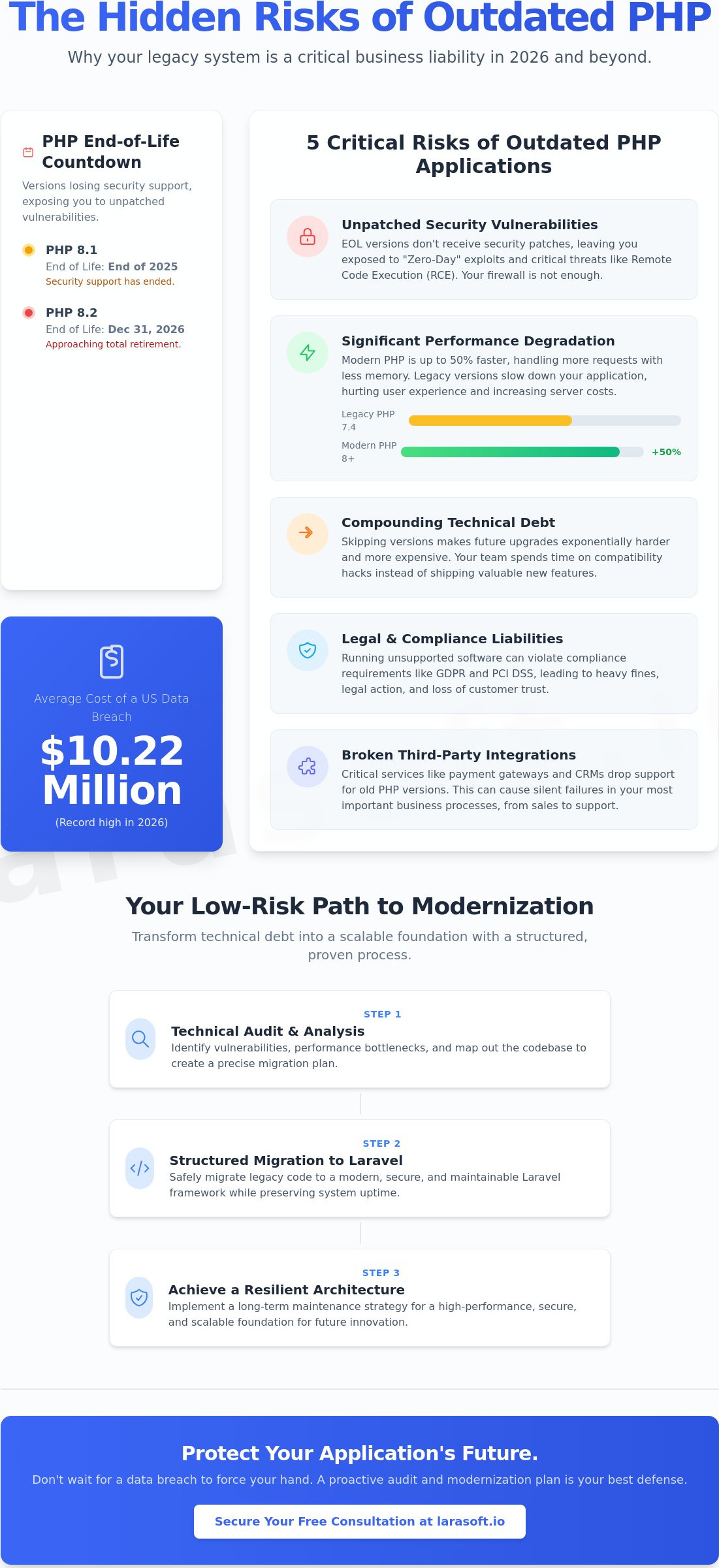
Transitioning away from a legacy system requires more than a simple version increment. It's a structural realignment that ensures your software remains a foundational asset rather than a liability. While earlier sections focused on the risks of outdated php applications, this stage is about execution. It's important to recognize that framework obsolescence is just as critical as the PHP version itself. Running an application on Laravel 5 or 6, for instance, presents similar security gaps and performance bottlenecks as running raw PHP 7.4. A successful modernisation strategy moves beyond reactive patching toward a disciplined, architectural upgrade.
Our proven approach follows a logical, five-step progression to ensure system stability:
An effective audit uses specialized tools to detect every instance of deprecated logic and incompatible library. We don't just find errors; we rank them by business impact versus ease of remediation. This data-driven approach is essential for securing stakeholder buy-in. When you can present a clear report on how specific risks of outdated php applications threaten your specific revenue streams, budget allocation becomes a strategic decision rather than a grudge purchase. An external audit provides the objective clarity needed to move from "it's fine for now" to "we need to act."
For many UK enterprises, the "Strangler Fig" pattern is the most effective route. This involves wrapping the legacy system in a modern Laravel shell and replacing features piece by piece. It minimizes risk and allows for continuous delivery. However, if the technical debt is too deep, a full rebuild may be more cost-effective than trying to salvage a failing system. You can explore these options further in our Legacy Code Modernisation: A Strategic Guide for UK Business Leaders. If you're ready to secure your platform, book a legacy code modernisation consultation to discuss your specific technical requirements.
Mitigating the risks of outdated php applications requires more than just a developer; it demands a technical ally who understands the intersection of architectural integrity and business continuity. At Larasoft, we specialise in high-stakes legacy code modernisation for UK enterprises that cannot afford system failure or data exposure. We don't just patch holes. We rebuild foundations. Our team approaches every project with the mindset of technical artisans, ensuring that the transition from obsolete runtimes to modern frameworks is handled with precision and discipline.
By partnering with a UK-based specialist, you gain more than just proximity. You benefit from a team that understands local regulatory pressures and the specific SEO requirements of the British market. We ensure your backend infrastructure is perfectly aligned with your growth strategy, providing the steady reliability needed to perform under pressure. Whether your system is struggling with a "dinosaur" stack or an outdated version of Laravel, we provide the structured journey toward a high-performance digital platform.
We've refined a process that transforms legacy PHP into clean, scalable Laravel architectures without disrupting your existing user base. A primary focus is ensuring that complex data structures and user permissions remain intact during the migration. Our technical interventions often lead to immediate, measurable results. In previous modernisation projects, we've successfully reduced technical debt while simultaneously improving application performance by up to 50%. This isn't just about security; it's about making your software faster, more maintainable, and ready for modern integration.
Modernisation is the first step, but permanent stability requires proactive software maintenance. We manage the entire PHP and Laravel lifecycle for our clients, ensuring they never face another EOL crisis. This ongoing care is essential for maintaining GDPR compliance, as it ensures your "Security by Design" remains current against evolving threats. Once your system is modernised, we can also implement Laravel AI integration, adding immediate value through automated workflows and intelligent data processing. This transforms your software from a legacy burden into a cutting-edge asset that drives revenue.
Don't wait for a critical failure to address the structural vulnerabilities in your stack. Proactive intervention is always more cost-effective than emergency recovery. Contact Larasoft today for a legacy code audit and modernisation roadmap.
Transitioning from legacy PHP to a modern Laravel architecture isn't just a technical fix; it's a strategic necessity for any growing enterprise. We've examined how deferred maintenance leads to severe performance bottlenecks and unpatched security vulnerabilities. Addressing the risks of outdated php applications is the most impactful step you can take to protect your organization's reputation and ensure long-term operational efficiency. By moving toward a supported runtime, you eliminate the legal liabilities associated with GDPR non-compliance and the threat of insurance claim denials.
Larasoft acts as your dedicated technical ally in this journey. Our UK-based team provides the specialized authority and quiet competence required for complex legacy code modernisation and Laravel transitions. We maintain a proven track record in delivering GDPR-compliant software maintenance that keeps platforms resilient under pressure. Don't let obsolete code dictate your growth potential. Secure your business future—book a legacy code audit with Larasoft. Taking this structured step today ensures your platform is ready for the innovations of tomorrow.
No, running PHP 7.4 in 2026 is highly insecure and poses a significant threat to your data. This version reached its official end of life in November 2022 and hasn't received security patches for several years. Continuing to use it exposes your server to well-documented exploits that automated botnets scan for daily, making it a major operational liability.
It can, especially if your codebase relies on functions that have been deprecated or removed in newer releases. Major jumps, such as moving from 7.x to 8.x, involve breaking changes in how the engine handles data types and errors. This is why we use automated testing and phased migrations to identify and resolve these issues before they reach your production environment.
The cost of modernisation depends entirely on the size of your codebase and the existing level of technical debt. A simple version bump for a clean application is relatively straightforward, but refactoring "spaghetti" code into a modern framework like Laravel requires more intensive work. We recommend starting with a technical audit to define the scope and provide a clear roadmap for your specific business needs.
Active support typically lasts for two years and includes both general bug fixes and security patches. Once this period ends, a version enters security support for one final year, where only critical security vulnerabilities are addressed. After that year, the version reaches its End of Life (EOL) and receives no official updates, leaving your application vulnerable.
A firewall is a perimeter defence, but it cannot fix fundamental logic flaws within your application code. One of the primary risks of outdated php applications is that vulnerabilities like Remote Code Execution (RCE) exist inside the runtime itself. Attackers can often bypass firewalls by exploiting these internal weaknesses, making a runtime upgrade the only reliable solution.
Timelines vary based on the complexity of the application and its third-party integrations. A standard modernisation project might span from a few weeks for a focused upgrade to several months for a full architectural refactor. We focus on a phased approach to ensure your business remains operational and maintains 100% uptime throughout the entire transition process.
You can check your version by creating a simple file named info.php with the code <?php phpinfo(); ?> and viewing it in your browser. Alternatively, if you have terminal access, you can run the command php -v. Knowing your version is the first step in assessing the risks of outdated php applications currently affecting your digital environment.
Yes, Larasoft provides comprehensive Laravel version upgrades alongside PHP runtime modernisation. Since Laravel is built on PHP, the two are deeply linked; a framework upgrade often requires a specific PHP version to function correctly. We handle the entire stack to ensure your application remains scalable, secure, and ready for future integrations like AI.
Here’s what we've been up to recently.
Certified Quality. Great Prices