Key Challenges with Offshore Development Teams and How to Solve Them in 2026

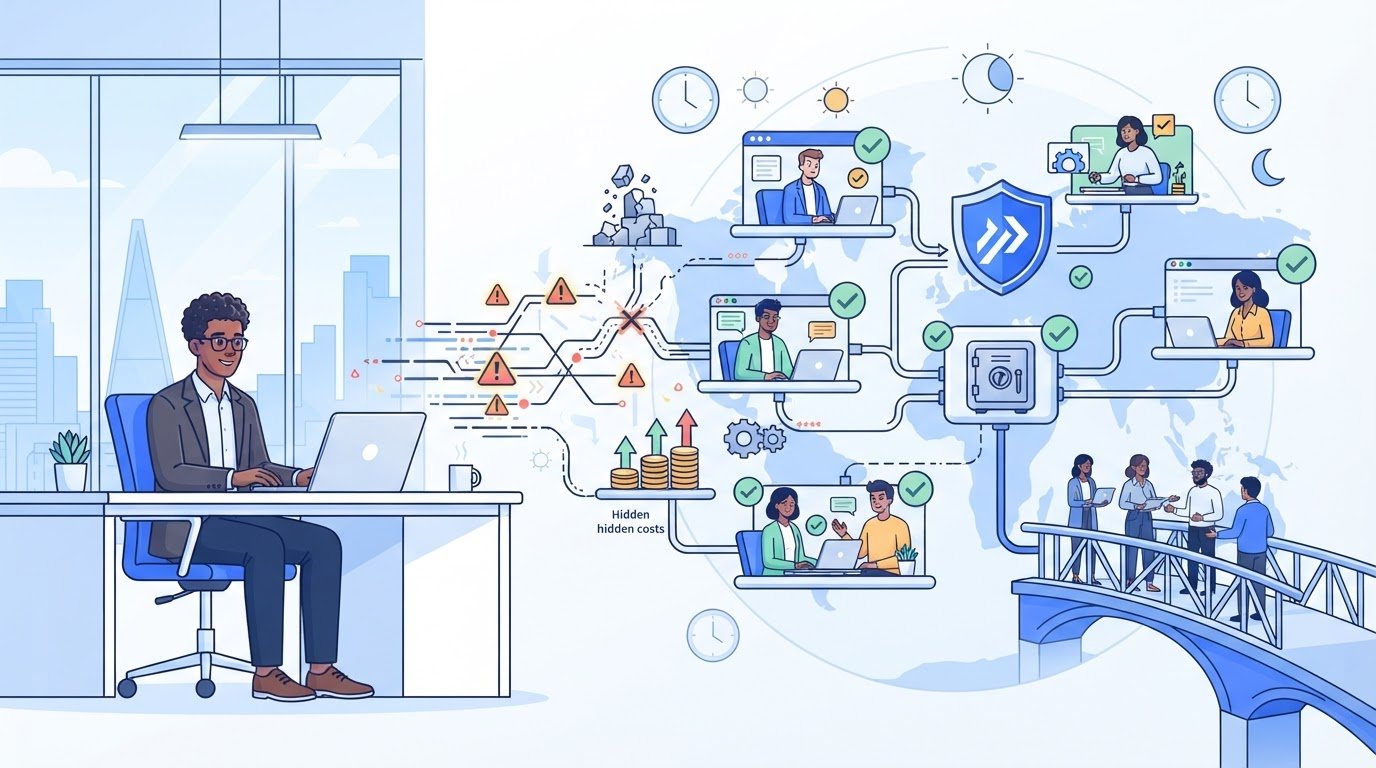
A low overseas hourly rate often produces the most expensive software an organisation will ever buy. While distributed engineering promises rapid scale and cost reduction on paper, practical execution frequently deteriorates into missed deadlines, silent communication gaps across conflicting time zones, and brittle architecture. If you find your internal resources consumed by constant oversight, unravelling technical debt, and managing rework rather than shipping new features, you aren't alone. These systemic challenges with offshore development teams routinely derail well-intentioned digital strategies.
In this guide, we examine the hidden architectural costs, governance oversights, and operational overheads that quietly undermine external builds. You will discover practical frameworks to accurately assess your true total cost of ownership, establish unyielding code quality standards across remote engineering teams, and objectively decide whether to remediate a distressed codebase or transition delivery to an onshore partner.
Offshore development involves delegating custom software engineering to vendors across distant geographies, often across multiple time zones. While organisations initially look abroad to access talent or control expenditure, operational reality rarely mirrors sales pitches. The history of offshore development reveals a continuous cycle of enterprises chasing lower headline rates, only to discover substantial friction in execution. Projected cost efficiencies frequently erode through communication gaps, architectural drift, and misaligned delivery goals.
When engineering workflows break down, domestic leadership ends up spending disproportionate time diagnosing delivery bottlenecks. Understanding the structural challenges with offshore development teams requires looking beneath sprint velocity metrics into how software is designed, communicated, and validated.
Physical distance amplifies minor ambiguities in technical specifications. When domestic product managers hand user stories to external agencies, transactional vendors often build precisely what was written rather than what the business requires. High sprint velocity can easily mask fragile foundations. An offshore agency may hit arbitrary ticket deadlines while committing unmaintainable spaghetti code, skipping automated regression tests, and ignoring foundational architectural integrity. Superficial delivery creates compounding technical debt that eventually brings feature releases to a dead halt.
Subtle language barriers and cultural norms introduce deep friction into complex development lifecycles. Engineering teams operating overseas often lack exposure to the commercial context of UK business workflows, resulting in costly errors across critical user journeys:
Navigating these challenges with offshore development teams demands extreme governance. When engineering partners treat software as ticket-clearing rather than a long-term business asset, domestic platforms inevitably suffer.
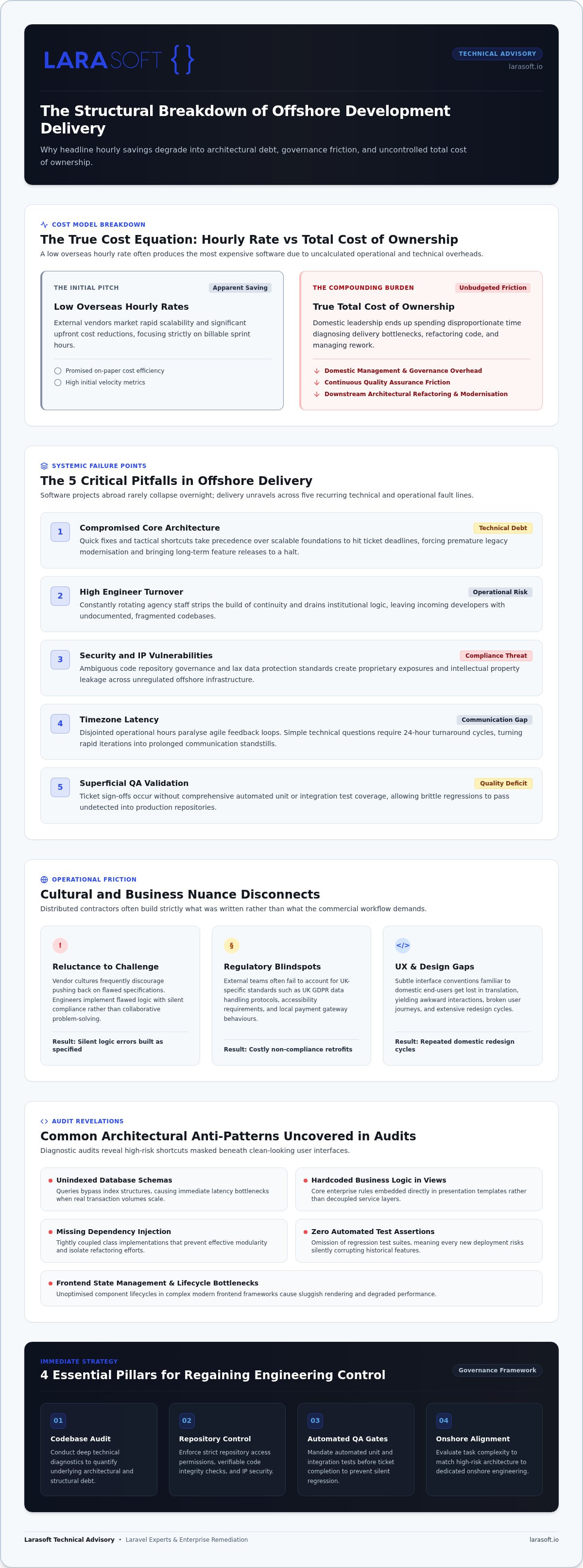
When software development fails abroad, it rarely collapses overnight. Instead, delivery unravels across five recurring technical and operational fault lines that degrade product viability. Without rigorous domestic oversight, projects accumulate structural compromises that eventually demand expensive remediation.
These persistent challenges with offshore development teams expose platforms to deep systemic risks:
Technical diagnostic audits frequently uncover alarming shortcuts beneath clean-looking interfaces. Offshore teams facing tight delivery milestones often bypass structured design patterns. Common code-level anti-patterns include unindexed database schemas, hardcoded business logic within views, missing dependency injection, and zero automated test assertions. On the client side, poor state management in modern frameworks triggers severe performance bottlenecks. For example, unoptimised component lifecycles in complex Vue.js frontend development cause sluggish rendering, memory leaks, and broken reactive states that render interfaces unusable under production loads.
Distributed time zones stretch simple code reviews into multi-day standstills. A blocking bug raised by a domestic product owner at 10:00 GMT often sits untouched until the vendor's shift begins the next morning. Domestic engineering leads end up working late-night shifts just to participate in basic sprint ceremonies. When requirements need real-time clarification, this asynchronous lag turns daily agile iterations into sluggish, disjointed progress.
Offshore agencies operate on high staff turnover. When an external engineer rolls off your account, critical context about proprietary algorithms and database structures vanishes with them. Because remote agencies rarely prioritise thorough technical documentation, incoming replacements must reverse-engineer the existing codebase on your budget. Each personnel cycle wastes valuable developer days on onboarding rather than delivering functional features.
If your platform is struggling under these compounded burdens, collaborating with a dedicated engineering partner like Larasoft can help restore architectural stability through structured code audits and modern UK-based development governance.
Procurement teams love rate cards. Comparing an overseas rate of £25 per hour against a domestic rate of £85 per hour makes offshoring look like an effortless 70% operational saving. Yet experienced technical leaders recognise that hourly rates represent only the visible tip of custom software expenditure. In practice, the hidden challenges with offshore development teams introduce cascading expenses across management, QA validation, and post-release refactoring that completely obliterate the initial arbitrage.
Calculating the true Total Cost of Ownership (TCO) requires accounting for the friction that rate cards hide:
Cheap headline rates assume every paid hour delivers pristine, deployable code. That assumption rarely survives production. When offshore teams lack domain familiarity, your domestic team must draft exhaustive, pixel-by-pixel specifications to avoid errors. If subtle ambiguities remain, vendors bill billable hours to build the wrong feature, bill additional hours to diagnose their own misunderstandings, and invoke contractual change requests to fix them. You end up paying repeatedly for the same feature delivery.
Architectural shortcuts taken overseas compound into steep structural liability. When overseas contractors fail to implement strict UK GDPR compliance, such as missing rigorous audit logging, storing plain-text PII in databases, or executing flawed token invalidation, the remediation liability falls squarely on your business. Patching these security holes retrospectively costs substantially more than architecting them correctly from sprint one.
When short-term patches inevitably overwhelm the platform's stability, standard maintenance breaks down completely. The code becomes unmanageable, fragile to any change, and hostile to new feature development. At that tipping point, businesses must invest in dedicated legacy code modernisation simply to unwind the accumulated architectural decay and rebuild system stability.
Assessing offshore delivery through TCO rather than headline contractor fees exposes the real economics. Once you tally management hours, testing friction, and technical remediation, the apparent financial benefits of distributed development quickly evaporate.
Offshoring isn't inherently flawed for every software requirement. Predictable utility emerges when the scope is entirely static. Severe friction occurs when leadership applies a distributed, transactional staffing model to high-stakes, rapidly evolving systems. Navigating the challenges with offshore development teams requires distinguishing between commoditised execution and bespoke product engineering.
Outsourcing overseas works best when tasks are repetitive, discrete, and decoupled from your core intellectual property. Non-critical administrative dashboards, routine data scripting, and basic maintenance tasks can succeed offshore if comprehensive automated test suites protect your production environment. These projects succeed because specifications leave no room for subjective interpretation. Even so, domestic teams must maintain strict, daily governance over pull requests to prevent quality regressions.
Core platforms handling complex transactions, third-party integrations, and proprietary business rules require an entirely different engineering approach. Developing scalable web applications across modern frameworks demands nuanced technical discussion, immediate feedback loops, and deep commercial empathy. Engaging an expert Laravel development agency ensures your software architecture remains clean, scalable, and responsive to rapid market shifts.
When engineering decisions directly influence conversion funnels, UK regulatory compliance, or client retention, asynchronous handoffs fail. Complex systems require technical partners who challenge weak assumptions, safeguard your codebase, and build sustainable assets for long-term growth.
If your digital roadmap demands robust architecture and dependable domestic delivery, book a technical discovery session with Larasoft to evaluate your platform requirements.
When an application begins showing symptoms of architectural decay, pushing forward with new feature requests only compounds the damage. Halting new commits to regain technical control is critical. Rescuing a distressed system and resolving the systemic challenges with offshore development teams requires a structured, diagnostic remediation strategy.
Remediation starts with an unvarnished assessment of the repository. An in-depth technical audit exposes hidden structural liabilities before they trigger catastrophic downtime. Key inspection areas include:
Before initiating contract renegotiations or offboarding an external vendor, organisations must secure their digital assets. Transfer version control repositories, staging environments, and production hosting accounts directly to company-owned accounts. Immediately rotate all database passwords, deployment SSH keys, third-party API tokens, and cloud secrets. Enforce strict role-based access control across all services and confirm that full legal ownership of the source code is properly documented and assigned internally.
Transitioning away from fragmented overseas vendors requires a disciplined engineering partner committed to architectural longevity. Working with UK-based technical specialists eliminates timezone delays, removes cultural friction, and establishes direct accountability for code quality.
A dedicated national partner establishes automated CI/CD pipelines, enforces automated linting and static analysis, and sets clear pull request review protocols. This structured governance model stops technical debt at the commit stage, restoring system performance and transforming fragile code into a reliable foundation for business growth.
Low headline rates rarely justify the hidden operational friction of persistent rework, domestic management drag, and architectural erosion. Resolving the endemic challenges with offshore development teams requires looking past short-term contractor arbitrage and committing to rigorous, long-term software governance. When digital products drive your revenue, code quality isn't merely an engineering metric; it's a vital commercial asset.
Taking back control starts with clear-eyed diagnostic audits and disciplined engineering practices. As a dedicated UK nationwide engineering partner, Larasoft delivers the structural integrity required for sustainable business expansion. Through targeted legacy code modernisation, rigorous codebase audits, and bespoke Laravel and Vue.js/React development, we eliminate architectural debt and restore delivery momentum to your product roadmap. Don't let fragile foundations compromise your vision. Partner with Larasoft for reliable software development and engineer an agile, maintainable platform built to scale.
The primary challenges with offshore development teams centre on communication friction, significant timezone discrepancies, and unpredictable architectural quality. Because offshore agencies often prioritise ticket completion over long-term maintainability, projects suffer from undocumented code, missing test coverage, and high developer churn. Additionally, cultural misalignment and reluctance to challenge flawed technical briefs frequently introduce subtle workflow defects that domestic teams must spend excessive time untangling later.
Offshore teams frequently increase technical debt by rushing delivery to meet contractual milestones rather than adhering to robust engineering standards. This practice leads to unindexed database queries, monolithic functions, skipped unit tests, and fragile frontend state management. Over time, these shortcuts compound into systemic architectural decay, making future feature development disproportionately expensive and leaving applications vulnerable to performance crashes under heavy production loads.
Offshore development rarely proves cheaper once you account for the total cost of ownership. While lower hourly rate cards appear attractive initially, businesses face significant hidden costs in domestic management overhead, protracted QA cycles, and downstream code remediation. When domestic engineering leads spend half their week supervising remote contractors and fixing broken pull requests, the actual cost per shipped feature often matches or exceeds UK agency engineering rates.
When an offshore vendor walks away, businesses typically face abandoned infrastructure, undocumented repositories, and severe continuity loss. You should immediately revoke vendor access, transfer repository ownership to internal accounts, and rotate all database credentials and API keys. Securing a specialised UK development partner to perform an emergency codebase audit allows you to stabilise existing environments, verify intellectual property ownership, and formulate a realistic recovery roadmap.
Auditing an offshore codebase requires combining automated static analysis with hands-on manual inspection by senior engineers. The process begins with scanning dependencies for known CVEs, auditing authentication logic against OWASP standards, and verifying data storage protocols to ensure UK GDPR compliance. Senior architects must also inspect query execution paths to catch SQL injection risks and verify that sensible role-based access controls protect critical business logic.
When communication stalls, immediately halt non-critical development and implement strict synchronous check-ins to regain alignment. Establishing precise definition-of-done criteria, mandating daily video standups during overlapping work hours, and requiring documented pull requests help bridge the gap. If persistent disconnects continue to derail project milestones, resolving these challenges with offshore development teams usually requires transitioning core feature delivery to a dedicated domestic technical partner.
Yes, compromised offshore codebases can be refactored through structured legacy code modernisation. Rather than risking a high-cost total rebuild, experienced software engineers isolate problematic modules, establish automated test coverage, and systematically refactor database queries and controller logic. Adopting proven frameworks like Laravel alongside clean frontend architectures enables UK technical specialists to transform fragile, legacy systems into secure, scalable assets without halting daily operations.
Here’s what we've been up to recently.
Certified Quality. Great Prices