How to Build a SaaS Application from Scratch: The 2026 Strategic Guide


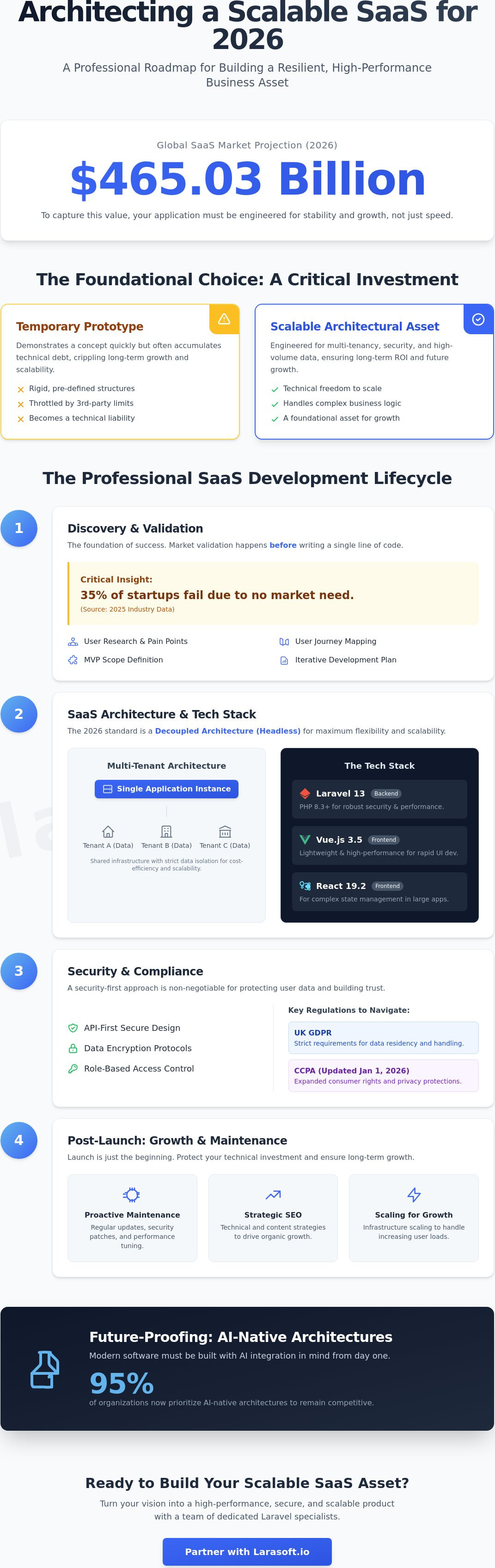
Building a SaaS isn't a weekend coding project; it's a strategic architectural investment that determines the next five years of your business ROI. You likely feel the pressure of choosing the right tech stack while fearing the technical debt that often cripples early-stage growth. It's a valid concern, especially with the global SaaS market projected to reach $465.03 billion in 2026. To capture this value, you must build a saas application from scratch using a framework that balances rapid deployment with the professional stability your users expect.
We understand that the complexity of UK GDPR compliance and the January 1, 2026, CCPA updates can feel like a barrier to entry. This guide provides the professional roadmap you need to architect, develop, and scale a high-performance product. You'll gain a clear understanding of the Laravel 13 and Vue 3.5.34 ecosystem, learning how to create a foundation ready for national scaling. We'll explore everything from API-first design to the AI-native architectures that 95% of organizations now prioritize, ensuring your software remains a resilient, long-term business asset.
Successful SaaS ventures aren't born from accidental code; they're engineered through meticulous planning. At its core, Software as a Service (SaaS) represents a centrally hosted software model that delivers applications over the internet. When you decide to build a saas application from scratch, you're making a choice between creating a temporary prototype or a scalable architectural asset. While a prototype might demonstrate a concept, an asset is designed to handle the complexities of multi-tenancy, security, and high-volume data from the first deployment.
Market validation must happen before you write a single line of code. According to 2025 industry data, 35% of startups fail because there is no market need for their product. Bespoke builds consistently outperform off-the-shelf solutions because they provide the technical freedom to scale without being throttled by third-party licensing or rigid, pre-defined structures. This flexibility is the bedrock of long-term ROI; it ensures your software remains a foundational asset for your future growth rather than a technical liability.
User research identifies the specific pain points your platform will solve, moving beyond generic assumptions. We map the user journey to define a Minimum Viable Product (MVP) scope that balances speed to market with high-quality craftsmanship. The discovery phase is the foundation of all successful software builds. By focusing on essential features first, you avoid the high cost of failed MVPs that try to do too much too soon.
Architecting for scale requires a choice between single-tenant and multi-tenant structures. Multi-tenancy is the modern standard for 2026 SaaS products; it allows multiple users to share the same infrastructure while keeping data strictly isolated. This choice impacts your database design, especially when integrating complex subscription models. To build a saas application from scratch that lasts, you must plan for high-performance data handling and seamless API interactions. This ensures your system remains responsive as your user base expands from dozens to thousands.
Building a SaaS application from scratch in 2026 isn't about finding the newest, most obscure library; it's about selecting a mature ecosystem that supports long-term growth. While some suggest you can prompt an AI to generate a product in hours, professional architecture requires more discipline. High-performance software demands a stack that offers both developer velocity and enterprise-grade security. This is where the combination of Laravel, Vue.js, and React provides a significant advantage over fragmented alternatives like Node.js, which often lack integrated security features.
A decoupled architecture, often referred to as Headless Laravel, has become the modern standard. By separating your backend logic from the frontend presentation layer, you create a system that's ready for any interface. Whether you're serving a web app, a native mobile application, or an external API integration, this separation ensures your business logic remains consistent. It's a strategic move that prevents technical debt from accumulating as you scale. If you're ready to turn your concept into a scalable asset, our team of Laravel specialists can help bridge the gap between vision and execution.
Laravel remains the premier choice for bespoke web applications in the UK due to its focus on "clean code" and rapid deployment. The release of Laravel 13 on March 17, 2026, solidified this position by requiring PHP 8.3 and introducing even more robust built-in security protocols. Its Eloquent ORM allows for intuitive data handling, which is essential when managing the complex multi-tenant databases we discussed in the discovery phase. Partnering with a specialized laravel development agency ensures you leverage these tools to their full potential, creating a product that's secure by design.
The user interface is where your vision meets the customer. Vue.js 3.5.34 is currently favoured for its light weight and high-performance rendering, making it ideal for rapid interface development. In contrast, React 19.2.6 excels at managing complex, highly interactive states within large-scale enterprise applications. Both frameworks allow for the creation of seamless, app-like user experiences that modern customers demand. You can explore our detailed comparison of these technologies in our guide to Vue.js frontend development. At Larasoft, our philosophy is "Your vision, our code," meaning we select the specific frontend tool that best aligns with your long-term business ROI rather than following a one-size-fits-all approach.
Transitioning from architectural planning to active development requires a disciplined "Build, Measure, Learn" loop. This isn't just about speed. It's about validating assumptions with real-world data. To build a saas application from scratch that endures, you need code that's written for humans to read and machines to execute efficiently. We treat every line of code as a brick in a foundational asset, ensuring that "craftsmanship" isn't just a buzzword but a technical requirement. This approach prevents the accumulation of legacy debt, which 42% of software companies cite as their primary barrier to innovation.
Automated testing and Continuous Integration/Continuous Deployment (CI/CD) pipelines aren't optional extras for a 2026 SaaS. They're the safeguards that allow you to push updates daily without breaking the user experience. By automating the deployment workflow, we reduce the risk of human error and ensure that every release meets our standards. This process allows your team to focus on feature innovation rather than manual server management. A robust pipeline ensures that code is automatically tested, built, and staged before it ever reaches a live user, maintaining the integrity of your platform under pressure.
Prioritise "must-have" features that solve the primary pain point discovered in your research. A common mistake is bloating the initial release with "nice-to-have" features that distract from the core value proposition. When you build a saas application from scratch, the MVP is your first chance to prove the business case. Establish a feedback loop with early adopters immediately. This ensures your roadmap is driven by user needs rather than internal guesswork. Your MVP should be a lean version of your vision, built on the same scalable Laravel foundation that will support your full-scale launch. Avoid the temptation of "throwaway" scripts; a professional MVP is simply the first phase of a permanent system.
Manual testing alone is a significant risk to your reputation; it's impossible to catch every regression in a complex multi-tenant system. We implement a tiered testing strategy: unit tests for individual functions, feature tests for user actions, and end-to-end (E2E) testing for the entire journey. Every code change passes through a staging environment, which acts as a perfect replica of your production server. This rigorous approach ensures a seamless experience for the end user. By 2026, users have zero tolerance for bugs in their paid subscriptions, making professional QA the difference between market growth and customer churn.
Security isn't a feature you toggle on; it's the invisible architecture that protects your business's reputation and long-term ROI. When you build a saas application from scratch, you're responsible for the integrity of every byte of user data. Generic forum advice often suggests using simple plugins for security, but this approach fails to address the rigorous demands of enterprise-level compliance. In 2026, security and compliance are addressed at the start of the development cycle. They're critical for market access, especially if you're targeting the B2B space where SOC 2 and the 2022 revision of ISO 27001 are the expected standards.
The regulatory environment became even more complex on January 1, 2026, with updated CCPA/CPRA regulations. These changes removed the 12-month lookback period for consumer data access and introduced mandatory risk assessments for high-risk data processing. Failing to account for these shifts during the initial build leads to expensive refactoring and potential legal exposure. By treating security as a core architectural requirement, you ensure your SaaS remains resilient against both external threats and regulatory scrutiny.
Handling European and UK user data requires more than a simple privacy policy; it requires technical discipline. We implement AES-256 encryption for data at rest and TLS 1.3 for data in transit, ensuring that sensitive information remains unreadable even in the event of a breach. Programmatic data deletion is equally vital. Your system must handle "Right to be Forgotten" requests across all database tables and third-party logs automatically. Security must be baked into the architecture from the very first line of code. This proactive stance protects your users and simplifies the path to global scaling.
A modern SaaS doesn't exist in a vacuum. It relies on a composable architecture that connects seamlessly with third-party tools like Stripe for usage-based pricing or AWS for object storage. By 2026, AI-native architectures have moved from a novelty to a necessity, with 95% of organizations adopting AI-powered applications. We specialize in Laravel AI integration to automate repetitive user tasks and provide predictive insights that drive customer retention. Whether you're building a well-documented API for future partners or integrating LLMs for advanced data analysis, your integrations must be as scalable as the core application. This ensures your product remains at the cutting edge of the $465 billion SaaS market while delivering immediate value to your users.
Deployment is often mistaken for the final step in the software lifecycle. In reality, it marks the transition from building a product to operating a high-performance business asset. The global SaaS market is projected to grow at a CAGR of 13 to 17% from 2026 onwards; capturing this growth requires more than just launching. When you build a saas application from scratch, the post-launch phase determines your long-term ROI. You must shift your focus toward performance monitoring and technical SEO to ensure your platform remains competitive and discoverable.
Operating a software asset involves identifying scaling bottlenecks before they impact the user experience. By 2026, the average company manages 305 SaaS applications, which means users have high expectations for speed and reliability. Technical SEO services turn your application into a lead-generation engine by optimizing core web vitals and metadata. This ensures that your bespoke build doesn't just function perfectly but also attracts the national audience it was designed to serve. Monitoring metrics like database query execution time and server response rates allows you to make data-driven decisions about your infrastructure.
System decay is a silent threat to any successful platform. Regular patching of security vulnerabilities is essential, especially as Laravel 12 security fixes are scheduled to end on February 24, 2027. Staying current with Laravel 13 ensures your application benefits from the latest performance enhancements and PHP 8.3 features. In some cases, rapid initial growth can lead to technical debt that requires legacy code modernisation to maintain agility. Refactoring code as your user base expands prevents your system from becoming sluggish, protecting the craftsmanship of the original build.
Scaling requires a strategic choice between horizontal and vertical upgrades. While vertical scaling adds more power to a single server, horizontal scaling adds more machines to your pool, which is often more resilient for a growing SaaS. To build a saas application from scratch that scales effectively, you must optimize database queries to handle increased concurrent loads. Leveraging Content Delivery Networks (CDNs) and advanced caching strategies ensures that users across the UK experience seamless performance. These technical interventions ensure that your vision continues to perform perfectly under the pressure of global market success.
The journey from a conceptual vision to a market-leading platform is a structured, manageable path when you have the right technical ally. Success in the projected $465 billion SaaS market requires more than just functional code; it demands a strategic roadmap that encompasses everything from multi-tenant architecture to post-launch technical SEO. By prioritizing a scalable Laravel foundation and integrating AI-native capabilities, you ensure your software remains a resilient business asset rather than a source of technical debt. We've examined how disciplined development cycles and rigorous security protocols protect your ROI while meeting the latest 2026 compliance standards.
Deciding to build a saas application from scratch is a significant investment in your company's future. As expert Laravel craftsmen and a leading UK-based technical authority, we're dedicated to transforming your requirements into a high-performance reality. Partner with Larasoft to build your bespoke SaaS application and leverage our specialized knowledge in scalable architecture and AI integration. Your vision is the blueprint; our code is the foundation. Let's create a system that works perfectly under pressure and grows alongside your ambition.
Total costs depend on the technical complexity, the number of integrations, and the specific security requirements of your industry. A bespoke build focuses on creating a long-term architectural asset rather than a temporary prototype. While we don't provide fixed pricing without a discovery phase, professional SaaS development in the UK prioritises high-quality craftsmanship and compliance to ensure a strong return on investment as you scale.
A professional MVP typically takes between 12 to 16 weeks to develop from the initial discovery phase to the first deployment. This timeline includes architectural planning, core feature development, and rigorous QA testing. By focusing on the "must-have" business logic first, you can reach market-fit faster while ensuring the foundation is ready for national scaling without needing a complete rebuild later.
You don't need to be a developer to launch a successful product, but you do need a technical ally to build a saas application from scratch. While no-code tools are useful for basic validation, they often lack the multi-tenancy, custom API integrations, and security features required for a scalable business. Partnering with a specialized agency allows you to focus on strategy while experts handle the complex engineering.
Laravel 13 is the premier choice for SaaS development in 2026 because it offers built-in security, a robust ecosystem, and rapid deployment capabilities. Its Eloquent ORM and support for decoupled architectures make it ideal for products that need to handle complex data and high user volumes. For businesses in the UK, Laravel provides a stable, long-term foundation that is significantly easier to maintain than fragmented alternatives.
Custom builds are foundational assets that you own entirely, providing the freedom to implement bespoke business logic and deep API integrations. No-code platforms often trap you in proprietary ecosystems with high monthly fees and rigid limitations on scalability. A custom build using Laravel or Vue.js ensures your software can grow with your company, whereas no-code is generally reserved for temporary, low-complexity prototypes.
Ensuring UK GDPR compliance involves implementing AES-256 encryption for data at rest and TLS 1.3 for data in transit. Your system must also handle "Right to be Forgotten" requests programmatically across all database tables. As of the January 2026 updates, we also build in mandatory risk assessments for high-risk data processing, ensuring your platform meets the latest international standards for data privacy and security.
An outdated codebase becomes a technical liability that increases security risks and slows down your ability to innovate. We address this through legacy code modernisation, refactoring older systems to use modern frameworks like Laravel 13 and PHP 8.3. A proactive software maintenance plan prevents system decay, ensuring your application remains secure and continues to perform perfectly as your user base expands.
Native apps offer the highest performance for device-specific features, while cross-platform development is more efficient for reaching both iOS and Android users with a single codebase. When you build a saas application from scratch, we analyze your specific user requirements to recommend the most cost-effective path. Cross-platform tools are often the strategic choice for SaaS products that require a consistent experience across multiple mobile devices.
Here’s what we've been up to recently.
Certified Quality. Great Prices