GDPR Compliant Laravel Applications: The 2026 Strategic Implementation Guide

The cost of manual Subject Access Requests is no longer just a nuisance; it's a structural threat to your development margins. As the UK's Data (Use and Access) Act 2025 reshapes the regulatory landscape, building gdpr compliant laravel applications requires more than a simple middleware fix or a generic privacy policy. You're likely feeling the pressure of UK vs EU divergence and the hidden liabilities lurking in legacy codebases, especially with the June 2026 deadline for direct data complaints now in effect.
We understand that balancing rapid feature development with rigorous data sovereignty is a constant tension, which is why this guide provides the technical and strategic framework you need to master compliance in the 2026 landscape. We'll explore how to implement Privacy by Design within Laravel 13, automate data rights workflows to slash operational costs, and architect secure environments for AI and LLM integrations. By the end, you'll have a roadmap to transform compliance from a legal hurdle into a foundational asset for your application's future.
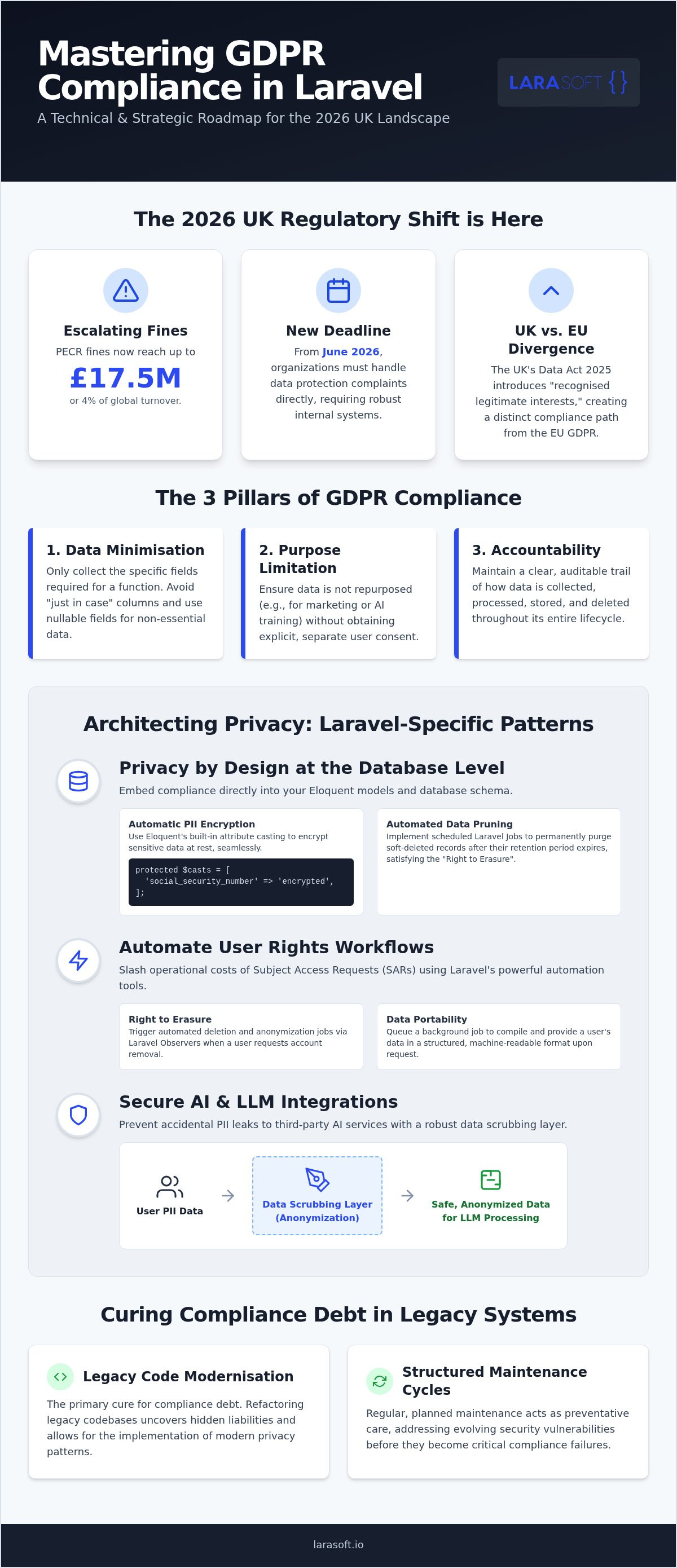
Building gdpr compliant laravel applications in 2026 isn't a post-launch task; it's a foundational architectural requirement. We define a compliant application as one where privacy is woven into every stage of the data lifecycle, from the initial migration schema to the final API response. This level of integrity is essential because the regulatory gap between the UK and the EU has widened significantly. While both frameworks share the same root in the General Data Protection Regulation (GDPR), the UK's Data (Use and Access) Act 2025 has introduced specific domestic nuances that developers must address to avoid escalating PECR fines, which now reach up to £17.5 million.
Bespoke Laravel builds often face higher audit scrutiny than generic SaaS platforms. Auditors expect custom systems to demonstrate exact data flows rather than hiding behind a third-party service level agreement. To pass this level of inspection, your system must adhere to three core pillars:
A custom Laravel application offers granular control that off-the-shelf software simply can't match. You can implement field-level encryption and custom data retention policies that align perfectly with your business logic. However, "bolting on" compliance after the code is written creates technical debt and operational risk. We integrate the Data Protection Impact Assessment (DPIA) directly into our development lifecycle. This ensures that every new feature, especially those involving complex integrations, is vetted for privacy risks before a single line of code is pushed to production.
The UK's regulatory environment shifted on February 5, 2026, with the full implementation of the Data (Use and Access) Act. One of the most significant changes for gdpr compliant laravel applications is the introduction of "recognised legitimate interests," which simplifies processing for specific use cases like public safety or emergencies. Additionally, as of June 19, 2026, the Information Commissioner’s Office (ICO) requires organisations to handle data protection complaints directly. This makes automated, transparent reporting within your Laravel dashboard a necessity rather than a luxury.
Architecting gdpr compliant laravel applications begins at the database level. Privacy by Design isn't a feature you add later; it's the structural foundation of your tables and relationships. In 2026, the Information Commissioner’s Office places heavy emphasis on how data is handled at rest. This means your schema must reflect the principles found in the official UK GDPR guidance, ensuring every byte stored has a clear, legal justification. Beyond the database, your application's logging and access patterns must be equally rigorous to prevent accidental data leaks during routine operations.
Data minimisation is the practice of limiting data collection to what is strictly necessary for the stated purpose. When designing your migrations, avoid "just in case" columns. Use nullable fields for any non-essential information, allowing users to provide only what they're comfortable with. Soft deletes are a powerful tool in Laravel, but they must be managed with precision. Retaining "deleted" records indefinitely is a compliance risk. We recommend implementing automated pruning jobs that permanently remove soft-deleted records after a defined retention period to satisfy the Right to Erasure requirements.
Laravel 12 and 13 have matured significantly in their native handling of sensitive data. You should leverage Eloquent attribute casting to encrypt PII automatically. By using the encrypted cast in your models, data is encrypted before it hits the database and decrypted on retrieval. This ensures that even if your database backups are compromised, the sensitive contents remain unreadable. For UK-based applications, ensure your encryption keys are managed within secure environments to maintain data-at-rest integrity within local infrastructure.
Managing logs is often where compliance fails. Laravel’s default logging can inadvertently capture PII in stack traces or request payloads. We implement custom log formatters to scrub email addresses, phone numbers, and IP addresses before they're written to disk. Coupling this with granular role-based access control (RBAC) ensures only authorised personnel can view specific data subsets. For high-stakes systems, multi-factor authentication (MFA) is no longer optional; it's a baseline requirement for administrative access. If you're concerned about hidden liabilities in your current setup, our team can provide the software maintenance needed to audit and secure your architecture.
Manual data management is a significant operational burden. For gdpr compliant laravel applications, the goal in 2026 is to remove the human element from compliance workflows. By leveraging Laravel's native event system, you can automate the 'Right to be Forgotten' (Article 17) with precision. We use Eloquent Observers to watch for deletion events, which then dispatch queued Jobs to scrub related PII from peripheral tables. This asynchronous approach ensures your application remains performant while meeting strict regulatory timelines without manual intervention.
Data Portability (Article 20) requires providing users with their information in a structured, machine-readable format. Laravel's robust file handling, combined with JSON resources, allows you to build export features that generate JSON or CSV files on demand. To manage consent dynamically, we implement custom middleware that checks a user's privacy preferences before processing data or loading third-party tracking scripts. This technical rigour ensures you're always operating within the Official ICO GDPR Guidance, protecting both your business and your users from compliance lapses.
A dedicated privacy dashboard empowers users to manage their own data without contacting support. This self-service model is built using Laravel's frontend agnostic tools, whether you're using Vue.js or React. We use the notification system to send secure, time-limited links for data downloads and provide immediate confirmation of deletion requests. Every action is logged in a dedicated audit table, creating a robust evidence chain for future regulatory reviews and ensuring total transparency.
Automating DSARs is the most effective way to reduce the high cost of manual data gathering. Instead of manually searching through disparate database tables, we develop custom service classes that aggregate PII from every corner of your gdpr compliant laravel applications. This includes user profiles, transaction histories, and metadata stored in complex JSON columns. By centralising this logic into a single technical workflow, you can generate a comprehensive data report in seconds. This focus on operational efficiency mirrors the approach taken by PS WebSolution, a leader in PeopleSoft process automation, where streamlining complex workflows is key to success. This reduces administrative overhead and significantly lowers the risk of missing sensitive information during the verification and delivery process.
Integrating Large Language Models (LLMs) into your ecosystem offers transformative efficiency, but it introduces unprecedented privacy risks. For gdpr compliant laravel applications, the primary danger lies in the accidental transmission of personally identifiable information (PII) to external AI providers. If your application sends raw user data to a third-party API for summarization or sentiment analysis, you may be inadvertently feeding sensitive information into a model's training set. In 2026, this constitutes a major breach of the Data Minimisation principle under the UK’s updated regulatory framework.
To mitigate these risks, we implement dedicated data scrubbing layers within the Laravel service container. Before any request leaves your server, a specialized middleware or service class identifies and redacts PII using pattern matching and named entity recognition. This ensures that only anonymized tokens reach the LLM. Furthermore, data residency remains a critical factor. When using global AI providers, you must ensure that the processing locations align with UK-specific data transfer rules, particularly following the divergence from EU standards that became more pronounced in early 2026.
AI governance is the framework for ensuring AI systems are transparent, fair, and compliant with data protection laws. Establishing this framework requires a clear internal policy that defines exactly which data types are eligible for AI processing. Technical controls must be absolute; we use environment-specific gates to prevent production data from ever reaching non-compliant AI sandboxes. These safeguards protect your application from becoming a liability as the Information Commissioner’s Office increases its focus on automated decision-making and algorithmic accountability.
While AI creates challenges, it also provides sophisticated tools for maintaining compliance. We use Laravel AI integration to scan legacy databases and flag forgotten pockets of PII that traditional migrations might miss. This automated categorization allows for more accurate compliance mapping and faster responses to data requests. However, you must balance this innovation with the "Right to Explanation" introduced in the Data (Use and Access) Act 2025. If an AI-driven process affects a user, your Laravel backend must be architected to provide a clear, human-readable audit trail of how that decision was reached.
If you're planning to scale your platform's intelligence while maintaining a bulletproof regulatory posture, our specialists can help you architect a secure Laravel AI integration that prioritizes data sovereignty.
Compliance is often viewed as a legal hurdle, but for high-growth UK businesses, it's a foundational asset. Building gdpr compliant laravel applications requires moving past the basic checklist and into a lifecycle of continuous architectural improvement. At Larasoft, we act as a deeply invested technical ally, ensuring your architecture doesn't just meet today's standards but is prepared for the regulatory shifts of tomorrow. We focus on the structural integrity of your code, where clean development meets strategic business returns.
Our collaborative approach treats complex development processes as a manageable, structured journey toward growth. We don't just provide services; we build systems that perform perfectly under the pressure of regulatory audits and high-volume usage. This commitment to quality ensures that your bespoke platform remains a secure, scalable foundation for your business operations.
Running outdated Laravel versions, such as v5.x or v6.x, in 2026 is a significant liability. These legacy systems often contain unpatched vulnerabilities and non-compliant data architectures that can't support modern rights automation or the latest encryption standards. Our approach to legacy code modernisation eliminates this compliance debt through a structured migration process. We focus on resolving the "compliance debt" inherent in older builds, bringing fragmented data structures into full alignment with 2026 standards.
GDPR Article 32 mandates the implementation of appropriate technical measures to ensure data security. This makes regular security patches and framework updates a legal requirement, not just a recommendation. Choosing the right Laravel development agency provides the ongoing software maintenance needed to safeguard your application against evolving threats. We ensure your gdpr compliant laravel applications stay updated with the latest security fixes, preventing vulnerabilities from escalating into costly data breaches.
Our maintenance cycles also look beyond security. We consider the role of technical SEO and accessibility in holistic application health, ensuring your bespoke build evolves alongside UK regulatory changes. This proactive stance allows you to focus on innovation while we handle the meticulous, detailed execution required to keep your platform performant and legally sound.
The 2026 regulatory environment demands a shift from reactive patching to proactive architectural discipline. Mastering the technical requirements of the UK Data (Use and Access) Act 2025 ensures your platform remains a competitive asset rather than a liability. By automating data rights and securing AI integrations, you reduce operational overhead while maintaining the highest standards of data sovereignty. Building gdpr compliant laravel applications is no longer a one-time project; it's a commitment to continuous maintenance and structural integrity.
As UK-based Laravel experts, we specialize in legacy code modernisation and bespoke AI integrations with privacy-first architecture. We're here to help you navigate the divergence between UK and EU standards with specialized expertise. Our team ensures your bespoke builds perform perfectly under the pressure of evolving 2026 standards, turning complex development into a manageable journey toward growth. Secure your application’s future with a Larasoft GDPR audit and gain the reassurance of a deeply invested technical ally. Your path to a resilient, compliant, and high-performance application starts with a single strategic step.
No framework is GDPR compliant by default; compliance is achieved through the specific way you implement application logic. Laravel provides the essential toolset, such as encryption, secure hashing, and session management, but the developer is responsible for configuring them correctly. You must design your database schemas to follow data minimisation and ensure your controllers don't inadvertently leak personally identifiable information through public-facing APIs or logs.
You handle the "Right to be Forgotten" by implementing automated workflows using Laravel Jobs and Eloquent Observers. When a user requests deletion, an observer triggers a background job to scrub their data from the primary database and any connected third-party services. This ensures that data is permanently removed rather than just soft-deleted. Automated pruning of backups and logs is also essential to meet the strict requirements of the 2026 UK regulatory landscape.
Running legacy codebases on outdated versions like Laravel 6 or 7 exposes you to unpatched security vulnerabilities and significant legal liability. In 2026, the Information Commissioner’s Office views technical debt as a failure to protect data by design. You risk heavy fines under the Data (Use and Access) Act 2025 if a breach occurs on an unsupported framework. Legacy modernisation is the primary cure for this compliance debt, ensuring your platform remains secure.
UK GDPR divergence means you must now account for specific domestic rules introduced by the Data (Use and Access) Act 2025. While the UK maintains high standards, the legal basis for processing, such as recognised legitimate interests, has shifted. For gdpr compliant laravel applications, hosting in UK-based data centres is often the simplest way to manage data residency. This avoids the complexities of international data transfer rules that now differ slightly from EU standards.
Yes, you can use AI by implementing robust data scrubbing layers before sending requests to external providers. You must ensure that no PII is transmitted to AI training sets without explicit consent. Our approach to Laravel AI integration prioritizes data sovereignty by anonymizing data at the service container level. This allows you to leverage modern intelligence while adhering to the Right to Explanation and other transparency requirements established in 2026.
The most critical technical controls include field-level encryption, multi-factor authentication, and granular role-based access control. Encryption at rest ensures that even if a database is compromised, the data remains unreadable. MFA and RBAC limit access to sensitive information to only those who strictly need it. These controls, combined with automated audit trails, form the backbone of a secure, bespoke environment that satisfies both UK and EU data protection authorities.
We recommend a comprehensive compliance audit at least once a year or whenever significant architectural changes occur. In the fast-moving 2026 landscape, annual reviews help you catch new regulatory divergences and security vulnerabilities. Regular audits are also a core part of the Accountability principle, providing documented evidence that you are actively managing your data protection obligations. Ongoing software maintenance ensures your application evolves in sync with the latest legal requirements.
Laravel middleware is an excellent tool for managing dynamic consent across your application. You can build custom middleware to check a user's privacy preferences before allowing specific routes to load or third-party scripts to execute. This ensures that data processing only occurs when the correct legal basis is met. Integrating this with gdpr compliant laravel applications allows for a seamless, automated approach to consent that reduces the risk of accidental non-compliance during the user journey.
Here’s what we've been up to recently.
Certified Quality. Great Prices