Custom API Integration Services: Building Scalable Business Ecosystems

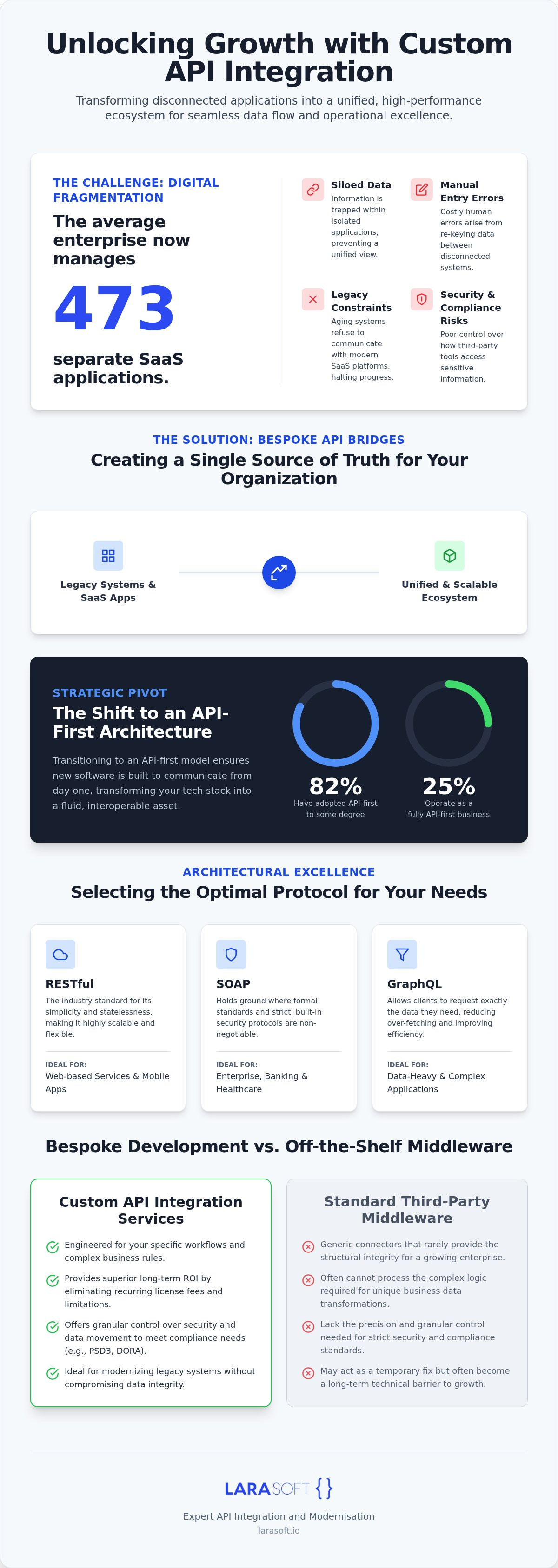
With the average enterprise now managing 473 separate SaaS applications, your business isn't just running on software; it's surviving in a fragmented digital wilderness. You likely feel the friction of siloed data every day. It manifests as manual entry errors, legacy systems that refuse to communicate with modern platforms, and recurring anxiety over how third-party tools access your sensitive information. These aren't just technical glitches; they're structural barriers to your growth.
Investing in professional custom api integration services transforms these disconnected tools into a unified, high-performance ecosystem. We understand that you need a seamless flow of data to reduce operational costs and eliminate the risks of manual handling. This guide explores how bespoke API architecture modernises legacy constraints and creates a secure, scalable foundation for your digital assets. We'll examine the shift toward AI-driven API consumption and provide a structured roadmap for building a technical architecture that performs perfectly under pressure.
Data silos represent more than just a technical inconvenience; they are a direct tax on your operational efficiency. When information is trapped within isolated applications, your team is forced into a cycle of manual data entry, which inevitably leads to costly human errors and fragmented reporting. At its core, an application programming interface (API) functions as a set of rules that allow one software application to interact with another. While standard connectors might offer a temporary bridge, they rarely provide the structural integrity required to support a growing enterprise.
Professional custom api integration services act as bespoke bridges designed specifically for your unique software environment. Unlike generic middleware, these custom builds are engineered to respect your specific workflows and data validation rules. This is particularly vital in the UK market, where businesses often navigate complex logic requirements that off-the-shelf tools simply weren't built to handle. By eliminating the friction between disparate systems, you create a unified technical architecture that serves as a single source of truth for the entire organisation.
Adopting an API-first architecture is a strategic pivot toward long-term agility. Recent data suggests that while 82% of organisations have adopted an API-first approach to some degree, only 25% operate as fully API-first. Transitioning to this model ensures that every new piece of software you introduce is built to communicate from day one. It transforms your technology stack from a collection of "black boxes" into a fluid, interoperable ecosystem that can adapt as quickly as the market demands.
Integrated systems enable real-time decision-making by ensuring that data captured in one corner of the business is immediately available in another. This moves the technical stack from being a collection of tactical "glue" to a foundational architectural asset. When your systems communicate perfectly, customer experience improves because data is consistent across every touchpoint. Simultaneously, employee productivity rises as staff are freed from the drudgery of reconciling mismatched spreadsheets. Interoperability isn't just a technical goal; it's a prerequisite for a modern, responsive business strategy.
You'll know it's time to move beyond standard automated connectors when your data transformations require logic that third-party tools cannot process. This is common during legacy code modernisation, where aging systems must be bridged to modern SaaS platforms without compromising data integrity. Bespoke custom api integration services are also essential when addressing unique security or compliance requirements. In the UK, regulations like PSD3 and the Digital Operational Resilience Act (DORA) make it necessary to have granular control over how data moves, a level of precision that generic tools rarely provide. Using a framework like Laravel development allows for the creation of secure, high-performance middleware that meets these exact standards.
The choice of protocol defines the efficiency of your digital infrastructure. RESTful APIs remain the industry standard for their simplicity and statelessness, making them ideal for web-based services. However, SOAP still holds ground in enterprise environments where formal standards and strict security protocols are non-negotiable. For data-heavy applications requiring granular queries, GraphQL allows clients to request exactly what they need, which significantly reduces over-fetching. Professional custom api integration services evaluate these protocols based on your specific latency requirements and the complexity of the data being exchanged.
JSON has largely superseded XML as the preferred data format due to its lightweight nature and native compatibility with modern JavaScript frameworks. Yet, XML remains essential for legacy system interoperability, especially within banking or healthcare sectors. Regardless of the data format, security is paramount. Implementing OAuth 2.0 or JSON Web Tokens (JWT) ensures that every data exchange is authenticated and authorized, protecting your internal assets from unauthorized access. This level of security is a critical component of building scalable business ecosystems that remain resilient as they expand.
Laravel serves as an exceptional foundation for building secure API endpoints in the UK. By utilizing Laravel Sanctum for simple token-based authentication or Passport for full OAuth2 implementation, developers can secure integrations with precision. Laravel's Eloquent ORM simplifies complex data mapping during integration by providing a fluent, expressive interface for interacting with your database. This structured approach ensures that your backend remains maintainable and clean as your system grows. If you're looking to strengthen your technical foundation, partnering with a specialist in API integration ensures your architecture is built to perform under pressure.
A unified API layer acts as the backbone for modern frontends built with Vue.js or React. These frameworks rely on asynchronous data flows to provide a responsive user experience, allowing for real-time updates without page reloads. Connecting these frontends to a robust Laravel backend ensures that data remains consistent across all user touchpoints. We're also seeing a significant rise in Laravel AI integration, where APIs connect your core systems to Large Language Models (LLMs) to automate complex decision-making. By 2026, Gartner predicts that over 30% of the increase in API demand will come from AI tools, making this integration a vital competitive advantage for forward-thinking businesses.
Choosing between off-the-shelf middleware and custom api integration services is a pivot point for your technical architecture. Middleware platforms often appear cost-effective initially; however, the long-term ROI usually favours bespoke ownership. Subscription fees for enterprise-level iPaaS can exceed $10,000 per year, which is a recurring expense that adds no equity to your business. While custom builds require ongoing maintenance, typically costing 20-35% of the initial build annually, you retain full control over the asset. By owning your code, you eliminate vendor lock-in and ensure your logic isn't constrained by a third-party roadmap. Custom builds also avoid the performance overhead inherent in generic platforms, providing lean endpoints that process data with minimal latency.
Generic middleware frequently struggles with highly specialised business rules. These platforms are designed for the "lowest common denominator" of use cases, meaning they often fail when faced with complex data transformations or unique UK-specific workflows. A custom-built integration layer allows for precise data validation and error handling that matches your internal processes exactly. This reduces the manual oversight required to manage "brittle" connections that tend to break when a third-party tool updates its schema. You gain a system that performs perfectly under pressure because it was engineered specifically for your load requirements.
Bespoke development is non-negotiable when handling high-volume data transfers where every millisecond affects the user experience. If your organisation relies on proprietary legacy systems with limited documentation, generic connectors simply won't suffice. Custom solutions allow you to maintain total control over data security and GDPR compliance, ensuring that sensitive information never passes through an unvetted intermediary. This is a foundational asset for your future growth, providing the structural integrity needed to scale without technical limitations.
Low-code tools are often a viable starting point for simple, non-critical tasks like syncing a contact form to a CRM. The challenge arises as business complexity grows; middleware can quickly become a web of disconnected logic that creates significant technical debt. A structured transition path from middleware to custom api integration services ensures that your initial speed doesn't compromise your future ability to modernise. We recommend using middleware for prototyping but moving toward custom code for any integration that sits at the core of your revenue-generating operations.
Successful system interoperability isn't achieved through ad-hoc coding; it requires a disciplined development lifecycle that prioritises structural integrity over quick fixes. When you engage with professional custom api integration services, the process begins far before the first line of code is written. It starts with a comprehensive mapping of your existing digital landscape. With businesses now managing an average of 305 SaaS applications, identifying how data moves between these platforms is essential to prevent the creation of new silos. This structured journey ensures that every connection is purposeful and every data exchange is secure.
Once the mapping is complete, the focus shifts to architecting the integration layer. This involves selecting the optimal protocols and security measures discussed earlier, such as OAuth 2.0 or JWT, to protect your internal assets. Agile development methodologies allow for an iterative approach, where components are built and refined in cycles. This reduces project risk by identifying potential bottlenecks early. The final stage of deployment must include the creation of comprehensive API documentation. Adhering to the OpenAPI Specification (OAS) 3.1.1 provides a standardised framework that makes your systems easier to maintain and scale as your business grows.
Understanding the "source of truth" is vital for every integration project. If your CRM and ERP systems hold conflicting customer data, the integration layer must know which system takes precedence to maintain data integrity. We meticulously document legacy endpoints and identify potential points of failure that could disrupt your workflows. A comprehensive technical audit serves as the blueprint for the entire integration, ensuring that no legacy constraint or data bottleneck is overlooked before the first line of code is written. If you're ready to map your route to a unified architecture, our team is ready to provide the expert API integration you need.
Quality assurance is the final safeguard against operational disruption. We employ a multi-tiered testing strategy to ensure your custom api integration services perform perfectly under pressure. This includes:
This level of meticulous testing ensures that your new architecture isn't just functional but is also resilient enough to support your long-term business objectives. By the time the system goes live, you can be confident that every automated workflow is reliable and every data point is accurate.
Larasoft positions itself as a deeply invested technical ally rather than a mere service provider. We understand that your digital infrastructure is the lifeblood of your operations, and our custom api integration services are designed to reinforce that foundation. By combining legacy code modernisation with advanced API strategies, we help UK businesses transition from fragmented, aging systems to unified, high-performance ecosystems. This isn't just about making two systems talk; it's about re-engineering your architecture so that it supports your long-term growth objectives without the drag of technical debt.
Our commitment to excellence is reflected in our choice of tools. We utilise the Laravel development framework to build clean, maintainable code that prioritises both security and scalability. Laravel's robust ecosystem allows our team of technical artisans to create bespoke middleware that performs perfectly under pressure. Once your integration is live, we provide comprehensive software maintenance to ensure your endpoints remain secure, functional, and compliant with evolving UK data regulations. This proactive approach prevents the "bit rot" that often plagues generic, unmonitored connections.
We align our technical implementation with your broader business growth goals. Our UK-based developers bring a sophisticated understanding of local market dynamics and regulatory landscapes, ensuring your custom api integration services meet the highest standards of data governance. We don't just deliver one-off products; we build foundational assets. By focusing on the structural integrity of every bridge we build, we ensure your technical stack remains agile enough to incorporate future innovations, such as Laravel AI integration, without requiring a total overhaul.
Taking the first step toward a unified digital ecosystem begins with a structured technical review. To prepare for an initial discussion, it's helpful to identify your primary data "source of truth" and any specific bottlenecks in your current manual workflows. During a Larasoft technical consultation, we'll examine your existing endpoints, identify potential points of failure, and map out a manageable journey toward full system interoperability. This disciplined discovery phase ensures that the final solution is perfectly tailored to your operational realities. We find genuine satisfaction in building systems that solve complex problems, and we're ready to help you turn your technical challenges into scalable digital assets.
Transitioning from fragmented data silos to a unified digital ecosystem is a strategic necessity for businesses managing hundreds of separate SaaS applications. By choosing bespoke custom api integration services, you move beyond the limitations of generic middleware and secure a foundation that is both performant and scalable. We have explored how a structured approach to discovery and protocol selection ensures that your integrations remain resilient as you grow. Owning your code doesn't just eliminate vendor lock-in; it creates a proprietary asset that evolves alongside your organisation.
Larasoft's UK-based team of specialists excels in Laravel development and legacy modernisation. We focus on building high-performance, secure digital products that solve complex interoperability challenges. If you're ready to eliminate manual errors and create a seamless flow of data across your organisation, we are here to help. Book a Technical Consultation with Larasoft today to begin architecting your scalable business ecosystem. It's time to turn your technical constraints into a powerful engine for growth.
A custom API is a bespoke piece of software engineered specifically for your unique business logic and data structures. In contrast, a third-party connector is a generic, pre-built tool designed to work for a broad audience. While connectors are faster to set up, they often lack the granular control and security required for complex custom api integration services. Bespoke builds provide total ownership of your technical assets.
Most complex custom integrations take between three and six months to complete from the initial discovery phase to final deployment. Simple data syncing projects might wrap up in a few weeks; however, enterprise-level ERP or SaaS connectors require a meticulous architectural phase. This timeline ensures that we map every data flow and conduct rigorous load testing to prevent performance degradation after the system goes live.
Yes, we specialise in bridging modern web and mobile applications with aging legacy systems through bespoke middleware. This process often involves wrapping the legacy system's database or core logic in a modern API layer. It's a critical part of legacy code modernisation, allowing your business to leverage contemporary tools without needing an immediate, high-risk replacement of your entire core infrastructure.
We prioritise security by implementing industry-standard authentication protocols such as OAuth 2.0 and JSON Web Tokens (JWT). All data in transit is encrypted, and we conduct thorough vulnerability assessments during the testing phase. Being a UK-based team, we ensure that every integration is built to respect local data protection standards, providing a secure, high-performance environment for your sensitive business information.
Yes, ongoing software maintenance is essential to ensure your integrations remain secure and functional over the long term. Third-party platforms frequently update their own APIs, which can break existing connections if they aren't proactively managed. A maintenance plan covers version updates, security patches, and performance optimisations, typically costing between 20% and 35% of the initial build cost annually to prevent technical debt.
The most frequent hurdles include undocumented legacy endpoints and conflicting "sources of truth" between disparate systems. Identifying which system holds the authoritative data is a critical discovery task that must happen early. Additionally, handling high-volume data transfers without causing latency requires careful architectural planning, especially when connecting multiple SaaS applications that each have their own specific rate limits and data formats.
Custom APIs are designed to act as a bridge, meaning they usually don't require intrusive changes to your existing software. We build the integration layer to communicate with your current systems via their native protocols or database structures. This non-disruptive approach allows you to modernise your technical architecture while maintaining the stability and performance of your core operational tools.
Custom custom api integration services provide granular control over exactly what data is shared and where it's stored. Unlike generic middleware that might pass data through third-party servers, a bespoke solution allows for strict data minimisation and clear audit trails. This level of transparency is vital for UK businesses needing to demonstrate compliance with GDPR and other local regulatory frameworks. You maintain full sovereignty over your data flows.
Here’s what we've been up to recently.
Certified Quality. Great Prices