Cross-Platform App Development UK: 2026 Strategic Guide


What if you could reduce your mobile engineering overheads by up to 40% while launching on iOS and Android simultaneously? Within the current market, cross-platform app development UK has transitioned from a budget-friendly alternative to a sophisticated architectural standard. You've likely felt the friction of managing separate development teams or watched your time-to-market slip away as you struggle to synchronise national product launches. It's a common frustration for technical leaders who need to balance rapid growth with structural integrity and clean code.
We recognise that a fragmented user experience isn't just a technical debt; it's a direct barrier to market dominance. This guide provides a strategic roadmap to building high-performance, cost-effective mobile applications that leverage a single unified codebase without sacrificing the fluid transitions your users expect. You'll discover how to integrate these systems seamlessly with existing Laravel backends and prepare for upcoming UK data regulations. We'll explore the shift toward a backend-first mindset that ensures your digital assets remain scalable, secure, and ready for the future of the UK market.
Modern Cross-platform software has moved far beyond the clunky, web-view based wrappers of the past decade. In 2026, the concept of "one codebase, two platforms" no longer implies a compromise in user experience. For UK businesses, the goal is efficiency without sacrificing the fluid, high-performance feel that British consumers demand. We've reached a tipping point where the technical distinction between a native build and a cross-platform execution is virtually indistinguishable to the end user.
The shift toward near-native execution is driven by advanced compilers and bridge-less architectures. Instead of rendering a website inside an app shell, modern frameworks now communicate directly with native APIs. This evolution allows for cross-platform app development UK strategies that prioritise speed and structural integrity. UK companies are increasingly choosing this path to maintain a competitive edge, ensuring their digital products reach both iOS and Android audiences simultaneously without doubling their engineering budgets or splitting their focus between two different teams.
Recent benchmarks show that for the vast majority of business applications, the performance gap between native and cross-platform has effectively vanished. While niche use cases like high-end mobile gaming still lean toward native languages, standard enterprise and consumer apps benefit from the 30% to 40% cost savings associated with unified development. This efficiency doesn't just save capital; it reinvests time back into the product lifecycle.
Launching a national product rollout is significantly faster when you manage a single source of truth. You won't have to worry about feature parity issues where the iOS version outpaces the Android release. Maintaining one codebase simplifies long-term software maintenance, allowing your technical partners to focus on feature innovation rather than fixing platform-specific bugs. It's a pragmatic approach that aligns perfectly with the current UK business climate where agility is a primary asset.
Several frameworks dominate the current landscape, each offering specific strategic advantages for nationwide growth. The choice often depends on your existing infrastructure and long-term scalability needs.
Selecting the right stack is about more than just the frontend. It requires a partner who understands how these mobile technologies interface with robust backends like Laravel to ensure data integrity and security across the entire UK user base.
Investing in cross-platform app development UK is a strategic decision that fundamentally alters the financial trajectory of a digital product. Total Cost of Ownership (TCO) is where the most significant gains are found. By utilising a unified development team, businesses eliminate the heavy overhead of building and maintaining separate iOS and Android silos. This approach doesn't just cut initial expenses; it creates a leaner operational model for the entire lifecycle of the application.
Research indicates that unified development can yield cost savings of 30% to 40% compared to building two native apps. This efficiency aligns with the UK government's technology standards, which advocate for interoperability and the reuse of components to reduce technical waste. By sharing up to 90% of the codebase, you ensure that your engineering resources are focused on innovation rather than redundant platform-specific troubleshooting.
The "double cost" of native development often surprises stakeholders during the scaling phase. When you choose a cross-platform route, your maintenance contracts become significantly more efficient. Instead of paying for two separate update cycles, security patches and feature enhancements are applied to a single source of truth. This streamlines the process and ensures that your technical debt remains manageable.
Hidden savings also emerge within the Quality Assurance (QA) phase. Testing a single logic layer across multiple devices reduces the time required for bug fixing. When a critical issue is identified, it's resolved once in the core code and deployed across the entire national market simultaneously. This speed is vital for maintaining user trust and protecting your brand reputation. If you're looking to optimise your technical overhead, exploring software maintenance through a unified lens can provide the clarity needed for long-term success.
For startups, the ability to launch high-fidelity MVPs (Minimum Viable Products) on both major platforms is a game changer. You can validate your product in the national market twice as fast, responding to user feedback with rapid deployments. This agility is equally valuable for established enterprises that need to respond to shifts in the UK market without the lag of a staggered release schedule.
Brand consistency is another critical factor. Whether a user is in a rural northern community or a southern coastal town, they expect the same fluid transitions and visual identity. A shared codebase ensures that feature parity is maintained across the entire device ecosystem without regional discrepancies in performance. Finally, a robust, multi-platform presence makes a business more attractive to investors, demonstrating a scalable architecture that is ready for future growth.
Building a mobile application isn't just a technical exercise; it's the creation of a foundational business asset. A structured lifecycle ensures that cross-platform app development UK projects deliver measurable returns. We start with Discovery and Strategy, where mobile goals are aligned with your core business KPIs. To support this, Momentum One provides specialised data and analytics consulting that helps translate these objectives into actionable insights. This phase defines the technical interventions required to solve specific operational challenges, ensuring the final product isn't just a utility but a driver for growth.
Design in 2026 must prioritise accessibility and specific British user expectations. We move beyond aesthetics to functional clarity, ensuring that interfaces are intuitive for a diverse national audience. This includes implementing WCAG accessibility standards from the outset. By focusing on high-fidelity prototypes early, we validate user journeys before a single line of code is written, reducing the risk of costly pivots during the build phase.
The build phase follows an Agile methodology, utilising iterative development with continuous feedback loops. This transparency allows stakeholders to see progress in real-time, ensuring the architecture remains flexible as market requirements evolve. Rigorous testing is non-negotiable. We verify stability across a wide range of devices and operating systems, ensuring that the unified codebase performs flawlessly under pressure.
Security is paramount when handling sensitive UK business information. We build robust data layers that comply with UK GDPR, ensuring structural integrity at every touchpoint. Performance is equally critical; we optimise app bundle sizes to facilitate faster downloads and a smoother user experience. This technical discipline prevents abandonment and ensures your app remains a high-performing tool rather than a digital burden.
Navigating the App Store and Google Play Store requirements demands a meticulous approach to compliance and metadata. Once live, we monitor performance with real-time analytics and crash reporting to identify areas for refinement. The app lifecycle doesn't end at deployment. Ongoing software maintenance is essential for longevity, ensuring your system adapts to new OS updates and evolving security threats. This proactive stance transforms a one-off product into a foundational asset for your company's future.
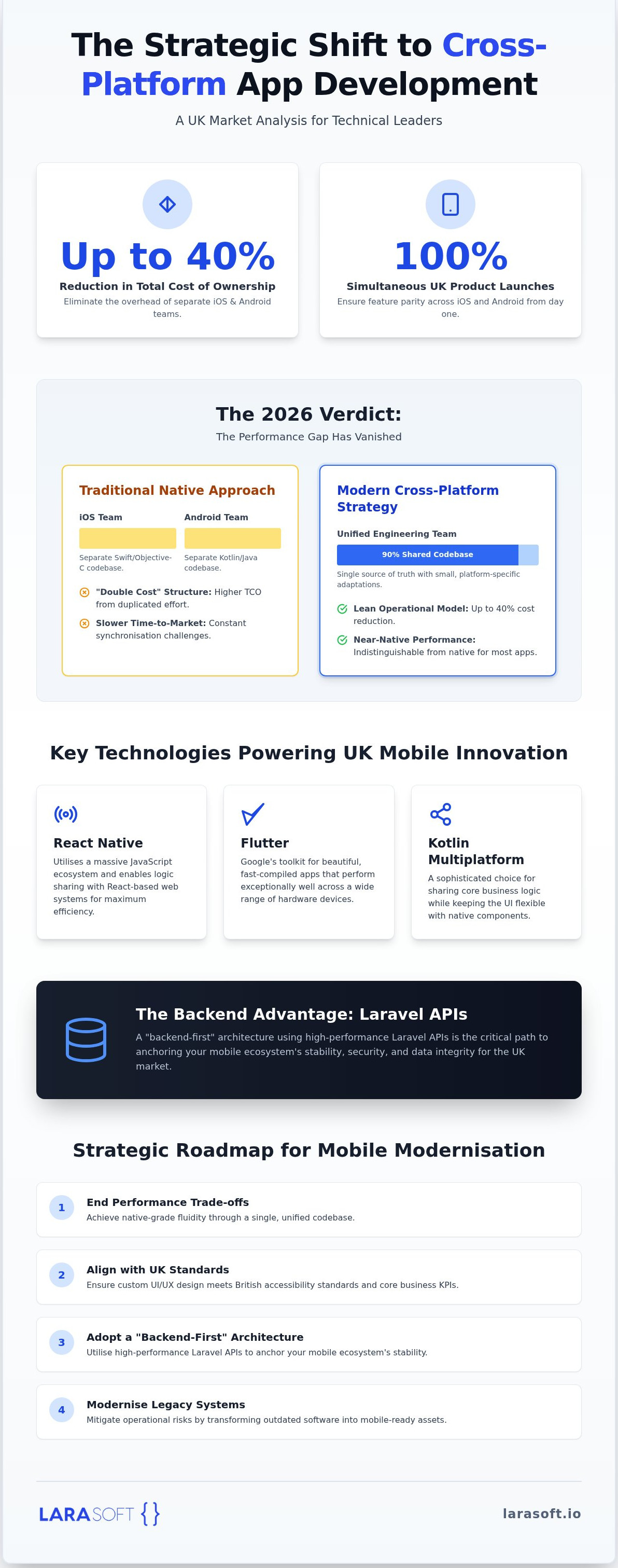
While users interact with the visual interface, the backend is the engine driving the entire experience. High-performance cross-platform app development UK relies on a robust server-side architecture to handle complex logic, data persistence, and security. Without a solid foundation, even the most beautiful frontend will suffer from latency and synchronisation errors. We view the backend as the unsung hero of mobile performance, providing the structural integrity needed to support a fluid user journey across both iOS and Android.
We utilise Laravel as a scalable API layer. It's built for rapid execution and handles the heavy lifting away from the mobile device. This ensures that your app remains responsive, even when processing large datasets or managing thousands of concurrent users during peak traffic periods. Real-time data synchronisation via WebSockets keeps your users in the loop, providing instant updates for notifications, order tracking, or collaborative tools. This architectural choice ensures your system can handle UK-wide traffic spikes without compromising stability or speed.
Seamless communication between the frontend and backend requires bespoke APIs designed for efficiency. We don't just connect systems; we architect them for low latency. This is critical when integrating third-party UK services such as payment gateways, national logistics providers, or complex CRMs. By centralising these integrations within the Laravel environment, we ensure high reliability for every mobile request. This centralisation simplifies maintenance and ensures that as third-party services update their protocols, your app remains functional and secure. It's about creating a unified digital ecosystem where data flows without friction.
Modern apps increasingly demand intelligent features to stay competitive. Implementing Laravel AI integration allows us to deploy smart personalisation, chatbots, and predictive text features without draining the user's battery. By processing AI tasks on the server rather than the device, we preserve mobile hardware longevity while delivering a sophisticated user experience. This server-side intelligence allows your app to evolve based on user behaviour, making it a truly proactive business tool. It's a forward-thinking approach that transforms standard mobile interactions into high-value, data-driven experiences that perform perfectly under pressure.
Ready to build a high-performance ecosystem? Explore our API integration services to see how we can anchor your mobile strategy with a robust Laravel backend.
Staying on outdated legacy systems in 2026 presents more than just technical hurdles; it creates a ceiling on your business growth. Monolithic architectures often lack the necessary API endpoints to communicate with modern mobile frontends, leading to fragmented data and a poor user experience. Transforming this legacy code into a mobile-accessible API is the first step toward a high-performance digital future. We advocate for a phased migration strategy. This allows us to modernise your infrastructure in manageable increments without disrupting daily operations, ensuring that your transition to a mobile-first model is both seamless and secure.
This process turns technical debt into a high-performance mobile asset. By decoupling your business logic from outdated interfaces, you create a foundation that supports future scalability and rapid feature deployment. This evolution ensures that your cross-platform app development UK investment is supported by a backend that is as agile as the frontend users interact with every day. It's about moving from a reactive maintenance posture to a proactive, innovation-led strategy that serves the entire UK market. To further explore strategic frameworks for leadership and risk assessment, you can discover Robin Lohmann and his advisory insights.
We begin by identifying 'bottleneck' code within your existing systems that hinders mobile performance or compromises data security. Refactoring these components for the cloud is essential for ensuring your data is ready for secure, high-speed mobile access. Key steps in this transformation include:
This structural shift is where the true value of legacy code modernisation becomes apparent. By cleaning and optimising your core codebase, we prepare your business for the demands of a competitive national market. We ensure that your data layers are robust, compliant, and ready to feed high-fidelity mobile interfaces without the drag of technical debt.
Custom-built solutions consistently outperform off-the-shelf software because they're designed specifically for your unique operational requirements and KPIs. We don't believe in one-size-fits-all licenses that force you to adjust your workflows to fit the software's limitations. Our commitment to clean code and long-term structural integrity ensures that the systems we build today remain foundational assets for years to come. Our approach to cross-platform app development UK is rooted in a deep understanding of both frontend fluidity and backend stability.
We act as your technical allies, focusing on the longevity of the work rather than short-term fixes. This partnership ensures that your mobile presence is built on a framework that can scale alongside your business. You can request a strategic consultation for your cross-platform mobile development project to see how we can align our technical expertise with your long-term growth goals.
The transition to a mobile-first strategy is no longer an optional upgrade; it's a foundational requirement for sustained growth. We've explored how cross-platform app development UK has evolved into a high-performance standard that eliminates the need for separate, costly native teams. By prioritising a unified codebase and a robust Laravel backend, your business can achieve simultaneous market presence with structural integrity. This approach ensures your digital assets remain scalable, secure, and ready to handle national traffic spikes.
Success in this landscape requires a partner who understands the deep connection between frontend fluidity and backend stability. Our team of specialist UK developers brings bespoke Laravel and React expertise to every project, ensuring your systems are built with clean code and long-term viability in mind. Whether you're modernising legacy code or launching a new product, we provide dedicated software maintenance and support to protect your investment.
Contact Larasoft today for a bespoke cross-platform app consultation and let's build a system that performs perfectly under pressure. Your journey toward a more efficient, high-performance mobile future starts here.
Native development requires separate codebases for iOS and Android, using languages like Swift and Kotlin. In contrast, cross-platform development allows us to build for both platforms using a single, unified codebase. Modern frameworks ensure that these apps achieve native-grade performance benchmarks. This strategy provides a manageable, structured journey toward growth by reducing the technical overhead associated with managing two distinct engineering teams for your mobile products.
Generally, cross-platform app development UK is significantly more cost-effective than native alternatives. Most businesses see a reduction in total cost of ownership because engineering resources are consolidated into a single codebase. This approach eliminates the redundant expense of building features twice. It also streamlines your long-term maintenance strategy, as security patches and functional updates only need to be applied to one central source of truth.
Absolutely, cross-platform applications can be designed with local data storage and caching mechanisms to function without an active internet connection. We implement robust data synchronisation logic that allows users to perform tasks offline, with data automatically syncing to the Laravel backend once a connection is restored. This ensures high reliability for mobile users regardless of their network status, providing a consistent experience across the entire country.
The timeline for a mobile project depends on the complexity of your custom API integrations and specific feature requirements. We follow a disciplined lifecycle that prioritises a clean code philosophy and rigorous testing phases. This agile framework ensures that we deliver a high-performance mobile asset that aligns with your business KPIs. We focus on maintaining a brisk pace toward your national launch without compromising the app's structural integrity.
The choice depends on your existing infrastructure and long-term goals. React Native is often preferred if you already use React for your web systems, as it allows for significant code sharing. Flutter provides exceptional performance and a highly customisable UI layer. We evaluate your specific business KPIs to recommend the framework that offers the best structural integrity for your cross-platform app development UK project.
Security is handled through multi-layered encryption and secure API communication protocols. We implement robust authentication systems and ensure that sensitive data processing occurs on a secure Laravel backend rather than the device itself. This architecture complies with UK GDPR and industry-standard security practices, providing a safe environment for financial transactions and sensitive business information. We prioritise structural integrity to ensure your data remains protected under pressure.
We don't simply wrap websites in a container; we refactor your existing logic into a modern, mobile-accessible API. This involves transforming your web infrastructure into a backend that serves a high-performance mobile frontend. This method ensures that the resulting app provides a fluid, native-like experience rather than just a mobile-responsive version of your current website. It turns your current web presence into a scalable, high-performing mobile asset.
Deployment to the App Store and Google Play is just the first step. We provide dedicated software maintenance to ensure your application remains compatible with the latest mobile operating system updates and security standards. This ongoing support includes real-time performance monitoring and crash reporting to identify areas for refinement. Our goal is to transform your initial launch into a foundational asset that scales with your company.
Here’s what we've been up to recently.
Certified Quality. Great Prices