25 Essential Questions to Ask a Software Development Agency Before You Hire

What if the most expensive part of your software isn't the initial $150,000 build, but the technical debt hidden beneath the surface? With 41% of all code in 2025 being AI-generated, the market is flooded with rapid solutions that often lack the structural integrity required for long-term growth. Code is only as good as the architecture supporting it. To avoid a project that stalls after its 13-month average delivery timeline, you must identify the right questions to ask a software development agency before signing any agreement. You aren't just looking for a vendor to write lines of code; you're seeking a technical ally who understands that annual maintenance typically consumes 15% to 25% of your initial development budget.
As we move through 2026, AI integration has become a baseline requirement for modernizing operations. While reports from 2025 indicated that 41% of all code was AI-generated, the real value lies in how that AI is governed. Specialized agencies like LuxNeva focus on these AI-driven digital solutions, ensuring automation is paired with architectural integrity. Ask your agency how they utilize Laravel AI integration to automate repetitive tasks or enhance user experiences. Savings in initial coding time, which can reach 40% with AI tools, should be reinvested into rigorous testing and data engineering to ensure compliance with the EU AI Act transparency obligations arriving in August 2026.
We recognize the anxiety surrounding vague pricing models and the strict data handling requirements of the 2026 CCPA updates. You deserve a predictable development lifecycle that results in a bespoke, high-performing asset. This guide provides a comprehensive checklist to vet technical expertise, ensure architectural scalability, and secure a transparent partnership. We'll walk through 25 essential questions designed to distinguish specialized craftsmen from generic shops, ensuring your vision is translated into clean, scalable code that serves as a foundational asset for your future.
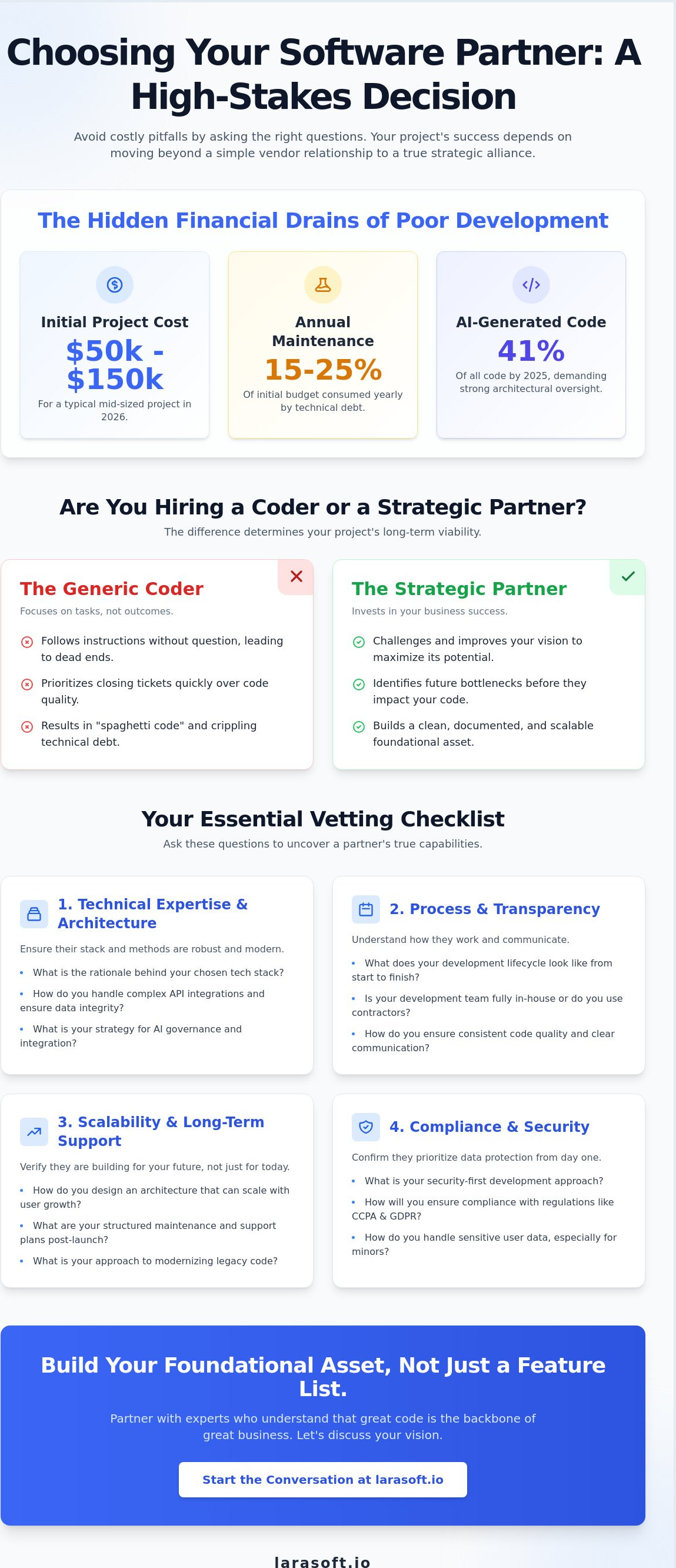
Software development is rarely a straight line from concept to launch. It's a complex architectural journey where a single misstep in the foundation can lead to a total system failure. The financial stakes are high. In 2026, a mid-sized project typically costs between $50,000 and $150,000. If you fail to vet your partner properly, you aren't just losing that initial investment. You're inheriting technical debt that can swallow 25% of your original budget in annual maintenance costs alone. This financial drain often stems from a lack of transparency during the discovery phase. The right questions to ask a software development agency act as a filter, separating high-volume code shops from dedicated technical allies who value long-term ROI.
True craftsmanship in code isn't about writing lines quickly. It's about building a scalable, resilient system that handles pressure without breaking. Many businesses enter these agreements with a limited understanding of outsourcing dynamics, treating software as a one-off purchase rather than a foundational business asset. When you shift from a transactional mindset to a strategic alliance, you stop buying "features" and start investing in a robust technical architecture. A specialized partner doesn't just deliver what you asked for; they deliver what your business needs to grow.
Generic coders follow instructions to the letter, even if those instructions lead to a dead end. They're focused on closing tickets, not on your business success. A true partner challenges your vision to improve it. They look at your roadmap and identify potential bottlenecks before they manifest in the code. You can spot this "Your vision, our code" philosophy early in the pitch. If an agency spends more time discussing your revenue goals and user retention than their own marketing hype, you've found a problem-solver. They prioritize business ROI over mere feature delivery, ensuring every pound spent contributes to a measurable outcome.
For UK businesses operating in a strict regulatory environment, "it just works" is a dangerous standard. As of January 1, 2026, updated CCPA regulations and the impending EU AI Act transparency obligations require a security-first development approach. Your architecture must be designed for compliance from day one. This includes handling sensitive personal information for users under 16 with the highest level of scrutiny. Transitioning from the "what" to the "how" of software development is essential. You need to know that your code is clean, documented, and ready for the 22.3% growth expected in the low-code and AI-integrated markets. High standards today prevent a costly rebuild tomorrow.
Technical excellence isn't about knowing every programming language. It's about mastering the specific frameworks that drive business scalability. Generalist shops often spread themselves too thin, resulting in code that "works" but lacks the optimization required for high-traffic environments. Crucial questions to ask a software development agency must focus on why they chose their specific stack. A team that specializes in Laravel or React brings a level of precision that generalists cannot match. This expertise ensures that your system architecture isn't just a collection of features; it's a cohesive, high-performance engine designed for longevity.
System interoperability is another critical pillar. Your software doesn't exist in a vacuum. It must communicate seamlessly with third-party tools, payment gateways, and internal legacy systems. Ask how the agency handles complex API integrations and what their protocol is for ensuring data integrity during these handshakes. Strategic choosing a software development partner involves looking for those who prioritize clean documentation and standardized protocols. This prevents your business from becoming trapped in a web of "spaghetti code" that is impossible to update or audit.
As we move through 2026, AI integration has become a baseline requirement for modernizing operations. While reports from 2025 indicated that 41% of all code was AI-generated, the real value lies in how that AI is governed. Ask your agency how they utilize Laravel AI integration to automate repetitive tasks or enhance user experiences. Savings in initial coding time, which can reach 40% with AI tools, should be reinvested into rigorous testing and data engineering to ensure compliance with the EU AI Act transparency obligations arriving in August 2026.
Choosing a laravel development agency offers distinct advantages over hiring a jack-of-all-trades. Specialized teams understand the nuances of framework-specific security patches and best practices that reduce long-term bugs. They don't waste time reinventing the wheel. Instead, they use deep knowledge of the ecosystem to build bespoke features faster and more securely. This focus results in a cleaner codebase that is easier for your in-house team to manage during a future project handover.
Performance at the frontend is where your users either convert or leave. Vetting expertise in vue.js frontend development or React is essential for delivering seamless web and mobile experiences. Ask about their approach to state management and component reusability. A high-performance frontend should load instantly and feel intuitive. If you're looking for a team that prioritizes these technical details, you can discuss your architectural needs with our specialists today.
Transparency in software development is often treated as a secondary concern, yet it's the primary predictor of project success. When you evaluate questions to ask a software development agency, you must look past the sales pitch and into the engine room. One of the most critical points of failure is the "broker" model, where an agency sells your project and then quietly outsources the execution to third-party contractors. This creates a fragmented development lifecycle and dilutes accountability. You need to know exactly who is writing your code. In-house experts ensure that the technical debt we discussed earlier remains minimal because the team is directly invested in the long-term health of the architecture.
Predictability stems from a structured communication rhythm. In a typical 13-month development cycle, a lack of visibility for even a few weeks can result in significant scope creep. We recommend an Agile or Scrum methodology for most bespoke projects. This approach allows for bi-weekly sprints where you see tangible progress in a staging environment. It also provides a framework for managing changes without blowing the budget. With mid-sized projects averaging between $50,000 and $150,000, having a dedicated point of contact who understands both the business ROI and the technical stack is non-negotiable for maintaining control over the project's trajectory.
You should never be locked out of your own product. A professional agency will provide you with direct access to the code repository, such as GitHub or GitLab, from day one. This level of openness prevents "hidden" complexity from mounting unnoticed. Regular demos and access to a staging environment allow you to test features as they're built, ensuring the final output aligns with your expectations. This is how we live the "Your vision, our code" philosophy, turning a complex build into a manageable, structured journey toward growth. It's about creating an atmosphere of trust through constant, verifiable evidence of progress.
The financial structure of your partnership should be as clean as the code itself. Whether you choose a fixed-price model for a defined MVP or a Time and Materials (T&M) approach for evolving products, the terms must be explicit. Confirm that you'll have 100% intellectual property (IP) ownership upon final payment. Avoid "licensing" traps where the agency retains rights to foundational components, as this can complicate future project handovers or sales of the business. Clear IP terms and transparent estimation of bespoke mobile app development costs are essential for a predictable, long-term technical alliance.
A digital product is never truly finished; it simply enters a new phase of its lifecycle. While the initial build often captures all the attention, the real business value is found in the software's ability to evolve. When drafting questions to ask a software development agency, you must look beyond the launch date. You need a partner who views your code as a foundational asset, not a one-off project. This means planning for a future where your user base might grow by 10x or where your system needs to integrate with emerging AI technologies. Planning for this growth from day one prevents the architectural bottlenecks that kill momentum.
Managing existing systems is another critical hurdle. Many businesses come to us with "black box" software left behind by previous vendors. In these scenarios, you must understand the agency’s approach to legacy code modernisation. Ask whether they recommend a complete rebuild or strategic refactoring. Refactoring can often preserve your existing ROI while cleaning up technical debt. If the underlying architecture is fundamentally flawed, a modern cloud-native rebuild might be the only way to ensure your 15% to 25% annual maintenance budget isn't wasted on patching a sinking ship.
Post-launch support shouldn't be an afterthought. It should be a structured service-level agreement (SLA) that includes regular security audits and framework updates. Ask the agency how they handle emergency patches and what their response time is for critical bugs. A specialized team will already have a roadmap for keeping your bespoke stack updated with the latest security patches. This proactive maintenance is what separates high-quality craftsmen from shops that move on to the next client the moment the final invoice is paid. If you want to ensure your system remains resilient, book a technical audit with our team to evaluate your current stack.
Technical SEO and WCAG accessibility compliance are not "marketing extras." They are core architectural requirements for any modern UK business. An SEO-ready build, where Core Web Vitals are optimized during the development phase, is significantly more cost-effective than trying to fix performance bottlenecks after the site is live. Ensure the agency integrates schema markup, clean URL structures, and fast-loading frontend components from day one. Accessibility is equally vital. With stricter digital inclusion standards in 2026, building for WCAG compliance ensures your product is usable by everyone and protects your business from legal risks. These are the questions to ask a software development agency to ensure you're hiring a partner who understands the full scope of modern web standards.
Choosing a technical partner is the final step in a structured journey toward growth. By this stage, you've likely narrowed your list to a few contenders. Now, you must look for the subtle indicators that separate a high-volume "code factory" from a dedicated team of craftsmen. The right questions to ask a software development agency at this juncture should focus on their alignment with your business goals. A green flag is an agency that pushes back on your initial feature list to suggest a more efficient architectural path. They prioritize your long-term ROI over simply ticking boxes. This proactive problem-solving is the hallmark of a technical ally who lives by the "Your vision, our code" philosophy.
Conversely, be wary of "too-good-to-be-true" proposals. In 2026, the average cost for a mid-sized project sits between $50,000 and $150,000 with a 13-month delivery timeline. If an agency promises a complex, bespoke system for significantly less than these industry benchmarks, they're likely cutting corners on security or scalability. Low initial costs often mask a lack of transparency in how maintenance is billed. Remember that annual support typically requires 15% to 25% of the original build budget. A red flag is any lack of clarity regarding who actually owns the code or how post-launch updates are structured. You need a partner who is transparent about these practical realities from the first meeting.
Technical expertise is essential, but cultural alignment ensures the project remains on track during high-pressure sprints. Assess whether the agency's values align with your internal team's way of working. Do they share your passion for clean, documented code and modern standards? The "initial chemistry" during the discovery phase is often a leading indicator of success. A team that specializes in Laravel and Vue.js will speak a specific technical language that signals their deep expertise. This specialization reduces friction and ensures that your software is built on a stable, modern foundation rather than a generic, outdated stack.
To move forward, structure your Request for Proposal (RFP) to demand specific architectural details rather than vague promises. This forces agencies to demonstrate their technical foresight. Don't rely solely on the polished case studies on their website. Check references by speaking directly to past clients about the agency's responsiveness and their handling of "hidden" complexity during the build. If you're ready to build, discuss your vision with our Laravel specialists to see how we turn complex challenges into seamless digital assets. A disciplined, organized kickoff process is the final green flag you need to start your development journey with confidence.
Selecting a development partner is a strategic choice that dictates your business trajectory. You've seen how technical vetting goes beyond surface-level features to address the core of system architecture. By prioritizing transparency and long-term support, you protect your investment from the drain of unmanaged technical debt. Using these targeted questions to ask a software development agency helps you identify a team that treats your code as a foundational asset rather than a disposable product.
We take pride in the efficiency of our code and the longevity of our builds. As UK-based Laravel specialists, our expertise in legacy code modernisation and high-performance Vue.js and React frontends ensures your product remains at the cutting edge. It's time to move past generic solutions and invest in a partnership built on quiet competence and technical authority. Partner with Larasoft for your next bespoke project to start your journey. We look forward to building a system that works perfectly under pressure and grows alongside your vision.
The most critical inquiry focuses on who owns the intellectual property and how the architecture handles a 10x increase in user volume. You must ensure 100% IP ownership upon final payment to avoid restrictive licensing traps. This is one of the essential questions to ask a software development agency to secure your product as a foundational business asset.
Verify their expertise by asking for specific examples of complex API integrations and their approach to framework security patches. A truly specialized team won't just use the framework; they'll demonstrate a deep understanding of full-stack development and architectural best practices. Look for agencies that prioritize clean code and have a proven track record of building bespoke, high-performance systems.
The choice depends on your need for communication proximity and compliance with 2026 data regulations. While Eastern European developers offer lower rates averaging $25 to $45 per hour, Western European agencies typically charge between $90 and $150 per hour. Local UK partners often provide better alignment with GDPR and the specific technical standards required for high-growth British businesses.
Agencies generally use either a fixed-price model for well-defined MVPs or a Time and Materials approach for evolving products. In 2026, a mid-sized bespoke project typically costs between $50,000 and $150,000. These figures reflect the specialized craftsmanship and technical authority required to build a scalable, secure digital asset that delivers a measurable business ROI.
A project handover is straightforward if your agency follows clean coding standards and provides comprehensive documentation. You should have direct access to your code repository, such as GitHub or GitLab, from the start of the build. This transparency ensures that a new technical ally can audit and manage your system without requiring a costly total rebuild.
Specialized agencies can modernise existing systems through strategic refactoring or a complete architectural rebuild. This is a common part of the questions to ask a software development agency when you're dealing with technical debt. Modernising your stack helps reduce the 15% to 25% of the initial budget that is typically lost to annual maintenance on outdated systems.
A mid-sized bespoke project has an average delivery timeline of 13 months as of May 2026. This schedule allows for a healthy development cycle that balances fast-paced innovation with meticulous execution. Timelines can vary based on the complexity of AI integrations or the need to comply with new transparency obligations under the EU AI Act.
Here’s what we've been up to recently.
Certified Quality. Great Prices