The Value of Human-Built Software in the AI Era

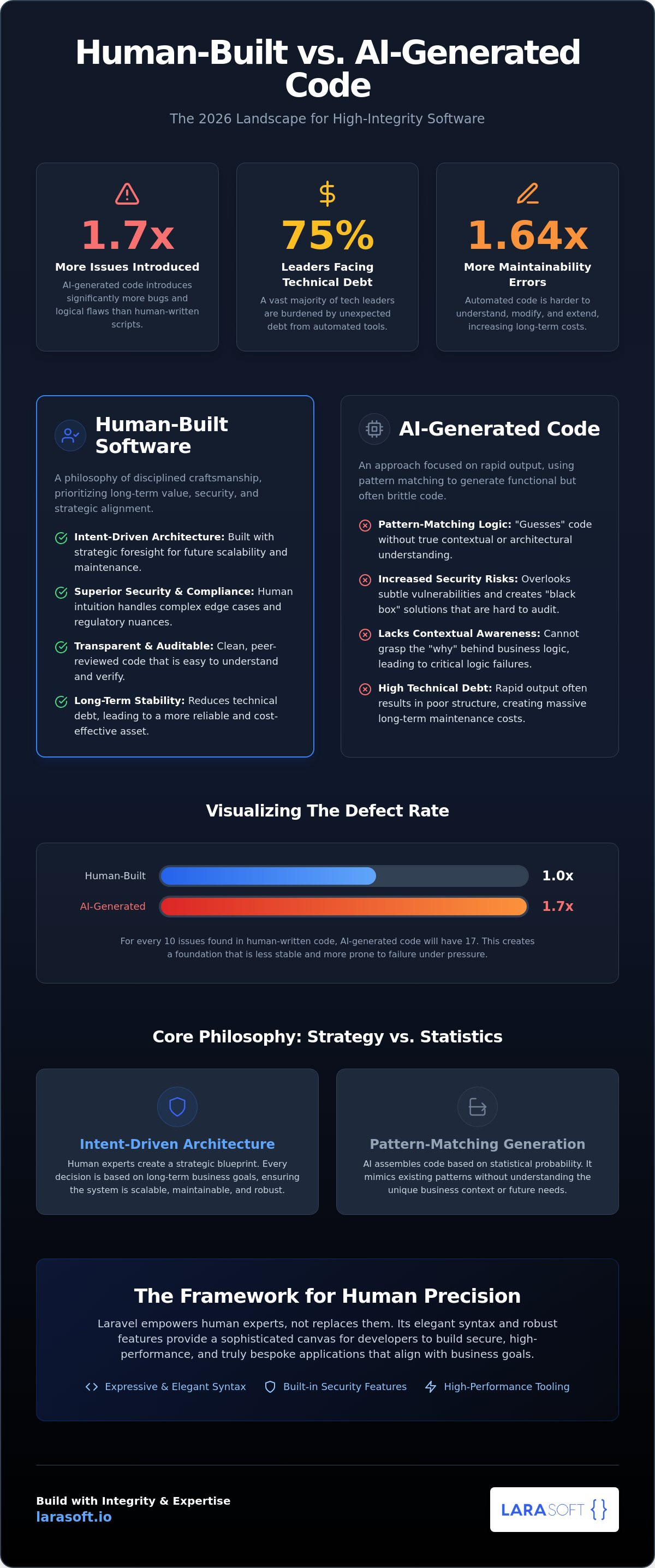
By early 2026, research revealed that AI-generated code introduces 1.7 times more issues than human-written scripts, leaving 75% of technology leaders drowning in unexpected technical debt. It's a sobering reality for any decision-maker who once viewed automation as a simple shortcut to quality. You likely value the speed of modern tools, yet you also recognize that a software foundation is only as strong as the architectural foresight behind it. Rapid output means very little if the resulting system lacks the structural integrity to scale or the security to protect your assets.
Choosing a human built framework isn't about resisting progress; it's about prioritizing the meticulous engineering and security that automated tools often overlook. In this article, you'll discover why bespoke Laravel development and human-centric design remain the gold standard for building systems that perform perfectly under pressure. We will break down how to avoid the "vibe coding" paradox, reduce your technical debt, and ensure your high-performance frontend aligns precisely with your unique business goals. This is your guide to creating a stable, scalable asset that serves as a foundation for growth rather than a liability.
In 2026, the term human built has transformed from a simple description into a prestigious engineering standard. It represents a software engineering philosophy where every line of code is anchored by human intent and strategic foresight. While automated tools can generate functional snippets, they often lack the contextual awareness required for high-stakes environments. A human built approach treats the software development process as a disciplined craft, ensuring that the final product isn't just a collection of scripts, but a cohesive asset designed to solve specific business problems.
UK businesses are increasingly moving away from fully automated "black box" solutions for their mission-critical applications. The reason is simple: reliability. When a system handles sensitive financial data or complex logistics, "good enough" code isn't an option. Senior engineers provide the necessary oversight to maintain structural integrity and security, acting as the ultimate safeguard against the logical gaps that AI often leaves behind. This commitment to manual excellence ensures that the software remains transparent, auditable, and perfectly aligned with the organization's long-term goals.
The year 2026 has marked a significant resurgence in the demand for hand-crafted code. As AI-generated output has become ubiquitous, many organizations have discovered that speed comes at a hidden cost. Research indicates that AI-generated code introduces 1.7 times more issues than human-written alternatives, often leading to 1.64 times more maintainability errors. For UK firms, these errors are particularly dangerous when navigating strict local regulations like GDPR or industry-specific compliance standards. Human intuition is indispensable for solving these complex "edge cases." A developer understands why a certain regulation exists; an algorithm only understands the pattern of the text. This distinction is what prevents catastrophic logic failures in production.
The fundamental difference between automated code and a human built system lies in the architecture. Automated tools rely on pattern matching, pulling from vast datasets to guess the next logical step. Human architects, however, focus on intent-driven design. They build with the future in mind, ensuring the system can scale without collapsing under its own weight. This foresight is critical during legacy code modernisation, where understanding the "why" behind old code is just as important as writing the new version. By prioritizing strategic intent, engineers create foundations that are easier to maintain, reducing the 75% risk of technical debt that currently plagues technology leaders who rely too heavily on automated refactoring tools.
Laravel has solidified its position as the premier framework for bespoke applications because it prioritizes developer happiness and expressive syntax. This isn't just a technical preference; it's a strategic choice. The framework acts as a sophisticated canvas for human creativity, allowing engineers to focus on high-level problem solving rather than repetitive boilerplate. While the AI revolution in software development has introduced new ways to generate code snippets, it hasn't replaced the need for the cohesive, intentional architecture that a human built system provides. A senior developer doesn't just write code; they craft a narrative of logic that ensures every feature serves a specific business objective.
The true power of Laravel lies in its ability to get out of the way. By providing elegant solutions for common tasks like authentication, routing, and caching, it frees up human experts to tackle the unique complexities of your business logic. Partnering with a specialized Laravel development agency ensures that these features aren't just implemented, but are optimized for long-term growth. Human oversight is particularly vital for security. While automated tools might miss subtle vulnerabilities in third-party integrations, an experienced engineer conducts rigorous peer reviews to maintain the structural integrity of the entire application.
A high-performance backend requires an equally sophisticated frontend. Senior developers utilize Vue.js and React to build interfaces that aren't just fast, but intuitive. This is where empathy-driven design becomes a competitive advantage. Automated UI generators often produce rigid, generic components that fail to account for the nuances of user behavior. In contrast, Vue.js frontend development led by human experts focuses on creating fluid transitions and responsive layouts that align with your brand's specific identity. Whether it's a web platform or a cross-platform mobile app, human UX expertise ensures the technology remains invisible to the user, providing a seamless experience that AI cannot yet replicate.
Readability is another cornerstone of the human built philosophy. The "clean code" movement isn't about aesthetics; it's about making code understandable for the next person who touches it. AI often generates "clever" code that is difficult to debug or extend. Human engineers prioritize clarity, ensuring that the software remains a manageable asset for years to come. This focus on transparency makes every update a structured journey rather than a technical gamble. If you are looking for a partner who values this level of precision, exploring a collaboration with technical artisans can help turn your vision into a high-performance reality.
The perceived speed of automated development often masks a growing crisis in software quality. While AI can generate code in seconds, research from early 2026 indicates that this output introduces 1.7 times more issues than human-written alternatives. These aren't just minor bugs; they include 1.75 times more logic and correctness errors that can compromise the core functionality of a business application. A human built system avoids these pitfalls by prioritizing architectural integrity over raw output. By the time an engineer fixes the 1.64 times more maintainability errors associated with AI code, the initial time savings have usually vanished, replaced by higher long-term costs.
Security remains the most significant differentiator. A 2025 study found that 45% of AI-generated code introduced at least one vulnerability from the OWASP Top 10. AI lacks the ability to "hallucinate" security context, often suggesting deprecated libraries or insecure data handling patterns. Human peer review acts as a critical filter, identifying subtle risks that automated scanners miss. In a bespoke environment, every line is scrutinized for how it interacts with the broader system, ensuring that security is baked into the foundation rather than bolted on as an afterthought.
Automated tools frequently struggle with the nuances of PHP and JavaScript, often producing code that is susceptible to injection attacks or broken authentication. Secure data handling requires human-led API integration to ensure that sensitive information is encrypted and transmitted according to specific regulatory standards. Architectural debt is the cumulative burden of unoptimized, pattern-matched code that functions in the short term but lacks the structural integrity to support future integrations or security patches. Without human intervention, this debt can become insurmountable, forcing expensive and disruptive rebuilds within just a few years of deployment.
A human built application is designed to evolve alongside shifting UK market conditions. While AI relies on hard-coded patterns derived from past data, human developers utilize flexible architecture that anticipates change. Strategic software maintenance is not just about fixing bugs; it is about extending the lifecycle of the asset. Human engineers plan for 5 to 10 years of growth, ensuring the database schema and internal logic can handle increased loads and new feature sets. This forward-thinking approach is why 75% of technology leaders now report moderate to severe technical debt in projects that prioritized AI speed over human engineering. For mission-critical systems, the verdict is clear: use automation for documentation and testing, but insist on human expertise for the core build.
Legacy code modernisation represents the ultimate challenge for any engineering team. It requires a deep understanding of historical logic, outdated dependencies, and business-critical workflows that have often been undocumented for years. Relying on automated refactoring tools for a "blind migration" is a recipe for disaster. These tools often strip away essential context, leading to broken features and performance bottlenecks that didn't exist in the original version. A human built modernisation strategy treats the transition as a surgical procedure rather than a bulk copy-paste operation. Experts analyze the existing architecture to preserve what works while meticulously replacing what doesn't, ensuring the new system remains faithful to your core business rules.
Larasoft approaches these complex UK business systems with a focus on longevity. We don't just upgrade the tech stack; we rebuild the foundation to support the next decade of growth. This process requires a level of intuition and strategic foresight that AI simply cannot replicate. By understanding the "why" behind old code, our engineers can eliminate technical debt without sacrificing the stability your operations depend on. This disciplined approach transforms a risky technical necessity into a manageable, structured journey toward digital maturity.
Successful technical renewal stands on three essential pillars: audit, refactor, and migrate. The process begins with a comprehensive audit where senior engineers map out every integration and dependency. We then refactor the code to meet modern standards, cleaning up inefficient logic while preserving the unique business rules that give you a competitive edge. Finally, the migration to a stable Laravel environment is handled with precision. We prioritize meticulous human-led planning to ensure that downtime is kept to an absolute minimum, protecting your revenue and user trust throughout the transition.
Modernisation in 2026 often involves adding intelligence to established systems. However, integrating AI capabilities shouldn't mean sacrificing architectural control. We utilize a hybrid approach, building human-led APIs that act as secure bridges between your stable core and modern AI tools. This ensures that your system remains predictable and easy to maintain. Furthermore, this human-centric design is the only way to guarantee data privacy and strict UK GDPR compliance in AI-enhanced apps. By keeping a human expert in the loop, you gain the efficiency of automation without the risks of logic drift or sensitive data leaks. If you are ready to transition your aging infrastructure into a high-performance asset, consider a partnership for expert legacy code modernisation.
Choosing a development partner is a decision that defines the trajectory of your digital infrastructure. At Larasoft, we provide the technical authority and architectural precision required to turn complex business goals into high-performance software. Our commitment to bespoke Laravel and mobile solutions ensures that your organization isn't just keeping pace with technology but is building a sustainable competitive advantage. A truly human built system isn't just a product; it's a foundational asset designed to perform perfectly under the pressures of a modern enterprise environment.
Our methodology bridges the gap between high-level business strategy and granular technical implementation. We don't just write code; we architect solutions that align with your specific commercial objectives. This disciplined approach is why we focus on UK-wide national delivery for custom enterprise software. Whether you're modernizing a legacy platform or building a new cross-platform mobile app, our team ensures every transition is fluid and every component is optimized for long-term reliability.
We view our role as a deeply invested technical ally rather than a mere service provider. This partnership extends far beyond the initial launch. We prioritize clean code and structural integrity to ensure your software remains easy to update and scale. Our comprehensive Software Maintenance and SEO Services are designed to protect and grow your digital investment over time. By maintaining a steady focus on the longevity of our work, we help you avoid the technical debt that often follows automated or unoptimized builds. It's a structured journey toward growth, managed by artisans who take immense pride in the efficiency of their craft.
Identifying whether your project requires the human built touch usually comes down to three factors: complexity, security, and scale. If your system handles mission-critical logic or sensitive data, relying on anything less than expert engineering is a risk your business shouldn't take. The first steps in a Larasoft consultation involve a deep dive into your current challenges and future goals. We break down complex processes into logical, manageable steps, providing you with a clear roadmap for success. When you're ready to move past generic solutions, contact our expert team to discuss your bespoke project today.
The shift toward automated code generation has highlighted a fundamental truth: software is only as resilient as the human intent behind it. We've explored how intentional architecture prevents the logical errors and security gaps that often plague AI-generated scripts. By prioritizing structural integrity and clean code, you ensure that your platform remains a scalable asset rather than a liability. A human built system provides the strategic foresight necessary to navigate complex UK regulations and evolving market demands.
Our dedicated UK-based engineering team specializes in high-performance Vue.js and React frontends that align perfectly with your unique business goals. We also bring deep expertise in legacy code modernisation, ensuring a fluid transition from unoptimized systems to stable, modern frameworks. If you're ready to invest in a robust digital foundation, we're here to help. Request a technical consultation for your bespoke Laravel project to begin your journey toward a more reliable future. Building something substantial starts with the right technical ally.
In software development, 'human built' refers to a disciplined engineering philosophy where every architectural decision is guided by human intent and strategic foresight. It contrasts with automated code generation by prioritizing long-term maintainability and contextual awareness. This approach ensures that the system isn't just a collection of patterns but a cohesive asset designed to solve specific business problems while maintaining strict structural integrity.
While AI tools offer low initial costs for code generation, the long-term expense of fixing logic errors and architectural debt often exceeds the investment in a human built system. Research from 2026 shows AI-generated code introduces 1.7 times more issues than human-written alternatives. By investing in bespoke development, you reduce the 75% risk of severe technical debt associated with automated shortcuts, leading to lower total cost of ownership.
We secure Laravel applications through a combination of rigorous human peer reviews and adherence to the OWASP Top 10 security standards. Unlike automated tools that may overlook subtle vulnerabilities in third-party integrations, our senior engineers manually audit every API connection and data handling pattern. This ensures that security is a foundational element of the build rather than a patch applied after deployment, protecting your data and user trust.
Yes, we specialize in legacy code modernisation through a structured process of auditing, refactoring, and migrating existing systems. We identify business-critical logic that must be preserved while replacing outdated dependencies with modern, stable Laravel components. This surgical approach allows you to upgrade your tech stack and eliminate performance bottlenecks without the disruption or cost associated with a total rebuild of your entire infrastructure.
We provide both Native Mobile App Development and Cross-Platform Mobile Development to complement our web solutions. Our team utilizes frameworks like React and Vue.js to create high-performance frontends that offer a seamless experience across all devices. By integrating your mobile and web platforms into a single, cohesive ecosystem, we ensure that your business logic remains consistent while providing a responsive, empathy-driven interface for your users.
A bespoke build offers perfect alignment with your unique business goals and eliminates the recurring licensing fees associated with off-the-shelf software. For UK businesses, custom solutions also provide superior control over data privacy and GDPR compliance. Off-the-shelf products often force you to adapt your workflows to the software's limitations; a custom build adapts to your operations, providing the scalability needed for long-term growth and technical independence.
Timelines vary based on complexity, but a typical human-led project follows a structured journey from audit to deployment. A simple web application might take 8 to 12 weeks, while complex enterprise platforms or legacy modernisations often span several months. We prioritize meticulous planning and transparent communication to ensure that each phase delivers measurable progress, allowing you to manage expectations and resources effectively throughout the development cycle.
We offer dedicated software maintenance plans that go beyond simple bug fixes to include regular security patches and performance optimizations. Our team acts as a long-term technical ally, ensuring your system evolves alongside your business. This ongoing support includes monitoring API integrations and managing technical debt, which extends the lifecycle of your software asset and ensures it continues to perform perfectly under the pressure of real-world use.
Here’s what we've been up to recently.
Certified Quality. Great Prices