Symfony to Laravel: Strategic Migration Guide for CTOs


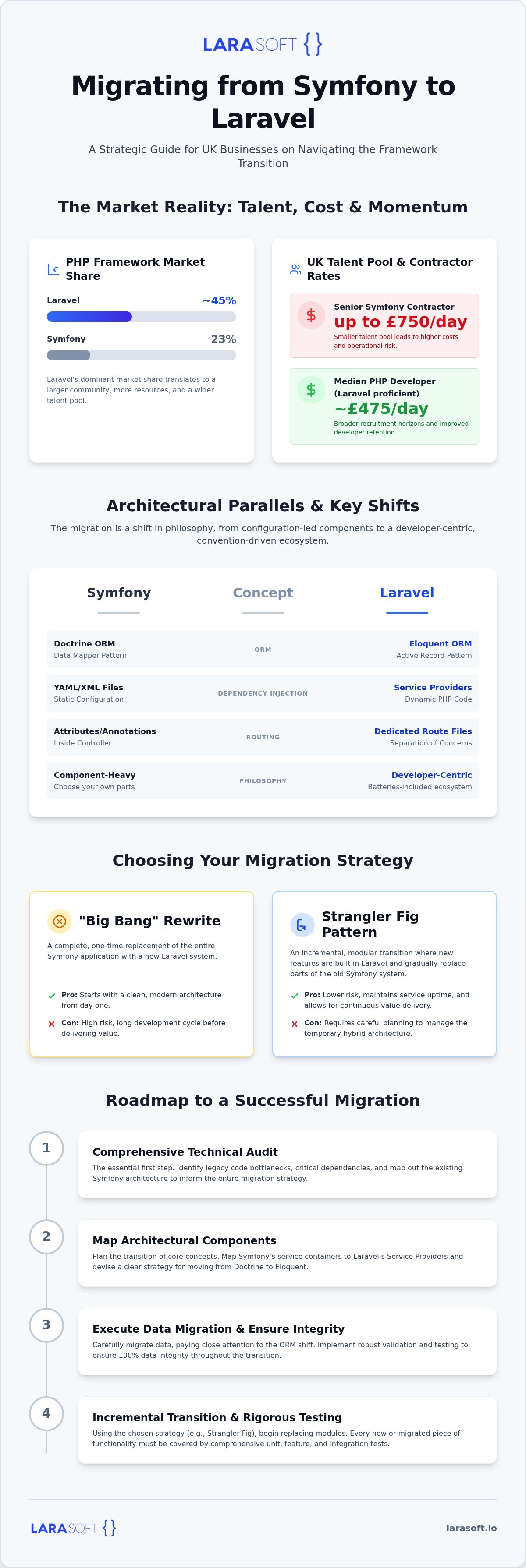
With Laravel currently holding nearly 45% of the PHP framework market share, the gap between it and Symfony has widened into a strategic divide. For UK-based CTOs, the decision to begin migrating from symfony to laravel is rarely about technical preference alone. It's a response to the practical reality of a market where senior Symfony contractors often command daily rates up to £750, while the specialized talent pool remains increasingly thin compared to the growing Laravel ecosystem.
You likely recognize that maintaining legacy Symfony versions is becoming a bottleneck for your engineering velocity and your bottom line. Transitioning to a modern Laravel 13 environment offers a path to faster feature releases and improved structural integrity. This guide provides a comprehensive architectural roadmap and risk-mitigation strategies to ensure your migration is a manageable, structured journey. We'll examine the business benefits, the technical nuances of the shift to PHP 8.3, and how to execute this transition without disrupting your core operations or compromising your existing data.
Migrating from symfony to laravel is a strategic repositioning of your technical assets. It involves more than a simple syntax swap; it's a transition from a component-heavy, configuration-led architecture to a developer-centric ecosystem. While Symfony provides the robust foundation for many enterprise systems, the Total Cost of Ownership (TCO) often climbs as the application ages. This is particularly evident in the UK market, where the scarcity of specialized Symfony engineers drives up maintenance costs and slows down feature delivery.
The "Developer Velocity" factor is the primary catalyst for this shift. The Laravel framework provides a suite of first-party tools that eliminate the need for custom-built boilerplate. When your team spends less time on infrastructure and more on business logic, your time-to-market accelerates. This agility is essential for staying competitive against rivals who can iterate on their products with significantly less friction.
Reducing technical debt requires more than just patching old code. It demands framework consolidation. By moving to Laravel, businesses can leverage an extensive library ecosystem, including Forge for server management and Vapor for serverless deployment. These integrations allow for a more streamlined development lifecycle. A move toward legacy code modernisation ensures your platform remains scalable and secure. This transition isn't just a technical upgrade; it's a commitment to the longevity of your digital assets.
Market dynamics in 2026 show a clear preference for Laravel. With an adoption rate of 64% among PHP framework users, the talent pool is vastly larger than Symfony’s 23%. In the UK, senior Symfony contractors can command daily rates as high as £750, whereas the median daily rate for a PHP developer remains closer to £475. This price gap represents a significant operational risk for businesses reliant on niche expertise. By migrating from symfony to laravel, you broaden your recruitment horizons and improve developer retention. Engineers are more engaged when working with modern tools like Laravel 13 and PHP 8.3, which reduces the churn often associated with maintaining cumbersome legacy systems.
Understanding the shared heritage between these two frameworks is the first step toward a successful transition. Laravel is not a complete departure from Symfony; it actually leverages several core Symfony components, including HttpFoundation, Routing, and Console. This shared DNA means that when you are migrating from symfony to laravel, you aren't moving to a foreign environment. You're shifting to a more expressive abstraction layer that sits on top of familiar foundations. This relationship is often highlighted in any comparison of the most popular PHP frameworks, where Laravel’s developer-first approach is praised for its ability to simplify complex architectural patterns.
The most significant shift occurs in how services are registered and managed. Symfony projects typically rely on YAML or XML files to define the Service Container and Dependency Injection. In contrast, Laravel uses Service Providers written in pure PHP. This move from static configuration files to executable code allows for more dynamic service binding. Similarly, while Symfony often uses Attributes or Annotations for routing directly within controllers, Laravel centralises routing in dedicated files like web.php. This separation of concerns often makes the application’s entry points easier to audit and manage as the system scales.
Transitioning from Doctrine to Eloquent represents a fundamental shift from the Data Mapper pattern to the Active Record pattern. Doctrine keeps your entities "pure" by separating the data object from the persistence logic. Eloquent, however, couples the model directly with the database. For many UK businesses, this change significantly reduces the boilerplate code required for standard CRUD operations. When handling complex relationships or large-scale data sets, your team must be mindful of the "N+1" query problem, which Eloquent addresses through aggressive eager loading. If you're managing a particularly intricate schema, a technical audit of your database layer can help identify potential performance bottlenecks before the migration begins.
The move from Twig to Blade is generally straightforward for most developers. Both engines use similar syntax for loops, conditionals, and inheritance, but Blade offers more seamless integration with modern PHP features. Beyond templating, this transition is an ideal time to evaluate your frontend stack. Many organisations choose to pair their new backend with Vue.js frontend development to create highly reactive user interfaces. Laravel’s built-in support for Vite ensures that asset bundling and hot-module replacement are handled with minimal configuration, providing a modern development experience that Symfony’s older Webpack Encore setups often struggle to match.
Selecting the right methodology is as critical as the code itself. A strategic modernization roadmap for CIOs helps frame this transition as a value-driven exercise rather than a sunk cost. For smaller, less complex applications, a "Big Bang" rewrite might be viable. This involves building the new Laravel system in parallel and switching traffic once complete. However, for enterprise-scale platforms, the risks of downtime and feature regression often make this approach untenable. The focus must shift toward maintaining service continuity while modernising the underlying infrastructure.
For large-scale Symfony applications, the Strangler Fig pattern is the industry standard for risk reduction. It involves building the new Laravel application around the edges of the legacy system. You route specific requests to the new Laravel services while the rest of the application continues to run on Symfony. This phased approach allows you to demonstrate value early by migrating "low-hanging fruit" modules first, such as a new reporting dashboard or user profile section.
By using an API gateway or a reverse proxy like Nginx, you can transparently direct traffic between the two frameworks. This ensures that the user experience remains uninterrupted while you are migrating from symfony to laravel at a pace that suits your budget. Maintaining feature parity during this multi-month process requires a robust suite of integration tests. These tests confirm that both systems produce identical outputs for given inputs, preventing silent failures during the transition.
A full rewrite is appropriate when the existing Symfony codebase has reached a state of terminal technical debt. If the version is so outdated that security patches are no longer available or the original architecture is fundamentally flawed, patching it becomes more expensive than starting fresh. Green-field development allows you to implement modern standards like PHP 8.3 and Laravel 13 from day one, ensuring the longevity of the new platform.
This path requires a clear budget and a strict timeline to avoid scope creep. It's often the faster route to technical excellence if the legacy system is small enough to be replicated within a few months. If you decide this is the best route, choosing a Laravel development agency with specific experience in legacy modernisation is vital to avoid repeating past architectural mistakes and to ensure a clean, scalable build.
Protecting the integrity of your data and the continuity of your user experience is the highest priority during any framework shift. When migrating from symfony to laravel, the primary risk isn't just code compatibility, but the subtle differences in how data is handled, stored, and retrieved. A structured approach to risk management ensures that the transition remains a controlled, predictable process rather than a leap into the unknown. This phase of the project is where the structural integrity of your application is either preserved or compromised.
Automated testing is your primary defense against regression. By using PHPUnit to verify feature parity, your team can confirm that the new Laravel endpoints return the exact same payloads as the legacy Symfony counterparts. This "black-box" testing approach allows you to swap out the underlying framework while maintaining the external contract of your services. It provides the empirical evidence needed to move forward with confidence, ensuring that business logic remains consistent across both environments.
Authentication and SEO preservation require equally meticulous handling. Laravel and Symfony use different session drivers and hashing algorithms. Bridging these systems ensures that users don't face forced logouts during the transition, which is critical for maintaining customer trust. Simultaneously, preserving your SEO footprint involves mapping every legacy Symfony route to its new Laravel equivalent. Implementing precise 301 redirects prevents the loss of organic search rankings and maintains the authority of your domain in the UK market.
Moving data from a Doctrine-managed schema to Eloquent requires more than a simple export. Custom ETL (Extract, Transform, Load) scripts are often necessary to handle complex relationships and specific data types. We validate every record post-migration using checksums to ensure zero data loss. Handling legacy password hashes is equally critical; your new Laravel build must support the legacy Symfony hashing methods to allow existing users to log in without a password reset. This attention to detail prevents the friction that often plagues less structured migrations.
A reliable deployment pipeline is essential for mitigating launch-day risks. We recommend setting up parallel staging and User Acceptance Testing (UAT) environments that mirror your production setup. This allows for rigorous testing in a sandbox environment before any code goes live. Your CI/CD pipeline should include automated rollback procedures, ensuring that if a critical issue is detected, you can return to the stable Symfony state within seconds. Automating these steps is the only way to achieve the zero-downtime releases that modern businesses demand. If you're concerned about the risks of a framework shift, our team can help you navigate the process with a comprehensive technical audit of your current environment.
Executing a successful transition between two high-level frameworks requires more than just coding proficiency. It demands a partnership grounded in transparency and technical precision. At Larasoft, we view ourselves as your technical ally, guiding your organisation through the intricacies of migrating from symfony to laravel while ensuring your business objectives remain the primary focus. Our approach is built on the foundation of structural integrity, ensuring that the final product is not just functional, but built to scale for years to come.
Every project begins with a rigorous technical audit. We don't believe in guesswork. By performing a deep-dive analysis of your existing Symfony architecture, we identify hidden dependencies and potential bottlenecks before they can disrupt the migration timeline. This diagnostic phase allows us to provide a realistic roadmap, preventing the scope creep that often plagues complex legacy code modernisation projects. We prioritise clean code standards, ensuring that your new Laravel 13 environment is free from the technical debt that hindered your previous system.
The Larasoft modernisation journey is divided into three distinct phases designed to maintain momentum and clarity. During the discovery phase, our UK-based team audits your Symfony codebase to map out service containers and database schemas. We then move into execution, utilising agile delivery methods and transparent project management. You'll receive regular updates and have access to staging environments to monitor progress in real-time. Finally, the handover phase ensures your internal team is fully equipped to manage the new system through comprehensive documentation and tailored training sessions.
Choosing the right partner is critical when migrating from symfony to laravel. Our expertise lies in crafting bespoke Laravel solutions that address the specific challenges of the UK market, from talent acquisition hurdles to high maintenance costs. We take immense pride in the efficiency of our work, treating every line of code as a foundational asset for your company's future growth. Beyond the initial migration, we offer dedicated software maintenance and long-term support to ensure your platform remains at the cutting edge of digital development. If you're ready to discuss your Symfony to Laravel migration strategy, contact us today to speak with a senior technical consultant.
Transitioning your application to a modern framework is a decisive step toward long-term operational efficiency. By migrating from symfony to laravel, you effectively resolve the challenges of high maintenance costs and talent scarcity while gaining access to a superior ecosystem for rapid feature delivery. Whether your journey involves the modular Strangler Fig pattern or a comprehensive rewrite, the priority remains the same: preserving the structural integrity of your business logic and data.
As UK-based Laravel specialists with deep expertise in legacy code modernisation, we understand the complexities of these transitions. We build bespoke high-performance software solutions that don't just solve today's problems but act as foundational assets for your future growth. Our team is ready to act as your technical ally, ensuring your migration is a manageable and structured success. Discuss your Symfony to Laravel migration with our experts today. Your platform deserves a clean, scalable architecture that performs perfectly under pressure.
Laravel is not objectively better but offers distinct advantages for businesses prioritising speed to market. While Symfony is renowned for its granular architectural control, Laravel’s approach significantly reduces development overhead. For UK businesses, the primary enterprise benefit is the vast talent pool. Accessing senior Laravel engineers is often faster and more cost-effective than sourcing specialised Symfony contractors, making it a more sustainable choice for long-term platform growth and maintenance.
A typical enterprise-scale migration takes between three and nine months to complete successfully. The exact duration depends on the volume of legacy code, the complexity of your business logic, and whether you choose a full rewrite or an incremental transition. Smaller applications can often be moved in weeks. However, larger systems using the Strangler Fig pattern require a phased approach to ensure that each module is fully tested before production deployment.
Yes, you can continue using specific Symfony components within a Laravel environment, as Laravel itself is built upon several of them. This architectural overlap simplifies the process of migrating from symfony to laravel. It allows your team to maintain familiar logic for tasks like console commands or request handling while slowly transitioning toward Laravel’s native abstractions. This interoperability is a key factor in reducing the technical risk associated with large-scale framework shifts.
The primary difference lies in the architectural pattern; Doctrine uses the Data Mapper pattern, while Eloquent follows Active Record. Doctrine separates your database logic from your business entities, which is ideal for highly complex domain models. Eloquent couples the model directly to the database table, providing a more expressive and rapid development experience. Most teams find that Eloquent's syntax reduces boilerplate code, though it requires careful management of query performance in high-load scenarios.
Users should experience zero downtime if the migration follows a structured, phased methodology. By implementing a reverse proxy or API gateway, traffic can be directed to the new Laravel services while the legacy Symfony system continues to handle other requests. This incremental approach ensures that the platform remains fully operational. Rigorous automated testing and parallel staging environments allow for seamless transitions that are completely transparent to your end users and customers.
Yes, decoupling the frontend is a viable strategy for modernisation. You can implement a modern Vue.js or React interface while retaining your Symfony backend as a headless API. This approach allows you to improve the user experience and interface speed immediately without committing to a full backend migration. It's often the first step in a broader modernisation roadmap, providing immediate value to users while the backend logic is eventually transitioned to Laravel.
Migration costs vary significantly based on the technical debt and architectural complexity of your existing system. Rather than a fixed price, we assess the investment based on the engineering hours required for code refactoring, data migration, and quality assurance. UK businesses should also consider the long-term savings gained from lower maintenance costs and faster feature delivery. A thorough technical audit is essential to provide an accurate budget that reflects your specific business requirements.
You do not need to rewrite your entire database schema when migrating from symfony to laravel. Laravel’s Eloquent ORM is highly flexible and can be configured to work with existing table structures and naming conventions. While you may choose to refactor certain tables to take advantage of modern database features, the core data can usually remain intact. The focus is on mapping your existing data to new models rather than performing a destructive schema overhaul.
Here’s what we've been up to recently.
Certified Quality. Great Prices