Software Project Rescue Services UK: Buyer’s Guide 2026


What if the fastest route back on track isn’t a rebuild? When milestones slip, ownership is unclear and defects keep surfacing, it’s tempting to replace the software or approve more development work. But choosing software project rescue services uk starts with understanding what’s failing and whether the existing system still has value.
A struggling project needs a clear diagnosis before it needs another promise. Delivery problems can stem from planning, requirements or governance as much as from unstable code and technical debt. The right response is proportionate: establish the facts, stabilise delivery, then decide what to repair, modernise or rebuild.
This buyer’s guide explains how to assess project health, compare recovery options and choose a UK partner who can show how findings will shape the work. You’ll learn what to examine in the codebase and delivery process, what risks and next steps to expect from an assessment, and how to set measurable milestones. The aim is to help you make an informed decision, protect the value of existing software and restore confidence without committing blindly.
A missed milestone can be recoverable. Repeated missed commitments, recurring defects, unclear ownership and falling stakeholder confidence point to a deeper problem, especially when each new deadline slips for a different reason. Distinguish a temporary setback, such as a delayed decision or external dependency, from persistent technical or organisational barriers that prevent reliable delivery.
Adding developers may seem like a way to catch up, but more people won’t fix unclear requirements, unstable releases or decisions waiting on a single owner. Without identifying the bottleneck first, a larger team can add coordination overhead: more handovers, competing assumptions and extra time spent aligning work. Start with evidence, not headcount.
Look for patterns rather than treating one bad sprint or release as a verdict. Warning signs to investigate include:
Any one of these can have a contained explanation. A defect might come from a recent change; absent documentation may reflect a small team with strong shared knowledge. Concern grows when issues recur, interact and resist ordinary corrective action. Understanding software project management principles, including planning, monitoring and control, can help leaders assess whether the underlying issue is technical, organisational or both.
First, define the business-critical outcome: what must the software enable, which users are affected, and what operational constraints cannot be disrupted? Then gather the records an independent reviewer can use to test assumptions: delivery plans and status reports, repository access, architecture notes, incident history, known dependencies, and input from stakeholders and the delivery team.
“A missed deadline is a symptom; the evidence behind the delay points to its root cause.”
This distinction matters when evaluating software project rescue services uk. A useful initial review should connect observed problems to their causes and explain what remains uncertain. The findings can then guide whether to adjust delivery, stabilise the system or consider a more substantial change. Until the diagnosis is clear, committing to more development risks paying to repeat the same problems.
A useful assessment follows a clear sequence: agree what the software needs to achieve, inspect the available evidence, identify technical and delivery risks, then present options. Its purpose isn’t to produce a long list of code issues. It should show which problems affect users or business operations, what needs attention first, and where more investigation is required.
The review should consider the application’s architecture, code quality, dependencies, deployment practices, automated tests, integrations, security and delivery workflow. Its depth depends on access to the repository and relevant environments, system complexity, and the quality of existing documentation. Ask the assessor to state access gaps or assumptions rather than treating an incomplete view as a definitive diagnosis. UK Parliament’s briefing on UK government IT project failures also highlights why governance and supplier management matter alongside technical concerns.
Ask for a review of repository history, application structure, dependencies, automated test coverage and how changes move into production. The aim is to understand not just whether a weakness exists, but how it affects reliability, maintainability or the ability to deliver a business-critical workflow.
For a Laravel application, relevant checks may include framework and dependency versions, boundaries between application components, and integration points such as APIs or other connected services. The technical focus should match the actual architecture. For each finding, request a plain explanation of its operational impact. For example, does a fragile integration delay a key process, or does limited test coverage make releases harder to verify?
Expect a concise findings summary and a prioritised risk register that distinguishes immediate stabilisation needs from longer-term improvements. Recommendations should explain their evidence, business relevance, assumptions and remaining unknowns. The report should also outline a practical first phase, identify who needs to make or approve decisions, and define measurable acceptance criteria for the work.
“Recommendations should follow evidence, not a default rewrite.” If replacement is proposed, ask what the assessment found that makes repair or modernisation less suitable. If the project is built with Laravel and that experience fits its architecture, Larasoft’s Laravel and modernisation capabilities may be relevant to explore. Confirm directly whether the assessment or engagement you need is available and how it would be scoped.
Rescue doesn’t automatically mean rewriting the application. The right route depends on the assessment findings, the software’s business value and the risks of changing it. A focused repair may restore a critical workflow, while deeper architectural constraints could justify modernisation or replacement. The UK Parliament report on IT project failures offers useful context on why large technology projects need careful oversight and realistic decisions.
| Route | When it may fit | Potential benefit | Risks and questions |
|---|---|---|---|
| Stabilise or repair | Production risks, release blockers or defects are concentrated in identifiable areas. | Focuses effort on restoring essential workflows while retaining the existing system. | Could leave deeper weaknesses in place. What needs containment now, and what durable fix follows? |
| Refactor or modernise | Parts of the software are difficult to maintain, dependencies need attention, or business needs have outgrown the current design. | Improves selected components while preserving useful functionality and knowledge. | Changes can affect connected features. How will scope, dependencies and regression testing be managed? |
| Rebuild or replace | Evidence shows the existing architecture or constraints prevent viable changes, and targeted work won’t meet business needs. | Creates an opportunity to design around current requirements. | Migration, continuity and acceptance need explicit planning. How will users, data and essential operations transition? |
Prioritise issues that threaten production, block releases or prevent users from completing critical journeys. Containment may reduce immediate disruption, but it isn’t the same as a lasting fix. For example, a workaround could restore a process while a separate change addresses the underlying defect. Test changes against existing system behaviour and constraints so a local repair doesn’t quietly break another workflow.
Assess maintainability, dependency support, changing requirements and integration limitations together. If specific components are the problem, targeted modernisation may be more proportionate than replacing everything. For more context on evaluating that route, read this legacy code modernisation guide.
A rebuild needs a clear migration approach, continuity plan and acceptance criteria before development begins. If the application uses Laravel, framework expertise may be relevant to assessing the options, but it shouldn’t determine the decision by itself. Compare software project rescue services uk by whether recommendations connect evidence to business impact, explain trade-offs and make the first step measurable.
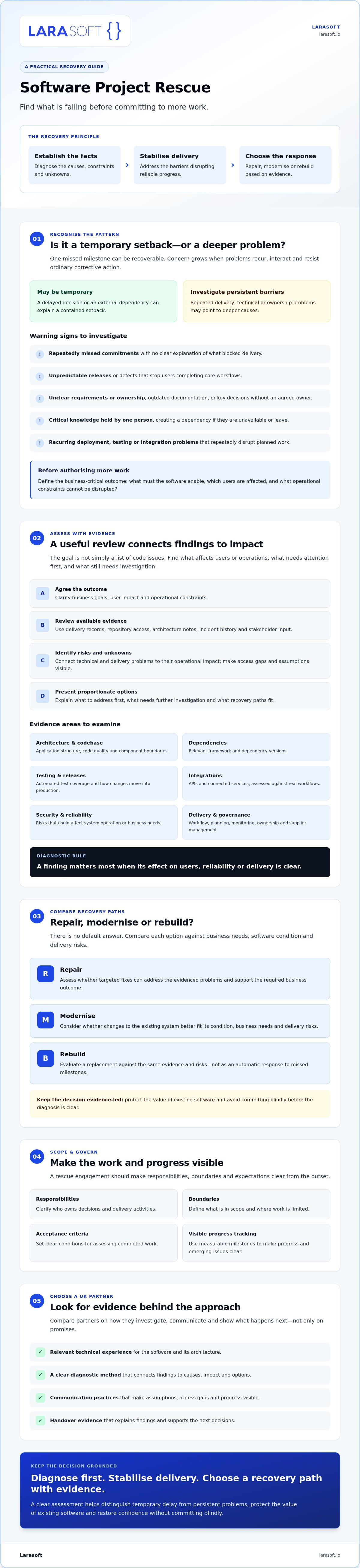
A rescue engagement needs clear boundaries, especially when the system is inherited and the full extent of its problems may not be known at the outset. Before work begins, agree the business outcome, what is in scope, who owns decisions and what evidence will show progress. This gives both sides a shared basis for handling new findings without letting the work expand unnoticed.
Use the statement of work to record the practical terms of delivery. Check that it covers:
Agree how risks, defects and scope changes will be recorded and reviewed. If investigation uncovers an issue outside the original scope, the delivery partner should explain its impact and propose options before proceeding. That keeps new discoveries visible, with any effects on priorities, responsibilities or the agreed plan discussed rather than assumed. Clarify access to hosting and other environments without confusing application work with responsibility for managing IT infrastructure.
Track outcomes people can inspect: a verified fix for an agreed defect, a working release that passes defined checks, or completion of a specific assessment action. A task marked “in progress” isn’t enough on its own. Agree a reporting cadence, a route for escalating blockers and the people authorised to make decisions, so unresolved questions don’t quietly stall delivery.
Use short feedback loops and a shared view of tasks, risks, decisions and completed work. The method can vary; what matters is that stakeholders can see what changed, what remains uncertain and what needs their input. Set an initial decision point before approving a larger programme. Review the evidence, progress against acceptance criteria and any new risks, then decide whether to continue, adjust the scope or pause.
These governance checks help you evaluate software project rescue services uk without relying on confident promises alone. If the work involves bespoke Laravel applications, Vue.js or React frontends, or legacy code modernisation, you can discuss your project context with Larasoft and confirm whether the required engagement is available and how it would be scoped.
Choose on evidence of fit, not broad claims about development expertise. A partner should understand the application’s framework and architecture, explain how they’ll diagnose unfamiliar systems, communicate risks clearly and leave the team with usable documentation and knowledge. Ask how recommendations will account for your constraints, and how the partner will compare repair, modernisation or replacement rather than defaulting to its preferred technology.
References and examples matter, but check that they’re relevant. A successful new build doesn’t by itself show experience with inherited code, unstable releases or incomplete documentation. Ask for examples involving comparable technical conditions and what the partner actually did. Verify any case study or outcome before relying on it, and request a reference where appropriate.
Use the discussion to understand the team’s approach before consequential changes begin. Ask:
Strong answers should be specific about methods and limits. Be cautious if a provider recommends a rewrite before examining the existing architecture, or can’t explain how decisions and handover will be handled.
Larasoft is a UK-based software development agency with capabilities in bespoke Laravel applications, Vue.js and React frontends, API integration, legacy code modernisation and software maintenance. Those skills may be relevant when they match the system being assessed. For example, Laravel experience is pertinent to a Laravel application, but it doesn’t establish that every project is a technical fit or that a recovery engagement is available.
Confirm directly whether Larasoft offers the assessment or project recovery work you need, how the scope would be agreed, and what delivery and handover arrangements could apply. The phrase software project rescue services uk covers different kinds of work, so establish fit before discussing a proposal. Ask for evidence relevant to your system and a clear explanation of what can and can’t be confirmed at the outset.
If you’re weighing up your options, contact Larasoft to discuss a software project and establish whether its capabilities align with your requirements before proposing work.
A struggling software project doesn’t automatically need a rebuild or a larger team. Start by establishing what’s affecting delivery, users and business operations, then use technical evidence to choose between stabilisation, targeted modernisation and replacement.
Whichever route you consider, set clear scope, responsibilities and acceptance criteria. Look for a partner who can explain the reasoning behind recommendations, make risks visible and support a practical handover. That’s a stronger basis for comparing software project rescue services uk than confident promises alone.
Larasoft is a UK-based agency founded in 2018, with capabilities in bespoke Laravel development, Vue.js and React frontends, legacy code modernisation, API integration and software maintenance. These may be relevant where they fit your system, but project rescue availability and engagement scope need to be confirmed directly.
Discuss your software project with Larasoft to share the context and establish whether its capabilities align with your requirements before proposing work. With a grounded diagnosis and a proportionate plan, you can make the next decision with greater confidence and protect the value in the software you already have.
A project may need intervention when delivery, software quality or ownership problems persist rather than appearing as isolated setbacks. Repeated missed commitments alongside defects in core user journeys and unclear responsibility for decisions, for example, suggest a pattern worth investigating. Gather delivery records, incident history, stakeholder input and technical information before deciding. This evidence can help distinguish a temporary delay from underlying issues that more time or extra developers won’t resolve.
Yes. Stabilisation or targeted modernisation may address the main problems while retaining useful software, data and established workflows. A team might first resolve defects blocking essential user journeys, then improve a component that has become difficult to maintain. The right route depends on the codebase, architecture, dependencies and business needs. An assessment should compare repair, modernisation and replacement, explaining the evidence and trade-offs behind each recommendation.
A practical assessment reviews the codebase and architecture alongside dependencies, automated testing, deployment practices and integrations. It should also consider delivery workflow and risks that could affect users or business operations. Ask for findings connected to their impact, not just a list of technical concerns. Decision-makers should receive prioritised recommendations that separate urgent stabilisation from longer-term improvements, with assumptions and access limitations made clear.
There’s no reliable standard duration for rescuing a project. Timing depends on the system’s condition, the agreed scope, access to code and relevant environments, and business constraints such as release windows or continuity needs. A focused assessment may establish what needs investigation before a delivery plan is proposed. Ask the provider to explain dependencies, uncertainty and decision points rather than relying on a timeline that hasn’t been grounded in evidence.
The cost depends on the scope, specialist effort, system complexity and uncertainty identified during assessment. A proposal should explain what work is included, what assumptions it relies on, and how newly discovered issues will be handled. When comparing software project rescue services uk, ask providers to separate assessment from any later recovery work and clarify how changes to scope affect the proposal. An estimate is only useful when you can see its basis.
Original developers may bring valuable system knowledge and continuity, while a new partner can offer an independent perspective and additional capacity. Either route depends on access to the codebase, documentation and decision-makers, as well as the team’s ability to explain findings clearly. Compare relevant experience and ask how assumptions will be tested. You could also seek an independent assessment before deciding who should carry out the recovery work.
Set out deliverables, exclusions, responsibilities, access arrangements and dependencies in writing. Define acceptance criteria so everyone understands how work will be reviewed, and agree a change-control process for newly discovered issues. The contract should also identify review points, how risks and defects will be recorded, and who can approve decisions. Clear boundaries help stakeholders see the impact of changes before committing to additional scope or authorising a larger programme.
Here’s what we've been up to recently.
Certified Quality. Great Prices