Software Development Project Plan Example: Build a Plan That Works


What if your project plan looked organised but still left the team unsure what to build, who makes decisions, or how success will be measured? A software development project plan example should do more than list tasks and dates. It should connect the business goal to a clear route from requirements to release.
A useful plan gives the team enough detail to estimate and manage delivery without pretending every dependency or risk can be predicted precisely. Make scope, responsibilities, assumptions and decision points visible, then update them as the team learns more.
In this guide, you’ll find a software project plan structure you can adapt to your goals, with practical guidance on outcomes, scope, deliverables, roles, dependencies, risks, milestones and progress measures. You’ll also see how to use the plan to discuss a bespoke software project with a development partner and account for maintenance after launch.
A software development project plan is a shared model of the outcome a project must achieve, the work and scope involved, who makes decisions, and what evidence will show whether delivery is on track. It connects a business need to practical choices about design, technology, responsibilities, dependencies and acceptance, giving stakeholders a common basis for discussion and action.
A plan is more than a task list. Tasks describe pieces of work, but not why they matter or how the team will know they’re complete. A product roadmap shows intended direction and priorities over time; a schedule sets out timing and sequence; a technical specification describes how parts of a solution should work. These documents can inform one another, but none replaces a plan that links the business outcome to delivery decisions.
That connection matters because sponsors, product owners, designers and developers bring different priorities. A sponsor may focus on business value, a product owner on user needs, designers on interactions, and developers on feasibility and architecture. A shared plan makes assumptions and trade-offs visible so the team can resolve gaps before they become delivery problems. This aligns with the broader view of Software project management, which covers planning alongside execution, monitoring and control.
Start with the problem, the intended users and the change the business wants to see. For example, is the goal to reduce manual hand-offs, give customers a clearer way to submit information, or make operational data easier to access? Define how progress or acceptance will be assessed before turning possible features into committed scope.
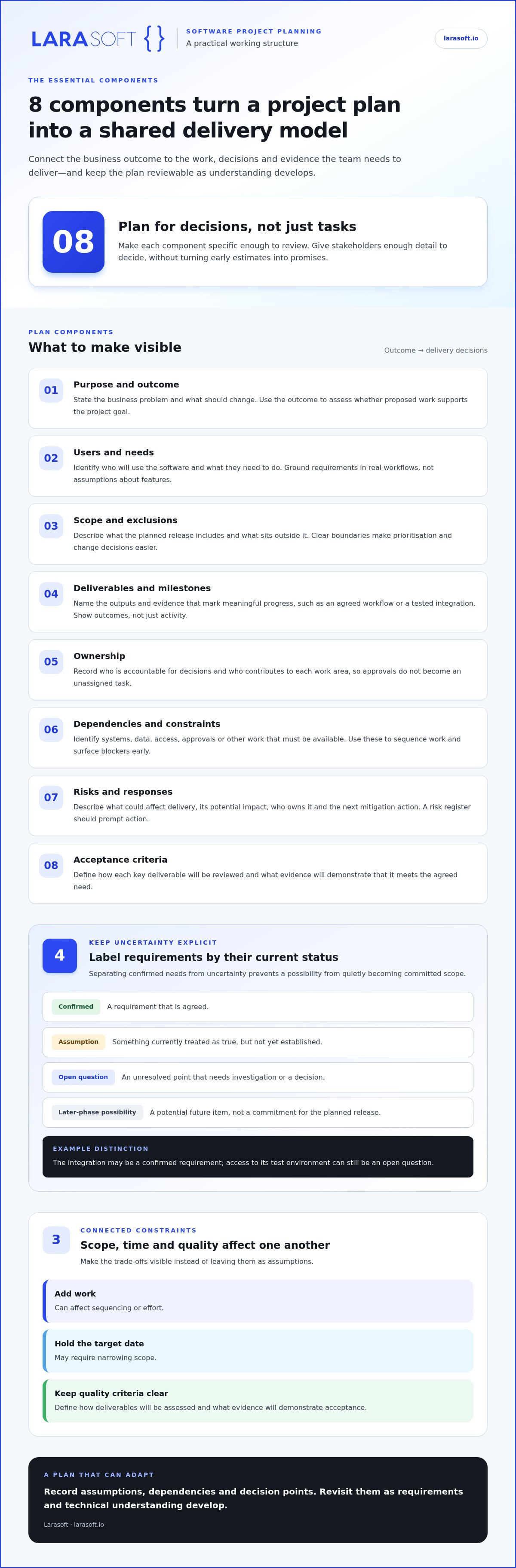
Then make the decisions that shape delivery explicit: who approves requirements, which systems must connect, what constraints apply, and who resolves competing priorities. Scope, time and quality are connected. Adding work can affect sequencing or effort; holding a target date may require narrowing scope, while quality criteria should remain clear. Record dependencies and approvals in the plan rather than leaving them as assumptions.
Planning is especially useful before committing to a delivery approach. A custom web application, mobile app or API integration may need to fit existing workflows, systems and technical architecture. Mapping these needs early helps stakeholders agree what belongs in the first release, what needs further investigation and what evidence will show that a deliverable meets its purpose.
A software development project plan example can provide a starting structure, but it shouldn’t be treated as a prediction of every step. New information may change priorities, reveal dependencies or reshape implementation choices. A good plan guides decisions and makes change manageable; it doesn’t remove uncertainty. Revisit assumptions and update the plan when evidence points to a different route.
A useful plan gives stakeholders enough detail to make decisions without turning early estimates into promises. Use this structure as a working document. Make each item specific enough to review, and update it as requirements and technical understanding develop.
Keep requirements distinct from uncertainty. Mark items as confirmed, assumption, open question or later-phase possibility. For example, an integration may be a confirmed requirement while access to its test environment remains an open question. This distinction prevents a possibility from quietly becoming committed scope and gives the team a clear agenda for discovery and approval.
Describe scope in language business stakeholders and intended users recognise. “Staff can review a submitted request and record a decision” is easier to assess than “build workflow functionality”. Record exclusions too, such as reporting enhancements being outside the initial release, so everyone understands the boundary.
Explicit acceptance criteria make delivery outcomes easier to assess because they define the evidence that shows whether a deliverable meets its agreed purpose. Pair each important output with observable checks, such as whether an authorised user can complete a stated workflow and see the resulting status.
Name an accountable decision-maker and relevant contributors for each major area, such as requirements, design, technical architecture and acceptance. Map milestones to reviewable outcomes, then list the dependencies that must be resolved before work can proceed. Avoid assigning fixed durations before the team has enough information to support them.
For each risk, capture an owner, its potential impact and the next mitigation step. If access to an external system could delay integration testing, name who will resolve access and what the team can progress in the meantime. If you’re shaping a bespoke build, work with Larasoft on a delivery plan that connects requirements to technical decisions.
Illustrative scenario: A business wants a custom application to coordinate an existing request-handling workflow. Staff currently move information between steps, and managers need a clearer view of request status. The aim isn’t to automate every possible process at once. It’s to agree a useful first release, test it against real user needs and make key dependencies visible.
This software development project plan example turns that aim into reviewable work. It avoids fixed dates and promises: the sequence and detail would be refined once stakeholders and the delivery team understand the workflow, integrations and constraints.
Discovery produces a summary of user needs, a map of the current workflow, known constraints and prioritised requirements. Stakeholders review these outputs and resolve open questions before the team commits to a solution. Design and technical planning then produce workflow designs for review, an agreed architecture direction and a view of dependencies, such as access to an existing system.
Development, integration, testing and release readiness are separate milestones, each with evidence and an owner. A milestone demonstrates progress by showing that an agreed outcome has been completed and reviewed, not simply that tasks have been marked finished.
The sample rows below connect the intended business outcome to practical scope and a clear acceptance signal. Roles are illustrative; a real plan should name the people accountable for decisions and review.
| Business outcome | Example scope | Milestone evidence | Owner | Acceptance |
|---|---|---|---|---|
| Staff can coordinate a request through the agreed workflow. | Submit a request, review its details and record its status. | Workflow is demonstrated using agreed scenarios. | Product owner, with design and development contributors. | Stakeholders confirm that the intended user can complete each agreed step and view the correct status. |
| Relevant information moves between the application and an existing system. | Implement the agreed data exchange for the first-release workflow. | Integration is exercised with representative test information. | Technical lead, with the business system owner. | The agreed information passes between systems and the outcome is reviewed against defined cases. |
| The application is ready for a controlled release decision. | Complete agreed testing, resolve release-blocking issues and prepare user guidance. | Test results and readiness review are available to decision-makers. | Delivery lead, with the product owner. | The named approver reviews the evidence and records whether release criteria are met. |
These rows are a planning aid, not a prescribed feature set. Actual scope, technical design, owners and milestone evidence should reflect the project’s complexity, existing systems and stakeholder decisions. A small workflow may need fewer review points; a more involved integration may need additional discovery and testing evidence. Keep the plan adaptable, but make each milestone concrete enough that the team can explain what has been completed and what decision comes next.
A plan should reflect how much is known, how tightly work is connected and how often stakeholders need to review progress. A milestone-led approach makes major outcomes, dependencies and approval points visible. Iterative planning breaks delivery into shorter cycles, letting the team refine requirements and use feedback to guide the next piece of work. Neither approach suits every project by default.
Use a milestone-led view when work depends on external systems, stakeholder approvals or decisions that must happen in a particular order. It helps teams see what must be ready before dependent work can begin. Iterative planning is useful when user feedback may reshape workflows or when requirements need to be validated through working software. Review each cycle and adjust upcoming priorities based on what the team learns.
Often, the practical answer is a combination: maintain a high-level delivery roadmap for intended outcomes and key dependencies, then plan detailed work in shorter cycles. The roadmap supports sponsor-level decisions; shorter cycles give product owners, designers and developers opportunities to inspect progress and refine scope. A software development project plan example is a starting point for choosing this balance, not a reason to force every project into one method.
Change is easier to manage when a request is assessed before it becomes work. Record what’s being proposed, why it matters and which deliverables it may affect. An additional approval step, for instance, may change workflow design, development tasks and testing cases. Capture the implications, not just the feature name.
Use a clear sequence for each change:
Keep a record of decisions and their rationale. It helps the team understand why priorities shifted and makes later reviews more useful. Change control shouldn’t block new ideas; it should make trade-offs visible so the project can respond without losing alignment.
If you’re shaping a plan around changing requirements, dependencies and stakeholder reviews, explore Larasoft’s custom software development services to see how a technical partner can connect business priorities with a workable delivery approach.
A plan becomes more useful when business and technical teams shape it together. A development partner can help translate business goals, user needs and constraints into a reviewable delivery approach, then refine it as requirements and technical decisions become clearer. This gives stakeholders a shared basis for discussing scope, dependencies, milestones and how each deliverable will be assessed.
Your software development project plan example can start that discussion. It doesn’t need to be a finished specification. Bring what you know, flag what’s uncertain and use planning to identify decisions that need further input.
A concise summary is enough to make the conversation productive. Include:
This context helps a delivery team explore the solution before detailed commitments are made. It also helps stakeholders distinguish essential requirements from useful ideas that could wait.
Larasoft plans bespoke software around the business need and the technical structure required to support it. A custom Laravel application can be shaped around a specific workflow, while Vue.js or React frontend development can support projects that need a dedicated user interface. If users need access through a mobile app, native or cross-platform mobile development may be relevant. Where information must move between systems, API integration can be included in the delivery plan.
The right combination depends on requirements, existing architecture, integrations and constraints. Planning makes those relationships visible, so technical choices can be discussed in terms of the business need they support. It also creates space to consider the software lifecycle, including maintenance after release, without assuming every future enhancement belongs in the first delivery scope.
As the work progresses, collaboration continues through shared scope, milestone reviews, technical decisions and acceptance discussions. Each review lets the team compare evidence with the agreed outcome, raise emerging questions and decide whether the plan needs to change. This keeps business priorities connected to implementation while allowing technical decisions to reflect project conditions.
Bring your goals, workflow and known constraints to the conversation, and discuss your software project plan with Larasoft. Together, you can develop a practical foundation for bespoke software delivery.
A plan earns its value when it helps people make the next decision with confidence. Treat your software development project plan example as a working agreement, not a document to file away. Keep the reasoning behind key choices visible as your understanding develops. That makes it easier to assess new ideas, protect the purpose of the work and adapt the delivery route without losing sight of what the business needs.
Your next step doesn’t have to be a fully defined specification. A clear account of the problem, the people affected and the constraints you already know gives a planning conversation a practical starting point. From there, business priorities and technical decisions can be shaped together into a plan your team can review and use.
Discuss your software project plan with Larasoft and take the next step towards a considered delivery plan. With clear goals and the right technical partnership, you can turn an idea into a solid foundation for what comes next.
A useful software development project plan template includes the project purpose, intended users, boundaries, deliverables, owners, dependencies, risks and acceptance measures. It can also include a decision log, communication arrangements and document owner so readers know where to find current information and who can approve changes. For example, record a decision to defer a reporting feature, who approved it and which release it may be reconsidered for.
Make the plan long enough to support decisions, but short enough for stakeholders to keep current. A focused project may need only a concise document with links to detailed requirements or technical notes. A project involving several teams or integrations may need more supporting detail. Judge it by usefulness: can a new contributor find current priorities, decision owners and unresolved blockers without searching through unrelated material?
Yes. Agile delivery still benefits from a plan, but the level of detail changes over time. Keep intended outcomes and major dependencies visible, then refine near-term work as feedback arrives. For example, a team building an internal tool might confirm the user journey in an early review, then adjust the next cycle’s priorities based on what users find confusing. The plan provides direction without requiring every task to be fixed upfront.
One named person should coordinate updates, while responsibility for content is shared. A project or delivery lead can maintain the working document and decision record; the product owner or business sponsor should confirm changes to priorities and outcomes; technical contributors should flag new dependencies or delivery risks. In a smaller team, one person may hold several roles. What matters is that updates have an owner and decisions have an accountable approver.
A product roadmap describes the product’s intended direction and the outcomes or capabilities that may be prioritised over time. A project plan organises a defined piece of delivery, including responsibilities, dependencies, reviews and acceptance. For example, a roadmap might identify a future customer self-service capability, while the project plan explains how the first agreed release will be designed, built, reviewed and approved.
Update the plan whenever a decision, dependency or new finding changes what the team will deliver or how it will be assessed. Review it at agreed delivery checkpoints too, so outdated assumptions don’t persist unnoticed. Check relevant sections during planning and milestone reviews instead of rewriting the entire document each time. Keep a visible version date and note material changes so contributors know they’re using current information.
Here’s what we've been up to recently.
Certified Quality. Great Prices