Laravel for B2B Ecommerce Platforms: A 2026 Buying Guide


What if the right B2B platform isn’t the one with the longest feature list, but the one that fits how your customers actually buy? Account-specific pricing, buyer permissions and approval flows can make standard ecommerce workflows a poor fit. The question isn’t simply whether Laravel can support a store. It’s whether laravel for B2B ecommerce platforms can model your requirements and connect with the systems your business relies on.
This guide will help you assess that fit before committing to an approach. You’ll compare package-led and bespoke builds against the same criteria, identify which commerce workflows should shape the decision, and consider how integrations, scalability and maintenance affect the platform over time.
You’ll also learn how to scope a maintainable Laravel implementation around your business needs. Larasoft builds bespoke Laravel applications through discovery and development, with a staging server provided for client testing. Code ownership is fully transferred to the client under the standard service agreement, and long-term support is available through service level agreements (SLAs).
A B2B ecommerce platform supports how businesses buy and sell, from finding products to placing and managing orders. Unlike a simple online catalogue, it may need to reflect how each customer account is structured, who can buy on its behalf and which terms apply. The broad principles of B2B e-commerce provide useful context, but your own purchasing processes should guide the platform decision.
Start by listing the tasks buyers and staff need to complete. One customer might let any approved employee place an order, while another requires a manager to approve purchases above an agreed limit. Repeat ordering may matter for customers who regularly buy the same supplies, but less for one-off or highly configured purchases. Negotiated pricing, account-specific product visibility and order approvals each affect the data, permissions and logic the platform needs.
A B2B platform fits when its workflows reflect how your customers are authorised to buy, what they can order and how their orders are processed.
Map each account type, buyer role and level of purchasing authority. Then trace a typical order from product discovery through approval, submission and fulfilment. This shows which steps are shared and where customer-specific rules apply.
Separate standard processes from exceptions. If every customer follows the same checkout steps but only a few require approval, record that distinction. It can help prevent a special case from shaping the entire experience.
Business purchasing can involve several people acting under one account. A buyer may prepare an order, an authorised colleague may approve it, and another team may handle fulfilment. The platform may therefore need to retain account context across users instead of treating every shopper as an independent customer.
Define pricing, product access and order rules as business requirements rather than assumed defaults. For example, customer-specific pricing matters if terms genuinely differ between accounts; it adds needless complexity if all buyers use the same price list. The same applies to approvals and restricted catalogues. Not every B2B business needs the same feature set.
For laravel for B2B ecommerce platforms, workflow fit should shape both the initial scope and the application logic. Classify requirements into three groups:
This approach keeps the initial scope focused without ruling out future needs. A clear first release can support the purchasing processes your business relies on now, while leaving room to extend the platform as requirements become better understood.
Laravel is an application framework, not a complete, ready-configured B2B commerce product. It provides a foundation for building application logic, handling data and connecting systems. Capabilities such as account permissions and order approvals must be selected and implemented as part of the platform. The B2B eCommerce Association offers industry context, but your architecture should be shaped by your own workflows and systems.
A framework supplies the building blocks; a ready-configured B2B platform supplies a predefined set of commerce workflows. With laravel for B2B ecommerce platforms, the central question is which rules belong in your application and how they should work together, not which features Laravel includes by default.
Laravel can provide the application layer for managing business rules, processing requests, working with platform data and connecting to other services. For example, an order flow might check account permissions and a buyer’s authority, then pass an approved order to another business system. The exact logic depends on how the systems exchange data and which one owns each record.
A modular design can group capabilities around business domains such as accounts, catalogues, pricing and orders. This helps keep responsibilities clear as requirements change. It does not guarantee that a platform will scale or perform well by itself. Data volumes, integration behaviour, hosting choices and testing all affect those outcomes and should be considered in the project architecture.
Map integrations early. Identify which system is authoritative for products, stock, customer terms and order status. Then define what information moves between systems, in which direction and when. This reduces the risk of duplicate records or unclear hand-offs becoming part of the application.
A traditional server-rendered experience can work well when the storefront and application logic can operate together. A separate frontend may suit a project that needs a highly interactive buyer experience, several interfaces using the same backend, or a clear division between presentation and application logic. An API-led structure can support those connections, but it also adds design and maintenance decisions. It isn’t automatically the better option.
A Vue.js single-page application is one possible approach, particularly where buyers need responsive interactions across catalogue search, account views or order management. Choose based on the interface requirements and the team’s capacity to maintain it. Explore the considerations in this Vue.js frontend development guide.
Larasoft builds bespoke Laravel applications around defined business requirements. During development, a staging server is provided for client testing. Code ownership is fully transferred to the client under the standard service agreement, and long-term support is available through service level agreements (SLAs). If you’re shaping a tailored platform, discussing Laravel development can help connect your workflow scope to an appropriate architecture.
Choosing a package or a bespoke build is a question of fit, not a contest between “ready-made” and “custom”. A Laravel commerce package may already cover your essential workflows. Bespoke development may be worth evaluating if your processes depend on rules or integrations that don’t fit the package’s assumptions. Compare both against your documented requirements, including what the platform must do at launch and what can wait.
| Decision factor | Laravel commerce package | Bespoke Laravel development |
|---|---|---|
| Fit | Strong when built-in capabilities align with core workflows. | Can be shaped around business-specific rules and processes. |
| Customisation | Depends on supported configuration and extension points. | Application logic can be designed for defined requirements. |
| Integrations | Assess available connectors and the work needed to connect existing systems. | Integration design can be planned around your systems and data flows. |
| Control | Platform structure and conventions influence implementation choices. | Greater control over the application architecture, with responsibility for design decisions. |
| Ongoing maintenance | Plan for package updates, extensions and compatibility. | Plan for maintaining custom code, integrations and framework updates. |
A package is a practical candidate when its capabilities match your essential workflows without forcing major changes to how staff or customers work. Compare its account, catalogue, pricing and ordering functions with your documented scope. Then assess whether its extension points can handle exceptions and whether the required integrations can be built without brittle workarounds.
Include implementation and ongoing maintenance in the decision. Configuration, data migration, integration testing and future updates all need an owner and a plan. A package provides a defined starting structure, but it still needs to be implemented to fit your business.
Consider bespoke development if essential workflows differ materially from a package’s assumptions. Examples might include approval logic tied to a customer’s internal structure, account-specific ordering rules, or an integration that coordinates data across several existing systems. The deciding factor is whether adapting a package would introduce complexity that undermines the intended workflow.
Phasing can make a bespoke scope more manageable. Establish the core buyer and order journeys first, then plan further capabilities as distinct releases. Evaluate integration dependencies and data ownership early, since they can affect both the design and delivery sequence. For broader delivery considerations, see this Laravel development agency guide.
Larasoft develops bespoke Laravel applications around defined business requirements. A staging server is provided for client testing during development.
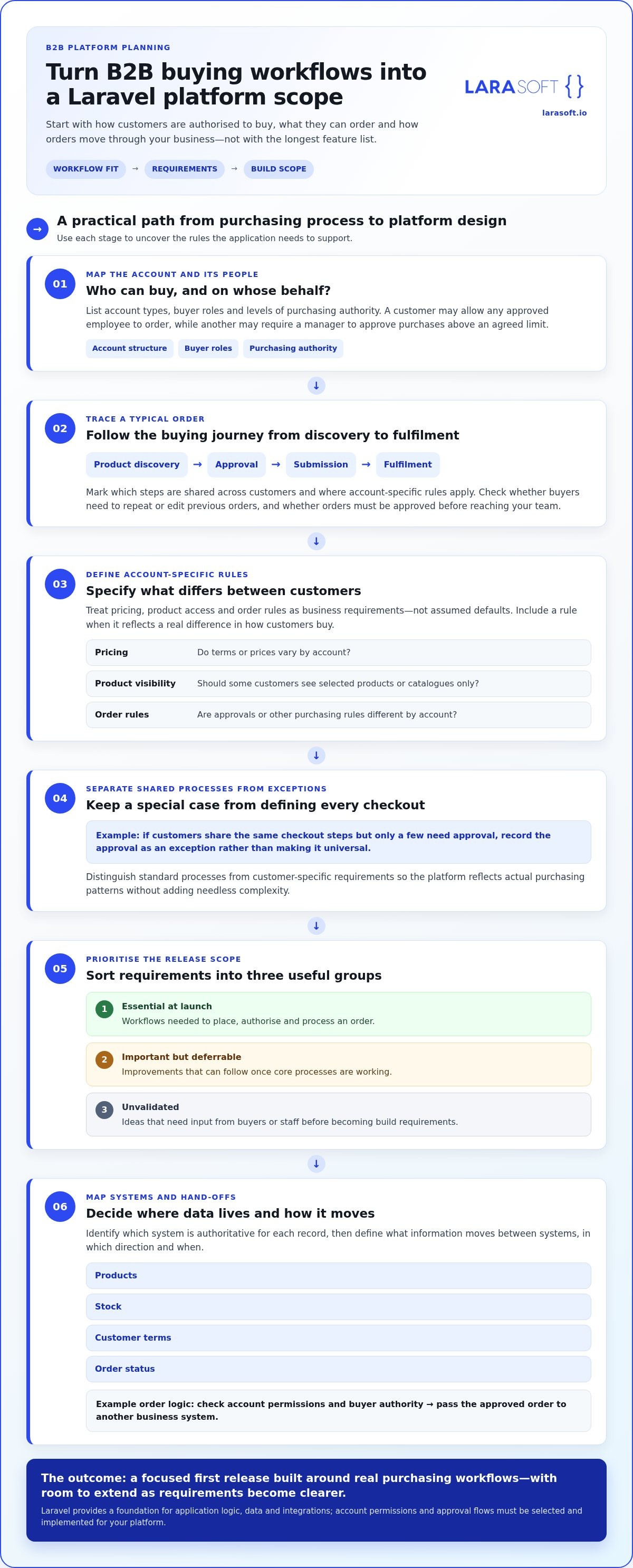
A useful scope turns business needs into decisions a delivery team can design, build and test. For laravel for B2B ecommerce platforms, document the people, processes, information and connected systems involved before prioritising features. This gives stakeholders a shared reference, exposes dependencies early and helps separate first-release requirements from later improvements.
Start with the people and work behind each order. Capture the current process, including exceptions, rather than describing only the ideal future journey. This helps reveal where rules are consistent and where the platform needs to handle different account, product or transaction conditions.
List each current system the commerce platform must exchange information with, including systems that hold product, customer or order data. For every data type, record its authoritative source, who owns it, how it is maintained and which processes depend on it. This clarifies integration responsibilities and helps identify where inconsistent or duplicated records could disrupt ordering.
Prioritisation doesn’t rule out future capabilities. It gives the project a stable starting point and a clear basis for reviewing changes as delivery progresses. Discovery, development and testing can then follow an agreed scope. Larasoft provides a staging server for client testing during development. Plan your Laravel platform scope around the workflows, systems and priorities your business has documented.
A successful project starts with the workflows, integrations and launch priorities your business has defined, not a generic feature list. Larasoft builds bespoke Laravel web applications around those requirements, shaping the platform’s application logic and structure to support how your customers and teams work. For laravel for B2B ecommerce platforms, that means translating the agreed scope into a considered build and planning for future development without losing sight of what the initial release needs to deliver.
Larasoft is an Official Laravel Certified Company, with Laravel developers since 2012. The company has built almost a hundred web and mobile apps and reports £100 k + Sales. That specialist experience informs the technical decisions behind a bespoke application, from organising business logic to connecting the platform with existing systems. The aim is to align the implementation with the requirements established during discovery and the platform’s intended role in your wider operations.
Larasoft’s stated proof points include 99 % Satisfaction and 24 / 7 Support. Technical delivery is only part of a B2B platform project. Your team also needs clear communication about scope, a way to test the developing application and an agreed approach to maintenance after launch.
Project planning begins with your requirements. Documented workflows, systems and priorities help shape the proposed approach, including what belongs in the initial release and how integrations fit into the build. As development progresses, a staging server is provided for client testing. Your team can review the application in a test environment and provide feedback before the work moves towards launch.
Continuity matters after development, too. Larasoft provides long-term support through service level agreements (SLAs), giving businesses an agreed basis for ongoing support as the platform is maintained. Under the standard service agreement, code ownership is fully transferred to the client. Your organisation owns the codebase and can make informed decisions about the application’s future.
Before discussing a project, bring together the scope you have already established: priority user journeys, key business rules, integration dependencies and launch-critical requirements. These details give the conversation a practical starting point and help connect business needs to the Laravel implementation.
Have a B2B commerce project in mind? Discuss your Laravel platform requirements with Larasoft and start turning your defined scope into a maintainable implementation.
The value of laravel for B2B ecommerce platforms comes from how well the implementation serves your business as it changes. Treat the initial scope as a foundation, with clear priorities and room to review requirements as customer processes, internal systems and trading needs evolve. This gives your team a practical way to make future platform decisions without losing sight of the workflows that matter now.
Larasoft’s recognition includes Most Reliable Web Development Agency in the UK Enterprise category for the SME Awards 2021. For your project, start with the business context: what buyers need to do, where existing processes create friction, and which systems the platform must work alongside. Those details can turn an abstract technology decision into a focused conversation about architecture and delivery.
Ready to define the next step? Discuss your Laravel B2B ecommerce platform requirements with Larasoft. A clear scope can help set your project on a thoughtful path, built around your business needs today and its plans for tomorrow.
Yes, Laravel can be suitable if its application framework can be shaped to your workflows, integration needs and level of customisation. Laravel isn’t a ready-configured commerce platform, so the commerce functions must come from the application design and any chosen packages. For laravel for B2B ecommerce platforms, assess the specific order journeys, data rules and systems involved before deciding. Suitability depends on the project architecture, not the framework name alone.
Yes, a Laravel application can be designed around defined account processes and business rules. For example, discovery can establish whether different buyer roles need distinct permissions, or whether certain orders pass through an approval step before submission. These are requirements to design and test, not features to assume are built in. Document who performs each action, what information they need and what should happen when an order falls outside the usual process.
Choose by comparing your essential requirements with the package’s available capabilities, extension options and integration needs. A package can be appropriate if its established workflows align with how your business operates. Bespoke Laravel development may be worth evaluating when important processes need distinct application logic. Include the work of implementing, updating and maintaining either approach in the assessment. There’s no universal winner, and neither option should be assumed to cost less.
Connections depend on the systems involved, the data they hold and the interfaces available for exchanging information. Start by tracing a specific process, such as how an order moves from the commerce application into the system your team uses to process it. Record which system owns each data item, when updates are needed and what should happen if an exchange fails. This gives the integration design a concrete basis without assuming a connector already exists.
Yes. A decoupled or API-led frontend is an architectural option when a particular user experience or set of channels justifies separating the interface from backend application logic. It also introduces another part of the system to design and maintain, so consider the team’s needs alongside the buyer experience. Larasoft develops Vue.js single-page applications, which can be considered for suitable projects. A separate frontend isn’t a requirement for every Laravel commerce platform.
Document buyer roles, the core tasks each role must complete, relevant business rules, current systems, data needs and launch priorities. Make the notes concrete: identify who owns product or customer information, which manual hand-offs cause delays, and what a successful first release must enable. Then distinguish essential requirements from ideas that can be explored later. This preparation makes discovery more focused and gives the project a clearer basis for architecture and scope decisions.
Here’s what we've been up to recently.
Certified Quality. Great Prices