Software Development for Non-Technical Founders (2026)


What if you could lead a software project without learning to code or reviewing a single line of it? Software development for non-technical founders starts with a different kind of expertise: understanding your customers, defining the problem and making clear product decisions.
It’s reasonable to worry about turning an idea into a useful brief, choosing the right technical partner and keeping scope, budget and progress visible. You don’t need to make every technical decision yourself, but you do need a reliable way to understand your options and stay involved.
This guide will help you shape your idea into a focused product, compare practical routes to delivery and reduce uncertainty before development begins. You’ll learn which decisions belong to you as the founder, what to look for when evaluating freelancers or agencies, and how to track progress through milestones and working demonstrations rather than code reviews. We’ll also cover what to plan for after launch so your product can evolve with your business.
Software development is the process of designing, building, testing and maintaining a digital product. In software development for non-technical founders, the first decision isn’t which technology to use. It’s whether a clear, recurring business problem needs solving. A product should make a task easier, faster or more reliable for a defined user, rather than add technology for its own sake.
A software brief is a concise description of the problem, its users, the outcome the product should support and the requirements for an initial release. It gives a development team a basis for discussing scope, approach, priorities and how to assess the work. You don’t need to specify the code, but you do need to own the business decisions behind the brief.
For a high-level overview of how software development works, see the lifecycle from design and creation through testing and maintenance. The founder’s role is to keep that technical work connected to customer needs and business priorities.
Make the idea specific. Identify who struggles, what they’re trying to do and what happens today. For example, a business might find that staff repeatedly copy information between spreadsheets to prepare customer updates. That describes a task and a workaround. “We need an app” doesn’t yet explain what needs to change.
Separate the result you need from the features you assume will deliver it. Start by asking:
Test your answers with customer conversations and existing business evidence, such as repeated support requests or time-consuming manual processes. Look for evidence that the problem is real before treating a preferred feature as a requirement.
Compare your actual requirements with the tools your business already uses or could adapt. If an existing tool handles the workflow reliably, a bespoke build may add avoidable complexity. Custom software is more relevant when a distinct process, user experience or integration need can’t be met well with available tools.
Keep the first release focused on the smallest set of capabilities that can test the core need. A bespoke web application, for example, may need to support one essential workflow before you add secondary features. Define what users must be able to do, what can wait and what evidence would justify expanding the scope. This gives the team a clear starting point while leaving room to adapt as you learn.
Once the problem is clear, turn it into a sequence of decisions and reviewable outcomes. Software development isn’t a single handover from brief to finished product. It moves through planning, design, implementation, testing and release, with feedback informing what happens next.
A first usable release is a focused product that supports an agreed set of essential tasks. It isn’t the finished long-term product. This distinction helps founders avoid treating every possible feature as a launch requirement.
Keep the initial scope anchored to one target user and the key task they need to complete. Prioritise requirements by user value and business necessity, then agree what can wait. Choose observable measures of usefulness, such as whether users complete the task or whether a manual process takes less effort. Use these measures to inform decisions, not to promise a particular result.
Business deliverables make progress easier to judge: an agreed scope describes what’s included, prototypes show the intended experience, working software demonstrates actual behaviour, and release criteria define what must be ready. Keep decisions and changes written down so everyone is working from the same plan.
Ask for demonstrations at agreed points and review the product from a user’s perspective. Feedback may lead to reprioritisation during delivery. Record each change, its reason and what it means for scope. Before release, decide how the product will be monitored and maintained, including who will handle issues and plan updates. Software maintenance is part of a product’s lifecycle, not an afterthought.
If a bespoke web application is the right fit for your requirements, you can explore Laravel web development as one possible delivery route.
The right route depends on the work you’ve defined, how much continuity it needs and how much coordination you can provide. In software development for non-technical founders, distinguish between people who advise on technical decisions and a team responsible for delivering the product. Agree who owns delivery, decisions and ongoing support before work begins.
| Option | Delivery responsibility | Continuity and oversight | Often suits |
|---|---|---|---|
| Agency | A coordinated team can cover several disciplines. Confirm who manages delivery and what’s included. | Structured communication and team coordination can reduce the founder’s day-to-day oversight, but you still own product priorities and feedback. | A defined build that needs a combination of skills, such as web development and integrations. |
| Freelancer | One person delivers an agreed area of work. You may need to coordinate other specialists and decisions. | Continuity depends on the individual and your agreement, so clear requirements and regular check-ins matter. | A bounded task or a project suited to one specialist’s experience. |
| In-house team | Your employees build and develop the product within the business. | An in-house team can build ongoing product knowledge, while the founder remains responsible for setting priorities and supporting the team. | Continuous development where the product and roadmap are central to the business. |
| Fractional technical leadership | Advises on or leads technical decisions, but isn’t automatically a team that builds the product. | Provides part-time strategic input. Someone still needs to carry out and coordinate delivery. | A business that needs senior technical guidance without a full-time leadership role. |
An agency may fit when delivery needs several skill sets, such as a web application, a modern frontend and connections to other systems. Check relevant project experience, who will do each part of the work, how progress and decisions are communicated, how testing is handled and what post-launch maintenance is available. For more guidance on evaluating a Laravel partner, read the Laravel development agency selection guide.
A custom development engagement means building software around defined requirements. It’s different from buying a ready-made software licence. Custom work may suit a distinct workflow or integration need, but it should follow a validated business case, not a preference for owning bespoke technology.
Technical confidence alone doesn’t determine whether you need a technical co-founder or CTO. Consider whether the business needs continuing technical leadership, such as someone to shape architecture, guide a growing engineering function or make decisions across an ongoing product roadmap. That’s different from hands-on delivery, which may be undertaken by a freelancer, agency or in-house team.
If you can’t assess a proposal’s assumptions, risks or technical approach, seek independent technical advice before committing. Clarify whether that adviser will review decisions, lead a team or build the software. These are distinct responsibilities.
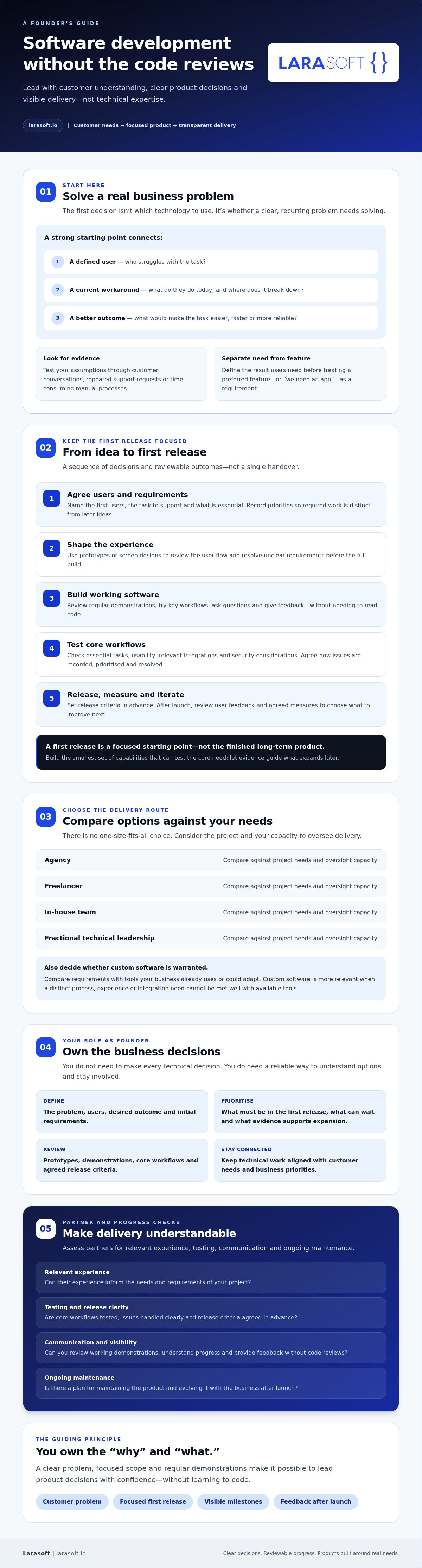
You don’t need to inspect code to keep a project accountable. In software development for non-technical founders, effective oversight means connecting technical work to user needs, making timely product decisions and checking progress against agreed outcomes.
Choose one product decision-maker who can resolve priority questions and provide feedback promptly. That person may consult colleagues, but the delivery team needs a clear route to a decision. Agree how often you’ll see demonstrations, where decisions and risks will be recorded, and how proposed scope changes will be assessed before they’re accepted.
Good questions turn technical recommendations into business choices. Ask which user problem a feature solves, how you’ll know it works and what alternatives were considered. If a proposed approach affects security, flexibility or future maintenance, ask the team to explain the trade-off in plain English, including the practical consequences for users and the business.
Request demonstrations of working workflows, not just status updates or lists of completed tasks. Try the product as a user would. Can you complete the intended task? What happens when information is missing or an action fails? Your feedback can help the team identify gaps while there’s still time to discuss priorities.
Keep requirements, decisions, responsibilities, risks and approved changes in one accessible place. When someone suggests a new feature, ask what it adds, what existing work it affects and whether another item should move out of scope. This makes trade-offs visible instead of allowing small requests to quietly expand the project.
Discuss how relevant data will be handled, who should have access, how core workflows will be tested and what maintenance will be needed after release. If the project involves existing software or inherited code, review its condition and dependencies as part of planning. Larasoft’s legacy code modernisation guide may help frame that discussion.
Use this checklist to review progress without judging code:
These checkpoints make collaboration more transparent and help you act on decisions only you can make as the founder. To discuss a bespoke product requirement with a development partner, explore custom software development with Larasoft.
A suitable partner should connect your business requirements to a delivery plan, explain important trade-offs and make progress visible. For software development for non-technical founders, the best fit isn’t necessarily the team recommending the most advanced technology. It’s the team that can show why its approach suits your users, workflows and priorities.
Ask how the team will clarify users, requirements, integrations and release priorities before recommending an approach. Check who will communicate progress, answer questions and explain technical decisions in business terms. Make sure the people doing the work have clear responsibilities.
Technology should follow those requirements, not lead them. Laravel may suit the application layer of a bespoke web product; Vue.js or React may be considered for its frontend, depending on the product and the team’s approach. If users need app-based access or device capabilities, native or cross-platform mobile development may be relevant. Ask the partner to explain the fit and trade-offs rather than accepting a stack recommendation without context.
Release is a transition into ongoing product work, not the end of responsibility. Plan for security updates, bug fixes, changes to connected services and other operational needs that may arise as the product is used. Confirm what maintenance covers and who is responsible for it. This helps you account for longer-term needs before choosing a delivery partner.
If your product includes public web pages that people need to find through search, include SEO requirements in the discussion. Consider which pages should be discoverable and how the site’s structure and content will support that goal.
Larasoft is a UK-based custom software development agency offering Laravel web development, Vue.js and React frontend development, native and cross-platform mobile development, API integration, software maintenance and SEO services. If you have a defined custom software need, discuss a development project with Larasoft.
Software development for non-technical founders doesn’t require you to become a developer. It does require you to understand the problem you’re solving, set priorities and stay engaged through clear decisions, demonstrations and agreed measures of progress. Choose a delivery route that fits the work, and plan for maintenance as part of the product’s future.
When your requirements point to custom software, the right partner should connect business goals with a considered technical approach. Larasoft develops custom Laravel web applications, with Vue.js and React frontend expertise, as well as native and cross-platform mobile applications. Its services also include ongoing software maintenance.
Have a defined product need? Discuss your custom software project with Larasoft and explore a practical next step. You don’t need every technical answer before you begin. A clear problem and a collaborative plan can give your idea a strong foundation.
Yes, you can build software without a technical co-founder if you can define the customer problem, make product decisions and work with people who can deliver the technical work. You might use a freelancer, agency or in-house team, depending on the product and how much ongoing development it needs. If you’re unsure whether a proposal is technically sound, seek independent advice before committing. You don’t need to write code to lead the business decisions.
Manage delivery by setting clear priorities, appointing one person to make product decisions and agreeing how the team will report progress. Ask for regular demonstrations of working user journeys, not just written status updates. Keep requirements, decisions, risks and scope changes in a shared record. When technical choices are proposed, ask what problem they solve and what trade-offs they create for users, security or future maintenance.
A useful brief describes the problem, target users, their key tasks and how they handle those tasks today. Set out the outcome the first release should support, essential requirements, relevant integrations and what can wait. Include how you’ll assess whether the product is useful, such as whether users can complete a core workflow. You don’t need to prescribe code or a technology stack. The brief should help a development team assess scope and options.
Choose based on the work you’ve defined and the coordination it requires. A freelancer may suit a focused task that matches one person’s expertise, while an agency may fit a build needing several skill sets and coordinated delivery. Ask who is responsible for each activity, how progress is communicated, how testing is handled and what happens after launch. Compare proposals on fit and clarity, not price alone, and make delivery responsibilities explicit.
There’s no reliable single figure without knowing the product’s scope, requirements, integrations and delivery approach. A quote should explain what work is included, the assumptions behind it, how changes are handled and whether testing, launch and maintenance are covered. Ask for costs in pounds sterling and compare like-for-like proposals. If the scope is still uncertain, first agree the essential user workflows and requirements so estimates have a clearer basis.
Check progress against agreed requirements, demonstrations and release criteria, rather than trying to assess code you can’t review. At each demonstration, confirm that the intended user workflow works and ask what remains, what risks or dependencies could affect delivery, and whether the team needs a decision from you. Keep approved scope changes documented. If progress is difficult to explain in terms of working product and next steps, ask the team to clarify the plan.
After launch, gather user feedback and review whether the product supports its intended workflows. Plan for bug fixes, security updates, changes to integrations and future improvements as ongoing product work. Agree who handles maintenance, how issues are prioritised and how updates will be managed. If the product includes public web pages intended to appear in search, consider SEO as part of its continuing development. Launch is a milestone, not the end of the product’s lifecycle.
Have a defined custom software requirement? Discuss your project with Larasoft to explore a practical next step.
Here’s what we've been up to recently.
Certified Quality. Great Prices