Legacy System Modernisation UK: The Strategic Guide for Business Leaders in 2026

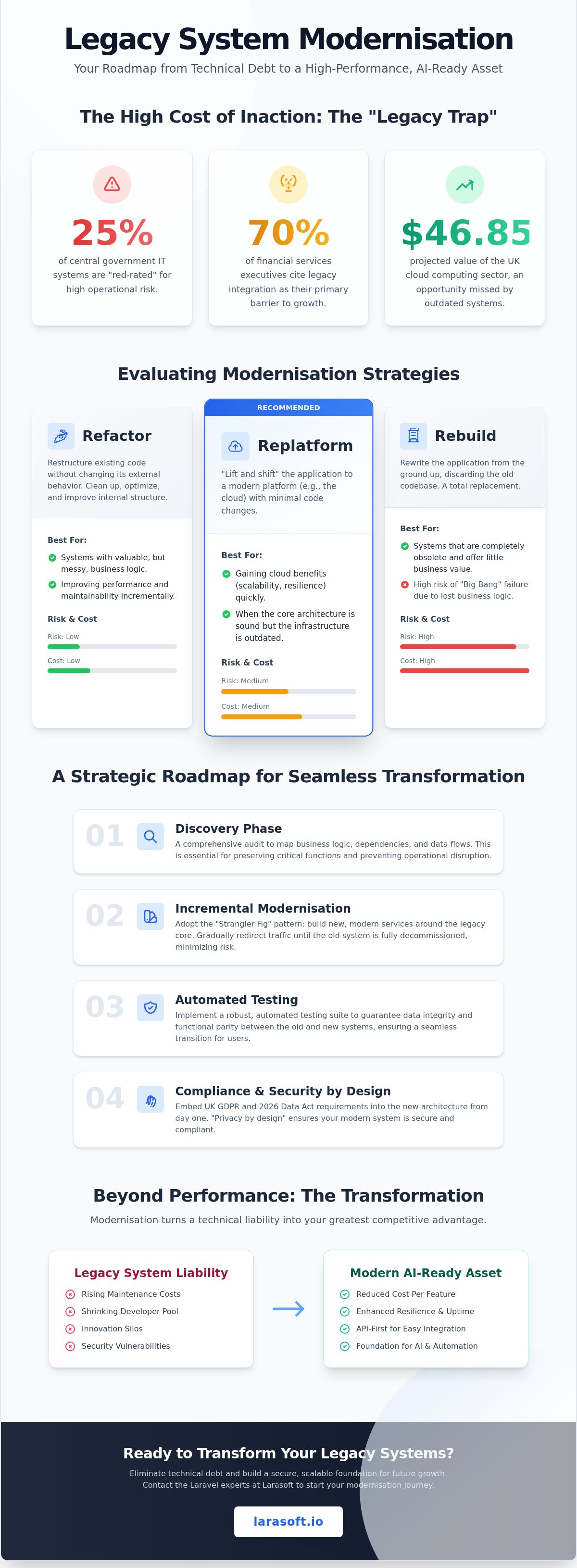
Did you know that nearly 25% of central government IT systems are currently "red-rated" for high operational risk? For private sector leaders, the pressure is equally intense; 70% of financial services executives now cite legacy integration as their primary barrier to growth. If you feel trapped by rising maintenance costs and a shrinking pool of developers who understand your aging frameworks, you aren't alone. Most UK businesses are currently balancing the need for innovation against the fear of a catastrophic system failure. Effective legacy system modernisation uk is no longer a luxury; it's a requirement for survival in a market where the UK cloud computing sector is projected to hit $46.85 billion this year.
We understand that the prospect of touching core business logic feels like open-heart surgery. You need a way to evolve without the risk of a total system replacement or operational downtime. This guide shows you how to transform these technical liabilities into high-performance, AI-ready assets that support your long-term goals. We'll explore the strategic shift toward API-first architectures, the impact of the 2026 Data (Use and Access) Act, and the roadmap for building a secure, scalable foundation that eliminates technical debt for good.
Technical debt is a silent drain on your capital. In the current UK economic climate, maintaining outdated software isn't just an IT issue; it's a strategic bottleneck. Many leaders fall into the "if it ain't broke, don't fix it" trap, but this logic is a dangerous fallacy in 2026. A system that "works" but cannot integrate with modern APIs or support AI workflows is, by definition, broken. Adopting a structured approach to legacy system modernisation uk is the only way to ensure your business remains competitive as the UK cloud market reaches its projected $46.85 billion valuation this year.
The cost of inaction manifests through innovation silos. When different departments rely on fragmented, aging platforms, data cannot flow freely across the organisation. This lack of interoperability prevents you from leveraging real-time analytics or automation. Implementing proven Software modernization strategies is no longer just a technical choice; it's a strategic necessity to break these silos and treat your code as a foundational asset. Furthermore, your infrastructure directly impacts your ability to hire. With 75% of UK public sector organisations reporting a skills shortage, top-tier developers will avoid companies tethered to obsolete frameworks.
Recognising when a system has reached the point of diminishing returns is critical. You might notice that simple updates now take weeks instead of days, or that your team spent more time on patches than on new features last quarter. A major red flag is key person dependency. If your entire operation relies on a single developer who understands a 15-year-old codebase, you're one retirement away from a crisis. This trap creates a massive opportunity cost; while you struggle with stability, your competitors are deploying AI-driven features that capture your market share.
Measuring the success of modernisation requires looking past immediate maintenance costs. While reducing server fees is a benefit, the true ROI comes from increased velocity and reliability. In the financial services sector, where 70% of leaders cite legacy integration as a primary obstacle, the value of a modernised system is found in:
By shifting your perspective from "repairing old software" to "building a scalable asset," you turn a technical liability into a driver for revenue growth. It's about creating a system that performs perfectly under pressure while remaining flexible enough to adopt whatever technology comes next.
Choosing the right technical path is the difference between a successful transformation and a sunk cost. While the industry often references the "Gartner 7" strategies, UK business leaders must adapt these frameworks to meet 2026 market demands. A total rebuild often seems like the cleanest choice, yet it's frequently the most expensive and least successful path. The high risk of "Big Bang" failures usually stems from underestimating the undocumented business logic hidden within decades of old code. Instead, successful legacy system modernisation uk projects typically favour incremental shifts that deliver value without halting operations.
The UK government's legacy systems report highlights how high-risk environments often stagnate because the perceived cost of change outweighs the perceived cost of maintenance. To counter this, many organisations now adopt the "Strangler Fig" pattern. This approach involves building new functionality around the edges of the old system, gradually migrating users until the legacy core can be decommissioned. It's a disciplined, results-oriented way to manage risk while maintaining a steady momentum of feature releases.
Isolating critical business logic is the first step in a modular transition. By wrapping legacy functions in modern APIs, you can connect old databases to high-performance frontends built with React or Vue.js. This allows your team to upgrade the user experience immediately while the backend is refactored in manageable, low-impact sprints. It's a strategy that preserves your historical data while enabling the integration of advanced tools. Partnering with a team experienced in Legacy Code Modernisation ensures these bridges are architecturally sound and secure.
There are instances where a codebase is truly beyond saving. If your system relies on hardware that is no longer manufactured or frameworks that have seen zero security patches for years, a total replacement becomes a survival requirement. The key to a successful cutover is ensuring absolute data parity. You must maintain the old and new systems in parallel, using automated testing to verify that the new platform produces the exact same outputs as the legacy one before you flip the switch. This meticulous approach prevents the "day one" disasters that often plague poorly planned migrations.
Outdated software creates an unpatchable attack surface that modern firewalls cannot fully protect. Many legacy systems rely on deprecated protocols or encryption standards that don't meet the requirements of the 2026 Cyber Security and Resilience Bill. When you operate in a hybrid environment during a transition, you're managing two different security profiles simultaneously. This complexity often leads to configuration gaps that attackers exploit. A structured approach to legacy system modernisation uk is the only way to close these vulnerabilities and move toward a Zero Trust security model.
Compliance is no longer just a checkbox; it's a core architectural requirement. The Data (Use and Access) Act 2025, which came into full force in February 2026, increased PECR fines to align with UK GDPR levels of up to £17.5 million. Legacy platforms rarely support the "privacy by design" principles needed to automate data deletion or manage complex Subject Access Requests (SARs) efficiently. Beyond legal penalties, failing to modernise often blocks your business from achieving Cyber Essentials Plus certification, a standard requirement for many high-value UK contracts and government tenders. Following the UK Government guidance on legacy systems helps ensure your transition meets these rigorous national standards.
Moving sensitive information from aging monolithic databases to modern schemas requires more than a simple transfer. You must map legacy data structures to modern, secure schemas while ensuring that data remains encrypted both at rest and in transit. During SQL migrations, data loss typically occurs when legacy null constraints or legacy data types conflict with modern, strict schema requirements. We use automated validation tools to ensure every record is accounted for and that its integrity remains intact throughout the entire migration pipeline.
Modern architectures simplify auditing by providing granular logs and real-time monitoring that legacy systems lack. Instead of manual quarterly reviews, you can integrate automated compliance checks directly into your deployment pipeline. This proactive stance is essential for navigating the UK’s evolving data protection laws. By treating legacy system modernisation uk as a compliance project, you transform a technical burden into a robust, auditable asset that actively protects your brand's reputation and financial health. It's a shift from reactive patching to a resilient, secure-by-default infrastructure.
Risk management in software transformation isn't about avoiding change; it's about controlling the variables. Successful legacy system modernisation uk projects prioritize stability over speed to protect the integrity of your daily operations. We've seen that systems with decades of history often contain undocumented "ghost logic" that keeps the business running. Attempting to replace these systems without a deep understanding of their inner workings is a recipe for disaster. Our approach balances technical precision with operational continuity, ensuring that your core functions remain uninterrupted throughout the transition.
Automated testing serves as your safety net. By creating a comprehensive suite of tests that replicate legacy outputs, we verify that new code performs exactly as the old code did where it matters most. This preservation of business logic is what separates a professional modernisation from a high-risk gamble. We specialize in legacy code modernisation, treating every line of code as a critical asset. This disciplined methodology allows us to provide the technical authority your project requires while offering the business-centric reassurance you need to move forward.
This initial stage involves an exhaustive audit of your existing code, third-party dependencies, and internal APIs. We prioritize uncovering "hidden" business rules that were never documented but remain vital to your daily operations. By identifying these early, we build a technical roadmap that aligns with your 2026 business strategy. This ensures the final architecture supports your long-term vision without leaving critical functionality behind.
We favour a model of incremental delivery and continuous feedback. By utilizing CI/CD pipelines, we deploy updates in small batches that don't disrupt your workflow. User Acceptance Testing (UAT) plays a pivotal role here, allowing your staff to validate the new system in real-time. Once the migration is complete, a robust software maintenance plan ensures your new platform continues to evolve alongside your business needs.
If you're ready to secure your technical future, contact our team today to discuss our Legacy Code Modernisation services.
Legacy code is often the primary barrier to adopting artificial intelligence. While over 75% of enterprises now use AI as part of their modernisation strategy, those tethered to monolithic systems struggle to provide the clean, accessible data these models require. Legacy system modernisation uk isn't just about speed; it's about making your data readable for machine learning and automation. Without modern APIs and structured database schemas, your business stays locked out of the AI revolution that now accounts for roughly one-third of enterprise modernisation investments.
Transitioning to an API-first or "headless" architecture provides the flexibility needed for the next decade. By decoupling your backend logic from the user interface, you create a system that can serve data to web apps, mobile platforms, and AI agents simultaneously. This structural shift ensures that your organisation isn't just catching up to 2026 standards but is prepared for the innovations of the 2030s. Working with a specialized Laravel development agency allows you to build these high-performance foundations while maintaining the structural integrity of your core business logic.
Modernised databases allow for real-time AI-driven business intelligence. Instead of waiting for manual reports, your system can proactively identify trends and anomalies within your operational data. Laravel AI integration reduces operational overhead by automating complex decision-making processes and repetitive data entry tasks. This allows your team to focus on high-value strategy rather than administrative maintenance. By integrating AI models directly into your web application, you transform your software from a passive record-keeper into an active business partner that scales with your growth.
Decoupling your frontend is essential for a modern user experience. Legacy systems often have "tangled" frontends where a simple change to the UI risks breaking the backend logic. Utilizing Vue.js frontend development or React allows you to build fast, interactive interfaces that feel like native applications. This approach ensures your mobile and web platforms share a single, modernised API, reducing development costs and ensuring feature parity across all devices. It's a disciplined way to provide the fluid transitions and high-quality execution your users now expect from a leader in legacy system modernisation uk.
The transition from fragmented legacy code to a high-performance, AI-ready infrastructure is no longer a matter of choice; it's a strategic imperative. We've explored how a disciplined approach to legacy system modernisation uk allows you to eliminate technical debt while maintaining operational continuity. By prioritizing a thorough discovery phase and adopting modular architectures, you ensure your business remains resilient against evolving security threats and regulatory changes like the 2026 Data (Use and Access) Act. This journey transforms your software from a maintenance burden into a foundational asset for innovation.
You don't have to navigate this complex journey alone. As UK-based Laravel experts with a proven track record in secure software modernisation, we specialize in bespoke API and AI integrations that transform aging systems into scalable assets. Our team provides the technical authority and business-centric reassurance required to execute these transitions with precision. It's time to stop managing technical limitations and start building for sustainable growth. Book a technical audit for your legacy system today and take the first step toward a more efficient, secure, and innovative digital future. Your most valuable assets should empower your growth, not hinder it.
Legacy system modernisation is the strategic process of upgrading outdated software architectures to meet current performance, security, and integration standards. It involves transforming monolithic applications into modular, cloud-ready systems while preserving the essential business logic that drives your operations. This approach allows organisations to shed technical debt without the high risk of a total system replacement. It's about evolving your existing assets into a foundation for future growth.
The financial investment for legacy system modernisation uk depends on the technical debt's depth and the chosen transformation strategy. Factors such as the volume of legacy data, the complexity of existing integrations, and the need for new features influence the total budget. While a total rebuild carries higher upfront costs, incremental refactoring allows for a phased investment. You should evaluate the project based on long-term maintenance savings and improved operational efficiency.
Choosing between modernisation and replacement depends on the structural integrity of your current codebase. Modernisation is usually the safer, more cost-effective path because it retains the specific business rules your team has refined over years. A complete replacement often fails to account for these undocumented processes, leading to operational friction. We typically recommend refactoring or replatforming unless the underlying technology is completely unsupported and poses an immediate security threat.
A modernisation timeline is dictated by the scope of the discovery phase and the complexity of the legacy environment. Small-scale refactoring of specific modules might take three to six months, while a full architectural overhaul can span over a year. Using an incremental delivery model ensures that you see value throughout the process rather than waiting for a single launch date. This phased approach allows for continuous feedback and risk mitigation.
Data corruption and the loss of critical business logic are the most significant risks during a software transition. If the original developers are no longer available, understanding how the old code handles edge cases becomes a major challenge. You also face the risk of scope creep if the discovery phase isn't thorough. Mitigating these issues requires a disciplined methodology that includes automated testing and a detailed audit of all system dependencies before work begins.
Zero downtime is achieved by running the legacy and modernised systems in parallel during the transition period. We use a "strangler" pattern to move individual services to the new architecture while the old system continues to handle the remaining traffic. Automated data synchronisation ensures both environments stay current. This allows for a gradual, verified cutover that protects your daily operations from disruption while you validate the new system's performance under pressure.
Integrating AI requires your system to have clean, structured data access, which is often missing in legacy environments. Once you modernise your architecture and implement robust APIs, you can connect your data to machine learning models and automated workflows. This transformation allows your software to move from simple record-keeping to proactive business intelligence. Modernisation acts as the necessary bridge between your historical data and the advanced tools available in 2026.
Select a partner that demonstrates specialized technical authority in modern frameworks and a clear understanding of the UK regulatory environment. The right agency should prioritize a comprehensive discovery phase to uncover hidden risks before writing a single line of code. Look for a track record in legacy system modernisation uk that includes successful API integrations and secure data migrations. A collaborative approach that aligns technical execution with your business goals is essential for success.
Here’s what we've been up to recently.
Certified Quality. Great Prices