Legacy System Modernisation UK: 2026 Strategic Guide

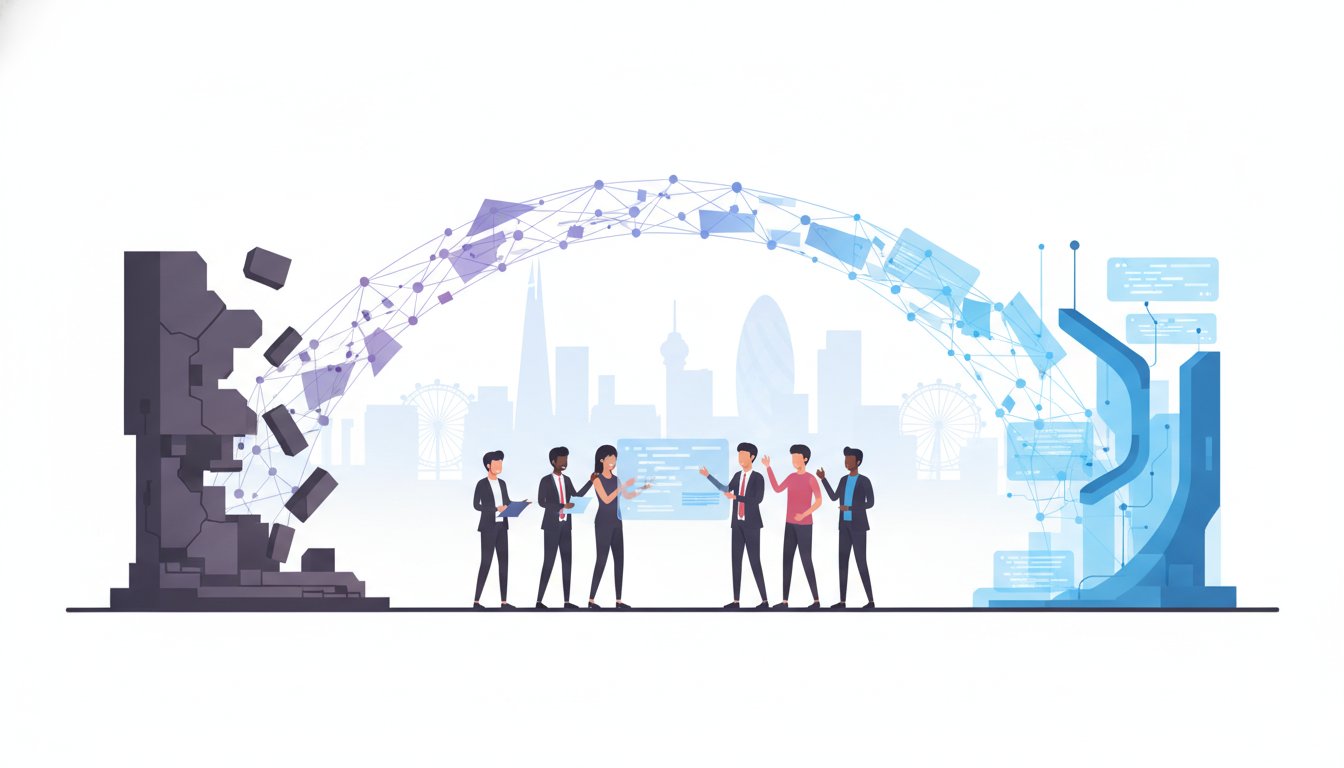
With the UK government alone spending £2.3 billion annually on outdated technology, it's clear that the cost of doing nothing is no longer an invisible line item. You've likely felt the friction of skyrocketing maintenance costs and the mounting frustration of a codebase that refuses to talk to modern AI tools or cloud-native frameworks. It's a common bottleneck for established firms where legacy system modernisation UK becomes a strategic necessity rather than a technical choice. Many leaders find themselves trapped by security vulnerabilities in unsupported frameworks and a dwindling pool of developers who understand obsolete languages.
We understand that your software should be a foundational asset, not a source of constant firefighting. This guide shows you how to transform these technical liabilities into high-performance, AI-ready assets using bespoke engineering and clean code principles. You'll learn how to move beyond basic patches to achieve a secure, scalable architecture that supports seamless API integrations. We'll provide a structured roadmap for implementing AI within your existing environment, ensuring your transition from ageing software to a modern digital platform is manageable, transparent, and built for longevity.
Technical debt has become the single greatest obstacle to business agility for UK firms in 2026. While maintaining a legacy system might seem like the safe financial choice, the reality is a compounding drain on resources. Research indicates that 60% to 80% of IT budgets are now consumed by simply keeping outdated software operational. This leaves little room for the innovation required to stay competitive in a landscape increasingly defined by real-time data and automated decision-making.
Legacy system modernisation UK is no longer just about upgrading old code; it's about building the infrastructure necessary for AI-readiness. The UK government’s commitment of £20 billion for digital transformation highlights a national shift toward modern data architectures. For private enterprises, this means moving away from the 'keep the lights on' mentality. Instead, firms must treat their software as a foundational digital asset that can integrate with modern LLMs and cloud-native services without constant manual intervention.
Updating your stack provides a direct path to reducing operational friction. Rigid monoliths often prevent UK businesses from reacting to rapid market shifts or regulatory updates. By transitioning to flexible, modular designs, you enable your team to deploy new features in days rather than months. High-performance bespoke engineering allows for a tailored fit that off-the-shelf software cannot match. This structural integrity ensures that your platform can scale as your user base grows, turning your technical environment into a tool for momentum rather than a weight on your progress.
The perceived risk of system downtime often stalls essential upgrades. However, in 2026, the risk of technical stagnation exceeds the risk of a phased migration. Security vulnerabilities in unsupported frameworks and the difficulty of finding developers for obsolete languages create a precarious situation. We approach these challenges through professional transparency and meticulous planning. By breaking down a complex legacy system modernisation UK project into logical, manageable steps, we ensure that mission-critical operations remain stable. A structured journey toward growth relies on a technical ally who prioritises clean code and reliable execution over quick, temporary fixes.
Recognising the signs of architectural decay before a critical failure occurs is a vital skill for any technical leader. In the current UK market, the most prominent red flag is the "integration gap." If your team finds it impossible to connect your core software to modern third-party APIs or cloud-native services without extensive, fragile workarounds, your system has become an island. This isolation prevents you from leveraging the latest fintech tools—like Lumo Wallet for secure digital asset management—logistics platforms, or AI services that your competitors are using to gain speed. When legacy system modernisation UK is delayed, these friction points evolve from minor annoyances into significant operational barriers.
High support costs for frameworks that have reached end-of-life (EOL) represent another urgent warning. If you're paying a premium for developers who specialise in obsolete languages just to keep the system stable, you're effectively subsidising technical debt. This often coincides with the "One Person" risk; a dangerous dependency where only a single individual understands the intricacies of the codebase. If that person leaves, they take years of undocumented system knowledge with them, leaving your UK operations in a precarious position.
Maintaining 2026 UK cybersecurity standards requires more than just a strong firewall. Legacy environments often struggle to meet Cyber Essentials requirements because they rely on outdated libraries with known vulnerabilities. Under evolved GDPR rules, the inability to precisely track or delete data within a convoluted database can lead to significant regulatory fines. The cost of a potential breach or a non-compliance penalty now far outweighs the investment required for professional legacy code modernisation that builds security into the very core of the application.
Old codebases were rarely designed to handle the traffic spikes or the high-performance frontends expected today. "Spaghetti code" often hides deep-seated performance issues where a single new feature request triggers a cascade of bugs. Slow database queries don't just frustrate users; they actively diminish business productivity and lower conversion rates. If your system requires frequent restarts or manual intervention to handle peak loads, it's a clear signal that your current architecture can no longer support your growth ambitions. Transitioning to a modular, clean-coded structure is the only way to ensure your platform remains responsive under pressure.
Selecting the right technical path for legacy system modernisation UK requires a balance between immediate operational needs and long-term architectural health. Most UK firms choose between replatforming and rearchitecting. Replatforming involves moving existing code to a modern cloud environment with minimal changes. While this offers a quick win for hosting costs, it rarely addresses the underlying technical debt. In contrast, rearchitecting involves a deeper transformation of the system's core structure. This path often delivers a superior ROI because it removes the bottlenecks that stifle growth; re-architecting projects are seeing a projected CAGR of 22.74% as businesses prioritise agility over mere survival.
A full bespoke rebuild is frequently the most viable option for mission-critical systems that have become too fragile to maintain. This approach allows your technical team to implement clean code principles from the ground up, ensuring every line of software serves a specific business purpose. For organisations that cannot afford a "big bang" replacement, encapsulating legacy code through modern API wrappers provides a manageable middle ground. This strategy allows you to build new, scalable microservices around the old monolith, gradually siphoning off functionality until the legacy core can be retired. This phased legacy system modernisation UK ensures business continuity while steadily improving system performance.
Off-the-shelf "wrapped" solutions often promise a fast fix, but they frequently introduce new layers of complexity without solving the original structural issues. Custom code provides the structural integrity needed for future growth, allowing your platform to evolve alongside your business. Relying on generic software often leaves you waiting for third-party updates that may never align with your specific UK market requirements. Choosing high-quality custom web application development services ensures that your architecture is built to your exact specifications, providing a level of performance and security that generic licenses simply cannot match.
An API-first strategy acts as the bridge between your historical data and the modern web. By implementing robust API integration, you can connect ageing backend databases to high-performance Vue.js or React frontends. This separation of concerns allows you to refresh the user experience immediately while you modernise the underlying logic in the background. It also enables better interoperability between disparate UK business systems, ensuring that data flows freely across your organisation. Preparing your data layer for high-performance cloud execution in this way is a prerequisite for any firm looking to implement AI-driven automation in the near future.
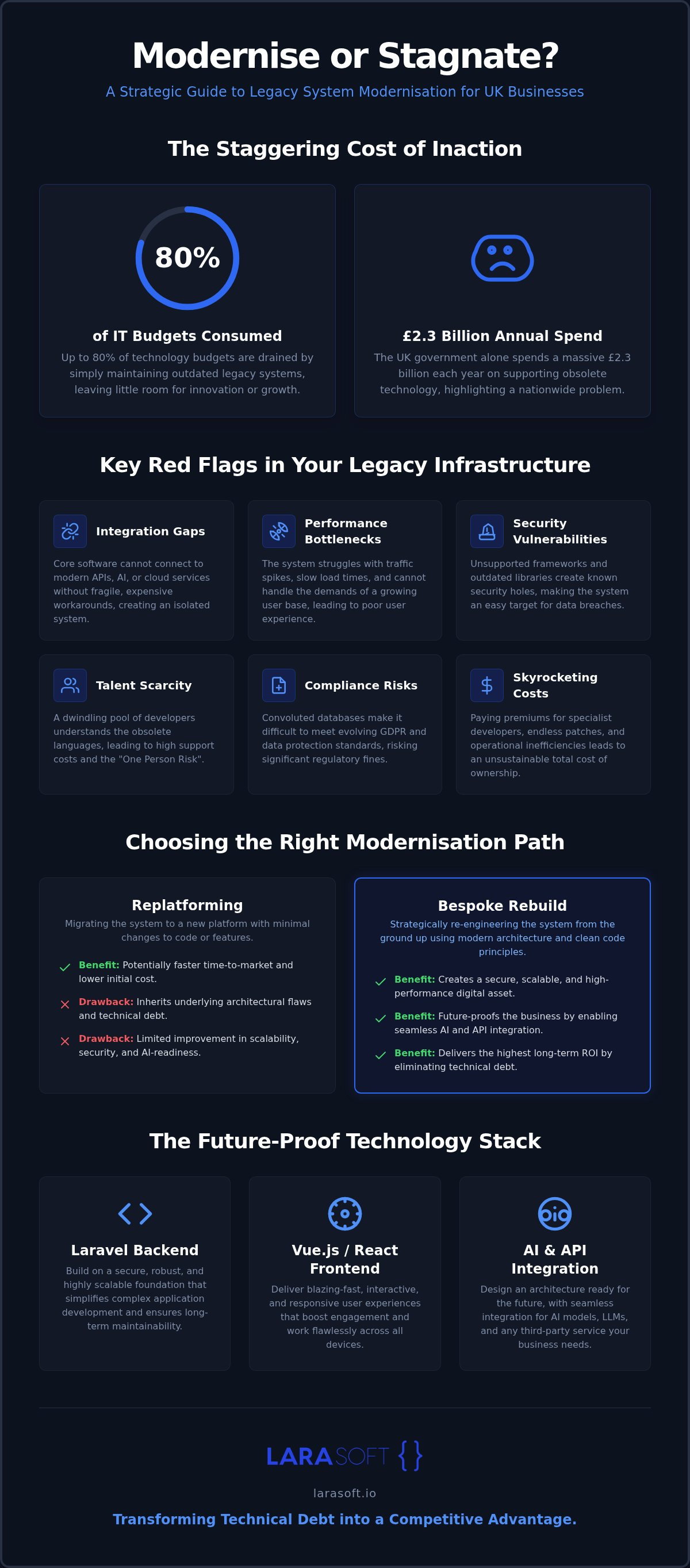
Building for the future requires a framework that balances rapid development with architectural rigour. In the context of legacy system modernisation UK, Laravel has emerged as the premier choice for enterprise-grade transformations. By August 2026, with the stability of Laravel 13.25.0, the framework provides a robust foundation for firms looking to move beyond fragile, inherited codebases. It offers the structural integrity needed to handle complex business logic while remaining flexible enough to integrate with the latest cloud-native tools. This shift ensures that your software isn't just updated for today, but engineered to scale with the demands of the next decade.
The transition to a modern stack also provides the perfect opportunity to implement high-performance frontends. Using Vue.js or React allows you to decouple your presentation layer from your business logic. This separation means that your user interface can remain lightning-fast and responsive, even when the backend is processing heavy data loads. Research shows that re-architecting applications around these modern, API-first designs is the fastest-growing approach in the industry, currently seeing a 22.74% annual growth rate. It's a strategic move that turns a slow, monolithic application into a fluid digital experience.
Laravel’s vast ecosystem simplifies the process of resolving years of accumulated technical debt. The framework’s built-in security features, such as protection against SQL injection and cross-site scripting, provide an immediate safety net for systems previously riddled with vulnerabilities. Professional legacy code modernisation using Laravel allows for a clean break from obsolete libraries. It introduces a standardised directory structure and dependency management that makes your codebase easier to maintain and audit. This discipline is essential for UK firms that must adhere to strict data protection and cybersecurity standards.
The most significant shift in 2026 is the widespread adoption of AI-driven automation. Over 75% of organisations now use AI to accelerate their modernisation projects and enhance system capabilities. By leveraging Laravel AI integration, you can deploy intelligent agents that automate manual data entry from legacy databases or provide predictive business analytics. These tools work best when paired with a high-performance frontend. Implementing Vue.js frontend development ensures that these AI-powered features are delivered through a seamless, intuitive interface. If you're ready to transform your ageing software into an AI-ready asset, you can consult with our technical specialists to map out your integration journey.
Choosing a partner for legacy system modernisation UK is a decision that dictates the trajectory of your technical infrastructure for years. While offshore models often promise initial cost savings, they frequently lack the professional transparency and architectural rigour required for complex UK enterprise environments. We provide a structured journey that begins with a comprehensive technical audit. This process identifies the specific bottlenecks in your current stack, from security vulnerabilities to integration gaps, before a single line of new code is written. Our goal is to move you from a state of technical stagnation to one of fluid, reliable performance.
Our execution phase follows a logical, highly organised progression. We don't just patch old software; we build foundational assets. This involves transitioning from monolithic structures to modular designs using high-performance engineering. Once the migration is complete, we ensure long-term stability through dedicated software maintenance. This ongoing support prevents the re-accumulation of technical debt, ensuring your system remains performant as UK market conditions evolve. By treating development as a meticulous craft, we ensure that every technical intervention serves a strategic business purpose.
Once your technical milestones are reached, celebrating the transition with your team can boost morale; for those in the Leicester area looking for event inspiration, click here for a guide on selecting the ideal venue for baby showers and other special occasions.
We believe in structural integrity above all else. Our team of technical artisans takes pride in writing clean, efficient code that performs perfectly under pressure. Unlike off-the-shelf software, which often forces your business processes into a restrictive box, our bespoke builds are designed to adapt to your specific operational needs. This approach ensures your architecture is scalable and ready for the next wave of digital innovation. We act as your dedicated technical ally, providing the specialised knowledge needed to navigate complex migrations with confidence. Our philosophy is simple: build it right, build it to last, and build it for growth.
Managing projects across the United Kingdom requires momentum and clear communication. We handle the heavy lifting of digital transformation, allowing your internal teams to focus on core business growth. By future-proofing your digital assets for the 2026 economy, we help you turn legacy liabilities into competitive advantages. This partnership model relies on professional distance and mutual respect for specialised knowledge. It's about more than just a one-off product; it's about building a foundation for your firm's future. Ready to transform your infrastructure? Request a technical consultation with Larasoft to begin your legacy system modernisation UK journey.
Transitioning from accumulated technical debt to a scalable, AI-ready environment requires more than just a surface-level fix. It demands a commitment to structural integrity and a clear roadmap for legacy system modernisation UK. By identifying the red flags in your current infrastructure and selecting a path based on bespoke engineering rather than restrictive off-the-shelf software, you turn a liability into a foundational asset. This transition ensures your business remains responsive to market shifts while maintaining the highest standards of security and performance.
At Larasoft, we've acted as a dedicated technical ally since 2018, specialising in Laravel AI solutions and custom API integrations that bridge the gap between old data and modern user experiences. Our UK-based team prioritises clean code and architectural rigour to ensure your migration is a manageable, structured journey toward growth. Ready to begin your transformation? Partner with Larasoft for Expert Legacy Modernisation and leverage our track record in complex technical migrations to future-proof your digital operations. Your software should be the engine of your growth; it's time to build a system that performs perfectly under pressure.
Critical signs include an inability to meet modern UK cybersecurity standards and a reliance on developers for obsolete languages. If your software maintenance costs are consuming the majority of your IT budget, it's a clear indicator. Frequent system crashes during traffic spikes or the inability to connect with third-party cloud services also signal that your architecture has reached its limit. Recognising these friction points early prevents a total system failure that could halt your operations.
The timeline for a legacy system modernisation UK project depends on the system's size and the chosen strategy. A phased migration of a single module might take three to six months, while a full bespoke rebuild of a mission-critical platform can span twelve to eighteen months. We prioritise a structured journey that delivers incremental value, allowing your team to use new features while we modernise the core logic in the background.
Strategic planning ensures that your daily UK operations continue without significant interruption. We utilise techniques like blue-green deployments and phased API-first migrations to keep your current environment stable while building the new infrastructure. By running the legacy and modern systems in parallel during the transition, we mitigate the risk of downtime. Professional transparency throughout the process keeps your stakeholders informed and ensures a fluid transition to the new architecture.
Choosing between refactoring and rebuilding depends on the level of existing technical debt. Refactoring is suitable for systems with a solid foundation that just need modern updates or library migrations. However, if the spaghetti code is too deep or the framework is entirely unsupported, a bespoke rebuild often provides a higher long-term ROI. A clean-slate approach allows us to implement architectural integrity and clean code principles that support your growth for the next decade.
AI integration typically starts with creating a robust data layer through custom API integration. Once your legacy data is accessible via modern endpoints, we can implement Laravel AI solutions to automate complex workflows or provide predictive analytics. Intelligent agents can then interact with your historical data to generate insights or handle repetitive manual tasks. This approach allows you to leverage modern machine learning without needing to replace your entire database structure immediately.
Modern frameworks like Laravel offer built-in security features that legacy systems often lack. These include automated protection against common vulnerabilities like SQL injection and cross-site scripting. By migrating, you benefit from a standardised directory structure and regular security patches that align with UK Cyber Essentials requirements. This structural integrity is vital for protecting sensitive customer data and ensuring your firm remains compliant with evolved GDPR regulations.
Modernisation costs vary based on the project's scope, but a typical legacy system modernisation UK for an SME often ranges between £5,000 and £150,000. These figures reflect the complexity of technical audits, data migration, and the development of a bespoke architecture. While the initial investment is significant, it's important to weigh this against the ongoing drain of maintaining outdated code. Investing in a foundational asset reduces these long-term operational costs.
Bespoke development ensures your software is a perfect fit for your specific business processes. Off-the-shelf software often involves restrictive licensing fees and forces you to adapt your workflows to their limitations. A specialised UK agency builds systems with structural integrity and clean code, providing the scalability needed for future expansion. This partnership model offers a competitive edge by allowing you to own your digital assets and integrate custom features that off-the-shelf products simply cannot support.
Here’s what we've been up to recently.
Certified Quality. Great Prices