Legacy PHP Modernisation: A Practical 2026 Guide

A full rewrite can be the riskiest way to modernise a legacy PHP application. If changes are already taking longer and are harder to test, replacing everything at once may add disruption before the team understands what needs to change. Yet leaving ageing code and dependencies untouched can also make future work less predictable. A considered legacy php application modernisation plan starts by identifying the problems the business needs to solve.
The answer is to make decisions from evidence, not assumptions. A structured assessment can show where technical risk sits, which parts of the system still support the business well and where targeted improvements could make the biggest difference. You don’t need complete architectural certainty to begin, but you do need a clear view of the application’s condition and priorities.
This guide explains how to assess your PHP application, weigh an incremental upgrade against a migration or rewrite, and build a roadmap that protects ongoing operations. It also explores how Laravel development, API integration and software maintenance can support a controlled plan, preserving useful business logic while making the system easier to maintain and evolve.
An application can become harder to change without suddenly becoming unusable. As code, dependencies and integrations accumulate, a small feature may require checking several connected parts of the system. Teams can spend more time tracing behaviour, testing side effects and correcting defects, leaving less capacity for planned improvements. The result may be slower delivery or greater uncertainty around releases, affecting customer journeys, internal processes and business priorities.
Legacy PHP application modernisation is the planned improvement of an existing system so it remains maintainable and useful, without assuming it must be replaced in full. The application’s age alone doesn’t determine whether it needs attention. A mature system may still handle essential workflows reliably; the key question is whether its structure and dependencies allow the business to maintain it and meet future needs. Over time, shortcuts and workarounds can add technical debt, making change more costly or uncertain.
Look for patterns to investigate, not instant proof of a particular cause. Recurring defects in the same workflow, fragile releases that require careful manual checks, or developers duplicating logic because existing code is hard to reuse can all indicate areas that deserve closer review.
Limited automated tests make it harder to judge whether a change has affected other behaviour. Incomplete documentation can create similar uncertainty, particularly when a workflow depends on rules that only long-serving team members understand. These gaps don’t mean the whole application is unsound; they show where evidence is thin and changes may need more careful assessment.
Operationally, slow delivery can delay a planned integration, leave a customer journey difficult to improve, or force staff to keep using a manual workaround. Track where these delays occur and which business activities they affect. This helps distinguish a genuine constraint from a general sense that the code is old.
Established applications often contain business rules shaped by years of real use, familiar workflows that staff rely on, and integrations with other systems. Some of this logic may be poorly documented but still support an important process. Preserving it can be as important as improving the technology around it.
Replacing a system before mapping its dependencies can disrupt those workflows or leave important behaviour out of the replacement. A controlled approach starts by understanding what the application does, who relies on it and how information moves between connected services. That context helps teams decide what to retain, change or retire rather than treating age as a reason to start again.
For a wider view of how technical priorities connect with business planning, see this legacy code modernisation strategic guide. The practical principle is to protect useful business logic while directing modernisation effort towards clearly identified needs.
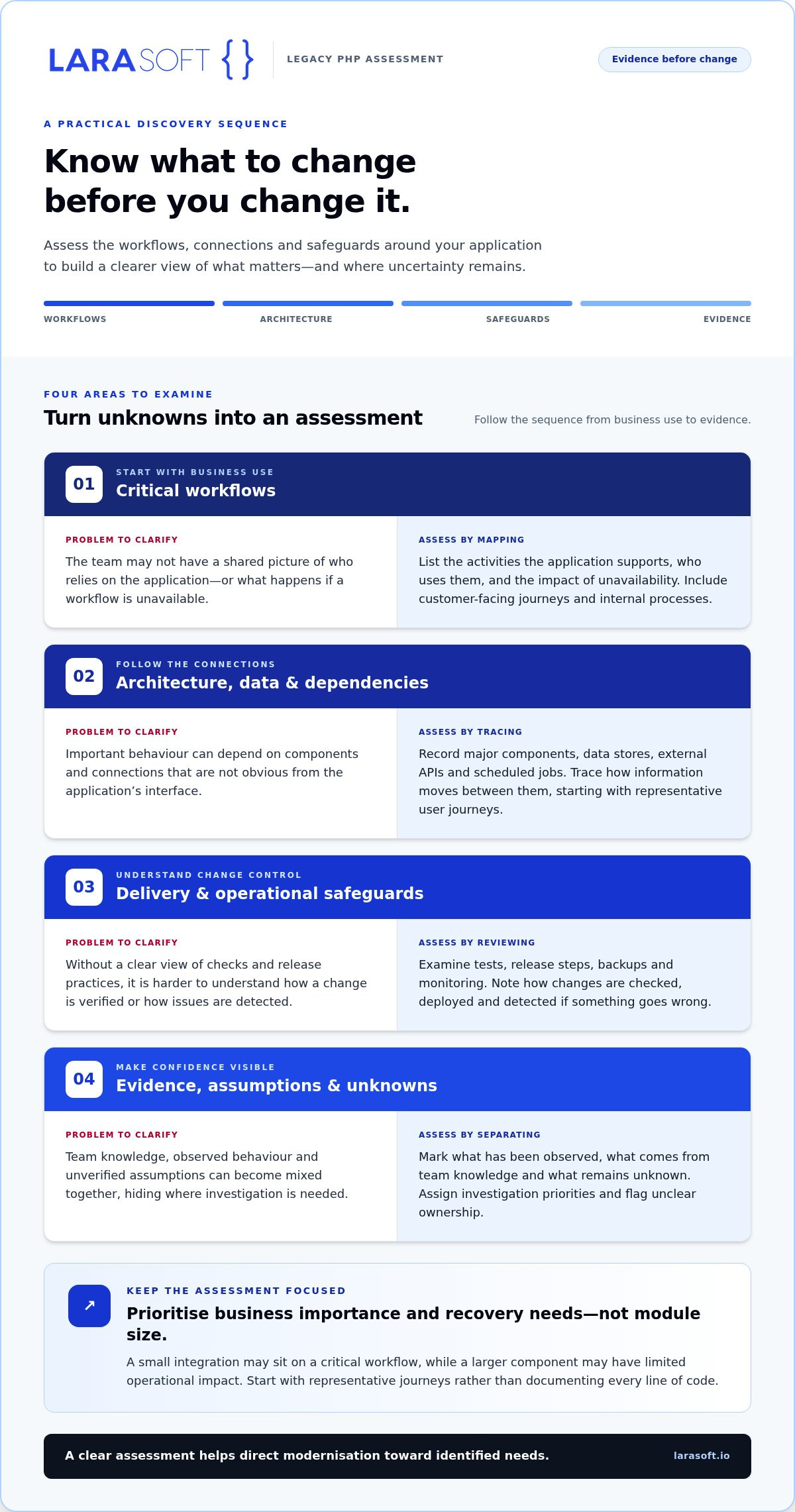
A modernisation plan should begin with system evidence and business priorities, not assumptions about what needs replacing. A clear assessment turns an unfamiliar codebase into a practical picture of how the application works, what it supports and where change needs careful control. For legacy php application modernisation, that picture should cover business workflows as well as technical components.
Work through the discovery in a deliberate order:
Start with representative journeys rather than attempting to document every line of code. For example, trace how a user action reaches the application, which data it reads or changes, and whether an external API or scheduled job is involved. A diagram or simple component inventory can reveal connections that aren’t obvious from the application’s interface.
Prioritise by business importance and recovery needs, not by the size of a code module. A small integration may sit on a critical workflow, while a larger component may have limited operational impact. Record who owns each system connection and flag unclear ownership, undocumented behaviour or dependencies whose support status needs investigation.
Inventory the PHP runtime, framework and package dependencies, then compare their versions and support status with current authoritative sources. Record findings alongside the source and date checked, so the assessment can be revisited as support information changes. Dependency age alone doesn’t establish the right response; compatibility, exposure and the application’s role all matter.
Next, inspect how the team tests and releases changes. Note which critical workflows have automated coverage, where checks are manual, and how deployments can be reversed or corrected. Review backup and monitoring arrangements as they actually operate, rather than assuming a tool or process exists. IBM’s overview of technical debt in software development can help frame how accumulated compromises affect future work.
Keep a separate list of questions that need specialist review, including security or compliance concerns where the application’s data, users or operating context make them relevant. Make unknowns visible rather than disguising them as conclusions. Larasoft’s legacy code modernisation team can help connect assessment findings with agreed technical priorities.
There’s no single best route for every PHP application. The assessment should show which parts are valuable, where the constraints sit and how much operational change the business can absorb. For legacy php application modernisation, compare the options against continuity, technical scope and the outcomes the organisation needs, rather than treating a rewrite as the default definition of progress.
The approaches differ in where they place the boundary between existing and new code:
| Approach | May suit when | Trade-off and key question |
|---|---|---|
| Incremental refactoring | Core workflows remain useful and the architecture allows parts to be improved in stages. | Change can be focused, but old and improved code may coexist. Which component should be addressed first? |
| Framework migration | The application’s requirements remain relevant, but its current structure or framework limits ongoing development. | Moving functionality into a framework such as Laravel requires careful mapping and validation. Which business rules and integrations must carry across? |
| Full replacement | Assessment shows that major constraints or changed business needs make the existing design unsuitable as a foundation. | It offers scope to redesign, but requires a broader transition and a plan for continuity. How will essential workflows operate during the changeover? |
These routes aren’t always mutually exclusive. A mixed strategy might replace one isolated component while refactoring another and leaving stable areas in place. This can align effort with business priorities, provided the boundaries between components and the long-term architecture are clear.
Staged improvement can suit an application whose key workflows still serve the business and whose architecture has workable boundaries. Teams might first add tests around a frequently changed area, then refactor it or isolate a component behind a defined interface. This creates clearer change boundaries and makes behaviour easier to check as work proceeds.
Incremental doesn’t mean unplanned. Without architectural direction, successive local fixes can create more inconsistency. Set an intended structure, agree priorities and define how each change contributes to that direction. The sequence should reflect operational importance, not simply whichever code is easiest to edit.
A larger change may be justified if discovery reveals constraints that block required capabilities, dependencies that cannot support the intended direction, or business requirements the current design cannot reasonably accommodate. These are assessment factors, not automatic triggers. First clarify what must change, what can be preserved and how data, integrations and user workflows would transition.
A Laravel migration may fit when the project’s requirements and technical discovery support that direction. A framework change alone won’t automatically resolve poor code structure or improve performance; those outcomes depend on the design and implementation. Compare the options against agreed business goals, delivery capacity and continuity needs, then choose a route the team can govern and evaluate as it progresses.
A roadmap turns assessment findings into controlled work. For legacy php application modernisation, agree the business outcomes first, then set a baseline showing how the relevant workflows and system behave before changes begin. Choose measures that fit those outcomes, such as whether a priority workflow completes correctly, how often a recurring defect appears, or how much manual work a process requires. Record the method as well as the result so later reviews use a fair comparison.
Build the plan in stages:
These checkpoints make scope and decisions visible to technical teams and business stakeholders. Communicate what each stage changes, which workflows may be affected and how issues will be reported. Plan validation and rollback before release, with a clear response if a change causes unexpected behaviour. Utilizing production readiness review services can help teams evaluate operational safeguards and verify that deployment procedures are resilient before going live. The appropriate rollback method depends on the change and system architecture, so define it for each increment rather than relying on a generic procedure.
Use a simple prioritisation record: describe the user or operational impact, dependencies, evidence for the proposed change and what remains uncertain. A change that reduces risk in a critical process may take precedence over a visible but optional enhancement. Keep essential scope distinct from future improvements; this makes decisions easier when capacity or new findings alter the plan.
Sequence API integration work around mapped dependencies. If a workflow relies on an external service, identify the data exchanged, the systems affected and the checks needed to verify the connection. This helps the team address prerequisites before changing the integration itself, while keeping related work aligned with business needs.
Where the architecture and project conditions allow, use small increments that can be reviewed against the baseline. Agree in advance how the team will test representative workflows, monitor behaviour after release and respond to unexpected results. Measures should reflect the intended outcome, not arbitrary targets; review them after each stage and revise priorities as evidence improves.
Specialist delivery can help connect technical decisions with a coherent implementation plan. Larasoft’s custom Laravel development agency guide explores what to consider when Laravel is part of the approach. A modernisation plan should connect those choices to your application’s priorities and architecture.
Modernisation is most effective when technical work follows a clear understanding of the application and the business processes it supports. Larasoft provides legacy code modernisation, bespoke Laravel development, API integration and software maintenance. These capabilities can be brought together around assessment findings and agreed priorities, preserving useful business logic while addressing the changes that matter.
The right scope depends on your application. Some projects need focused improvements to existing code; others call for migrating selected functionality or developing new components. Laravel, Vue.js and React are options where they fit the requirements, not prerequisites for every modernisation plan. The objective is a maintainable solution shaped by the system’s constraints and intended direction.
Custom Laravel development can support planned application changes when the framework suits the project’s requirements and architecture. That might mean building or extending part of a custom web application while retaining established workflows elsewhere. Where a frontend needs to work alongside the application, Vue.js or React can also form part of the design if they meet the project’s needs.
Integration work should follow an understanding of system dependencies and data flows. Once teams know which applications exchange information, what those exchanges support and where responsibilities sit, API integration can be planned around the right boundaries. This keeps connectivity work tied to actual business processes rather than treating an API as an isolated technical task.
Modernisation also extends beyond the initial changes. Software maintenance supports continued attention to the application as needs evolve, helping teams plan future development in the context of the system they have built. Together, modernisation, development, integration and maintenance connect technical improvements with the longer-term application roadmap.
You don’t need a finished technical specification to begin a useful discussion. A concise outline can provide a strong starting point:
This gives the discussion a practical foundation: what is known, what needs further investigation and which potential routes merit consideration. It helps avoid presuming a rewrite or a particular outcome before the application’s needs are understood.
If you’re considering legacy php application modernisation, bring the workflows, concerns and goals you already understand. A focused discussion can help clarify the questions to investigate and the sensible next step for your system.
Modernisation doesn’t have to begin with a commitment to a particular framework or a fixed end-state. Start by deciding what the application needs to make possible next, then shape the work around that direction. This keeps legacy php application modernisation connected to business priorities while leaving room to adjust as the system and its needs become clearer.
Larasoft brings legacy code modernisation and Laravel development together with API integration and software maintenance, connecting technical priorities with the application’s wider development needs. The right first step might be a focused assessment, a defined improvement or a broader discussion about the system’s future. What matters is choosing a path your organisation can understand and progress with confidence.
If you’re ready to explore a practical next step, discuss your legacy PHP application with Larasoft. Bring the questions you’re working through and the outcomes you want the application to support.
Legacy PHP application modernisation means making deliberate technical changes so an existing application can continue to support business needs. The work might involve updating PHP and package dependencies, improving a specific module, or replacing a part of the system while keeping other functionality in place. The appropriate scope depends on the application. Modernisation can address a defined maintenance issue without requiring a complete redesign.
Neither approach is automatically better; the right choice depends on what the application must do and what its current structure can support. If key processes work and change can be contained, updating selected areas may be more suitable. A rewrite may deserve consideration if fundamental requirements have changed or the existing design blocks essential capabilities. Compare transition risk, preservation of business rules and the capacity to run old and new functionality where needed.
Yes, some modernisation work can leave the database structure intact. For example, a team could improve application code or update a user-facing feature while continuing to use existing tables. First check how the application reads and writes data, including any reports or connected systems that rely on the current schema. If changes to the data model are later needed, plan those separately and test data integrity before deployment.
Reduce user impact by choosing a contained change, verifying the affected journeys in a test environment and scheduling release activity around the organisation’s operational needs. For example, a change to an account form should be checked for successful submission, validation and any downstream processing it triggers. Prepare a way to identify unexpected behaviour and communicate relevant changes to users or staff. The level of disruption depends on the change and application architecture.
There isn’t a reliable timeframe without understanding the application and the work involved. Updating a bounded component is different from migrating a framework, untangling several integrations or replacing core workflows. The schedule also depends on access to knowledgeable stakeholders, available tests and how much behaviour needs to be discovered. A useful estimate follows an initial scope and dependency review, with uncertainty recorded rather than hidden inside a fixed delivery assumption.
Yes, a PHP application can be migrated to Laravel, either as a broader transition or by moving selected functionality in stages. The approach depends on compatibility, business rules, data handling and connections to other systems. Laravel provides a different application structure, but moving code into a framework won’t automatically resolve design or performance issues. Define how each required workflow will behave in the migrated application and validate it against the existing system.
Look for recurring problems that affect delivery or operations, such as repeated defects, releases that require extensive manual checking, or routine changes that are difficult to make safely. Then check whether the issue is isolated or appears across several workflows. A mature application that continues to meet business needs may not need broad intervention. The case for modernisation is stronger when evidence shows current constraints are affecting maintenance, planned changes or essential processes.
Here’s what we've been up to recently.
Certified Quality. Great Prices