Laravel LangChain Integration: Architecture, Options and Implementation

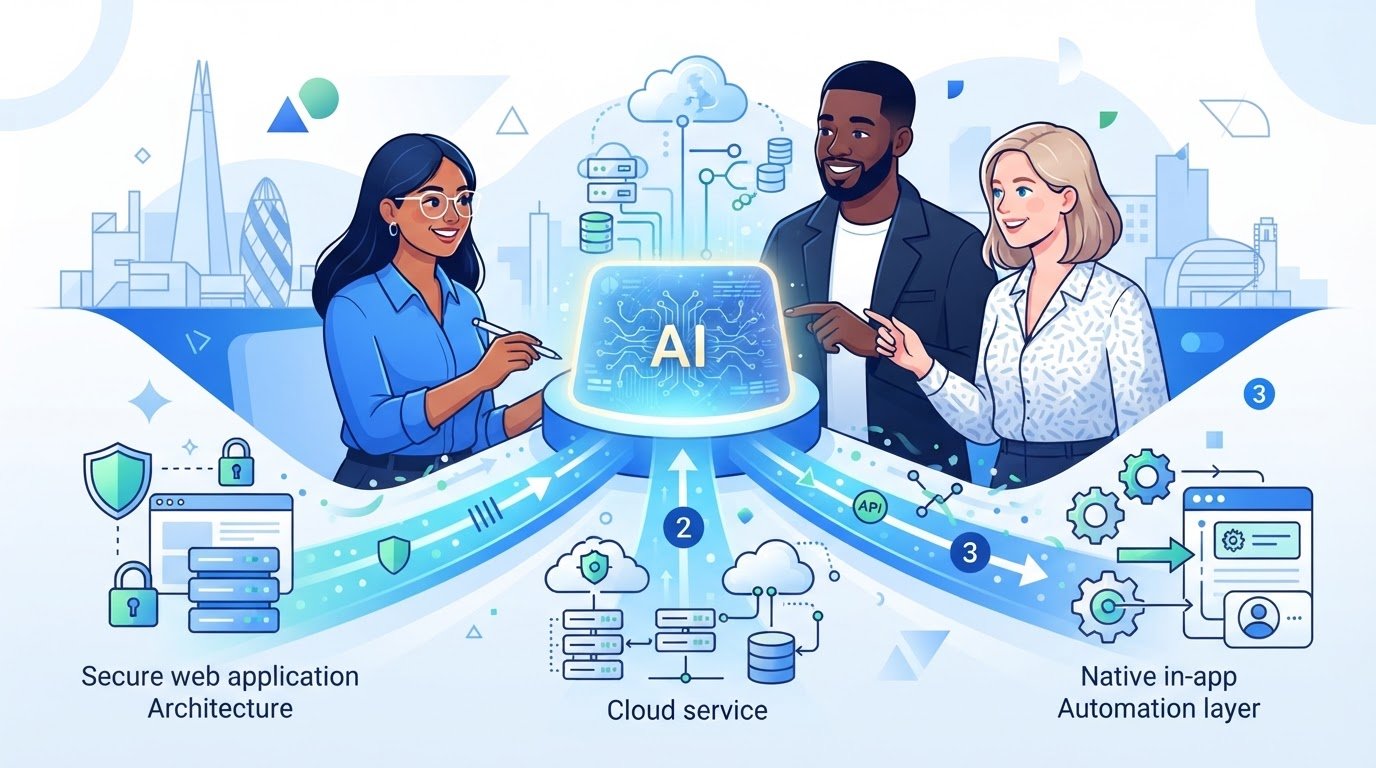
The most maintainable laravel langchain integration may not use LangChain at all. The right choice depends on where the AI workflow should run, which tools your team can support, and how it needs to fit your Laravel application.
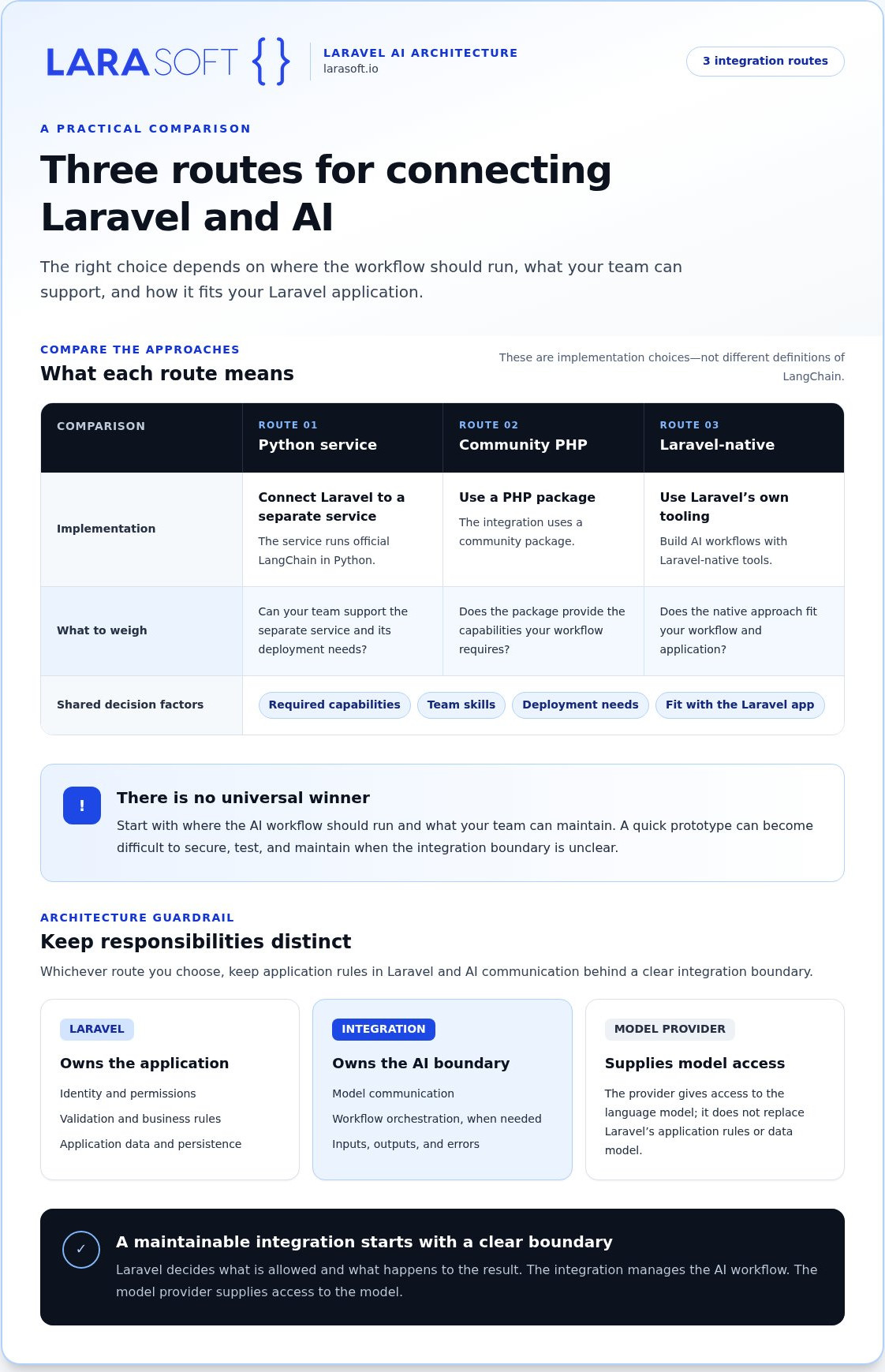
There are three distinct options: connect Laravel to a separate Python service running official LangChain, use a community PHP package, or build AI workflows with Laravel’s own tooling. Each suits different requirements. A quick prototype can become difficult to secure, test and maintain if the integration boundary isn’t clear from the start.
This guide explains how LangChain concepts map to Laravel, compares PHP and service-based approaches with Laravel-native tooling, and outlines architecture and implementation choices. You’ll also find practical guidance on queues, validation, provider flexibility and production safeguards. Larasoft provides Laravel AI integration to help turn a promising experiment into a maintainable part of your application.
LangChain is a framework and ecosystem for composing applications around large language models (LLMs). It provides building blocks for connecting models with prompts, tools, data sources and multi-step workflows. As outlined by LangChain Wikipedia, its purpose is to help developers build applications that use language models, not to provide the models themselves.
In short, LangChain is an orchestration framework; a model provider such as OpenAI supplies access to the AI model. A Laravel LangChain integration connects application workflows to model access and, where required, orchestration capabilities. That connection might use a PHP package, Laravel’s AI tooling or a remote service running LangChain. These are implementation choices, not different definitions of LangChain.
This distinction matters because model access, workflow orchestration and application rules have separate responsibilities. A model can generate text, but Laravel should determine what a user is allowed to do, which records they can access and what happens to the result. LangChain concepts can organise AI steps; they don’t replace your application’s business logic or data model.
Start with the concepts that address an actual product requirement. A model generates or interprets language. A prompt gives it task-specific instructions, such as asking it to summarise a support request in a consistent format. A tool lets an AI workflow call a defined capability, such as looking up an order through an application-controlled function.
A chain sequences steps, for example, classifying an incoming document before summarising it. An agent can choose among permitted tools based on a task, while retrieval supplies relevant material, such as selected policy documents, to inform an answer. These terms describe patterns, not a checklist. A feature that needs one predictable summary may need a prompt and model call, not an agent with multiple tools.
Keep the boundaries clear: Laravel owns authorisation, validation, business decisions and application data. The integration layer manages model communication and any orchestration the workflow needs. This separation makes it easier to test each responsibility and change an AI component without scattering provider-specific logic across controllers.
Useful applications begin with a user need, not the novelty of adding AI. An assistant could help users find answers in approved support content; a document workflow could extract fields from submitted files for staff review; or a business process could classify enquiries and route them to the right queue. In each case, the integration supports a defined task while Laravel retains control of records and actions.
These patterns don’t guarantee accuracy or suitability. Feasibility depends on the quality and access controls of the available data, the behaviour of the chosen model, and requirements such as response time and review steps. Define those constraints before deciding how much orchestration the Laravel feature needs.
A maintainable laravel langchain integration gives each part of the application a clear job. A controller accepts a request and returns a response; Laravel checks whether the user may perform the action; an integration service prepares the AI task and communicates with the model or orchestration layer. Laravel then validates the result before deciding whether to show it, store it or pass it to another process.
Consider a staff member asking for a summary of a customer account. The application first confirms their access and selects relevant records. The integration service sends only the approved context and task instructions to the AI workflow. The response returns to Laravel, where it can be checked against an expected format and reviewed or saved according to the business process. LangChain’s official architecture and feature overview can help clarify the orchestration layer, but it doesn’t take ownership of your application’s permissions or data.
Architecture summary: Laravel owns identity, authorisation, business rules and persistence; the integration boundary owns orchestration; the model provider supplies language-model access. Keeping those responsibilities distinct makes provider changes and workflow updates easier to manage.
Put prompts, model calls and orchestration behind a dedicated service or module. The controller should handle HTTP concerns, not provider-specific details. This boundary gives the workflow one place to manage inputs, outputs and errors, and makes it easier to test without routing every change through a user-facing endpoint.
Use a Laravel job when processing may take longer than a user request should wait, or when the work is suitable for controlled retries. A request can queue the task and return a clear status; the job calls the integration service and records completion or failure. Design retry behaviour deliberately so a repeated job doesn’t create duplicate records or actions.
Pass only the context needed for the task. Retrieve records through authorised application logic, then shape them into an explicit input contract rather than giving a model unrestricted database access. Define the output contract too: specify the fields or format expected, and treat returned content as untrusted until Laravel has checked it.
For example, a workflow might return a summary and a proposed category. Laravel can validate that the response contains the required fields and that the category belongs to an allowed set before storing it or using it downstream. If validation fails, route the result to an appropriate fallback or human review instead of assuming generated text is correct.
These boundaries are central to project-specific Laravel AI integration: they connect the workflow to real business needs without giving up application control. A well-defined service layer also provides a practical foundation for testing and ongoing maintenance.
There’s no single best route for a laravel langchain integration. The decision depends on the capabilities your product needs and the operational boundary your team can maintain. LangChain’s original ecosystem is Python-based; PHP options are community-developed, while Laravel’s AI SDK provides a Laravel-native way to build AI features without being a PHP port of LangChain.
Compare the approaches against your actual workflow, not a feature checklist. If the task needs a model call and one or two controlled tools, native Laravel tooling may be sufficient. If it depends on a specific LangChain integration available in Python, a separate service may justify the extra runtime. A PHP package can keep the implementation in one stack, provided its current capabilities and compatibility fit the project.
| Route | Potential fit | Trade-offs and checks |
|---|---|---|
| Community PHP LangChain package | Keep AI orchestration close to a PHP application. | Verify current feature coverage, provider support, maintenance activity, PHP and Laravel compatibility before adoption. |
| Laravel AI SDK | Build AI workflows using Laravel-oriented tooling and conventions. | It isn’t LangChain. Confirm that its current features cover the workflow you need. |
| Python LangChain service | Use Python-specific LangChain capabilities behind an API. | Adds a service boundary, API contracts, deployment ownership and service-to-service security to maintain. |
A PHP-native approach is practical when the team wants to keep application logic, deployment and day-to-day maintenance within its existing PHP stack. Before committing to a community package, check its repository activity, documentation, supported framework and PHP versions, provider integrations, and the exact features your workflow requires. Treat each point as a current verification task, not an assumed package capability.
Laravel’s AI SDK is another native option, especially when its available features align with the product. It can support Laravel AI workflows without a separate Python runtime, but it shouldn’t be presented as LangChain itself or assumed to offer identical integrations.
Choose a service boundary when a required integration or orchestration capability depends on LangChain’s Python ecosystem and isn’t practical to reproduce in PHP. Define a stable API contract for inputs, outputs, errors and timeouts. Also assign ownership for deployment, monitoring, authentication between services and interface changes.
A second runtime has a real operational cost, even if it doesn’t create a direct infrastructure problem. Avoid adding one simply to use a familiar framework name. The route earns its place when it provides a necessary capability or a meaningful boundary for the product and team.
Make the decision against required features, team skills, deployment constraints and long-term maintenance. For any named PHP package, confirm current compatibility and maintenance before building around it; for native tooling, compare actual workflow needs rather than assuming feature parity. This gives the architecture room to evolve without tying Laravel business processes unnecessarily to one AI framework.
A reliable laravel langchain integration starts with a narrow workflow and expands only after it performs well under realistic conditions. Treat implementation as a sequence of decisions and tests, not simply a package installation. Keep examples and configuration aligned with the specific package, Laravel version and deployment environment you’ve selected.
The first milestone should show that one complete workflow solves its intended user problem, not that the system can demonstrate every agent feature. Test typical and unusual inputs against agreed success criteria. Include a slow or failed response and invalid model output; confirm the application handles each safely. This gives the team evidence to refine the workflow before widening its scope.
Protect provider credentials in the deployment environment or an appropriate secrets store, not in source control. Enforce Laravel authorisation before retrieving records, and send only task-relevant context. Validate incoming requests and verify generated output against the expected schema and allowed values before storage or downstream use.
Set sensible limits for request frequency, input size, retrieved context and generated output. For queued work, define timeouts and retry behaviour that won’t create duplicate effects. Log operational signals such as latency, failure type and workflow status, while avoiding unnecessary prompts, personal data or other sensitive content. Restrict log access and retention to what the team needs for diagnosis.
Production gate: Release only after access controls, secrets handling, input and output validation, failure behaviour, operational limits and integration tests are in place.
Larasoft provides project-specific support for reviewing architecture, implementation and release safeguards through Laravel AI integration.
A framework choice becomes useful only when it connects to a real application workflow. Once you’ve selected an approach, turn the decision into a scoped plan: define what the feature must do, which Laravel responsibilities remain unchanged, and how the AI component will fit into the application over time. A well-planned laravel langchain integration should serve a clear business need without making routine application changes harder.
Make ownership visible in the plan. Identify who maintains the Laravel code, any AI framework or service, and the connections between them. This is particularly valuable when an existing product has established workflows, data structures or deployment processes that the integration must respect.
Start with the user workflow and its intended outcome. If staff need AI-assisted document classification, for example, define what information enters the workflow, what response Laravel expects, and how a person handles uncertain results. Record which records may be accessed, where decisions are made and what gets stored. These details turn a broad AI idea into a bounded implementation that can be designed and tested.
This map helps surface integration risks early. A change to a model provider, package or external API should have a known impact rather than causing unexpected changes across unrelated application code.
Larasoft builds bespoke Laravel applications and provides Laravel AI integration and API integration. These services support a project-specific approach: connect the chosen AI capability to the application’s workflows and existing systems, while keeping the implementation structured for future changes. The work can cover architectural decisions, integration boundaries and testing, with attention to how the feature fits the wider application.
For an older application, assess its existing code and interfaces as part of planning. Legacy code modernisation can help prepare the foundation for a new integration, while software maintenance supports application stability after launch. A delivery plan should account for both the initial feature and the ongoing work needed to keep its dependencies and behaviour maintainable.
When evaluating development support, consider how the team will connect architectural choices to your requirements, testing approach and longer-term ownership. Larasoft can shape Laravel AI integration around those project needs. Start planning an integration that fits your Laravel application and business workflow.
Your next move doesn’t have to be a full-scale AI rollout. Choose one workflow where a carefully designed laravel langchain integration could make a meaningful difference, then shape the architecture around how your application already works. A focused plan gives your team a practical route from technical evaluation to a solution that can evolve with the product.
That journey may involve custom Laravel web application development, connecting AI capabilities and external systems through Laravel AI integration and API integration, then supporting the application with ongoing software maintenance. The aim is not to add complexity for its own sake. It’s to make the integration a dependable part of your product and its future development.
Larasoft provides custom Laravel development, AI and API integration, and ongoing software maintenance. Discuss your Laravel AI integration with Larasoft to plan an implementation around your application and business workflow.
Yes, a Laravel LangChain integration can support multiple providers if the chosen library or service exposes the required connections. Place provider selection behind a consistent application interface, then route tasks according to needs such as output format or available capabilities. Before adding a fallback, define what happens to partially completed requests and how errors are reported. Switching providers isn’t automatically seamless: prompts, response formats and supported features can differ.
No. Send only the information needed for the current task, selected through application queries that respect the user’s permissions. For example, a request about one invoice should use the relevant invoice details, not an entire customer history. Keep retrieval filters and access checks in Laravel, and consider whether fields can be excluded or summarised before sending context. Smaller, task-focused inputs can also make it easier to inspect what the workflow uses.
Yes. A workflow can request a defined structure, such as fields for an enquiry classification or document extraction. Specify expected field types and allowed values, then validate the response in Laravel before using it. A response that looks structured can still contain missing fields, invalid categories or unsuitable content. Treat the schema as an interface contract, and decide how the application handles results that fail validation.
Set a bounded timeout and make the failure path explicit. A user-facing feature might show that the task couldn’t be completed and offer a way to try again, while background work can record a failed status for later handling. Retry only when appropriate, and make operations idempotent so a repeated request doesn’t create duplicate updates. Capture the failure type for diagnosis without exposing provider details or sensitive request data to users.
Yes. An existing application can add an AI feature around a specific workflow, provided its codebase and dependencies support the chosen integration approach. Start by tracing where the feature belongs in the current application, including its data access, user permissions and existing APIs. For older code, assess the relevant components before changing them. A contained integration boundary can limit disruption and make the new capability easier to maintain.
Separate predictable application behaviour from variable model output. Use fixed test responses to check parsing, validation, permissions and downstream actions, then maintain representative prompt cases to assess whether outputs meet the task’s criteria. Test edge cases such as empty, incomplete or unexpected responses. A limited live check can help reveal provider or configuration issues, but avoid relying on an exact generated sentence as the sole pass condition.
Here’s what we've been up to recently.
Certified Quality. Great Prices