Laravel with React Authentication: A Strategic Implementation Guide for 2026

Storing your authentication tokens in LocalStorage isn't just a technical shortcut; it's a security debt that 90% of modern projects can no longer afford to carry in 2026. You've likely felt the friction of choosing between Sanctum, Passport, and Inertia.js while trying to secure a decoupled architecture. Balancing a fluid user experience with rigid security protocols often feels like a moving target. This guide ensures you master the architectural choices and security protocols required to build robust, scalable laravel with react authentication. We'll provide a clear roadmap for choosing between session-based and token-based systems, specifically focusing on the latest standards in Laravel 13.9 and React 19.2. You will learn why the industry has shifted toward headless starter kits and how the built-in XHR client in Inertia.js v3 redefines your frontend logic. By the end, you'll have the confidence to implement a system that performs perfectly under pressure while protecting your digital assets for the long term.
The transition from traditional Blade-based monoliths to decoupled React frontends represents a fundamental shift in how we architect modern digital assets. In the past, Laravel handled both logic and presentation within a single codebase. Today, the framework functions as a high-performance API gateway. This separation allows React to manage the user interface while Laravel secures the data layer. Implementing laravel with react authentication requires a deep understanding of this stateless transition and the security protocols that govern it.
Laravel has evolved into a specialized backend powerhouse. It provides the structural integrity needed to handle complex business logic while offering a fluid transition for frontend frameworks. By 2026, the industry standard has solidified around Laravel Sanctum for the majority of React-based projects. It offers a bridge between the simplicity of traditional session-based auth and the requirements of modern single-page applications. This setup ensures that your application remains scalable and secure as user demands grow.
Separating the frontend and backend concerns significantly improves the developer experience. Your React team can iterate on UI components without touching PHP files; your backend engineers can optimize database queries without breaking the layout. This independence leads to faster deployment cycles and cleaner codebases. Performance also sees a boost, as React state management and asynchronous data fetching reduce server load and improve perceived speed for the end-user.
Headless Laravel serves as the centralized logic engine that powers web, mobile, and third-party integrations from a single source of truth.
Choosing the right tool depends on your specific business requirements. While some teams prefer the simplicity of a single repository, others require the flexibility of a fully independent API. Here are the primary options available in the 2026 ecosystem:
Consistency is vital for long-term maintenance. Whether a user logs in via a web browser or a native mobile app, the underlying laravel with react authentication logic must remain secure and predictable. This unified approach reduces maintenance costs and minimizes the surface area for security vulnerabilities across your entire digital ecosystem.
Selecting the right architecture for laravel with react authentication is a pivotal decision. It influences your team's velocity and the future scalability of your software. You must weigh the simplicity of a unified codebase against the flexibility of a fully decoupled system. This choice isn't merely about personal preference; it's a strategic move that dictates how your application handles state, security, and multi-platform expansion over the next several years.
Inertia.js v3.0.0, released in March 2026, is the premier choice for teams prioritizing development speed and a unified workflow. It allows you to build a single-page application while maintaining the classic Laravel routing and controller flow. This approach is perfect for internal tools and SaaS products where SEO isn't the primary driver. By utilizing the new built-in XHR client, Inertia v3 removes the overhead of managing separate API documentation. It simplifies the developer experience by keeping everything within a single repository. If your project doesn't require a separate backend for native mobile apps, this is often the most efficient path forward.
For projects requiring high levels of independence, a decoupled approach using Laravel Sanctum v4.3.2 is the industry standard. This architecture is essential if you plan to launch native mobile apps alongside your web platform. It allows your React frontend and Laravel API to scale independently. Frontend teams can work in a pure JavaScript environment, consuming data from endpoints that follow the OWASP REST Security Cheat Sheet. This separation ensures that your backend remains a clean, data-focused gateway. If you're upgrading older systems, our team specializes in Laravel Web Development to ensure these transitions are seamless and secure.
Evaluating your long-term maintenance is critical. While a decoupled setup offers more flexibility, it introduces the complexity of managing CORS and cross-domain authentication. Consider these factors during your planning phase:
SEO needs also play a role. While React 19.2 offers improved server-side rendering capabilities, a decoupled architecture requires more initial configuration to ensure search engines index your content effectively. Conversely, Inertia.js simplifies this by leveraging Laravel's server-side strengths. Your choice should align with your business's growth trajectory and the technical expertise of your current staff. Building on a solid foundation today prevents expensive refactoring tomorrow.
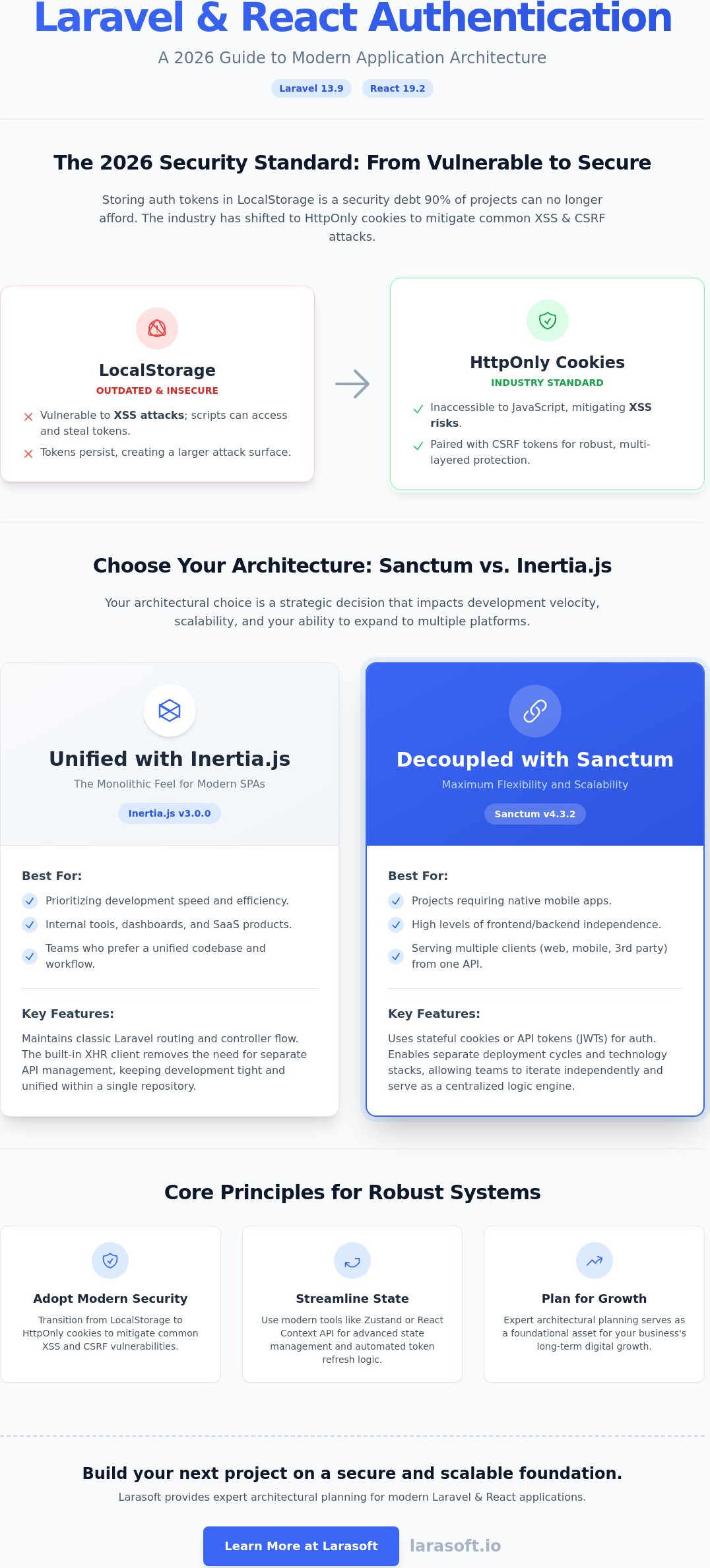
Security is the foundation of any professional digital asset. While many legacy tutorials suggest storing tokens in LocalStorage for ease of use, this practice creates significant vulnerabilities. By 2026, the industry standard for laravel with react authentication has shifted toward more sophisticated, cookie-based protocols. Protecting user data requires a multi-layered approach that addresses both Cross-Site Scripting (XSS) and Cross-Site Request Forgery (CSRF).
Laravel Sanctum v4.3.2 provides a stateful authentication layer that's ideal for modern React applications. This system relies on the browser's ability to store and send cookies automatically. To begin the process, your React frontend must first make a request to the /sanctum/csrf-cookie endpoint. This call initializes the CSRF protection by setting an XSRF-TOKEN cookie in the user's browser. Subsequent POST, PUT, or DELETE requests must include this token to be validated by the server. It's a silent but powerful handshake that secures every interaction.
HttpOnly cookies are superior to LocalStorage for storing sensitive authentication data because they're completely inaccessible to client-side JavaScript, which prevents malicious scripts from stealing user sessions. Using this method effectively neutralizes the most common XSS attack vectors found in React applications.
Correctly configuring Cross-Origin Resource Sharing (CORS) is another critical step. You must strictly define which domains can interact with your API. In a decoupled architecture, your cors.php configuration should only allow requests from your specific React frontend URL. This prevents unauthorized third-party sites from making requests on behalf of your users. We often implement these strict boundaries during API Integration projects to ensure data remains isolated and protected.
Beyond basic authentication, your system needs defense-in-depth strategies. Implementing rate limiting at the API level is essential to prevent brute-force attacks. Laravel 13.9 offers flexible rate limiting configurations that allow you to throttle requests based on IP addresses or authenticated user IDs. This ensures your application remains resilient even under heavy automated pressure.
Maintaining this level of structural integrity isn't just about code; it's about building a trustworthy platform. Our approach to Software Maintenance ensures that these security benchmarks are met and updated as new threats emerge. By prioritizing these protocols now, you protect your business from future liabilities and technical debt.
Scalability in laravel with react authentication is a multi-dimensional challenge. It involves balancing the immediate responsiveness of the frontend with the rigorous security checks required on the backend. As your application attracts more users, the way you handle state persistence and token lifecycles will determine whether your platform remains fluid or becomes sluggish. A strategic implementation focuses on minimizing latency while ensuring every request is verified with absolute certainty.
Managing authentication state effectively requires a deliberate choice between React's built-in tools and specialized libraries. While the Context API suffices for basic permission flags, we often utilize Zustand or Redux for more complex applications. These libraries provide a more predictable state container and better performance when dealing with deep component trees. To optimize data fetching, tools like React Query or SWR are indispensable. They handle the caching of authenticated data, ensuring that your React components render instantly by serving cached results before fetching fresh data in the background.
Global error handling is another essential component of a scalable architecture. Your application must handle 401 "Unauthenticated" errors gracefully across all API calls. By implementing global interceptors, you can catch these errors and trigger a seamless token refresh or redirect the user to a login screen without manual intervention. This ensures that user sessions persist across browser refreshes through secure, server-side cookie verification, maintaining both security and a frictionless user experience.
High-traffic environments put immense pressure on the authentication layer. To maintain performance, Laravel must perform user lookups and permission checks with surgical speed. Database indexing on unique identifiers is a prerequisite, but for truly high-scale apps, we recommend caching user roles and permissions in Redis. This prevents the system from hitting the primary database for every protected route, drastically reducing response times.
Advanced monitoring is also part of a modern scalability strategy. We leverage Laravel AI integration to monitor authentication events for anomalous patterns. By identifying suspicious behavior like rapid-fire login attempts or unusual access locations, the system can proactively block threats before they escalate. This level of security auditing is vital for maintaining the structural integrity of your digital assets. If you're planning a high-performance build, our React Frontend Development team can help you architect a system that scales effortlessly while remaining secure under pressure.
Constructing a robust authentication system isn't merely a technical box to tick. It's a strategic investment in the longevity of your digital platform. Professional architectural planning prevents the accumulation of technical debt, which often cripples growing businesses. When you implement laravel with react authentication through a bespoke lens, you ensure that the system remains performant and secure as your user base scales from hundreds to millions of active sessions.
Many UK enterprises currently operate on aging infrastructures that struggle to support decoupled React frontends. In these scenarios, legacy code modernisation becomes the most effective path forward. By upgrading the underlying security protocols and refactoring authentication logic, we transform a liability into a foundational asset. This process ensures that your backend can handle the stateless requirements of modern JavaScript frameworks without compromising the integrity of your historical data.
Third-party SaaS authentication providers often promise a quick start, but they carry hidden long-term costs. As your application grows, per-user pricing models can become a significant financial burden. A bespoke Laravel-based solution is frequently more cost-effective at scale. It offers total control over data residency, which is a critical requirement for compliance with UK data protection regulations. You own the code, you own the data, and you have the freedom to tailor the user onboarding journey to match your specific business logic exactly.
We believe that high-performance frontends shouldn't come at the expense of backend security. Our development process combines the fluid user experience of React 19.2 with the battle-tested security of Laravel 13.9. We take immense pride in the cleanliness and efficiency of our work, ensuring every line of code serves a strategic purpose. Our commitment doesn't end at deployment. We provide dedicated software maintenance to keep your authentication systems patched against emerging vulnerabilities and optimized for peak performance.
Success in the digital landscape requires more than just a service provider; it requires a deeply invested technical ally. Partnering with a specialized Laravel development agency provides the specialized knowledge needed to navigate complex implementation journeys. This partnership ensures that your authentication architecture isn't just a one-off product but a scalable system built to perform perfectly under pressure for years to come.
Mastering laravel with react authentication requires a deliberate shift from standard configurations to a high-performance, security-first architecture. You've seen how the choice between Laravel Sanctum and Inertia.js dictates your development velocity and how HttpOnly cookies provide the structural integrity needed to protect user data. By prioritizing these 2026 standards, you eliminate technical debt and build a foundation ready for multi-platform expansion. High-traffic applications demand this level of precision to ensure every user session remains fluid and secure.
Implementing these complex systems doesn't have to be a solitary journey. As an expert UK-based Laravel development team, we specialize in high-performance React frontends and have a proven track record in legacy code modernisation. We focus on building systems that perform perfectly under pressure, turning technical challenges into manageable paths for growth. Discuss your bespoke Laravel and React project with Larasoft today to ensure your platform is built for the long term. Your vision deserves the reliability of expert craftsmanship.
Laravel Sanctum is absolutely secure enough for enterprise-level applications when configured with HttpOnly cookies and proper environment hardening. It provides a robust foundation for laravel with react authentication by offering both stateful and token-based security layers. For 90% of modern web projects, it's the recommended choice because it balances high-level security with a simplified developer experience that reduces the risk of misconfiguration.
You should always store authentication tokens in HttpOnly cookies to mitigate Cross-Site Scripting (XSS) risks. LocalStorage is accessible to any JavaScript running on your page, making it a prime target for malicious script injections. By using HttpOnly cookies, you ensure that the token is invisible to client-side scripts, providing a much higher level of structural integrity for your user sessions.
CSRF protection across different domains relies on the browser's ability to share cookies between the API and the React application via Cross-Origin Resource Sharing (CORS). You must configure your Laravel backend to accept credentials from your specific frontend domain. Once established, the Sanctum middleware validates the XSRF-TOKEN cookie sent with each state-changing request, ensuring that the interaction is legitimate and authorized by the user.
Yes, Laravel Socialite integrates seamlessly with React by acting as the controller for the OAuth handshake. The process involves redirecting the user from your React frontend to a Laravel endpoint, which then handles the provider's redirect. After a successful login, Laravel returns the user to your React application with a secure session or token, allowing for a fluid and modern social login experience.
The primary difference lies in complexity; Sanctum is a lightweight solution for single-page applications, while Passport is a full OAuth2 server. If you only need to authenticate your own React frontend, Sanctum is the more efficient choice. Passport is reserved for complex scenarios where third-party clients need to integrate with your API or when you require full OAuth2 compliance for specialized business requirements.
User roles should be managed on the Laravel backend using a package like Spatie Laravel-Permission and then synchronized with the React frontend. We recommend sharing the user's permission set through an initial state object or a dedicated API endpoint upon login. This allows your React components to conditionally render UI elements while the Laravel API remains the ultimate authority for enforcing access control logic.
The choice depends on your long-term roadmap; Inertia.js is superior for rapid web development within a single repository, while a separate React app offers better mobile scalability. If you plan to build native mobile applications using the same backend, a separate React app using laravel with react authentication via Sanctum is the more strategic choice. It allows your frontend and backend to evolve independently as your business grows.
MFA is typically implemented at the backend level using Laravel Fortify to challenge users before finalizing the authentication session. Your React frontend handles the secondary input field for the TOTP code or recovery key. Once verified by the Laravel backend, the system issues the final authentication cookie. This multi-layered approach is essential for protecting sensitive user data in high-stakes enterprise environments.
Here’s what we've been up to recently.
Certified Quality. Great Prices