Laravel Vue.js Project Structure: The 2026 Architectural Guide


Building a high-performance application only to see it collapse under the weight of its own technical debt is a silent killer of digital growth. You've likely felt the friction of a messy directory where logic is scattered and "spaghetti code" makes every new feature a gamble. In 2026, maintaining a clean laravel vue js project structure isn't just about aesthetics; it's a strategic requirement for rapid developer onboarding and long-term software maintenance. We understand that as your codebase grows, the boundary between your backend and frontend must remain disciplined to prevent expensive refactoring later.
You deserve an architecture that mirrors your business's ambition for scale and reliability. This guide reveals the industry-standard patterns for Laravel 13 and Vue 3.5.34, moving beyond basic file placement to address the core logic of modern development. We'll clarify exactly when to utilize the Inertia.js monolithic approach versus a fully decoupled API. You'll gain a repeatable directory blueprint that eliminates confusion and prepares your application for future integrations, including the latest Laravel AI capabilities and Tailwind CSS v4 styling. By the end, you'll have the structural clarity needed to lead your team with technical confidence and build systems that perform perfectly under pressure.
Establishing a robust laravel vue js project structure requires a clear understanding of where business logic ends and user experience begins. In 2026, this stack remains the premier choice for bespoke web applications because it balances Laravel's enterprise-grade security with the fluid interactivity of Vue.js 3.5.34. While early implementations relied on basic Blade templates with sprinkled JavaScript, modern architecture has shifted toward a sophisticated component-driven approach. This evolution allows developers to build foundational assets that are easier to maintain, test, and scale over time.
The synergy between these two frameworks creates a development environment where productivity doesn't come at the cost of structural integrity. Laravel 13 serves as the reliable backend engine, handling complex data processing and API integrations. Meanwhile, Vue.js operates as the reactive frontend, ensuring that the user interface remains fast and responsive. By leveraging this combination, businesses can achieve a faster time-to-market while ensuring their software remains adaptable to future shifts in the digital landscape.
The transition from Laravel Mix to Vite marked a significant turning point in developer efficiency. Vite provides near-instant hot module replacement, which drastically reduces the feedback loop during the build process. In 2026, we've moved beyond the traditional Single-Page Application (SPA) architecture that often required managing two entirely separate codebases. Instead, the "Splendid Monolith" pattern has gained dominance. This approach uses Inertia.js to bridge the gap, allowing you to build modern, reactive interfaces without the overhead of a fully decoupled API. Furthermore, the industry has standardized on TypeScript. Type-safety is no longer optional for professional builds; it's a prerequisite for preventing runtime errors in large-scale applications.
A disciplined laravel vue js project structure relies on a strict separation of concerns. Laravel takes full responsibility for the "source of truth." This includes routing, authentication, authorization, and the core business logic. It ensures that data is processed securely before it ever reaches the client. Vue’s role is strictly focused on state management and UI reactivity. It consumes the data provided by Laravel and presents it through a hierarchy of reusable components. The choice of "bridge" between these two, whether it's Inertia.js for a monolithic feel or a JSON API for a decoupled setup, dictates how your folders are organized. When these roles are clearly defined, the codebase becomes predictable, which is essential for rapid developer onboarding and long-term software maintenance.
Choosing this stack isn't just about using popular tools. It's about utilizing a mature ecosystem that offers security by design. With Laravel 13's built-in AI SDK and Tailwind CSS v4's streamlined styling, the 2026 architectural standard provides a comprehensive toolkit for building high-performance systems that perform perfectly under pressure.
Choosing between a monolithic or decoupled architecture is the most significant decision you'll make when defining your laravel vue js project structure. This choice dictates how your team will communicate, how you'll manage state, and how easily you can scale the platform in the future. In 2026, the industry has moved away from "one-size-fits-all" solutions. Instead, successful projects align their technical architecture with their specific business objectives, whether that is rapid market entry or multi-platform expansion.
Inertia.js has become the standard for developers who want the user experience of a Single-Page Application without the overhead of building a separate API. It eliminates the need for Axios or REST boilerplate by allowing your Laravel controllers to return Vue components directly. This approach keeps your frontend files within the Laravel /resources/js directory, as detailed in the official Laravel documentation. It's an ideal choice for internal tools and data-heavy applications where rapid development is a priority. Because the routing remains server-side, you also benefit from simplified SEO management and authentication workflows.
A decoupled structure treats Laravel strictly as a headless JSON API, while Vue.js exists as a completely standalone application. This separation is necessary for projects that plan to launch native mobile apps or require a specialized microservices architecture. In this setup, your laravel vue js project structure will involve two distinct repositories. While this adds complexity to authentication and deployment, it provides maximum flexibility for frontend teams to use tools like Nuxt.js for server-side rendering or Vite for ultra-fast client-side builds. This pattern is often the foundation for high-traffic platforms that need to serve data to multiple different client types simultaneously.
The fundamental trade-off lies in choosing between the high-velocity development of an Inertia monolith and the granular, multi-client flexibility of a decoupled SPA. If your roadmap includes software maintenance for a legacy system, a hybrid approach might be best. This involves embedding Vue components within traditional Blade views to modernize features incrementally without a full rewrite.
When making your final choice, consider these factors:
Building the right foundation prevents technical debt from accumulating as you grow. If you're unsure which architectural path fits your specific business goals, our specialists at Larasoft can help you audit your requirements and design a scalable blueprint.
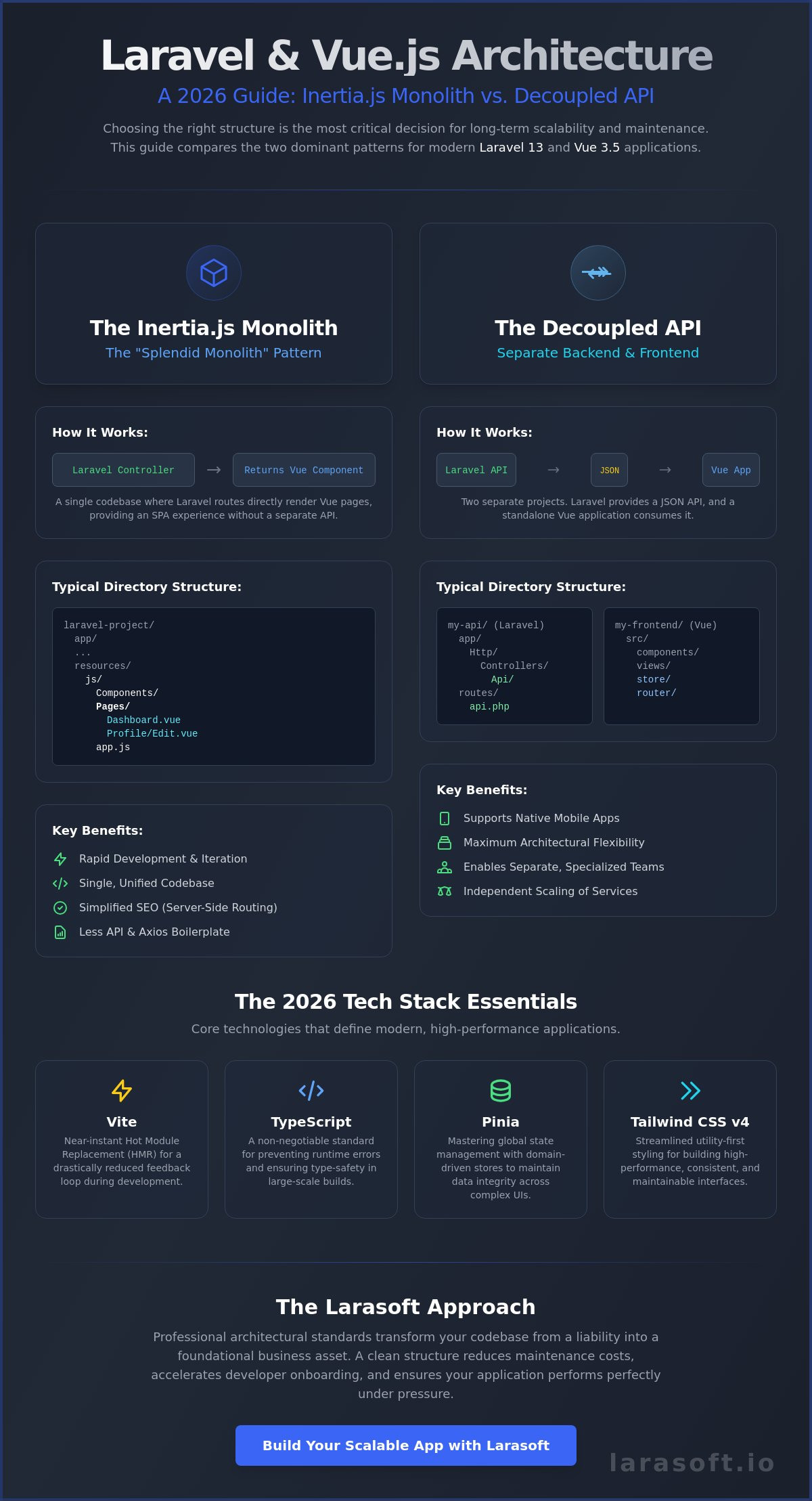
A professional laravel vue js project structure is the primary defense against technical debt. In 2026, we've moved far beyond simply dumping files into a components folder. Instead, we utilize a hierarchical approach that ensures every file has a logical, predictable home. This predictability is what allows a team to scale without the friction of "spaghetti code" or lost logic. When your directory mirrors your architectural intent, developer onboarding becomes a matter of hours rather than weeks.
The /resources/js directory serves as the command centre for your user interface. To avoid the "flat folder" trap, we categorise components using Atomic Design principles. This involves breaking the UI into Atoms (buttons, inputs), Molecules (form groups), and Organisms (headers, data tables). By separating these from your /Pages directory, which should map directly to your routes, you create a highly reusable UI library. Persistent elements like sidebars or navigation menus belong in a dedicated /Layouts folder to ensure they don't re-render unnecessarily during page transitions.
Managing logic requires equal discipline. We no longer rely on heavy components to handle data fetching or complex calculations. Instead, we centralise this logic within Vue 3 Composables. This approach leverages JavaScript fundamentals to create stateless, reusable functions that can be shared across multiple components. Additionally, the transition from Vuex to Pinia has simplified state management. We structure the /stores directory by domain, creating specific files like useAuthStore.ts or useCartStore.ts to keep the global state modular and easy to debug.
The backend must be equally organised to support the frontend's requirements. Whether you're returning Inertia responses or JSON data, your Laravel Controllers should remain thin. Their only responsibility is to orchestrate data flow. To achieve this, we use Data Transfer Objects (DTOs) and Eloquent Resources to standardise how data is passed from the database to the Vue frontend. This ensures that your frontend always receives a consistent, type-safe data structure, regardless of how complex the underlying database queries might be.
By centralising utility functions, constants, and API wrappers in a /js/utils or /js/services directory, you ensure that your laravel vue js project structure remains clean and maintainable. This level of structural integrity is what separates a hobbyist project from a foundational business asset that performs perfectly under pressure.
True scalability involves how gracefully your codebase handles increased complexity over a five-year lifecycle. It's not just about server load; it's about developer cognitive load. A professional laravel vue js project structure must be built to withstand this evolution from the first line of code. By 2026, the industry has shifted away from monolithic state objects. We now favor modularity to ensure that a change in the shopping cart logic doesn't inadvertently break the user's authentication status or profile settings.
Adopting Pinia as the central state manager provides the type-safety and modularity required for enterprise applications. By splitting the store into specific domains, such as an AuthStore or a CartStore, we create isolated environments that are easier to debug and scale. This approach is fundamental when planning for legacy code modernisation. It ensures that every module remains independent, preventing the system from becoming a rigid, unmanageable block as new features are added over time.
Reducing API overhead is vital for maintaining a fluid user experience, especially when dealing with large datasets. We implement smart frontend caching and lazy loading to ensure the browser isn't overwhelmed by unnecessary data processing. Laravel’s API Resources act as a critical filter, ensuring the frontend only receives exactly what it needs for the current view. For applications requiring real-time updates, we integrate Laravel Reverb. This provides a stable bridge for live data without compromising the overall application's structural integrity or performance.
Rigorous testing yields reliability. A scalable build requires a dual-testing strategy that addresses both ends of the stack. We utilize PHPUnit to validate backend business logic and Vitest or Cypress to ensure frontend components react as expected. These automated tests are integrated into CI/CD pipelines, which serve as a mandatory quality gate for every deployment. Clear documentation of the laravel vue js project structure is the final piece of the puzzle. It allows new developers to understand the architectural intent immediately, keeping development speed high as the project expands.
Building for the future requires more than just code; it requires a strategic architectural vision. If your current application is struggling to scale or requires a professional audit, our team at Larasoft can help you modernise your stack for long-term success.
At Larasoft, we don't just deliver "working code." We build foundational digital assets designed to drive long-term business returns. A disciplined laravel vue js project structure is the backbone of this philosophy. It ensures that your application remains an agile tool rather than a rigid liability. When structural integrity is prioritized in vue.js frontend development, you're investing in a system that can evolve alongside market demands without requiring a total rewrite every few years. This foresight is what separates market leaders from those hampered by mounting technical debt.
Technical excellence isn't an abstract goal; it's a direct contributor to your ROI. A well-architected project reduces the time spent on bug fixes and increases the speed of new feature deployments. This efficiency is why choosing a specialized laravel development agency is a strategic decision for UK business leaders. It guarantees that your software is built to professional standards that any high-level team can pick up and maintain immediately. We treat every line of code as a brick in a larger, scalable infrastructure.
Our "Clean Code" standard is non-negotiable. We avoid the off-the-shelf shortcuts that lead to messy, unmaintainable directories. Instead, we leverage the latest capabilities of Laravel 13, such as the first-party AI SDK, to build intelligent, future-proof systems. By integrating AI-native workflows directly into a clean laravel vue js project structure, we provide our partners with a competitive edge that is both innovative and stable. As a UK-based team, we offer the technical reliability and transparent communication necessary for complex builds. We act as a deeply invested technical ally, ensuring your platform performs perfectly under pressure.
Transitioning from a legacy system to a modern architecture is a structured journey toward growth. The first step involves identifying scalability bottlenecks within your current setup. Whether you're dealing with slow load times or a codebase that has become too complex to manage, a professional audit provides the roadmap you need for modernisation. We help you move beyond the "flat folder" trap into a modular, domain-driven structure that supports your specific business goals.
Ready to transform your digital infrastructure into a high-performance asset? Discuss your Laravel Vue.js project architecture with our experts today and build a foundation that is ready for the future.
Mastering the modern development stack requires a shift from reactive coding to proactive architecture. You've explored how the choice between an Inertia monolith and a decoupled API defines your team's development velocity and how atomic directory organization prevents technical debt. Implementing a disciplined laravel vue js project structure is the most effective way to ensure your application remains a scalable asset rather than a maintenance burden. By centralizing logic through composables and managing state with Pinia, you create a system that is both resilient and adaptable.
Precision in planning today prevents expensive refactoring tomorrow. Our team of expert Laravel and Vue.js developers specializes in bespoke architectural planning, providing reliable UK-based technical support to guide your project from concept to launch. We focus on building systems that don't just work, but excel under the pressures of real-world growth. Build your scalable Laravel Vue.js application with Larasoft and secure a foundation designed for long-term success. Your journey toward a cleaner, more efficient codebase starts with these professional structural standards.
The industry-standard approach utilizes the resources/js directory for all frontend assets, organized into three primary subdirectories: Pages, Components, and Layouts. This structure mirrors the official Laravel starter kits and ensures a clean separation of concerns. By categorizing your UI elements into Atoms, Molecules, and Organisms within the Components folder, you create a highly maintainable and scalable codebase that supports long-term growth.
Choose Inertia.js if you want the fluid user experience of a Single-Page Application without the overhead of managing a separate API and authentication system. It's the most efficient path for building modern web platforms. Decoupled architectures are better suited for projects that require dedicated native mobile apps or a microservices-based backend. Inertia remains the gold standard for developer productivity in 2026.
Store your Vue components in the resources/js/Components directory to keep them isolated from your page-level logic. This placement is a central pillar of a professional laravel vue js project structure, allowing for maximum reusability across different views. Routing-specific components should live in the resources/js/Pages folder, ensuring that each route in your Laravel application maps directly to a specific Vue view.
Yes, Pinia is the essential choice for state management in modern builds because it offers superior TypeScript support and a more intuitive API than Vuex. It eliminates the need for complex mutations, allowing you to manage global state with less boilerplate. Its modular design allows you to split your store by domain, which improves debugging speed and prevents the state from becoming a bottleneck as your application scales.
Handle SEO by utilizing the built-in meta-tag management provided by Inertia.js or by implementing server-side rendering for decoupled SPAs. Since search engines now crawl JavaScript effectively, ensuring your application provides accurate title and description tags via the server is vital. For high-performance marketing sites, using a monolithic approach with server-side routing often provides the most reliable results for search visibility and initial load performance.
You can use Vue.js within Blade templates by embedding specific components into your views, a method often called the "hybrid" approach. This strategy is particularly effective for legacy code modernisation, allowing you to add reactive features to existing pages without a full architectural rewrite. It provides a bridge between traditional server-side rendering and modern reactive interfaces, letting you modernize your platform incrementally and safely.
Manage API authentication using Laravel Sanctum, which provides a secure, lightweight system for SPAs and mobile applications. For monolithic applications using Inertia.js, you can rely on standard session-based authentication, which is both secure and simple to implement. This approach avoids the complexity of managing JWT tokens manually while ensuring that your user data remains protected by Laravel's enterprise-grade security features.
Vite acts as the lightning-fast build tool that compiles your frontend assets and provides near-instant hot module replacement during development. It's the standard tool in any modern laravel vue js project structure, replacing the older Webpack-based Laravel Mix. By significantly reducing build times, Vite allows your team to maintain high momentum, ensuring that the development cycle remains brisk and efficient even as the project grows in complexity.
Here’s what we've been up to recently.
Certified Quality. Great Prices