Laravel Test-Driven Development: 2026 Buyer’s Guide

More tests don’t automatically make a Laravel application safer. The value of laravel test driven development services depends on whether tests protect the behaviour your business relies on and make future changes easier to manage. You may be weighing whether writing tests before code will slow delivery, or what a TDD engagement should include beyond adding tests to a project.
A thoughtful test strategy can help teams find issues earlier and give developers clearer feedback as an application evolves. The goal isn’t to maximise test counts. It’s to build confidence in important workflows, integrations and business rules while keeping the codebase maintainable.
This guide explains how TDD can support Laravel application development and what to look for in an engineering approach. You’ll learn how to assess testing scope, workflow and handover, and compare proposals on more than hourly rates or broad promises. With a clearer picture of what effective TDD work involves, you can choose a technical partner to build bespoke software around your needs today and as they change.
Laravel test-driven development services use tests to guide implementation and check that an application behaves as agreed. Instead of building a feature and testing it afterwards, developers first describe expected behaviour in a test, then write code to meet that expectation. For a bespoke Laravel application, this can make business rules more explicit and give the team a repeatable way to check important behaviour as the software changes.
TDD is a working method, not a standalone product or a guarantee that software will be defect-free. Tests only check the behaviour they cover, so results still depend on clear requirements, appropriate test choices, careful engineering and ongoing maintenance. The aim isn’t to create the largest possible test suite. It’s to build useful automated checks around important functions and likely future changes.
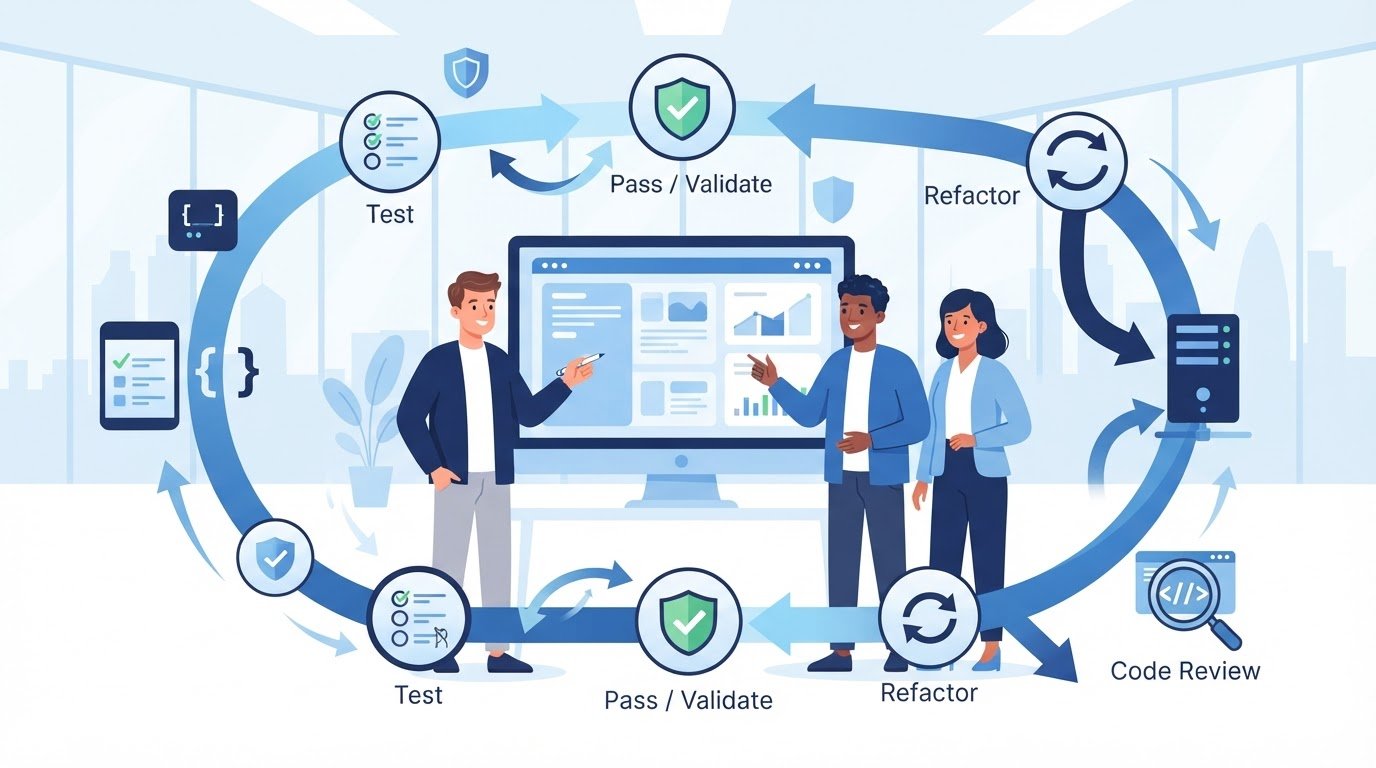
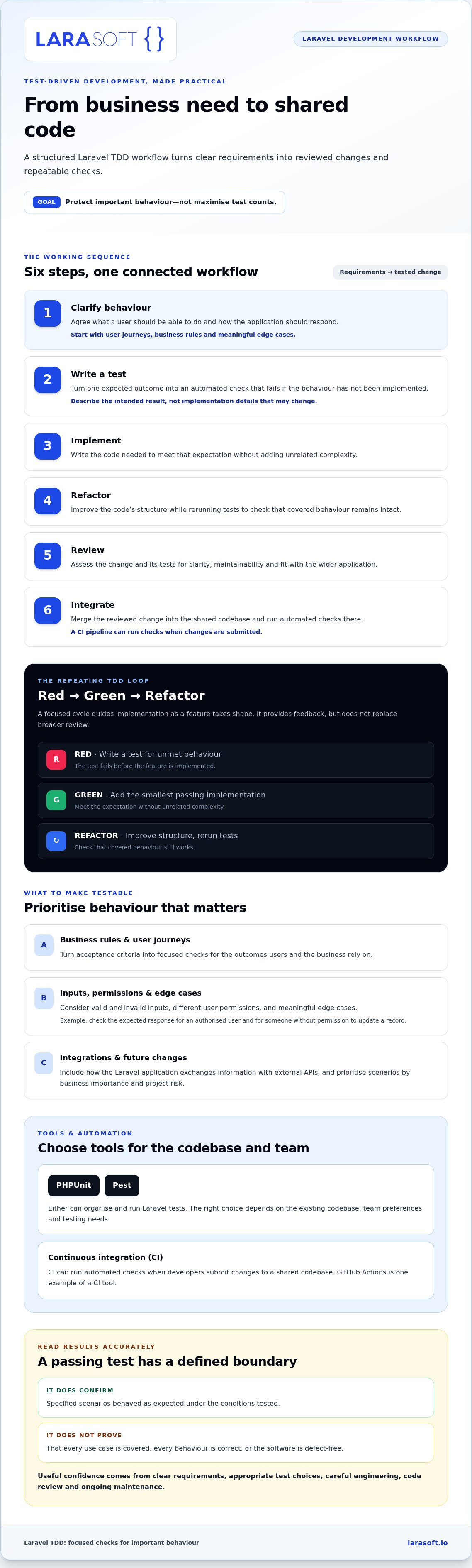
Test-driven development (TDD) is often summarised as a three-step loop: red, green, refactor. First, write a test for a requirement the application doesn’t yet meet. The test fails, or turns red. Next, add the smallest implementation that makes it pass, or turns it green. Then refactor the code for clarity and structure, rerunning the tests to check that the behaviour still works.
For example, a test might describe what should happen when a user submits an incomplete form. The implementation can then be built around that expected response instead of relying on someone to remember the requirement during a later testing phase. The cycle repeats as the feature takes shape. It provides focused feedback, but doesn’t replace broader review.
Tests should live with the application code as an ongoing development asset, not as a detached checklist added at the end. Acceptance criteria and business rules help identify the scenarios that matter. A workflow might include valid and invalid inputs, different user permissions, or the way a Laravel application exchanges information with an external API.
This gives business and technical teams a clearer reference for intended behaviour. If a requirement is ambiguous, describing it as a test scenario can expose unanswered questions before they become embedded in code. Tests can also help developers spot unintended changes when extending a feature or modernising an existing application.
Be clear about what the checks establish. A passing test confirms that specified scenarios behaved as expected under the conditions tested. It doesn’t prove that every use case is covered or guarantee overall quality. A considered test strategy connects requirements to repeatable checks, with priorities based on the application rather than a universal test-count target.
A reliable workflow connects business needs to code changes, then checks those changes before they become part of the shared application. In laravel test driven development services, small, observable requirements guide the cycle, rather than a broad instruction to “test everything”. Martin Fowler’s explanation of Test-Driven Development provides a useful overview of the test-first approach.
Laravel projects may use PHPUnit or Pest to organise and run tests. The right choice depends on the existing codebase, team preferences and testing needs. The tool matters less than whether the checks express expected behaviour clearly and can be maintained.
Start with user journeys, business rules and meaningful edge cases. For example, a requirement might state that only an authorised user can update a record. Tests can check the expected response for an authorised user and for someone without permission. Keep acceptance criteria focused on outcomes, not implementation details that may change as the application evolves. Prioritise scenarios according to business importance and project risk.
A continuous integration (CI) pipeline can run automated checks when developers submit changes to a shared codebase. GitHub Actions is one example of a CI tool. A passing result means the code met the conditions in the tests that ran. It doesn’t prove that every behaviour is correct or every risk is covered. Reviewers still need to consider the design, requirements and possible impact of the change.
Clear test results help focus review by showing which checks ran and where a change needs attention. For a bespoke application, this workflow can support a considered approach to Laravel web development, with testing priorities based on the product’s requirements and likely changes.
Test-first development isn’t the only way to build confidence in a Laravel application. The right approach depends on how often a feature changes, the impact of failure, the condition of the existing code and delivery constraints. This comparison outlines the practical trade-offs.
| Approach | When tests are written | Requirements and feedback |
|---|---|---|
| TDD | Before implementation. | Expected behaviour is clarified early. Developers get feedback as they build, based on the scenarios described in tests. |
| Testing after implementation | After a feature or change has been coded. | Tests check behaviour once the implementation exists. Gaps or unclear expectations may surface later in development. |
| Risk-led combination | Test-first for selected work, with other checks added during or after implementation. | Testing effort focuses on higher-impact workflows and can adapt to existing code and delivery needs. |
TDD adds deliberate work upfront: the team discusses expected behaviour, expresses it as tests and checks it as the code evolves. That doesn’t mean it always makes delivery slower overall. Initial implementation is only one part of the work. Later changes may also require investigation and regression checks, so the balance varies by project.
Tests can’t resolve unclear requirements by themselves. If users, stakeholders and developers interpret a business rule differently, writing a test first may expose the disagreement, but the team still needs to resolve it. A focused strategy aligns effort with business risk instead of treating every part of the application as equally critical.
A blended approach can suit applications where some behaviours warrant test-first attention and others need a different level of checking. Consider TDD for complex business rules, high-impact workflows or features expected to change frequently. Clear behavioural specifications and repeatable feedback can be especially useful in these areas.
Existing applications need a measured approach. In legacy code, teams can start by adding tests around important current behaviour before making wider changes. This helps establish what the application does today, even when its original design or documentation is unclear. This legacy code modernisation guide covers a careful way to approach that work.
The practical question isn’t whether to test everything first or leave all testing until later. It’s how to select an approach that fits the application’s risks, codebase and priorities. Strong laravel test driven development services should explain the trade-offs in terms of the work, rather than present one method as a universal rule.
A strong proposal explains how testing will support your application, not simply how many tests the team plans to write. Assess laravel test driven development services against your product’s requirements, risks and roadmap. Look for a clear connection between the proposed engineering work and the behaviour your users and business rely on.
Ask how acceptance criteria and business rules will shape the test strategy. How will the team decide which behaviours need test-first development? How will tests be updated as features and rules evolve? Which automated checks support code review, and how do results inform release decisions? Clear answers describe a practical approach tied to your application, not a fixed recipe detached from its requirements.
Notice how the team explains a sample test. A useful example should make the expected behaviour understandable to technical and business stakeholders. The proposal should also explain how testing effort can adapt when priorities or the product roadmap change.
Tests are most useful when they remain understandable and relevant after delivery. Confirm that the test suite and supporting documentation form part of the application handover, and that ownership of the code and its maintenance is clear. As the software evolves, ongoing maintenance can address changing requirements, dependencies and defects, helping the application remain a dependable foundation for future work.
For broader selection criteria, read this Laravel development agency guide. When you’re ready to explore a tailored approach to your application, Explore Larasoft’s Laravel development services.
A useful project brief gives a development partner the context to shape the application and its testing scope. You don’t need every technical decision settled in advance. Start with the outcomes the business needs, the people who’ll use the software and the workflows it must support. Testing priorities can then reflect the application’s requirements, risks and changing business needs.
Describe the problem you’re trying to solve and what success should look like for users. Then outline practical details that may affect the work:
This information helps distinguish essential safeguards from lower-priority checks. A workflow that supports a central business operation may warrant particular attention. A feature expected to change often may also benefit from tests that make its intended behaviour easier to verify over time.
Bespoke Laravel development gives the team room to align architecture with the way your organisation works, rather than forcing requirements into a generic model. Test scope should follow the same principle. Shape it around the application’s business rules, integrations and likely areas of change, then revisit it as priorities evolve.
Consider the work beyond the initial build, too. Software maintenance can support the application as dependencies are updated, requirements change and defects emerge. Tests remain useful when they’re kept relevant as part of that continuing work. For existing systems, Laravel modernisation can provide a route to improve the codebase incrementally while preserving important behaviour.
Larasoft builds bespoke Laravel applications and provides legacy code modernisation and ongoing software maintenance. Project scope and delivery approach are tailored to the brief, including the application’s needs and future direction.
Ready to plan a custom Laravel application or develop an existing one further? Discuss your project and the outcomes you need with Larasoft.
The right testing approach depends on your application’s requirements, business risks and expected changes. TDD can guide implementation with checks for important behaviour, while a blended strategy may better suit parts of an existing codebase. Assess a proposal by the clarity of its test priorities, review process, documentation and handover, not by test counts alone.
Strong laravel test driven development services should support a maintainable product, not treat testing as a one-off task. Larasoft builds bespoke Laravel web applications and supports their ongoing development through software maintenance, legacy code modernisation and API integration. These services can help align technical decisions with your operating needs as the application evolves.
Ready to discuss a custom Laravel application or the next stage of an existing one? Discuss your Laravel application with Larasoft. A clear brief is a practical starting point for software that can adapt with your business.
Laravel test-driven development services use automated tests to guide how developers build and verify application behaviour. A developer writes a test for an expected outcome, implements code to meet it, then refines the code while rerunning relevant checks. Tests become part of the application’s codebase, helping teams review changes against documented expectations. TDD is a development method, not a separate software product or a guarantee that defects can never occur.
No single development method suits every Laravel project. TDD can help with complex business rules, critical workflows and features likely to change, where clear behavioural checks support ongoing development. A smaller, stable feature or an existing codebase with limited test coverage may call for a blended approach. The decision should reflect business risk, requirements, the current application and delivery priorities, rather than applying test-first development uniformly.
TDD adds deliberate work at the start of a feature because expected behaviour must be clarified and tests written before implementation. Whether that increases total delivery time depends on the project. Later changes may be easier to assess when relevant automated checks are available, but tests don’t prevent rework caused by unclear or changing requirements. A focused strategy prioritises important workflows instead of attempting to test every detail equally.
PHPUnit and Pest are tools for writing and running automated tests in PHP projects, including Laravel applications. PHPUnit uses a long-established testing style, while Pest offers a more concise, expressive syntax and builds on the PHPUnit ecosystem. The best fit depends on the project’s existing tests, team familiarity and compatibility needs. Whichever tool is selected, tests should make expected behaviour clear and remain practical to run and maintain.
There’s no single coverage percentage that proves a Laravel application is well tested. Coverage indicates which code has been executed during tests, but it doesn’t show whether those tests check meaningful outcomes or important business rules. Prioritise scenarios according to the impact of failure, such as permissions, payment-related logic or key integrations where relevant. A smaller set of clear, useful tests can offer more insight than a higher percentage of shallow checks.
Yes. TDD principles can guide new features in an existing Laravel application, even if the whole codebase wasn’t built test-first. For established behaviour, teams can add tests around important workflows before changing the related code. These checks help record what the application currently does and highlight unexpected changes during modernisation. A gradual, risk-led approach lets teams strengthen test coverage alongside legacy code modernisation and ongoing software maintenance.
A Laravel TDD service should connect testing to the project’s requirements and priorities. Its scope may include translating acceptance criteria and business rules into test cases, implementing features against those checks, and reviewing code and tests together. Buyers should also understand how automated checks fit into integration, what documentation is produced and how tests are handed over. The approach should be tailored to the application, not measured by a fixed test-count target.
Choose a partner who can explain how testing priorities relate to your business risks, expected changes and existing systems. Review whether sample tests express behaviour clearly, and whether the proposal addresses code review, automated checks, documentation and handover. Larasoft develops bespoke Laravel applications and provides API integration, legacy code modernisation and software maintenance. Consider how these capabilities can support both your immediate project and the application’s longer-term evolution.
Here’s what we've been up to recently.
Certified Quality. Great Prices